
Toyota Sequoia Payload Capacity: How Much Weight Can It Really Carry?

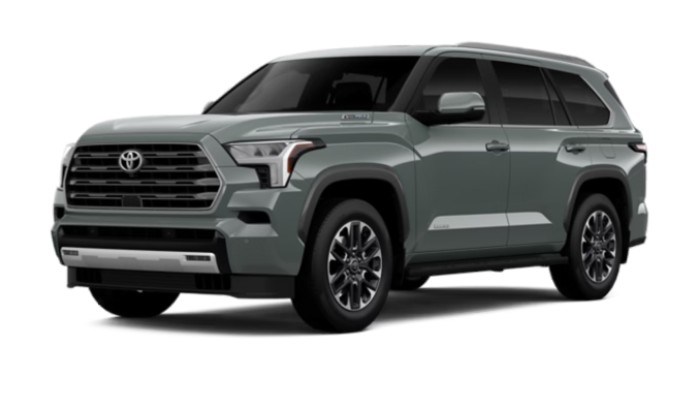
The Toyota Sequoia payload capacity matters more than many SUV buyers realize. Towing capacity usually steals the spotlight, especially with a full-size SUV that can pull a substantial trailer, but payload tells us something equally important: how much weight the Sequoia itself can safely carry.
That includes people. Luggage. Camping equipment. Coolers. Roof-mounted gear. Accessories. And, when we're towing, the trailer's tongue weight also consumes part of the available payload.
For the 2025 Toyota Sequoia, maximum payload ranges from 1,375 pounds to 1,730 pounds, depending on trim and drivetrain. The highest published figure belongs to the SR5 4x2 at 1,730 pounds, while heavier luxury configurations carry less.
That difference is substantial. Think of payload as a backpack: the more equipment Toyota installs permanently on the vehicle, the less room remains in that backpack for everything we bring along.
Let's break down the numbers, explain why they vary, and figure out what Toyota Sequoia payload capacity actually means on a family vacation, camping trip, or towing weekend.
Content in this publication
- What Is the Toyota Sequoia Payload Capacity?
- 2025 Toyota Sequoia Payload Capacity by Trim
- Toyota Sequoia SR5 Payload Capacity
- Toyota Sequoia Limited Payload Capacity
- Toyota Sequoia Platinum Payload Capacity
- Toyota Sequoia 1794 Edition Payload Capacity
- Toyota Sequoia TRD Pro Payload Capacity
- Toyota Sequoia Capstone Payload Capacity
- How Toyota Sequoia Payload Capacity Is Calculated
- Payload Capacity vs. Cargo Capacity
- Toyota Sequoia Payload Capacity vs. Towing Capacity
- How Many Passengers Can the Sequoia Carry Without Exceeding Payload?
- Does Four-Wheel Drive Reduce Sequoia Payload Capacity?
- Does Adding Accessories Reduce Payload?
- Payload and the Sequoia Hybrid Powertrain
- Is 1,500 Pounds of Payload Good for a Full-Size SUV?
- Best Toyota Sequoia Trim for Payload
- How to Find the Exact Payload Capacity of Your Toyota Sequoia
- A Practical Toyota Sequoia Payload Example
- Why Payload Capacity Matters for Travel Trailers
- Toyota Sequoia GVWR Explained
- Ways to Avoid Exceeding Toyota Sequoia Payload Capacity
- Should You Buy a Sequoia Based on Payload Capacity Alone?
- Final Thoughts on Toyota Sequoia Payload Capacity
- Frequently Asked Questions
What Is the Toyota Sequoia Payload Capacity?
Payload capacity is the amount of weight that can be added to the vehicle without exceeding its specified weight limits.
Toyota states that payload includes occupants, cargo, and options and that allowable payload is also affected by weight distribution.
That's an important distinction.
Payload doesn't simply mean boxes thrown into the cargo area.
It includes virtually everything added after the vehicle's base curb weight.
For example, imagine we load a Sequoia with:
- Driver: 190 lb
- Passenger: 150 lb
- Two teenagers: 250 lb combined
- Luggage: 200 lb
- Cooler and camping supplies: 120 lb
- Trailer tongue weight: 500 lb
Our total payload usage would already be 1,410 pounds.
Suddenly, a theoretical 1,500-pound payload limit doesn't seem enormous.
That's why understanding payload becomes especially important when the Sequoia serves double duty as both a passenger vehicle and tow rig.
2025 Toyota Sequoia Payload Capacity by Trim
Toyota's official 2025 specifications provide a useful picture of how payload changes across the Sequoia lineup.
| Toyota Sequoia configuration | Maximum payload |
|---|---|
| SR5 4x2 | 1,730 lb |
| SR5 4x4 | 1,555 lb |
| Limited 4x2 | 1,565 lb |
| Limited 4x4 | 1,485 lb |
| Platinum 4x4 | 1,410 lb |
| 1794 Edition 4x4 | 1,410 lb |
| TRD Pro 4x4 | 1,435 lb |
| Capstone 4x4 | 1,375 lb |
These figures immediately reveal something interesting: the most expensive Sequoia isn't necessarily the one that can carry the most weight.
In fact, the opposite tends to happen.
Luxury equipment adds mass. Bigger wheels, additional comfort features, upgraded interiors, suspension hardware, four-wheel-drive equipment, and other components increase curb weight.
Because the vehicle still has a defined Gross Vehicle Weight Rating, more vehicle weight usually means less remaining capacity for passengers and cargo.
Which Toyota Sequoia Has the Highest Payload Capacity?
Among the 2025 configurations published by Toyota, the Sequoia SR5 4x2 has the highest maximum payload at 1,730 pounds.
That's not terribly surprising.
The SR5 is the relatively straightforward member of the family. It doesn't carry as much luxury equipment as higher trims, and choosing rear-wheel drive eliminates some of the additional hardware associated with four-wheel drive.
Less vehicle weight leaves more capacity available for whatever we put aboard.
Why the Base Trim Can Be the Workhorse
Luxury SUVs often behave like travelers with oversized suitcases. Before we've packed anything, a good portion of the allowance has already disappeared.
A lighter trim starts with less weight.
That's why buyers who prioritize:
- maximum useful load,
- towing,
- camping equipment,
- large families,
- recreational gear,
may actually find a lower trim better suited to their needs than the flashier flagship model.
Toyota Sequoia SR5 Payload Capacity
The SR5 is particularly interesting because its payload changes considerably depending on drivetrain.
Toyota lists the 2025 SR5 at:
SR5 4x2: 1,730 lb
SR5 4x4: 1,555 lb
That's a difference of 175 pounds.
Where does that capacity disappear?
Mostly into the vehicle itself.
Toyota lists the SR5 base curb weight at 5,620 pounds for the 4x2 and 6,030 pounds for the 4x4. Its corresponding GVWR figures are 7,350 and 7,585 pounds.
Four-wheel-drive equipment brings capability, but capability has mass.
If we regularly explore muddy campsites, snowy roads, trails, or loose surfaces, losing some payload may be worthwhile. If the vehicle spends almost all its life on pavement and maximum load capacity matters more, the 4x2 has a numerical advantage.
Toyota Sequoia Limited Payload Capacity
The 2025 Limited offers up to 1,565 pounds of payload in 4x2 configuration and 1,485 pounds with 4x4.
That still provides useful capacity for most family duties.
Imagine four adults averaging 175 pounds each.
That's 700 pounds.
Add 350 pounds of luggage and supplies, and we reach 1,050 pounds.
A Limited 4x2 would theoretically have roughly another 515 pounds before reaching its published maximum payload.
Once a trailer gets involved, though, calculations tighten quickly.
A 500-pound tongue weight would consume almost all that remaining margin.
This is exactly why payload and towing capacity should always be considered together.
Toyota Sequoia Platinum Payload Capacity
The 2025 Sequoia Platinum has a maximum published payload of approximately 1,410 pounds.
That represents a noticeable reduction compared with the SR5 4x2.
But there's a tradeoff.
The Platinum is designed to provide a more premium experience rather than simply maximize carrying capacity. Added equipment contributes to higher curb weight, which reduces the amount available for occupants and cargo.
For typical commuting and family travel, 1,410 pounds can still be perfectly practical.
The limitation becomes more noticeable when combining:
several adult passengers + cargo + trailer tongue weight.
That's when every 50 or 100 pounds starts mattering.
Toyota Sequoia 1794 Edition Payload Capacity
Toyota lists the 2025 1794 Edition at 1,410 pounds of maximum payload, matching the Platinum.
The 1794 Edition emphasizes distinctive styling and a more upscale interior experience.
It's therefore better viewed as a luxurious tow-capable SUV than a stripped-down maximum-payload machine.
That doesn't make it incapable.
Quite the opposite.
A 1,410-pound payload allowance can cover plenty of real-world scenarios. We simply need to pay closer attention when filling all three rows while simultaneously hooking up a substantial trailer.
Toyota Sequoia TRD Pro Payload Capacity
The TRD Pro takes a slightly different route.
Its maximum payload is 1,435 pounds for the 2025 model, according to Toyota's specifications.
The TRD Pro also uses specialized off-road hardware. Toyota lists TRD Pro-specific 2.5-inch FOX internal-bypass front coilovers, rear remote-reservoir shocks, a TRD Pro stabilizer bar, 18-inch forged BBS wheels, and all-terrain tires among its equipment.
In other words, this version isn't chasing the payload trophy.
It's built to balance load-carrying, towing, and off-road ability.
Is TRD Pro Good for Carrying Camping Gear?
Absolutely, provided we stay within the vehicle-specific weight rating.
A 1,435-pound maximum payload still provides considerable flexibility.
Suppose we have:
- Two adults: 350 lb
- Two children: 180 lb
- Camping equipment: 300 lb
- Food and water: 150 lb
We're at roughly 980 pounds.
That leaves theoretical room for additional supplies.
But install heavy accessories, load roof gear, or attach a trailer and the equation changes.
That's why serious overlanders should calculate weight rather than relying on intuition.
A Sequoia is huge, but exterior size isn't a magic wand that makes weight disappear.
Toyota Sequoia Capstone Payload Capacity
The luxurious Capstone sits at the opposite end of the payload chart.
Toyota lists the 2025 Capstone with a maximum payload of approximately 1,375 pounds, the lowest figure among the published 2025 configurations.
Why?
Weight.
Toyota lists the Capstone's base curb weight at 6,185 pounds and its GVWR at 7,560 pounds.
Subtract those numbers:
7,560 − 6,185 = 1,375 pounds.
There's our payload figure.
The math illustrates the concept perfectly.
How Toyota Sequoia Payload Capacity Is Calculated
The basic formula is straightforward:
Payload Capacity = GVWR − Curb Weight
GVWR means Gross Vehicle Weight Rating.
It's the maximum allowable total weight of the loaded vehicle.
Curb weight represents the vehicle itself in its standard operating condition.
If a Sequoia has:
- GVWR: 7,560 lb
- Curb weight: 6,150 lb
then:
7,560 − 6,150 = 1,410 lb payload
That doesn't mean we have 1,410 pounds purely for cargo behind the third row.
Passengers count too.
So do applicable accessories and equipment.
Toyota specifically warns that payload includes occupants, cargo, and options.
Payload Capacity vs. Cargo Capacity
This distinction creates plenty of confusion.
Cargo capacity describes space.
Payload capacity describes weight.
A Sequoia might have enough physical room for a mountain of equipment, but that doesn't mean we're allowed to fill every cubic inch with bricks.
Imagine filling the cargo area with pillows.
Huge volume, tiny weight.
Now imagine filling the same space with bags of cement.
Same volume. Completely different load.
Payload is the invisible boundary.
Can We Fill the Toyota Sequoia to the Roof?
Maybe.
It depends entirely on what we're carrying.
Suitcases, sleeping bags, children's clothing, and lightweight recreational equipment may use plenty of interior volume while remaining comfortably below the weight limit.
Dense items are another story.
Water, tools, construction materials, batteries, generators, and heavy recovery equipment can eat through payload remarkably quickly.
Toyota Sequoia Payload Capacity vs. Towing Capacity
Here's where things become particularly interesting.
The Sequoia is an impressive tow vehicle.
The current 2026 Sequoia is advertised with a maximum towing capability of up to 9,500 pounds, while Toyota's 2025 specifications list configurations reaching 9,520 pounds.
But towing capacity and payload aren't independent.
They're roommates sharing the same refrigerator.
A trailer places weight on the hitch.
That tongue weight becomes part of the load carried by the tow vehicle.
Toyota also explains that maximum towing capability depends on vehicle weight plus cargo, occupants, and added equipment.
How Trailer Tongue Weight Uses Payload
Imagine our Sequoia has 1,500 pounds of available payload.
Then we add:
- Driver: 200 lb
- Passenger: 160 lb
- Two children: 180 lb
- Luggage: 200 lb
Total so far:
740 pounds.
Remaining theoretical payload:
760 pounds.
Now attach a trailer producing 700 pounds of tongue weight.
Suddenly we're down to only about 60 pounds of remaining capacity.
The vehicle may theoretically have enough towing capability for the trailer, yet payload becomes the limiting factor.
This is one of the most important concepts for anyone buying an SUV to tow a travel trailer.
How Many Passengers Can the Sequoia Carry Without Exceeding Payload?
Toyota's 2025 specifications show seating for up to eight people in SR5 and Limited configurations, while Platinum, 1794 Edition, TRD Pro, and Capstone configurations are listed with seven seats.
But seat count doesn't guarantee that every possible passenger-and-cargo combination remains within payload limits.
Consider eight occupants averaging 170 pounds.
That's:
8 × 170 = 1,360 pounds
In a Sequoia SR5 4x2 with a theoretical 1,730-pound maximum payload, roughly 370 pounds would remain for luggage and other items.
In a configuration carrying only around 1,400 pounds of payload, the same passenger load would leave almost no margin.
Of course, actual passengers won't all weigh exactly 170 pounds. That's why real calculations matter more than generic examples.
Does Four-Wheel Drive Reduce Sequoia Payload Capacity?
Often, yes.
We can see the effect clearly in the 2025 SR5.
The SR5 4x2 carries up to 1,730 pounds, while the SR5 4x4 is listed at 1,555 pounds.
Similarly, the Limited drops from 1,565 pounds in 4x2 form to 1,485 pounds with 4x4.
Why?
Four-wheel-drive components increase curb weight.
But this isn't necessarily a disadvantage.
We're trading some payload for additional drivetrain capability.
The right choice depends on how the SUV will actually be used.
Does Adding Accessories Reduce Payload?
Yes, and this is easy to overlook.
Heavy aftermarket accessories don't float in another dimension.
They become part of the vehicle's weight.
Think about equipment such as:
- Steel skid plates
- Heavy-duty running boards
- Roof racks
- Cargo platforms
- Recovery equipment
- Winches
- Large aftermarket wheels
- Storage systems
- Additional spare tires
Individually, some don't seem particularly significant.
Together, they can swallow hundreds of pounds.
Toyota's own payload disclosure includes vehicle options when discussing payload, reinforcing the need to account for installed equipment.
Why Overlanders Should Watch Payload Carefully
Overlanding setups are especially vulnerable to creeping weight.
First we add a refrigerator.
Then drawers.
Then a roof platform.
Then recovery boards.
Then tools.
Then extra water.
Then camping equipment.
Each item looks harmless.
Combined, they're like snow gathering on a roof: eventually the accumulated weight becomes the real story.
Payload and the Sequoia Hybrid Powertrain
The modern Sequoia uses Toyota's i-FORCE MAX twin-turbo V6 hybrid powertrain, rated at 437 horsepower and 583 lb-ft of torque.
Those numbers give the Sequoia plenty of muscle.
But horsepower doesn't determine payload.
Payload comes from the relationship between vehicle weight, structural limits, suspension, tires, axles, and overall GVWR.
That's why a powerful SUV can still have a lower payload than someone might expect.
Engine output and carrying capacity are related to vehicle capability, but they aren't interchangeable measurements.
Is 1,500 Pounds of Payload Good for a Full-Size SUV?
For everyday family use, approximately 1,500 pounds is useful.
We can transport several passengers and a significant amount of luggage without approaching the limit in many normal scenarios.
But buyers should avoid treating a full-size SUV like an unlimited-weight cargo van.
The Sequoia is fundamentally designed to balance:
comfort,
passenger accommodation,
towing,
off-road capability,
technology,
and cargo-carrying ability.
The more demanding our towing or expedition setup becomes, the more important payload calculations become.
Best Toyota Sequoia Trim for Payload
If maximum carrying capability is the priority, the numbers point toward the SR5 4x2.
Its 1,730-pound published maximum payload is the strongest figure in Toyota's 2025 lineup.
But maximum payload shouldn't automatically decide the purchase.
Choose the SR5 4x2 If…
Maximum payload and straightforward highway driving matter more than off-road capability.
Choose the SR5 4x4 If…
We want strong payload capability while adding four-wheel-drive versatility.
Choose the TRD Pro If…
Off-road equipment and trail performance matter more than extracting every last pound of payload.
Choose Platinum, 1794 Edition, or Capstone If…
Comfort, luxury, and premium equipment take priority over maximum load-carrying capacity.
There isn't one universally "best" Sequoia.
There's simply the Sequoia that best matches what we're asking it to do.
How to Find the Exact Payload Capacity of Your Toyota Sequoia
This may be the most important section in the entire article.
Don't assume an internet chart represents the exact capability of your specific vehicle.
Options and equipment matter.
Toyota itself notes that payload includes occupants, cargo, and options and is limited by weight distribution.
Check the certification and tire-and-loading labels on the actual vehicle, usually located around the driver's door or door jamb, and consult the owner's manual for the applicable weight restrictions.
Why?
Because two Sequoias sharing the same model year and trim can potentially have different installed equipment.
Published maximum figures are useful for comparison.
The vehicle's own label is what matters when planning an actual load.
A Practical Toyota Sequoia Payload Example
Let's make the numbers feel less abstract.
Suppose we own a Sequoia with 1,555 pounds of available payload.
We're heading out for a weekend.
Driver: 190 lb
Passenger: 150 lb
Child 1: 90 lb
Child 2: 80 lb
Luggage: 180 lb
Cooler: 60 lb
Camping equipment: 180 lb
Bikes and rack: 150 lb
Total:
1,080 pounds
Remaining theoretical payload:
475 pounds
No problem yet.
Now suppose we're also towing a trailer imposing 550 pounds of tongue weight.
1,080 + 550 = 1,630 pounds
We've exceeded our hypothetical 1,555-pound capacity.
The trailer itself might still fall well below the Sequoia's advertised maximum towing capacity.
That's the trap.
Towing capacity says, "I can pull it."
Payload asks, "Can I carry everything associated with pulling it?"
Why Payload Capacity Matters for Travel Trailers
Travel trailers create one of the most common payload challenges.
Families frequently calculate trailer weight but forget that the tow vehicle must simultaneously carry:
people,
luggage,
pets,
food,
hitch equipment,
and tongue weight.
A Sequoia capable of towing more than 9,000 pounds under certain configurations doesn't necessarily mean every Sequoia can tow a trailer near that figure while also being fully loaded with people and cargo. Toyota specifically notes that towing limits depend on occupants, cargo, vehicle equipment, and base curb weight.
That's why experienced towing setups work backward from the entire load rather than focusing on one impressive headline number.
Toyota Sequoia GVWR Explained
GVWR provides the ceiling that payload lives beneath.
Toyota's 2025 specifications show GVWR figures varying by configuration, including ratings in the range of roughly 7,350 to 7,615 pounds.
The vehicle's loaded weight should remain within its specified rating.
This isn't simply about whether the engine feels strong enough.
A Sequoia can accelerate confidently while still being overloaded.
Payload limits consider the vehicle as a complete system.
Payload Is About More Than Engine Strength
Imagine a weightlifter wearing roller skates.
Strong legs don't automatically make the entire setup capable of safely handling massive loads.
Similarly, engine torque is only one part of vehicle capability.
Brakes, suspension, tires, axles, cooling systems, chassis limits, and weight distribution all matter.
Ways to Avoid Exceeding Toyota Sequoia Payload Capacity
The easiest strategy is simply to know what everything weighs.
That doesn't require obsession.
A few careful calculations before a major trip can prevent unpleasant surprises.
We can weigh camping gear at home, estimate passenger weight realistically, check the tongue weight of a loaded trailer, and use a public vehicle scale when preparing a particularly heavy towing setup.
Also remember that water is heavy.
So are tools.
So are bicycles, generators, refrigerators, roof tents, and aftermarket bumpers.
Weight sneaks aboard one innocent-looking item at a time.
Should You Buy a Sequoia Based on Payload Capacity Alone?
Probably not.
Payload should be one part of the decision.
The modern Sequoia combines a powerful hybrid drivetrain, three-row capability, substantial towing potential, and available off-road equipment. Toyota currently advertises the 2026 model with 437 horsepower, 583 lb-ft of torque, and up to 9,500 pounds of towing capacity.
But buyers planning to tow large campers or carry heavy recreational equipment should pay closer attention to payload than the average commuter.
Someone transporting two adults and a few suitcases has very different requirements from a family of six towing a travel trailer.
Same SUV.
Completely different workload.
Final Thoughts on Toyota Sequoia Payload Capacity
The Toyota Sequoia payload capacity is strong enough for many family, recreational, and towing situations, but the exact number varies considerably between configurations.
For the 2025 lineup, Toyota publishes maximum payload figures ranging from 1,375 pounds for the Capstone to 1,730 pounds for the SR5 4x2.
That's nearly a 355-pound difference between configurations.
And 355 pounds isn't pocket change.
It's roughly the difference between carrying extra luggage and equipment comfortably or having almost no capacity left after passengers climb aboard.
The biggest lesson is simple: don't shop using towing capacity alone.
Payload deserves a seat at the table.
If we regularly carry a large family, tow a camper, transport bicycles, install heavy accessories, or head into the wilderness with half the garage packed behind us, payload may become the number that determines whether our setup actually works.
Use advertised maximums to compare trims, but check the weight label on the individual vehicle before planning a real load. Toyota's own specifications emphasize that occupants, cargo, options, and weight distribution all affect payload.
The Sequoia may look like a rolling fortress, but even fortresses have engineering limits.
Know them, respect them, and the SUV becomes far more useful.
Frequently Asked Questions
1. What is the maximum Toyota Sequoia payload capacity?
For the 2025 model year, the highest published maximum payload is 1,730 pounds for the SR5 4x2. Payload decreases on other configurations depending on drivetrain, equipment, and curb weight.
2. What is the Toyota Sequoia 4x4 payload capacity?
It varies by trim. Toyota lists the 2025 SR5 4x4 at 1,555 pounds, Limited 4x4 at 1,485 pounds, Platinum and 1794 Edition at 1,410 pounds, TRD Pro at 1,435 pounds, and Capstone at 1,375 pounds.
3. Do passengers count toward Sequoia payload capacity?
Yes. Toyota specifies that payload includes occupants, cargo, and options and is also subject to weight distribution limits.
4. Does trailer tongue weight reduce Toyota Sequoia payload?
Yes. The weight transferred from the trailer onto the tow vehicle contributes to the load the Sequoia must carry. This is why a vehicle can remain below its towing limit yet encounter a payload limitation first. Toyota also notes that towing capability depends on occupants, cargo, added equipment, and vehicle weight.
5. Which Toyota Sequoia is best for towing and payload?
If maximizing payload is the priority, the 2025 SR5 4x2 stands out with its 1,730-pound maximum payload and a published maximum towing capacity of up to 9,520 pounds. Drivers needing four-wheel drive will sacrifice some payload but gain additional drivetrain capability. Always verify the exact ratings of the individual vehicle before towing.
If you want to know other articles similar to Toyota Sequoia Payload Capacity: How Much Weight Can It Really Carry? you can visit the category Service and Parts.
Kia Sorento Service Reset: How to Reset the Service Light
Kia Sorento Fuel Tank Capacity: Gallons, Litres and Model Differences
Kia Sorento Tyre Pressure: Recommended PSI, Bar and Complete Guide
Kia Sorento Boot Space: How Much Luggage Space Does It Really Have?
Kia Sorento Towing Capacity: How Much Can a Sorento Tow?
Honda Passport Payload Capacity: How Much Weight Can It Carry?
Leave a Reply
More content of your interest