
Mazda CX-30 Dimensions — The Sweet Spot Between Hatchback and SUV

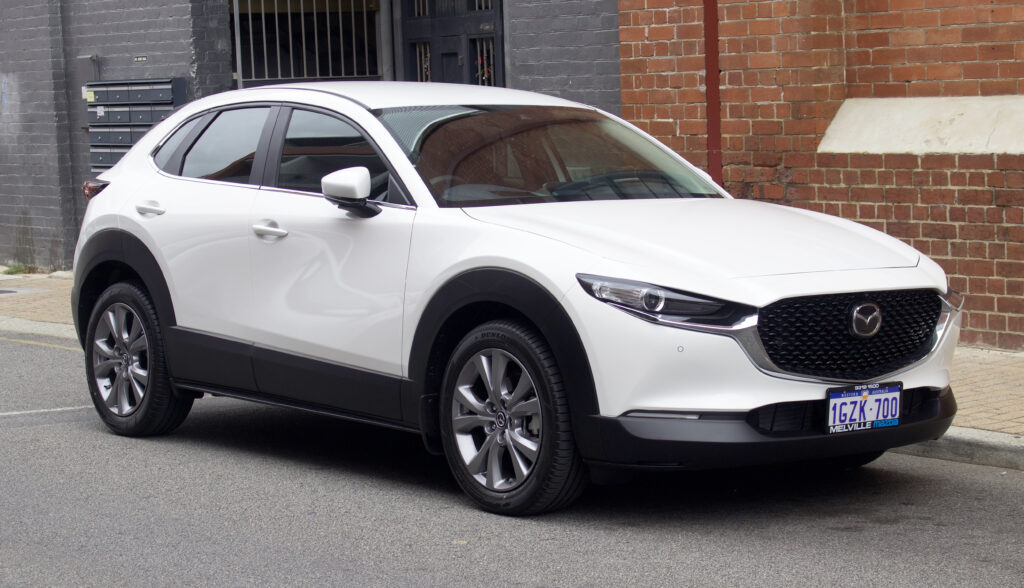
There’s a moment when you first walk around a car and your brain quietly asks: Is this big… or just cleverly designed?
That’s exactly the question the Mazda CX-30 triggers.
It sits between categories — not quite a compact hatchback, not quite a traditional SUV — and its dimensions are the reason why. Everything about this car is engineered around proportion: parking ease vs cabin space, agility vs comfort, aesthetics vs practicality.
Today we’re diving deep into the Mazda CX-30 dimensions — not just numbers, but what those numbers actually feel like in real life.
Content in this publication
- Why Dimensions Matter More Than Horsepower
- Overall Exterior Dimensions
- Ground Clearance — The Hidden Dimension
- Turning Circle — Urban Superpower
- Wheel Sizes and Their Impact
- Interior Dimensions — Where Space Actually Matters
- Boot Space (Cargo Capacity)
- Rear Seat Folding Geometry
- Passenger Comfort vs Exterior Size
- Comparison With Other Compact Crossovers
- Driving Feel Explained by Dimensions
- Parking Practicality
- City vs Highway Behavior
- Design Proportions — The Secret Sauce
- Who These Dimensions Are Perfect For
- The Psychological Size Effect
- Closing Thoughts — A Car Sized for Real Life
- FAQs
Why Dimensions Matter More Than Horsepower
We often obsess over engines and acceleration. Yet daily life depends more on size than speed.
Think about it:
- Does it fit tight city parking?
- Can passengers stretch comfortably?
- Will luggage fit without playing Tetris?
- Does it feel stable on the highway?
Dimensions determine the lifestyle compatibility of a car — and Mazda tuned the CX-30 to live right in the middle of urban and long-distance worlds.
Overall Exterior Dimensions
Length
4,395 mm (173.0 inches)
This places the CX-30 perfectly between a hatchback and a compact SUV.
It’s:
- Longer than a Mazda 3 hatchback
- Shorter than a CX-5
- Ideal for tight urban streets
In practice, it feels like wearing perfectly fitted shoes — not restrictive, not bulky.
Width
1,795 mm (70.7 inches)
Wide enough for:
- Shoulder comfort
- Highway stability
- Confident cornering
But still narrow enough for:
- European parking spaces
- Narrow residential streets
- Underground garages
Mazda didn’t just pick a number — they picked a comfort threshold.
Height
1,540 mm (60.6 inches)
Here’s where the personality shows.
It’s lower than most SUVs, which means:
- Better aerodynamics
- Less body roll
- Sportier driving feel
Yet still high enough to provide:
- Easy entry
- Elevated driving position
- Better road visibility
The CX-30 sits like a crossover wearing a sports jacket.
Wheelbase
2,655 mm (104.5 inches)
Wheelbase determines ride smoothness more than suspension does.
Longer wheelbase = smoother ride
Shorter wheelbase = sharper handling
The CX-30 balances both:
- Stable on highways
- Nimble in cities
- Comfortable over bumps
Mazda aimed for harmony rather than extremes.
175 mm (6.9 inches)
This single number explains why the car feels versatile.
You can:
- Climb curbs
- Drive gravel roads
- Handle mild trails
- Survive speed bumps without scraping
But still:
- Corner like a hatchback
- Avoid excessive body lean
It’s the “confidence clearance.”
Turning Circle — Urban Superpower
10.6 meters (34.8 ft)
You may be interested in reading Mazda CX-30 Tyre Pressure: The Complete Practical Guide
You don’t notice turning radius until you drive somewhere old — narrow streets, tight parking, awkward U-turns.
Then suddenly it becomes the most important spec.
The CX-30 feels dramatically easier to maneuver than most SUVs because its footprint remains compact despite interior space.
Wheel Sizes and Their Impact
Available sizes:
- 16-inch
- 18-inch
What Changes?
| Wheel Size | Feel |
|---|---|
| 16” | Softer ride, quieter |
| 18” | Sharper handling, sportier |
The dimensions don’t change — but the perception of size does.
Larger wheels make the car feel planted. Smaller wheels make it feel comfortable.
Interior Dimensions — Where Space Actually Matters
Exterior numbers sell the car. Interior numbers keep the owner.
Front Headroom
Approx 981 mm (38.6 in)
Enough for tall drivers without brushing the roof — even with a sunroof.
The low roofline looks sporty outside but remains practical inside.
Rear Headroom
Approx 953 mm (37.5 in)
This is the compromise zone.
Adults fit comfortably — but this isn’t a limousine.
It’s designed for realistic usage:
- Daily commuting
- Friends
- Small families
Not basketball teams.
Legroom
Front: 1,058 mm (41.7 in)
Rear: 921 mm (36.3 in)
This is where the wheelbase pays off.
Passengers don’t feel cramped — yet the car still parks like a compact.
It’s packaging efficiency at work.
Shoulder Room
- Front: 1,412 mm
- Rear: 1,390 mm
This is why the CX-30 never feels narrow despite modest width.
The cabin tapers smartly — not aggressively — creating usable space instead of visual space.
Boot Space (Cargo Capacity)
430 liters (15.2 cu ft)
~1,406 liters seats folded
Now this is interesting.
The CX-30 carries more than it looks capable of — like a backpack that keeps swallowing items.
You can realistically fit:
- 2 large suitcases
- Weekly grocery run
- Baby stroller
- Sports equipment
It’s not huge — but incredibly usable.
Boot Opening Dimensions
The opening is wide and low, which matters more than raw volume.
Practical advantages:
- Easier loading
- Heavy objects manageable
- No awkward lifting angles
Mazda optimized the shape, not just the liters.
Rear Seat Folding Geometry
60:40 split folding seats create a flat load floor.
Meaning:
You may be interested in readingMazda CX-30 Tyre Pressure: The Complete Practical GuideYou may be interested in reading
 Mazda CX-30 Towing Capacity: How Much Can It Really Pull?
- Bikes fit
- Furniture fits
- IKEA runs become easy
This is where compact cars usually fail — but the CX-30 succeeds.
Passenger Comfort vs Exterior Size
Mazda’s philosophy:
Reduce wasted space, not usable space.
Instead of increasing size, they refined packaging.
The result:
- Smaller parking footprint
- Larger usable cabin feel
A rare combination.
Comparison With Other Compact Crossovers
| Model | Length |
|---|---|
| Mazda CX-30 | 4,395 mm |
| VW T-Roc | 4,236 mm |
| Toyota C-HR | 4,390 mm |
| Hyundai Kona | 4,350 mm |
| Mazda CX-5 | 4,575 mm |
The CX-30 sits almost perfectly in the middle — intentional positioning.
Driving Feel Explained by Dimensions
Low Height + Wide Track = Stability
The car feels planted because the center of gravity is lower than typical SUVs.
Moderate Wheelbase = Balance
- Not twitchy
- Not floaty
Compact Length = Confidence
Drivers instantly feel comfortable in tight environments.
Numbers translate directly into behavior.
Parking Practicality
Real world test:
- Fits standard parallel parking
- Fits supermarket bays
- Easy reversing visibility
You never feel like you’re handling an SUV — but you benefit from one.
City vs Highway Behavior
In the City
Feels compact
Easy maneuvering
Effortless parking
On the Highway
Feels stable
Quiet
Mature ride quality
Most cars choose one.
The CX-30 refuses to.
Design Proportions — The Secret Sauce
Mazda used “human-centric proportions.”
Meaning:
- Hood length optimized for visibility
- Roofline optimized for headroom
- Overhangs optimized for stability
The car looks elegant because its dimensions follow human posture — not just engineering formulas.
Who These Dimensions Are Perfect For
Ideal Users
- Urban drivers
- Couples
- Small families
- Long commuters
Less Ideal For
- Large families
- Frequent 5-adult trips
- Large cargo hauling
It’s a lifestyle crossover, not a utility van.
The Psychological Size Effect
Here’s the fascinating part:
The CX-30 feels bigger inside than outside.
That’s the golden ratio of automotive design — when perception beats measurement.
Closing Thoughts — A Car Sized for Real Life
The Mazda CX-30 isn’t trying to be the biggest, tallest, or most spacious.
It’s trying to be the most livable.
Its dimensions create a car that:
- Drives like a hatchback
- Sits like an SUV
- Parks like a compact
- Travels like a cruiser
Instead of maximizing one trait, it harmonizes all of them.
And that’s why the numbers matter — they quietly shape your daily experience.
FAQs
1. Is the Mazda CX-30 bigger than a hatchback?
Yes — longer and taller, but still compact enough for easy city use.
2. Can 5 adults fit comfortably?
For short trips yes, for long journeys four is ideal.
3. Is the boot big enough for a family?
For small families, absolutely — especially with seats folded.
You may be interested in readingMazda CX-30 Tyre Pressure: The Complete Practical GuideYou may be interested in reading
Mazda CX-30 Towing Capacity: How Much Can It Really Pull?You may be interested in reading
 Mazda CX-30 Engine Size: Complete Guide to Every Engine Option
4. Is the CX-30 easy to park?
Yes, its length and turning radius make it one of the easiest crossovers to maneuver.
5. Does the ground clearance allow off-road driving?
Light trails and gravel roads — yes. Hardcore off-road — no.
If you want to know other articles similar to Mazda CX-30 Dimensions — The Sweet Spot Between Hatchback and SUV you can visit the category Service and Parts.
How to Reset Volvo XC60 Infotainment System: The Complete Practical Guide
Volvo XC60 Gearbox Oil Change: The Complete Expert Guide
Volvo XC60 Engine Management Light: Causes, Fixes, and What It Really Means
Skoda Kamiq Size Comparison: Dimensions, Space & Real-World Practicality
Volvo XC60 Headlight Adjustment for Europe: The Complete Practical Guide
Volvo XC60 City Safety Service Required: What It Means, Causes, and Fixes
Leave a Reply
More content of your interest