
Mazda CX-30 vs Nissan Qashqai — The Stylish Driver vs The Family Favorite

Choosing a compact SUV today feels like picking a smartphone — they all promise to do everything, yet each has a personality. One leans toward emotion, the other toward logic. One whispers “take the scenic road”, the other says “let’s make life easier.”
That’s the essence of the Mazda CX-30 and the Nissan Qashqai.
Both sit in the same crowded crossover class. Both target drivers upgrading from hatchbacks. Both aim at the “one-car-does-everything” lifestyle. But live with them for a while and you realise they approach daily driving from opposite philosophies.
We’ll break them down in real-world terms — not just specs — but how they actually feel to own.
Content in this publication
- Design Philosophy — Art vs Architecture
- Size and Presence — Compact vs Family-Sized
- Interior Quality — Premium vs Practical
- Technology and Infotainment
- Driving Experience — The Biggest Difference
- Engine Options and Performance
- Fuel Economy — Real World Expectations
- Practicality and Boot Space
- Safety Systems
- Running Costs and Ownership
- Reliability Personality
- Daily Life Scenarios
- Comfort vs Connection
- Who Should Buy the Mazda CX-30
- Who Should Buy the Nissan Qashqai
- Long-Term Ownership Perspective
- Verdict — Not a Winner, But a Personality Match
- Conclusion
- FAQs
Design Philosophy — Art vs Architecture
Mazda CX-30: Emotional Sculpture
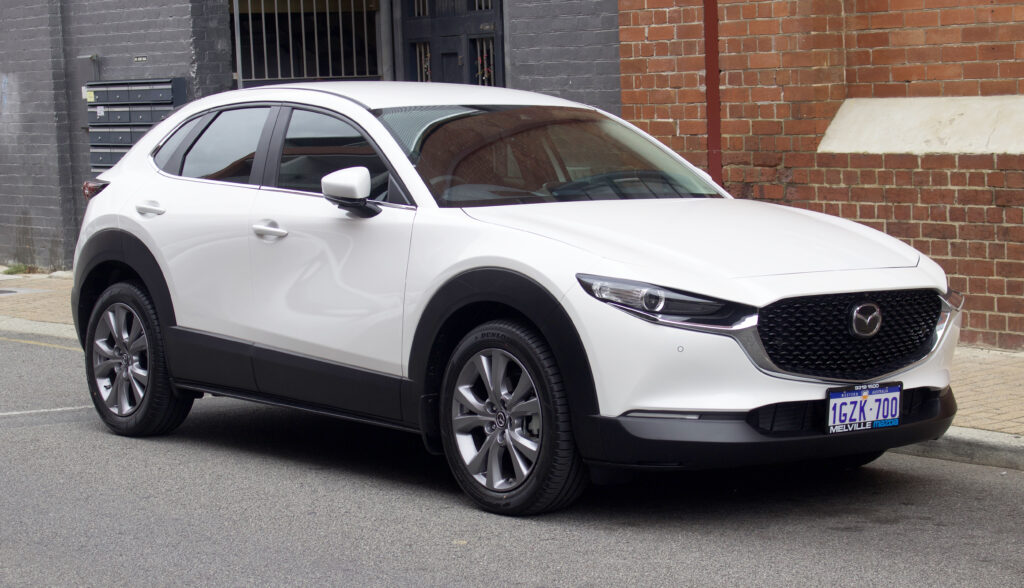
Mazda treats design like fine art. The CX-30 doesn’t look engineered — it looks carved.
The body panels flow like liquid metal, reflections stretch across the doors, and even parked it feels in motion. You notice it in supermarket car parks — people glance twice.
Key visual traits:
- Minimal sharp creases
- Rounded surfacing
- Low roofline
- Large wheel arches
- Premium-looking paint finishes
It feels closer to a luxury brand than mainstream.
Nissan Qashqai: Functional Modernism
The Qashqai goes in a different direction — structured and confident. It looks modern, smart, and practical rather than artistic.
Think of it like contemporary architecture: clean lines, geometric LED lights, and a higher stance that signals usefulness.
Key visual traits:
- Bold grille
- Floating roof effect
- Angular lighting
- Larger glass area
- Taller body
It appeals to the head more than the heart — and that’s deliberate.
Size and Presence — Compact vs Family-Sized
Exterior Dimensions Comparison
| Measurement | Mazda CX-30 | Nissan Qashqai |
|---|---|---|
| Length | Smaller | Larger |
| Height | Lower | Taller |
| Width | Slightly narrower | Wider cabin feel |
| Road presence | Sporty | SUV-like |
What This Means In Real Life
- Mazda fits tight streets and parking better
- Nissan feels more like a proper SUV
- Families prefer the Qashqai footprint
- Drivers prefer the CX-30 proportions
The CX-30 is a lifted hatchback.
The Qashqai is a downsized SUV.
That single difference shapes the whole ownership experience.
Mazda CX-30 Cabin
Step inside and something unusual happens — silence. Not just noise silence, but visual silence. No clutter.
Mazda believes fewer buttons = calmer driving.
Highlights:
- Soft dashboard materials
- Knurled metal controls
- Driver-centric layout
- Heads-up display
- Excellent seat support
It feels crafted, not assembled.
Nissan Qashqai Cabin
The Qashqai focuses on usability. Bigger screens, bigger storage, bigger everything.
Highlights:
- Larger infotainment display
- More rear legroom
- Massive center console
- Better door pockets
- Easier rear access
It feels designed for families rather than enthusiasts.
Technology and Infotainment
Screen Philosophy
| Feature | CX-30 | Qashqai |
|---|---|---|
| Control style | Rotary controller | Touchscreen focused |
| Learning curve | Short | Instant |
| Distraction level | Low | Higher |
| Passenger usability | Limited | Easy |
Mazda purposely avoids touchscreen use while driving. It’s controversial… until you drive at night on a highway. Suddenly it makes sense.
Nissan prioritizes familiarity — like using a tablet.
Driving Experience — The Biggest Difference
Mazda CX-30: The Driver’s Choice
This car doesn’t just transport you. It communicates.
You may be interested in reading Mazda CX-30 vs Volvo XC40 — The Thoughtful Driver’s Dilemma
- Steering feels alive
- Body control is tight
- Throttle response is natural
- Cornering feels confident
You don’t notice speed — you notice rhythm.
Even a short trip feels intentional, not routine.
Nissan Qashqai: The Relaxed Cruiser
The Qashqai is calmer. It isolates instead of engages.
- Light steering
- Softer suspension
- Better pothole comfort
- Quieter low-speed ride
You arrive less tired, but less involved.
Engine Options and Performance
Mazda Approach: Bigger Engine, No Downsizing
Mazda resists tiny turbo engines.
Common engines:
- 2.0 Skyactiv-G petrol
- 2.5 petrol (markets vary)
- Mild hybrid assistance
Why it matters:
Linear power delivery. No turbo lag. Predictable acceleration.
Nissan Approach: Efficient Turbo Tech
Qashqai uses smaller turbo engines with hybrid assistance.
Common engines:
- 1.3 DIG-T mild hybrid
- e-Power hybrid system
Why it matters:
Better fuel efficiency and smoother city driving.
Fuel Economy — Real World Expectations
| Driving Type | CX-30 | Qashqai |
|---|---|---|
| City | Higher consumption | Lower consumption |
| Highway | Similar | Similar |
| Mixed | Slightly worse | Better overall |
The Qashqai wins the efficiency battle — especially the e-Power.
But the CX-30 trades fuel savings for driving feel.
Practicality and Boot Space
Boot Capacity
- CX-30: Weekend luggage
- Qashqai: Family holiday luggage
Rear Passenger Comfort
Qashqai wins clearly:
- More knee room
- Easier child seat fitting
- Better headroom
Mazda prioritizes front passengers.
Nissan prioritizes everyone.
Safety Systems
Both offer advanced driver assistance, but their personalities differ.
Mazda Safety Character
- Subtle interventions
- Driver assistance, not replacement
- Feels natural
Nissan Safety Character
- Active intervention
- Semi-autonomous highway features
- Easier for new drivers
Running Costs and Ownership
Maintenance Expectations
Mazda:
- Simpler engines
- Lower long-term risk
- Fewer turbo components
Nissan:
- Better fuel savings
- More complex hybrid tech
- Higher long-term system complexity
Insurance Perspective
Typically:
- CX-30 = driver oriented category
- Qashqai = family friendly category
Insurance groups often favor the Nissan slightly.
Reliability Personality
Mazda bets on mechanical simplicity.
Nissan bets on electrical sophistication.
Which ages better depends on usage:
- High mileage drivers → Mazda advantage
- City commuting → Nissan advantage
Daily Life Scenarios
School Run
Qashqai wins — space and visibility.
Commute Alone
CX-30 wins — engagement and comfort.
Long Trips
Tie:
You may be interested in readingMazda CX-30 vs Volvo XC40 — The Thoughtful Driver’s DilemmaYou may be interested in reading
 Mazda CX-30 vs Ford Puma — The Driver’s Soul vs The Clever Athlete
- Nissan comfort
- Mazda fatigue reduction via posture
Parking City Streets
CX-30 easier to manage.
Comfort vs Connection
This comparison really becomes a philosophical question:
Do you want to relax while driving…
or enjoy driving while relaxing?
The Qashqai removes effort.
The CX-30 rewards effort.
Who Should Buy the Mazda CX-30
You’ll love it if you:
- Enjoy driving itself
- Care about interior quality
- Drive mostly solo or as a couple
- Prefer long-term mechanical reliability
- Like understated luxury
It’s the emotional choice.
Who Should Buy the Nissan Qashqai
You’ll prefer it if you:
- Have a family
- Want maximum practicality
- Drive in heavy traffic
- Value fuel economy
- Want modern tech features
It’s the rational choice.
Long-Term Ownership Perspective
After years, owners tend to say:
Mazda owners:
“I still enjoy driving it.”
Qashqai owners:
“It made life easy.”
Neither is better — they serve different happiness types.
Verdict — Not a Winner, But a Personality Match
If cars were people:
- The Mazda CX-30 is a designer watch.
- The Nissan Qashqai is a smartwatch.
One makes you feel something.
The other makes life simpler.
Choose based on who you are, not what a spec sheet says.
Conclusion
The CX-30 and Qashqai sit in the same category but live in different worlds. Mazda chases driver emotion — steering feel, posture, control harmony. Nissan chases lifestyle convenience — space, efficiency, technology ease.
There’s no universal winner because they answer different questions:
Do you want driving to disappear… or matter?
Pick accordingly and you’ll never regret the decision.
FAQs
1. Is the Mazda CX-30 more reliable than the Nissan Qashqai?
Generally yes long-term, mainly due to simpler engine design and fewer complex hybrid components.
2. Which has better fuel economy?
The Nissan Qashqai, especially the hybrid versions.
3. Which is more comfortable on long journeys?
Qashqai for passengers, CX-30 for the driver.
You may be interested in readingMazda CX-30 vs Volvo XC40 — The Thoughtful Driver’s DilemmaYou may be interested in reading
Mazda CX-30 vs Ford Puma — The Driver’s Soul vs The Clever AthleteYou may be interested in reading
 Mazda CX-30 and Ferrari Purosangue: When Everyday Logic Meets Pure Passion
4. Is the CX-30 too small for a family?
For small families it works, but the Qashqai is noticeably more practical.
5. Which is better to drive?
The Mazda CX-30 — by a large margin — if you enjoy steering feedback and handling.
If you want to know other articles similar to Mazda CX-30 vs Nissan Qashqai — The Stylish Driver vs The Family Favorite you can visit the category Models.
Volvo XC60 vs Mazda CX-60: The Ultimate SUV Showdown
Volvo XC60 vs BMW X5: The Ultimate SUV Showdown
Volvo XC60 vs Ford Kuga: The Ultimate SUV Showdown
Volvo XC60 vs Kia Sportage: The Ultimate SUV Showdown
Volvo XC60 vs Toyota RAV4: Which SUV Truly Wins Our Hearts?
Volvo XC60 vs Lexus NX: Which Premium SUV Truly Wins?
Leave a Reply
More content of your interest