
MG4 Battery Type: Complete Guide to Chemistry, Longevity, Charging & Real-World Care

Content in this publication
- Understanding the MG4’s Battery Technology
- What Battery Type Does the MG4 Use?
- Why Two Battery Types?
- MG4 Battery Capacity Options
- How the MG4’s Battery Pack Is Designed
- LFP vs NMC in MG4: Which One Should You Choose?
- MG4 Battery Chemistry Explained Simply
- How Long Does the MG4 Battery Last?
- MG4 Battery Longevity Tips
- MG4 Charging Behaviour by Battery Type
- Battery Cooling and Thermal Management
- Real-World MG4 Battery Behaviour in Cold Weather
- Typical MG4 Battery Problems (And How to Avoid Them)
- MG4 Battery Replacement Cost
- MG4 Battery Safety
- Conclusion
- FAQs
Understanding the MG4’s Battery Technology
The MG4 has quickly become one of the most compelling EVs on the market thanks to its blend of value, range, and cutting-edge battery design. When we explore the “MG4 battery type,” we’re really diving into the DNA of the car—its chemistry, structure, durability, charging intelligence, and the long-term behaviours that define ownership experience.
We take the MG4’s battery tech seriously because it’s the core that shapes range confidence, charging speed, heat management, and overall reliability. As we break down each layer, we’ll do it in a conversational way—like we’re sat together, walking through everything you’d ever want to know about the MG4’s powerpack.
What Battery Type Does the MG4 Use?
At launch, MG offered the MG4 with two primary battery chemistries depending on trim and market:
1. LFP Battery (Lithium Iron Phosphate)
- Used on the 51 kWh Standard Range version
- Known for its incredible cycle life
- Highly stable under heat
- Able to charge regularly to 100% with minimal degradation
- Slightly heavier and lower energy density
This chemistry is a favourite among cost-efficient EV buyers and fleet users thanks to its rugged nature.
2. NMC Battery (Nickel-Manganese-Cobalt)
- Used on the 64 kWh and 77 kWh Extended Range versions
- Higher energy density
- Better cold-weather performance
- Faster charging capabilities
- More range per kWh
NMC is the go-to chemistry for long-range EVs thanks to its impressive efficiency and lightweight characteristics.
Why Two Battery Types?
We find that MG4 buyers fall into two clear camps:
- Those who value maximum durability and affordability → LFP
- Those who need bigger range and faster charging → NMC
By splitting the lineup, MG can offer both worlds without compromise.
MG4 Battery Capacity Options
Let’s zoom into the specific capacities MG offers.
MG4 51 kWh LFP (Standard Range)
- Chemistry: LFP
- Usable capacity: ~50.8 kWh
- WLTP range: 218–226 miles
- Real-world range: 170–190 miles
- Charging:
- AC: 6.6 kW
- DC: Up to 117 kW
MG4 64 kWh NMC (Long Range)
- Chemistry: NMC
- Usable capacity: ~61.7 kWh
- WLTP range: 281–316 miles
- Real-world range: 220–260 miles
- Charging:
- AC: 6.6 or 11 kW
- DC: Up to 135 kW
MG4 77 kWh NMC (Extended Range)
- Chemistry: NMC
- Usable capacity: ~74.4 kWh
- WLTP range: 323–360 miles
- Real-world range: 260–300 miles
- Charging:
- AC: 11 kW
- DC: Up to 144 kW
How the MG4’s Battery Pack Is Designed
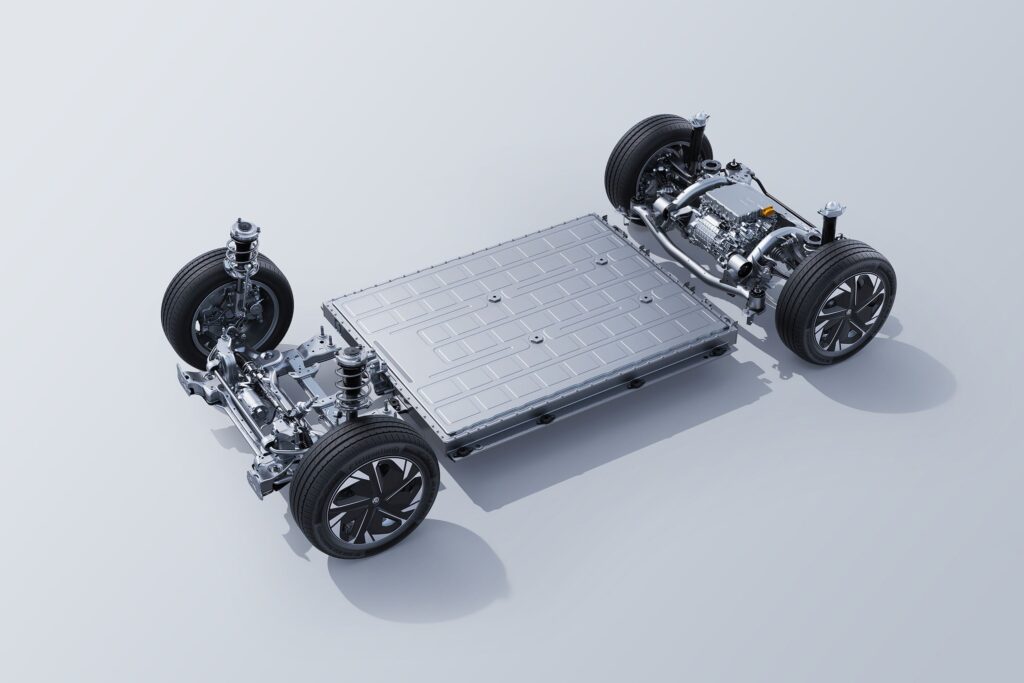
MG uses its innovative “ONE PACK” platform. Imagine a skateboard with a super thin, ultra-rigid structure. This battery pack:
- Sits low for better handling
- Reduces rollover tendencies
- Improves cornering stability
- Provides a flatter interior floor
- Enhances thermal management efficiency
The Ultra-Thin Cell-To-Pack Design
This pack avoids traditional modules. Instead:
- Cells → directly integrated into the pack
- Fewer components → lower weight
- Better energy density
- Improved cooling flow
- Reduced manufacturing cost
It’s the same philosophy used by CATL’s leading cell-to-pack technology.
LFP vs NMC in MG4: Which One Should You Choose?
There’s no wrong answer—just different strengths.
When LFP Makes More Sense
Choose LFP if:
- You mostly drive short to moderate distances
- You prefer charging to 100% daily
- You want a battery that lasts potentially 3,000+ cycles
- Winter performance isn’t your top priority
When NMC Is the Better Fit
Choose NMC if:
You may be interested in reading MG4 Dashboard Symbols: The Complete Guide to Every Warning Light and What They Really Mean
- You need long-distance range
- You travel frequently on motorways
- You want improved cold-weather efficiency
- You rely heavily on faster DC charging
- Weight savings matter (performance, handling, efficiency)
MG4 Battery Chemistry Explained Simply
Let’s break it down like we’re chatting at a café.
LFP (Lithium Iron Phosphate)
Think of LFP as that indestructible Nokia brick phone we all had—it doesn’t quit.
It’s stable, calm, and lasts forever.
- Very low fire risk
- Loves sitting at 100% charge
- Handles heat well
- Cheap to produce
- Extremely long lifespan
The trade-off? It stores less energy per kilogram, meaning a heavier battery for the same range.
NMC (Nickel Manganese Cobalt)
NMC is more like a modern flagship smartphone—light, powerful, high-performance.
- Excellent range
- Fast charging
- Works great in cold climates
- High energy density
But it’s more sensitive to high charge levels and high heat.
How Long Does the MG4 Battery Last?
MG backs the battery with an 8-year / 100,000-mile warranty, whichever comes first.
But in real use?
LFP Lifespan
- 3,000–5,000 cycles
- Equivalent to: 300,000–600,000+ miles
NMC Lifespan
- 1,500–2,000 cycles
- Equivalent to: 200,000–350,000+ miles
In both cases, the MG4 battery should outlive most ownership cycles.
MG4 Battery Longevity Tips
We’ve gathered the most practical and effective ways to extend your MG4 battery life.
Best Practices for LFP Batteries
- Charge to 100% as often as needed
- Avoid rapid DC charging back-to-back
- Preheat the battery before winter charging
- Don’t store the car depleted for long periods
Best Practices for NMC Batteries
- Daily charging limit: 70–80%
- Use DC fast charging sparingly
- Avoid leaving the car at 100% overnight
- Keep the battery between 20–80% for routine driving
- Precondition the battery before fast charging
MG4 Charging Behaviour by Battery Type
The MG4’s charging style varies noticeably depending on LFP or NMC.
LFP Charging Traits
- Slower cold-weather charging
- More stable voltage curve
- Can hit 100% regularly
- Rarely overheats
NMC Charging Traits
- Faster peak DC speeds
- Better efficiency in winter
- More pronounced tapering near 80%
- Prefers partial charging
Battery Cooling and Thermal Management
MG employs a liquid-cooling system for the MG4 battery pack.
What This Means for You
- More consistent charging speeds
- Longer battery lifespan
- Reduced overheating risk
- Enhanced performance on hot days
- Battery preconditioning for DC chargers
Thermal management is one of the strongest parts of MG’s engineering.
You may be interested in readingMG4 Dashboard Symbols: The Complete Guide to Every Warning Light and What They Really MeanYou may be interested in reading
 MG4 How to Charge: The Complete, Human-Written Guide for New and Experienced EV Owners
Real-World MG4 Battery Behaviour in Cold Weather
Cold climates impact all EVs, but MG4 owners see differences by chemistry.
LFP in Winter
- Slower charging until warmed up
- Range drops more significantly
- Regeneration limited early in trips
NMC in Winter
- Better cold efficiency
- Faster accepting charge
- Improved regen availability
Typical MG4 Battery Problems (And How to Avoid Them)
We’ve seen some common issues reported across forums and user groups.
1. Slow Winter Charging
- Mostly affects LFP
- Solve by: enabling preconditioning or starting trip before charging
2. DC Charging Taper Too Early
- Common in NMC once past 60–70%
- Workaround: charge to 80%, continue trip
3. Range Drop Unexpectedly
- Usually temperature-related
- Use heat pump (if equipped)
- Warm battery before DC sessions
4. Software Limiting Charging
Occasional updates tweak charging curves for safety and longevity.
MG4 Battery Replacement Cost
While MG doesn't publicly publish exact costs, industry averages give us a clear expectation:
- LFP pack replacement: £4,000–£6,500
- NMC pack replacement: £6,500–£9,000
In reality, very few owners will ever need a full pack replacement.
MG4 Battery Safety
Both LFP and NMC versions have modern safety mechanisms:
- Cell monitoring
- Liquid cooling
- Overheat protection
- Voltage balancing
- Short-circuit protection
The LFP variant naturally has lower fire risk thanks to its chemistry.
Conclusion
The MG4 battery type—whether LFP or NMC—is the heart of what makes this EV such a game-changer. The clever mixture of chemistries, cell-to-pack technology, and robust thermal management means buyers can genuinely choose a battery that fits their driving style rather than settling for a one-size-fits-all solution.
We’ve explored what makes each chemistry special, how they charge, how long they last, and how to treat them well. Whether you’re team LFP or team NMC, the MG4 delivers efficiency, reliability, and long-term peace of mind in a package that stands out in the EV world.
FAQs
1. Does the MG4 use an LFP or NMC battery?
It depends on the version—51 kWh uses LFP, while 64 kWh and 77 kWh use NMC.
2. Can the MG4 be charged to 100% daily?
Yes for LFP; with NMC it’s best to charge to 70–80% daily for longevity.
3. How long will an MG4 battery last?
Most MG4 packs can last 200,000–600,000 miles depending on chemistry.
You may be interested in readingMG4 Dashboard Symbols: The Complete Guide to Every Warning Light and What They Really MeanYou may be interested in reading
MG4 How to Charge: The Complete, Human-Written Guide for New and Experienced EV OwnersYou may be interested in reading
 Peugeot 2008 Oil Type, Oil Capacity & Complete Maintenance Guide (All Engines & Years)
4. Is the MG4 battery safe?
Yes—the pack uses liquid cooling, advanced monitoring, and industry-standard protections.
5. Which MG4 battery is better?
Neither is better universally—LFP suits durability, NMC suits long-range driving.
If you want to know other articles similar to MG4 Battery Type: Complete Guide to Chemistry, Longevity, Charging & Real-World Care you can visit the category Service and Parts.
Ford Mondeo Key Fob Not Working: Complete Troubleshooting & Fix Guide
Ford Mondeo Gearbox Replacement Cost: What You Really Need to Know
Ford Mondeo Alternator Replacement Cost: Complete Guide for Smart Owners
Ford Mondeo Oil Service Reset: The Complete DIY Guide We Wish We Had Earlier
Ford Mondeo Service Reset: The Complete DIY Guide We Actually Use
Ford Mondeo Headlight Bulb Replacement: The Complete DIY Guide
Leave a Reply
More content of your interest