
Ford Ka Fuel Tank Capacity: Complete Guide by Generation

The Ford Ka fuel tank capacity sounds like one of those specifications that should have a simple, one-number answer. It does not.
Over its long life, the Ford Ka changed dramatically. The tiny, cheerful original Ka of the late 1990s had a different tank from the Fiat-based second-generation model. Then things became even more interesting when Ford introduced the Ka+ in Europe while selling a significantly different third-generation Ka in markets such as Brazil.
So, if we simply say, “A Ford Ka has a 40-litre fuel tank,” we may be right for one car and completely wrong for another.
The useful short answer is this: Ford Ka fuel tank capacity generally ranges from about 35 to 51.6 litres depending on generation and market. The first-generation European Ka uses approximately 40 litres, the European second-generation Ka uses 35 litres, the Ka+ uses 42 litres, while later Brazilian-market Ka models can carry around 51.6 litres. Ford documentation confirms these important variations.
That difference is substantial. An extra 15 or 16 litres can transform how often we stop for fuel and how far we can realistically travel between petrol stations.
In this guide, we will break down the Ford Ka fuel tank size by generation, explain reserve fuel, look at realistic driving range, and clear up the confusion surrounding how much fuel actually fits when we fill the tank.
Content in this publication
- Ford Ka Fuel Tank Capacity at a Glance
- First-Generation Ford Ka Fuel Tank Capacity
- Second-Generation Ford Ka Fuel Tank Capacity
- Ford Ka+ Fuel Tank Capacity
- Third-Generation Ford Ka Fuel Tank Capacity
- Ford Ka Fuel Tank Capacity in Gallons
- Does Ford Ka Fuel Tank Capacity Include Reserve Fuel?
- Why Your Ford Ka May Take Less Fuel Than Its Stated Capacity
- Why You Should Not Try to Squeeze in Extra Fuel
- How Far Can a Ford Ka Travel on a Full Tank?
- Ford Ka Fuel Tank Size and Fuel Economy
- How to Calculate Your Ford Ka's Real Fuel Range
- Low Fuel Warning on the Ford Ka
- Which Ford Ka Has the Largest Fuel Tank?
- Which Ford Ka Has the Smallest Fuel Tank?
- Ford Ka Petrol and Diesel Tank Capacity
- Ford Ka Fuel Capacity When Buying a Used Car
- What If Your Ford Ka Takes More Fuel Than Expected?
- Is a Bigger Ford Ka Fuel Tank Better?
- Ford Ka Fuel Tank Capacity by Generation: What We Learn
- Frequently Asked Questions
Ford Ka Fuel Tank Capacity at a Glance
Before diving into the details, here is the easiest way to understand the major Ford Ka versions.
| Ford Ka version | Approximate years | Typical market | Fuel tank capacity |
|---|---|---|---|
| First-generation Ford Ka | 1996–2008 | Europe and other markets | 40 litres |
| Second-generation Ford Ka | 2008/2009–2016 | Europe | 35 litres |
| Ford Ka+ | 2016–2020 approx. | Europe | 42 litres |
| Third-generation Ford Ka | 2014–2021 approx. | Brazil/Latin America | Around 51–51.6 litres |
Ford's first-generation technical information lists a 40-litre fuel tank.
The European second-generation owner's information specifies 35 litres, including approximately 5 litres identified in the capacity information as reserve.
The European Ford Ka+ moved upward again to 42 litres.
Meanwhile, Ford's Brazilian documentation for a 2019 Ka lists a much larger 51.6-litre fuel tank for the 1.0-litre Flex Fuel version.
That is why checking the generation matters more than simply searching for “Ford Ka tank size.”
First-Generation Ford Ka Fuel Tank Capacity
The original Ford Ka appeared in the 1990s and quickly became one of Europe's most recognizable city cars.
Its curved styling was unlike almost anything else on the road. Underneath that playful body, however, was fairly conventional Ford engineering.
How Many Litres Does a Mk1 Ford Ka Hold?
For the first-generation Ford Ka, Ford technical information lists the fuel tank capacity at 40 litres.
That figure applies broadly to the conventional first-generation hatchback covered by Ford's technical specifications.
Forty litres might sound small when compared with a family SUV carrying 55, 60 or even 70 litres, but we have to remember what the Ka was designed to do.
It was small, lightweight and aimed heavily at urban driving.
Putting a huge tank underneath it would have been like giving someone a hiking backpack for a walk to the corner shop. Technically useful, perhaps, but hardly necessary.
Why a 40-Litre Tank Worked Well
Small petrol engines and relatively low vehicle weight meant the first Ka did not necessarily need a huge fuel reserve.
If a particular Ka achieves around 7 L/100 km in mixed real-world use, for example, a theoretical 40-litre tank could represent roughly 570 km.
At 8 L/100 km, theoretical range falls to around 500 km.
Neither number should be treated as guaranteed range. Traffic, engine condition, tyre pressure, weather, driving speed and even how enthusiastically we use the accelerator can change the result substantially.
Still, it illustrates why 40 litres was perfectly practical for a little city car.
Second-Generation Ford Ka Fuel Tank Capacity
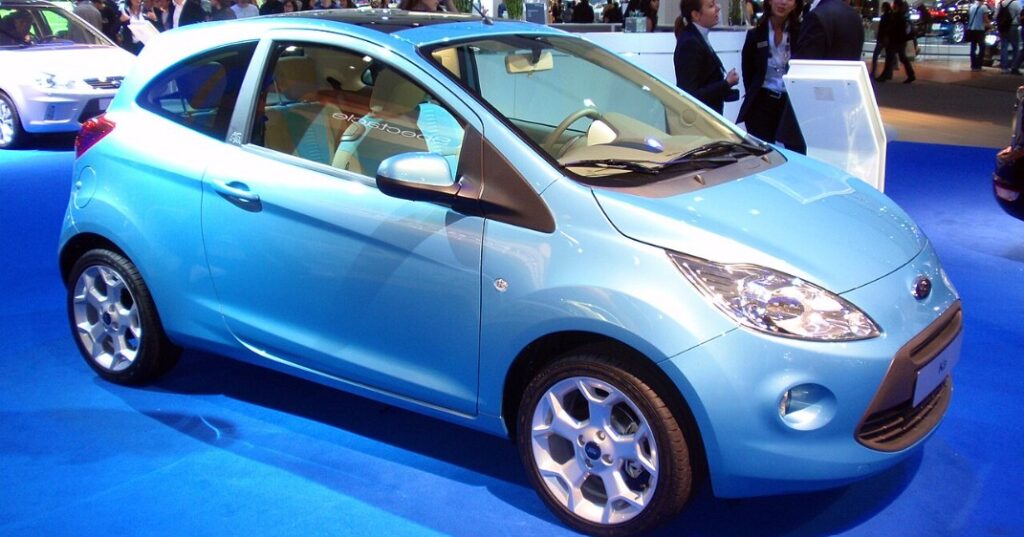
The second Ford Ka was a major change.
Introduced in Europe around 2008–2009, this Ka was developed through Ford's cooperation with Fiat and shared important architecture with the Fiat 500.
The styling remained recognizably Ford, but mechanically it belonged to a very different family from the original Ka.
That also meant a different fuel tank.
Second-Generation Ka Tank Size: 35 Litres
Ford documentation lists a 35-litre fuel tank for both the 1.2-litre Duratec petrol and 1.3-litre Duratorq diesel versions covered by the European specifications.
The same documentation identifies approximately 5 litres as reserve within the stated capacity.
This is one of the most important details to remember when comparing Mk1 and Mk2 cars.
The original Ka carries around 40 litres.
The second-generation European Ka carries around 35 litres.
So newer does not automatically mean bigger.
Why Did Ford Reduce the Fuel Tank Size?
At first glance, shrinking from 40 to 35 litres seems like a backward step.
But tank capacity cannot be judged in isolation.
The second-generation Ka came with relatively efficient small engines, and improved fuel economy can offset reduced capacity.
Think about two water bottles. One is bigger, but its owner drinks twice as quickly. Suddenly the smaller bottle does not look like such a disadvantage.
Exactly the same principle applies to cars.
Range depends on both tank capacity and fuel consumption.
Petrol Versus Diesel Range
The 1.3 Duratorq diesel could potentially travel substantially farther from its 35-litre tank than a petrol Ka under similar circumstances simply because diesel fuel consumption could be lower.
That means two cars with identical fuel tanks can have noticeably different ranges.
When buying a used Ka, therefore, tank capacity gives us only half the story.
Ford Ka+ Fuel Tank Capacity
The Ford Ka+ represented another major shift.
Despite the familiar Ka badge, it was larger and more practical than the tiny second-generation European car.
The Ka+ offered five doors, five-seat practicality and dimensions that pushed it closer toward the supermini class.
Its fuel tank grew accordingly.
How Big Is the Ford Ka+ Fuel Tank?
The European Ford Ka+ fuel tank capacity is 42 litres according to published specifications for the model.
That gives the Ka+ noticeably more fuel capacity than the 35-litre second-generation European Ka.
We are talking about an additional 7 litres.
At 6 L/100 km, those seven litres theoretically represent another 116 km of driving.
Real life will vary, of course, but the difference is large enough to matter.
Why the Ka+ Needed More Fuel
The Ka+ had a somewhat different mission from the tiny Ka that came before it.
It was still affordable and city-friendly, but greater passenger space and stronger everyday practicality meant owners were more likely to use it for longer trips.
A 42-litre tank suited that broader role.
Carwow's specifications likewise list the Ka+ with a 42-litre tank and calculated a substantial theoretical range for economical versions, although real urban driving naturally reduces that figure.
Third-Generation Ford Ka Fuel Tank Capacity
Here is where searches for Ford Ka specifications often become confusing.
Outside Europe, particularly in Brazil and parts of Latin America, Ford sold another Ka that was not simply the European second-generation model.
The third-generation Brazilian Ka was a larger, more conventional five-door hatchback. A Ka sedan was also offered in some markets.
And its fuel tank was significantly larger.
Brazilian Ford Ka Tank Capacity
Ford's Brazilian owner's documentation for the 2019 Ka lists the fuel tank at 51.6 litres for the 1.0-litre Flex Fuel version.
Independent Brazilian specifications commonly round the figure to approximately 51 litres.
That makes this Ka dramatically different from the European second-generation model.
Compare:
European Mk2 Ka: 35 litres.
European Ka+: 42 litres.
Brazilian later-generation Ka: about 51–51.6 litres.
Someone reading specifications from the wrong country could therefore be off by more than 16 litres.
Why Regional Ford Ka Specifications Differ
Manufacturers often adapt cars to different markets.
Fuel types differ. Driving distances differ. Infrastructure differs. Customer expectations differ.
Brazil also has widespread use of flex-fuel vehicles capable of running on gasoline or ethanol blends, making regional engineering specifications particularly important.
The Brazilian Ka should therefore not be assumed to share every specification with a European Ka+ simply because the cars occupy similar parts of Ford's global model history.
Ford Ka Fuel Tank Capacity in Gallons
Drivers in the UK or United States may prefer to think about capacity in gallons.
The conversion itself introduces another potential trap because a UK imperial gallon is not the same as a US gallon.
A 40-litre tank equals approximately 8.8 UK gallons or 10.6 US gallons.
A 35-litre tank is approximately 7.7 UK gallons or 9.2 US gallons.
A 42-litre tank is roughly 9.2 UK gallons or 11.1 US gallons.
A 51.6-litre tank works out at about 11.4 UK gallons or 13.6 US gallons.
When reading international Ford Ka specifications, always check which gallon measurement the source uses.
Otherwise, perfectly correct figures can look completely contradictory.
Does Ford Ka Fuel Tank Capacity Include Reserve Fuel?
This is probably the biggest source of confusion around fuel capacity.
Drivers sometimes imagine the reserve as a completely separate miniature tank hidden somewhere in the vehicle.
Usually, that is not what we are dealing with.
Understanding the Ford Ka Fuel Reserve
For the second-generation Ka, Ford's capacity documentation gives 35 litres including a reserve of approximately 5 litres.
In other words, we should not normally calculate 35 litres plus another 5 litres and conclude that the car actually has a 40-litre tank.
The reserve forms part of the usable fuel strategy around the low-fuel point.
This distinction matters because otherwise we can accidentally overstate the vehicle's capacity.
What Happens When the Gauge Reads Empty?
“Empty” does not necessarily mean every drop of fuel has disappeared.
Ford documentation for the Brazilian Ka explicitly explains that reserve fuel can remain after the gauge indicates empty and that, as a result, a driver may not be able to refill the entire advertised capacity.
That is deliberate.
A fuel gauge would be rather unforgiving if the engine stopped at the precise instant the needle reached its final mark.
Reserve gives us a margin.
But it should be treated as emergency breathing room, not extra everyday range.
Why Your Ford Ka May Take Less Fuel Than Its Stated Capacity
Suppose we own a Ka with a 40-litre tank.
The low-fuel warning appears, we head to the petrol station, fill until the nozzle clicks, and the pump shows only 33 litres.
Does that mean the specifications are wrong?
Usually, no.
There was still fuel in the tank.
Tank Capacity Is Not Refill Capacity
This distinction is essential.
Tank capacity means how much fuel the system is designed to contain under its specified conditions.
Refill quantity means how much fuel we personally add during one visit to a petrol station.
Those values are rarely identical.
If our 40-litre Ka still contains 6 litres when we arrive at the pump, adding roughly 34 litres makes perfect sense.
The same applies when the dashboard displays a low remaining range.
There is normally still fuel inside.
Why You Should Not Try to Squeeze in Extra Fuel
We've all seen it.
The nozzle clicks.
Someone pulls the trigger again.
Click.
Again.
Click.
They keep adding tiny amounts until fuel practically reaches the filler neck.
It might feel like getting maximum value from the stop, but repeatedly topping off after automatic shut-off is not a good habit.
Modern fuel systems need appropriate space for fuel expansion and vapour management.
When the pump reaches automatic cut-off, that is generally the sensible moment to stop rather than treating the filler neck like the final level of a video game.
How Far Can a Ford Ka Travel on a Full Tank?
There is no universal answer because Ford Ka fuel economy varies enormously across generations, engines and driving conditions.
Still, we can estimate range mathematically.
If a 40-litre first-generation Ka consumes 7 L/100 km, its theoretical full-tank range is around 571 km.
A 35-litre second-generation Ka achieving 6 L/100 km would theoretically cover about 583 km.
A 42-litre Ka+ returning 6 L/100 km could theoretically approach 700 km.
A later Brazilian Ka with 51.6 litres and consumption of 7 L/100 km could theoretically approach 737 km.
Those are mathematical examples rather than official promises.
Why Real-World Range Changes So Much
City traffic can destroy an otherwise impressive range estimate.
Cold starts increase consumption. Short journeys prevent the engine from spending as much time operating efficiently. Fast motorway driving raises aerodynamic drag. Extra weight matters. Underinflated tyres matter. Aggressive acceleration certainly matters.
Even two people driving the same Ka along the same route may see different results.
One treats the accelerator like a dimmer switch.
The other treats it like an on/off button.
Their fuel bills will tell the story.
Ford Ka Fuel Tank Size and Fuel Economy
A larger fuel tank does not automatically make a vehicle more economical.
This misunderstanding appears surprisingly often.
Fuel tank capacity determines how much fuel we can carry.
Fuel economy determines how efficiently we use it.
Those are related to driving range, but they are not the same measurement.
Large Tank Does Not Mean High Consumption
The Brazilian Ka's 51-plus-litre capacity does not prove that it burns more fuel than a European Ka+ with 42 litres.
Similarly, the second-generation European Ka's tiny 35-litre tank does not automatically make it the economy champion.
Engine technology, gearing, vehicle weight, fuel, traffic and driving style determine consumption.
The tank simply stores the energy supply.
How to Calculate Your Ford Ka's Real Fuel Range
The most useful range figure is not one copied from a brochure. It is one measured from our own car.
Fill the car normally until the pump automatically stops.
Reset the trip meter.
Drive as usual.
At the next refill, record the kilometres travelled and litres added.
If we travel 600 km and add 36 litres, our calculated consumption is 6 L/100 km.
We can then combine that figure with our Ka's tank capacity to estimate realistic maximum range.
More importantly, we can establish a comfortable refuelling point that leaves a healthy margin.
Low Fuel Warning on the Ford Ka
The appearance of the low-fuel warning does not mean we need to panic.
It means we should start thinking seriously about finding fuel.
How far we can travel afterward varies with generation, calibration, driving conditions and current consumption.
Trying to discover the absolute maximum by intentionally driving until the engine stops is a poor experiment.
Why Running the Tank Very Low Is Best Avoided
There are practical reasons not to make a habit of running on fumes.
First, range estimates become increasingly uncertain near empty.
Second, hills and vehicle movement can affect how fuel sits inside the tank.
Third, deliberately using every final drop gives us no safety margin if the nearest station is closed, traffic suddenly stops or our route changes.
A fuel reserve is rather like an emergency umbrella.
Its existence does not mean we should deliberately walk into every storm.
Which Ford Ka Has the Largest Fuel Tank?
Among the major Ka variants discussed here, the later Brazilian-market third-generation Ford Ka has the largest tank, at approximately 51.6 litres according to Ford's Brazilian technical documentation.
That is followed by the European Ka+ at 42 litres, the original European Ka at around 40 litres, and the European second-generation Ka at 35 litres.
The difference between smallest and largest is roughly 16.6 litres.
That is nearly half another second-generation Ka tank.
Which Ford Ka Has the Smallest Fuel Tank?
The European second-generation Ford Ka is the smallest among these principal versions at 35 litres.
It may seem surprising because it replaced the 40-litre original Ka, but its efficient small-engine philosophy helped compensate for the lower capacity.
For urban owners, the smaller tank was unlikely to be a major inconvenience.
For drivers covering long motorway distances, however, capacity can become more noticeable.
Ford Ka Petrol and Diesel Tank Capacity
On the European second-generation Ka, Ford listed both the 1.2 Duratec petrol and 1.3 Duratorq diesel with the same 35-litre fuel tank specification.
Their driving ranges could nevertheless be different because consumption differs.
This illustrates why searching for “Ford Ka diesel tank size” and “Ford Ka petrol tank size” sometimes produces identical capacity numbers even though owners report substantially different distances between fill-ups.
The engine changes how quickly the tank empties, not necessarily how large the tank is.
Ford Ka Fuel Capacity When Buying a Used Car
If we are shopping for an older Ford Ka, fuel capacity itself probably will not decide whether we buy the car.
But it can reveal useful information.
Suppose a seller describes a second-generation European Ka and claims it has a 50-litre tank.
That should immediately encourage us to verify exactly what model, market and specification we are looking at.
Knowing basic factory specifications is one small way of checking whether an advertisement makes sense.
Check the Exact Vehicle, Not Just the Badge
Ford used the Ka name across vehicles that differed considerably depending on region.
That is particularly important when online information comes from multiple countries.
A specification page from Brazil may be completely accurate while being completely irrelevant to a UK Ka.
Whenever possible, identify the model year, engine, market and generation before relying on a capacity figure.
What If Your Ford Ka Takes More Fuel Than Expected?
Small differences can occur because of how the vehicle was positioned, when the pump nozzle stopped, remaining fuel, filler-pipe volume and other practical factors.
But a very large discrepancy deserves attention.
If a supposed 35-litre Ka apparently accepts dramatically more than its expected capacity, verify the exact model specification first.
Do not assume every Google result applies to your vehicle.
And if a petrol pump reading seems genuinely implausible, keep the receipt and investigate rather than forcing additional fuel into the tank to test the theory.
Is a Bigger Ford Ka Fuel Tank Better?
Not necessarily.
A bigger tank can give us longer intervals between filling stations, which is convenient.
However, carrying more fuel also adds weight when the tank is full.
For city driving, where petrol stations are everywhere, huge range is rarely essential.
Ford designed the Ka primarily as a small, accessible everyday car rather than a machine built to cross continents between fuel stops.
The best fuel tank is therefore not automatically the biggest one.
It is the one that suits the car's purpose.
Ford Ka Fuel Tank Capacity by Generation: What We Learn
Looking across the Ka family reveals something interesting.
The original European Ka offered about 40 litres.
The second-generation European car dropped to 35 litres.
The more practical Ka+ increased that to 42 litres.
Meanwhile, Ford's later Brazilian Ka stretched the figure beyond 51 litres, with Ford documentation specifying 51.6 litres on the referenced 2019 model.
There was never one universal Ford Ka tank.
There were several cars, several markets and several engineering approaches wearing the same famous badge.
Conclusion: How Much Fuel Does a Ford Ka Hold?
So, what is the Ford Ka fuel tank capacity?
For most first-generation European Ford Ka models, we are looking at approximately 40 litres. The second-generation European Ka reduced that to 35 litres, including the reserve specified in Ford's capacity information. The later European Ka+ holds around 42 litres, while the significantly different Brazilian third-generation Ka can carry approximately 51–51.6 litres, depending on the specific version and published specification.
That enormous spread explains why conflicting answers appear online.
The trick is simple: never ask only, “How big is a Ford Ka fuel tank?”
Ask, “Which Ford Ka?”
Generation, year, engine and market can transform the answer.
Once we identify those details, fuel capacity stops being confusing and becomes exactly what it should be: one straightforward specification that helps us understand range, refuelling habits and everyday running costs.
Frequently Asked Questions
1. What is the Ford Ka fuel tank capacity?
Ford Ka fuel tank capacity depends on the generation and market. The first-generation European Ka is typically around 40 litres, the second-generation European Ka uses 35 litres, the European Ka+ has approximately 42 litres, and some later Brazilian Ka models have roughly 51–51.6 litres.
2. How many litres does a Ford Ka Mk2 hold?
The second-generation European Ford Ka has a 35-litre fuel tank. Ford's capacity information states that this figure includes approximately 5 litres of reserve for the versions documented with 1.2 Duratec petrol and 1.3 Duratorq diesel engines.
3. What is the Ford Ka+ fuel tank capacity?
The European Ford Ka+ fuel tank holds approximately 42 litres. That makes it larger than the 35-litre tank fitted to the preceding European second-generation Ka.
4. How far can a Ford Ka go on a full tank?
There is no single distance because range depends on engine, generation, traffic, speed and driving style. A Ka consuming 6 L/100 km from a 40-litre tank has a mathematical maximum of roughly 667 km, whereas consumption of 8 L/100 km would reduce that theoretical figure to about 500 km. We should always leave a safety margin rather than planning to use every litre.
5. Does Ford Ka tank capacity include the reserve?
In Ford documentation for the second-generation Ka, the 35-litre capacity includes the stated 5-litre reserve. Ford documentation for later Brazilian models also explains that fuel can remain after the gauge indicates empty, which is why the quantity added during refuelling may be less than the nominal tank capacity.
If you want to know other articles similar to Ford Ka Fuel Tank Capacity: Complete Guide by Generation you can visit the category Service and Parts.
Nissan Rogue Oil Change Cost: Prices, Service Options, and What to Expect
Nissan Rogue Key Battery Replacement: Easy Step-by-Step Guide
Nissan Rogue Oil Change Interval: Complete Guide by Model Year
Nissan Rogue Brake Pads and Rotors Cost: Complete 2026 Guide

Kia Sorento Service Reset: How to Reset the Service Light
Kia Sorento Fuel Tank Capacity: Gallons, Litres and Model Differences
Leave a Reply
More content of your interest