

Toyota Estima Tank Capacity: Complete Guide by Generation

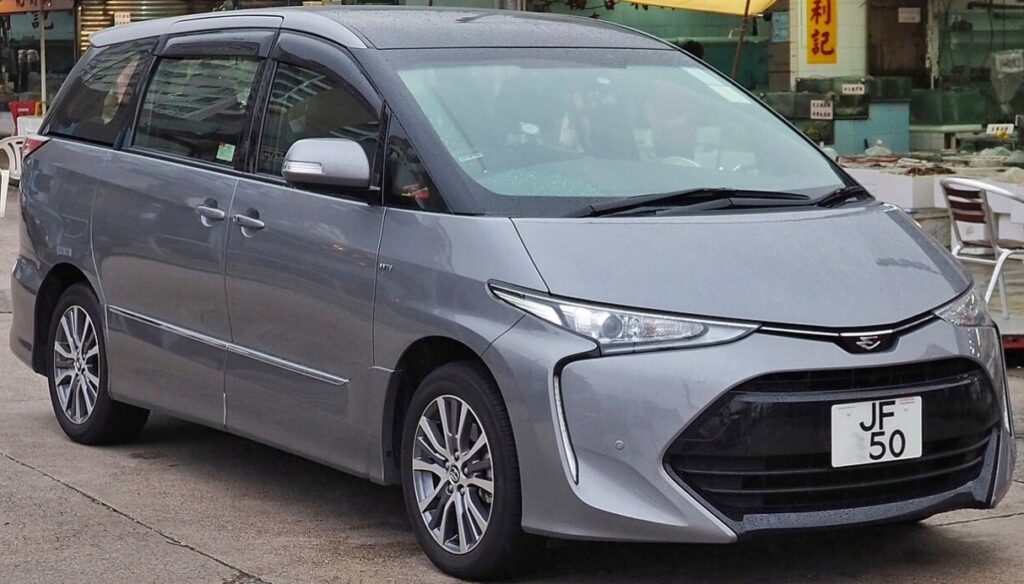
The Toyota Estima tank capacity is one of those specifications that sounds simple until we start comparing different years, engines, drivetrains, and hybrid versions. Depending on which Estima sits in the driveway, the fuel tank can hold roughly 65 to 75 litres.
That difference matters. Ten litres may not seem enormous on paper, but on a long motorway trip it can mean another hour or more of driving before we start hunting for a petrol station.
The Toyota Estima was sold across several generations beginning in 1990, while closely related versions appeared internationally under names such as the Toyota Previa and Toyota Tarago. Toyota itself confirms three major generations of the Estima, with the original model introduced in May 1990 and the third generation arriving in January 2006.
So, how large is the Estima fuel tank?
Here's the quick answer.
| Toyota Estima version | Approx. fuel tank capacity |
|---|---|
| First generation Estima (1990–1999) | 75 L |
| Second generation petrol (2000–2005/06) | 70 L |
| First Estima Hybrid AHR10W (2001–2005) | 70 L |
| Third generation petrol (2006–2019) | 65 L |
| Third generation Hybrid AHR20W | 65 L |
Those figures give us the broad picture, but there's plenty more worth knowing—especially if we're buying a used Japanese import.
Content in this publication
- What Is the Toyota Estima Fuel Tank Capacity?
- Toyota Estima Tank Capacity by Generation
- Second Generation Toyota Estima Tank Capacity
- Toyota Estima Hybrid Tank Capacity: AHR10W
- Third Generation Toyota Estima Tank Capacity
- Toyota Estima 3.5 V6 Tank Capacity
- Third-Generation Toyota Estima Hybrid Tank Capacity
- Toyota Estima Tank Capacity in Gallons
- How Far Can a Toyota Estima Travel on One Tank?
- Why Can't We Put the Full Tank Capacity in During Refuelling?
- Should We Drive an Estima Until Empty?
- Does 2WD or 4WD Change Toyota Estima Tank Capacity?
- How to Find Your Exact Estima Tank Capacity
- Toyota Estima Petrol vs Hybrid Tank Capacity
- Is a 65-Litre Tank Big Enough for the Toyota Estima?
- Does Tank Capacity Affect Estima Buying Decisions?
- Common Toyota Estima Fuel-Tank Problems
- Can We Install a Larger Fuel Tank?
- How to Get More Range From an Estima Tank
- Which Toyota Estima Has the Largest Fuel Tank?
- Which Toyota Estima Offers the Best Range?
- Final Thoughts on Toyota Estima Tank Capacity
- Frequently Asked Questions
What Is the Toyota Estima Fuel Tank Capacity?
Most Toyota Estimas have a fuel tank between 65 and 75 litres, equivalent to roughly 17.2 to 19.8 US gallons.
The capacity generally became smaller as the Estima evolved.
The first-generation van carried about 75 litres. Toyota reduced that to approximately 70 litres for the second generation and then to around 65 litres for many third-generation models.
Interestingly, reducing tank size didn't necessarily mean reducing driving range. Engines became more efficient, and hybrid technology dramatically changed how far the Estima could travel on each litre.
Think of it like swapping a huge backpack for a smaller but better-organized one. We carry slightly less fuel, yet use what we have more efficiently.
Toyota Estima Tank Capacity by Generation
Before diving into individual engines, this is the easiest way to understand the changes.
First Generation Toyota Estima Tank Capacity
The original Toyota Estima was introduced in Japan in May 1990. Toyota lists its original 2.4-litre engine as the 2TZ-FE, with both two-wheel-drive and four-wheel-drive versions offered.
For these early TCR-series Estimas, the typical fuel tank capacity is:
75 litres
A 1990 TCR21W specification lists a 75-litre tank, while specifications for later 1994 and 1998 TCR21W models—including supercharged versions—also show the same 75-litre capacity.
That converts to approximately:
- 19.8 US gallons
- 16.5 Imperial gallons
For a 1990s Japanese minivan, that's a reasonably substantial tank.
Why Did the First Estima Need 75 Litres?
Efficiency wasn't exactly the first Estima's superpower.
Its unusual mid-engine layout made it one of Toyota's most interesting people carriers, but moving a large seven- or eight-seat van with a 2.4-litre petrol engine takes fuel.
A large tank therefore helped compensate for relatively modest fuel economy.
It was Toyota's way of saying: if the engine is thirsty, we'd better give it a bigger bottle.
First-Generation Estima 2WD vs 4WD Capacity
Owners sometimes assume the 4WD version must have a smaller fuel tank because additional drivetrain hardware occupies space underneath the vehicle.
For the TCR-series Estima, however, commonly published Japanese specifications show approximately 75 litres even on four-wheel-drive versions. For example, period TCR21W 4WD specifications list the fuel tank at 75 litres.
That makes remembering the first generation relatively easy:
First-generation Estima = approximately 75 L.
Second Generation Toyota Estima Tank Capacity
Toyota completely changed the Estima for its second generation around 2000.
The quirky mid-engine arrangement disappeared, and the vehicle adopted a more conventional front-engine format.
Petrol engines included the:
- 2.4-litre 2AZ-FE
- 3.0-litre V6 1MZ-FE
The fuel tank capacity for these mainstream petrol versions is generally:
70 litres
Technical fluid-capacity information for Japanese-market ACR30/40 and MCR30/40 models lists a 70-litre fuel tank for both the 2AZ-FE and 1MZ-FE engines.
That's approximately:
18.5 US gallons or 15.4 Imperial gallons.
Toyota Estima ACR30 Tank Capacity
The ACR30W is one of the most common second-generation Estimas on the used-import market.
It uses Toyota's 2.4-litre four-cylinder 2AZ-FE engine and normally has:
70 L fuel capacity
Its combination of a large cabin, respectable efficiency, and relatively simple naturally aspirated petrol engine helped make the ACR30 extremely popular.
If we're checking an imported Estima and the chassis plate begins with ACR30, a 70-litre tank is the figure we would normally expect.
Toyota Estima MCR30 Tank Capacity
The MCR30W uses Toyota's 3.0-litre 1MZ-FE V6.
Tank capacity is again around:
70 litres
However, range will normally be lower than an equivalent 2.4-litre model simply because the V6 can consume more fuel.
This illustrates an important point: tank capacity and driving range aren't the same thing.
Two vehicles can have identical tanks and dramatically different distances between fill-ups.
Toyota Estima Hybrid Tank Capacity: AHR10W
Toyota introduced something particularly interesting in 2001—the Estima Hybrid.
Toyota confirms that the original Estima Hybrid arrived in June 2001 as part of the second-generation lineup and used the 2.4-litre 2AZ-FXE petrol engine alongside electric motors.
Its fuel tank capacity is approximately:
70 litres
Specifications for the 2001 ZA-AHR10W Estima Hybrid list a 70-litre tank, and later 2004 AHR10W versions retain that capacity.
Does the First Estima Hybrid Have a Smaller Tank?
Surprisingly, no.
Even though Toyota had to package batteries, electric motors, electronics, and hybrid hardware inside the vehicle, the AHR10W retained approximately the same 70-litre fuel capacity as petrol second-generation models.
That's rather impressive packaging.
And because the hybrid consumes less petrol under favourable conditions, that 70 litres can theoretically provide significantly greater range.
Third Generation Toyota Estima Tank Capacity
The third-generation Estima debuted in Japan in January 2006.
Toyota offered a 2.4-litre 2AZ-FE four-cylinder and a considerably more powerful 3.5-litre 2GR-FE V6. Toyota's historical specifications identify model codes including ACR50W, ACR55W, GSR50W, and GSR55W for this generation.
Most petrol third-generation models use approximately:
65 litres
For example, specifications for a 2007 ACR50W Estima G list a 65-litre fuel tank, while 2012 and 2013 ACR50W versions also show the same capacity.
That's equivalent to around:
17.2 US gallons or 14.3 Imperial gallons.
Toyota Estima ACR50 Tank Capacity
The ACR50W is arguably the model most people imagine when discussing a modern used Toyota Estima.
It combines the 2.4-litre 2AZ-FE engine with front-wheel drive.
Fuel capacity:
Approximately 65 L
Multiple ACR50W specifications from different production years support the 65-litre figure.
This capacity remained remarkably consistent through much of the ACR50's long production life.
Toyota Estima ACR55 Tank Capacity
The ACR55 is essentially the four-wheel-drive counterpart to the ACR50.
Capacity is generally also around:
65 litres
Individual trim and market specifications should always be confirmed through the chassis information or owner's documentation, but the third-generation petrol family broadly revolves around this 65-litre figure.
Toyota Estima 3.5 V6 Tank Capacity
Now we arrive at the fun one.
The GSR50/GSR55 Estima uses Toyota's 3.5-litre 2GR-FE V6, producing considerably more power than the four-cylinder model.
Toyota's original third-generation data confirms the engine displacement at 3,456 cc and output of 280 PS for representative Japanese-market versions.
Its fuel tank capacity is generally:
65 litres
So despite having two additional cylinders and significantly more performance, it doesn't receive a substantially bigger tank than the 2.4-litre model.
Does the 3.5 V6 Need Refuelling More Often?
Usually, yes.
If we compare two Estimas driven under similar conditions, the 3.5 V6 tends to use fuel faster.
That isn't necessarily bad news.
The V6 delivers far stronger acceleration and makes a fully loaded Estima feel considerably more effortless. It's the difference between politely asking the van to accelerate and simply telling it.
The trade-off is that the same 65 litres disappear faster.
Third-Generation Toyota Estima Hybrid Tank Capacity
Toyota also introduced a new Estima Hybrid based on the third-generation platform in June 2006.
This model uses the AHR20W chassis code and Toyota's 2.4-litre 2AZ-FXE hybrid engine.
Toyota's historical specification identifies the AHR20W and confirms the combination of a 2.4-litre petrol engine with the hybrid system.
The typical fuel tank capacity is:
65 litres
A 2011 AHR20W specification, for example, lists a 65-litre fuel tank.
Why Is the AHR20 Tank Smaller Than the AHR10?
The earlier AHR10 Hybrid carried approximately 70 litres.
The later AHR20 dropped that figure to around 65 litres.
At first, that sounds like a downgrade.
In reality, improved hybrid efficiency meant Toyota didn't necessarily need to carry quite as much petrol to deliver a useful driving range.
Reducing capacity can also save some weight and simplify vehicle packaging.
Toyota Estima Tank Capacity in Gallons
Because Estimas travel far beyond Japan, we often encounter gallons instead of litres.
Here are the approximate conversions.
| Capacity | US gallons | Imperial gallons |
| 65 L | 17.2 gal | 14.3 gal |
| 70 L | 18.5 gal | 15.4 gal |
| 75 L | 19.8 gal | 16.5 gal |
Remember that US and UK gallons are not the same.
That's an easy source of confusion when reading international specifications.
How Far Can a Toyota Estima Travel on One Tank?
This is where capacity becomes interesting.
Range depends on:
Tank capacity × real-world fuel economy
Suppose our Estima has a 65-litre tank and averages 10 km/L.
The theoretical distance would be:
65 × 10 = 650 km
But we shouldn't expect to use every single litre.
In reality, we need to account for reserve fuel, traffic, temperature, passengers, air conditioning, driving style, tyre pressure, and terrain.
Possible Estima Driving Ranges
As a broad real-world illustration:
| Average economy | 65 L tank | 70 L tank | 75 L tank |
| 7 km/L | 455 km | 490 km | 525 km |
| 9 km/L | 585 km | 630 km | 675 km |
| 11 km/L | 715 km | 770 km | 825 km |
| 13 km/L | 845 km | 910 km | 975 km |
| 15 km/L | 975 km | 1,050 km | 1,125 km |
Those are mathematical estimates rather than guaranteed real-world figures.
Nobody should treat them as instructions to drive until the engine coughs to a stop.
Why Can't We Put the Full Tank Capacity in During Refuelling?
Here's a common scenario.
Our Estima supposedly has a 65-litre tank.
The low-fuel warning appears.
We drive to the petrol station and fill it completely.
The pump stops at 53 litres.
So where did the missing 12 litres go?
Nothing is necessarily wrong.
There Is Still Fuel in the Tank
A low-fuel warning does not mean the tank is literally empty.
Manufacturers deliberately leave a reserve.
The vehicle is effectively whispering:
"Find petrol soon."
It isn't saying:
"You have thirty seconds to live."
Consequently, a 65-litre tank might still contain several litres when the warning illuminates.
Should We Drive an Estima Until Empty?
No.
Regularly running extremely low on petrol offers little benefit.
The fuel pump relies partly on surrounding petrol for cooling and lubrication. Running extremely low can also make fuel starvation more likely during sharp cornering, steep gradients, or hard acceleration.
There's also the practical problem.
A large minivan stranded with seven passengers beside the road is nobody's idea of entertainment.
Refuelling somewhere around one-quarter tank is a far less stressful habit.
Does 2WD or 4WD Change Toyota Estima Tank Capacity?
For many Estima generations, drivetrain differences don't produce a dramatic change in listed tank capacity.
The chassis code remains important, though.
Common codes include:
- TCR10/TCR20 series – first generation
- ACR30/ACR40 – second-generation 2.4 petrol
- MCR30/MCR40 – second-generation 3.0 V6
- AHR10 – first Estima Hybrid
- ACR50/ACR55 – third-generation 2.4 petrol
- GSR50/GSR55 – third-generation 3.5 V6
- AHR20 – third-generation Hybrid
When ordering a replacement fuel tank, pump, sender, or related component, we should use the chassis code rather than simply searching "Toyota Estima fuel tank."
Toyota parts catalogs show different fuel-tank and fuel-pump assemblies depending on chassis and production period, reinforcing why model identification matters.
How to Find Your Exact Estima Tank Capacity
If we're uncertain about a specific imported Estima, the safest method is to identify its chassis code.
Check the Vehicle Identification Plate
Look for a code such as:
ACR50W
or
AHR20W
The plate is normally found in the engine compartment or another manufacturer identification location depending on model year.
Check Japanese Import Documentation
Japanese export certificates often contain:
- chassis number
- engine size
- model
- production year
- fuel type
This information makes finding the proper technical specification much easier.
Check the Owner's Manual
If we have the correct Japanese owner's manual, fuel capacity should appear among the fluid or vehicle specifications.
Avoid Guessing From Registration Year Alone
Two Estimas registered in the same year can have completely different powertrains.
A 2006 vehicle, for example, sits around an important generational transition.
Chassis code beats guesswork every time.
Toyota Estima Petrol vs Hybrid Tank Capacity
Let's put the main versions side by side.
| Model family | Engine | Tank |
| TCR-series | 2.4 petrol | 75 L |
| ACR30/40 | 2.4 petrol | 70 L |
| MCR30/40 | 3.0 V6 | 70 L |
| AHR10 | 2.4 hybrid | 70 L |
| ACR50/55 | 2.4 petrol | 65 L |
| GSR50/55 | 3.5 V6 | ~65 L |
| AHR20 | 2.4 hybrid | 65 L |
There's a clear pattern.
Toyota gradually reduced fuel capacity while improving powertrain technology.
Is a 65-Litre Tank Big Enough for the Toyota Estima?
For most owners, absolutely.
Sixty-five litres is still a fairly substantial fuel tank for a passenger vehicle.
Where the Estima really benefits is its intended role.
It was designed to carry families and passengers over meaningful distances. A reasonably large tank means fewer fuel stops compared with small cars carrying 40–50 litres.
The hybrid stretches those litres even further.
When the 65-Litre Tank Feels Small
It can feel less generous if we're driving:
- a 3.5 V6 aggressively
- continuously in urban congestion
- with seven or eight passengers
- with heavy luggage
- through mountainous terrain
- with air conditioning constantly running
A large engine can drink from a 65-litre tank surprisingly quickly.
Does Tank Capacity Affect Estima Buying Decisions?
Not much by itself.
We wouldn't choose between two Estimas simply because one carries five additional litres.
What matters more is the relationship between:
tank size + fuel economy + engine choice + driving habits.
A 70-litre V6 may travel less distance than a 65-litre hybrid.
That's why looking only at litres can be misleading.
For long-distance family use, range is the better number to think about.
Common Toyota Estima Fuel-Tank Problems
The tank itself is normally fairly straightforward, but older vehicles can develop related issues.
Potential problems include:
- inaccurate fuel gauge readings
- deteriorated fuel-pump assemblies
- damaged filler pipes
- leaking hoses
- blocked tank ventilation components
- faulty fuel-level sender units
- corrosion in vehicles exposed to harsh conditions
Toyota parts listings show that fuel-pump and tank-related components changed across production periods, particularly on ACR50 and AHR20 models.
If our gauge behaves strangely, replacing the entire fuel tank shouldn't be the first assumption.
Often, the sender or pump assembly deserves investigation first.
Can We Install a Larger Fuel Tank?
Technically, custom fabrication is possible.
Practically?
For most Estima owners, it isn't worth it.
The fuel system is engineered around specific mounting points, ventilation systems, pumps, fuel-level senders, crash protection, and emissions equipment.
A poorly designed aftermarket modification can turn a minor convenience into a serious safety problem.
For everyday use, maintaining the original system makes far more sense.
How to Get More Range From an Estima Tank
We cannot magically stretch a 65-litre tank into 75 litres, but we can make those litres work harder.
The most effective habits are straightforward:
- maintain correct tyre pressures
- avoid excessive idling
- accelerate progressively
- remove unnecessary heavy cargo
- keep the engine properly serviced
- use the correct engine oil
- fix dragging brakes
- maintain wheel alignment
- anticipate traffic instead of constantly accelerating and braking
On a hybrid, smooth driving becomes even more useful because regenerative braking and electric assistance can reduce petrol consumption.
Which Toyota Estima Has the Largest Fuel Tank?
Among the main Estima generations covered here, the prize goes to the first-generation TCR-series, with approximately:
75 litres
The second-generation models generally follow at 70 litres.
Third-generation vehicles typically carry around 65 litres.
Curiously, the oldest Estima therefore has the biggest petrol tank.
Newer isn't always larger.
Which Toyota Estima Offers the Best Range?
The vehicle with the biggest tank isn't necessarily the range champion.
Hybrid Estimas can compensate for their smaller tanks with much better fuel efficiency, particularly in stop-and-go driving where regenerative braking and electric assistance have opportunities to work.
So if our priority is covering more kilometres while buying less petrol, the AHR-series Hybrid deserves serious attention.
If performance matters more, the 3.5 V6 remains difficult to resist.
One saves petrol.
The other makes motorway merging considerably more entertaining.
Final Thoughts on Toyota Estima Tank Capacity
The Toyota Estima tank capacity ranges from approximately 65 to 75 litres depending on generation and powertrain.
The simplest breakdown is:
75 L for most first-generation TCR models.
70 L for second-generation petrol Estimas and the AHR10 Hybrid.
65 L for most third-generation petrol models and the AHR20 Hybrid.
The fascinating part isn't just that Toyota reduced the tank size over time. It's that newer Estimas could still provide competitive—and sometimes better—driving range because their engines and hybrid systems became more efficient.
For anyone buying a used Estima, we recommend checking the chassis code rather than relying solely on registration year. Japanese-market Estimas have numerous combinations of drivetrain, engine, trim, and production period, and accurate identification makes everything from calculating range to ordering a fuel pump much easier.
In short, the Estima gives us a generous enough fuel supply for the job it was designed to do: carrying people comfortably across serious distances without turning every journey into a petrol-station tour.
Frequently Asked Questions
1. How many litres is a Toyota Estima fuel tank?
Toyota Estima fuel capacity generally ranges from 65 to 75 litres. First-generation models normally have around 75 litres, second-generation versions around 70 litres, and third-generation Estimas around 65 litres.
2. What is the Toyota Estima ACR50 tank capacity?
The Toyota Estima ACR50W normally has a 65-litre fuel tank. Specifications for several ACR50W production years list the same 65-litre capacity.
3. What is the Toyota Estima Hybrid tank capacity?
It depends on generation. The first Estima Hybrid, chassis code AHR10W, has approximately 70 litres, while the later AHR20W Hybrid generally has approximately 65 litres.
4. What is the Toyota Estima 3.5 V6 fuel tank capacity?
Third-generation Toyota Estima 3.5-litre V6 models from the GSR50/GSR55 family generally use a tank of around 65 litres, similar to the 2.4-litre third-generation versions.
5. Why can I only put 50–55 litres into my 65-litre Estima tank?
Because the tank normally still contains reserve fuel when the low-fuel warning appears. The listed tank capacity represents the entire fuel-tank volume, not necessarily the amount we will add during a normal fill-up.
If you want to know other articles similar to Toyota Estima Tank Capacity: Complete Guide by Generation you can visit the category Service and Parts.
Kia Sorento Service Reset: How to Reset the Service Light
Kia Sorento Fuel Tank Capacity: Gallons, Litres and Model Differences
Kia Sorento Tyre Pressure: Recommended PSI, Bar and Complete Guide
Kia Sorento Boot Space: How Much Luggage Space Does It Really Have?
Kia Sorento Towing Capacity: How Much Can a Sorento Tow?

Honda Passport Payload Capacity: How Much Weight Can It Carry?
Leave a Reply
More content of your interest