
Hyundai Veloster Engine Size: Complete Guide by Year and Trim

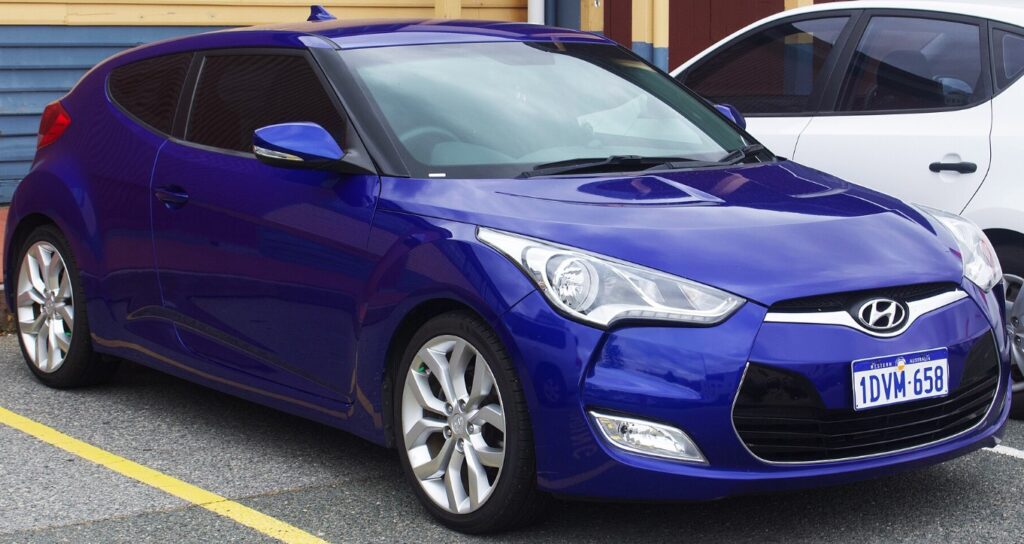
The Hyundai Veloster engine size depends heavily on the model year, trim level, and market. That sounds simple enough, but the Veloster's engine history is surprisingly varied. During its production run, Hyundai offered naturally aspirated 1.6-liter engines, turbocharged 1.6-liter engines, naturally aspirated 2.0-liter engines, and the considerably more aggressive 2.0-liter turbocharged unit found in the Veloster N.
So, when someone asks us, "What size engine does a Hyundai Veloster have?" there isn't one universal answer.
In broad terms, Hyundai Veloster engine sizes range from 1.6 liters to 2.0 liters, depending on the version. First-generation cars were primarily associated with 1.6-liter four-cylinder engines, while the second generation expanded the lineup with a naturally aspirated 2.0-liter engine. The high-performance Veloster N also used a 2.0-liter engine, but with turbocharging and dramatically different tuning. Hyundai's own specifications confirm 1,591 cc for the 1.6-liter engines, around 1,999 cc for the naturally aspirated 2.0, and 1,998 cc for the Veloster N's turbocharged 2.0-liter engine.
That's the short answer. The interesting part is understanding what those numbers actually mean and why a smaller turbocharged Veloster can feel much stronger than a larger naturally aspirated one.
Content in this publication
- What Is the Hyundai Veloster Engine Size?
- Hyundai Veloster Engine Size by Generation
- Hyundai Veloster 1.6 Engine Size
- Hyundai Veloster 2.0 Engine Size
- Hyundai Veloster N Engine Size
- Hyundai Veloster Engine Size in CC
- How Many Cylinders Does a Hyundai Veloster Have?
- Does Engine Size Determine Hyundai Veloster Horsepower?
- Is the Hyundai Veloster 1.6 or 2.0 Better?
- Which Hyundai Veloster Has the Biggest Engine?
- Which Hyundai Veloster Engine Is the Most Powerful?
- Does the Hyundai Veloster Engine Size Affect Fuel Economy?
- Does Engine Size Affect Veloster Reliability?
- How Do We Find the Engine Size of a Specific Veloster?
- Hyundai Veloster Engine Size vs Engine Power
- Which Veloster Engine Size Should We Choose?
- Why the Hyundai Veloster Engine Lineup Is More Interesting Than It Looks
- Hyundai Veloster Engine Size: Final Thoughts
- Frequently Asked Questions About Hyundai Veloster Engine Size
What Is the Hyundai Veloster Engine Size?
Most Velosters use one of three basic engine configurations:
- 1.6-liter four-cylinder naturally aspirated engine
- 1.6-liter turbocharged four-cylinder engine
- 2.0-liter four-cylinder naturally aspirated or turbocharged engine
The exact configuration depends on generation and trim.
The original Veloster was closely associated with Hyundai's 1.6-liter Gamma engine family. Hyundai documentation lists a displacement of 1,591 cc for versions of the 1.6 Gamma GDI.
Later, the redesigned Veloster offered a 2.0-liter MPI naturally aspirated engine alongside the familiar 1.6-liter turbo engine. Hyundai's Australian specifications, for example, list the second-generation car with a 1,999 cc 2.0-liter engine and a 1,591 cc 1.6-liter turbo.
Then there is the Veloster N. Think of it as the regular Veloster's caffeinated sibling. Instead of merely increasing the displacement slightly, Hyundai paired a 1,998 cc 2.0-liter engine with a twin-scroll turbocharger, creating an entirely different level of performance.
Hyundai Veloster Engine Size by Generation
The easiest way to understand the Veloster engine lineup is to divide it by generation.
First-Generation Hyundai Veloster Engine Size
The first-generation Veloster primarily relied on a 1.6-liter four-cylinder engine.
Depending on market and model, Hyundai offered versions using multipoint injection, gasoline direct injection, or turbocharging. Hyundai's international specification information lists the 1.6 Gamma GDI engine at 1,591 cc, while another Hyundai brochure lists a 1.6 MPI version at the same general displacement class.
This means that seeing two 1.6-liter Velosters doesn't automatically mean they have identical engines.
One may be naturally aspirated. Another may be turbocharged.
And behind the wheel, that difference is enormous.
Second-Generation Hyundai Veloster Engine Size
The redesigned Veloster broadened the engine selection.
In markets such as the United States and Australia, second-generation versions were available with a 2.0-liter naturally aspirated engine or a 1.6-liter turbocharged engine. Hyundai's U.S. specifications identify the naturally aspirated engine as 2.0 liters/1,999 cc, while the turbo engine remained 1.6 liters/1,591 cc.
Interestingly, displacement alone might make us assume the 2.0-liter model is the quicker car.
It isn't.
The 1.6-liter turbo produces substantially more power because forced induction allows it to push far more air into the cylinders.
That's a perfect example of why engine size is only one piece of the performance puzzle.
Hyundai Veloster 1.6 Engine Size
The 1.6-liter Veloster engine is approximately 1,591 cubic centimeters.
In simple language:
1,591 cc = roughly 1.6 liters.
The engine uses four cylinders, meaning that total displacement is divided across four combustion chambers.
Engine displacement describes how much volume the pistons sweep through as they move inside the cylinders. Generally speaking, larger displacement gives an engine the potential to consume more air and fuel per cycle.
But potential isn't the same thing as actual performance.
Modern turbochargers complicate the equation beautifully.
1.6-Liter Naturally Aspirated Veloster
The naturally aspirated 1.6-liter engine was designed more around everyday usability than outright speed.
Without a turbocharger forcing additional air into the combustion chambers, acceleration feels more progressive. The engine generally needs higher revs before giving us its strongest response.
That isn't necessarily a disadvantage.
For buyers interested in a straightforward used hatchback, naturally aspirated engines can feel pleasantly uncomplicated. There is no turbocharger changing the character of the engine as boost builds. Push the accelerator, rev the engine, and the response develops predictably.
Hyundai documentation for certain international Velosters identifies the naturally aspirated Gamma GDI as a 1,591 cc engine.
Hyundai Veloster 1.6 Turbo Engine Size
Here's where things become more entertaining.
The Veloster Turbo still uses a 1.6-liter engine.
It doesn't suddenly become a 2.0-liter just because the performance increases.
The displacement remains approximately 1,591 cc, but the turbocharger compresses incoming air before sending it into the cylinders. With more oxygen available, the engine can burn more fuel and generate considerably more power.
For the second-generation U.S.-market Veloster Turbo, Hyundai rated the 1.6-liter turbocharged direct-injected four-cylinder at 201 horsepower and 195 lb-ft of torque.
That's quite a jump compared with the naturally aspirated alternatives.
Why Does a 1.6 Turbo Feel Bigger?
Because displacement isn't the only way to increase the amount of air entering an engine.
Imagine two people filling balloons.
The naturally aspirated engine breathes in whatever air atmospheric pressure allows. The turbocharged engine effectively has someone helping squeeze extra air inside.
Same basic cylinder capacity. Much more oxygen.
That extra air allows additional fuel to be burned, creating stronger combustion and more torque.
It's one reason a modern 1.6-liter turbo can outperform older engines with considerably larger displacement.
Hyundai Veloster 2.0 Engine Size
The second-generation Veloster introduced a 2.0-liter naturally aspirated four-cylinder in several markets.
Hyundai specifies this engine at approximately 1,999 cc. In U.S.-market documentation, the 2.0-liter engine produced 147 horsepower at 6,200 rpm and 132 lb-ft of torque at 4,500 rpm.
At first glance, 2.0 liters versus 1.6 liters sounds like a significant upgrade.
For normal driving, the 2.0 does provide a straightforward, naturally aspirated character. Yet it isn't positioned above the 1.6 Turbo in performance.
Quite the opposite.
2.0 Veloster vs 1.6 Turbo
This comparison illustrates why shopping by engine displacement alone can mislead us.
The naturally aspirated 2.0-liter engine has more physical displacement than the 1.6 Turbo, but the turbocharged engine generates considerably more output. Hyundai rated the U.S.-market 1.6 Turbo at 201 horsepower, compared with 147 horsepower from the 2.0-liter naturally aspirated engine.
So we get the slightly counterintuitive result:
Smaller engine, greater performance.
The turbocharger effectively allows the 1.6 to punch above its weight.
Who Is the 2.0-Liter Veloster Best For?
The naturally aspirated 2.0 makes sense for drivers who like the Veloster's unusual styling but aren't particularly interested in turbocharged performance.
Around town, displacement doesn't tell us much about whether a car will suit our lifestyle.
A driver commuting through traffic may prefer smooth, predictable throttle response. Someone who enjoys mountain roads may happily trade that simplicity for the stronger midrange shove of a turbocharged engine.
Engine choice, then, becomes less about "bigger is better" and more about what kind of Veloster experience we actually want.
Hyundai Veloster N Engine Size
Now we reach the wild one.
The Hyundai Veloster N uses a 2.0-liter turbocharged four-cylinder engine.
Hyundai specifies the N engine at 1,998 cc and identifies it as an N Theta 2.0 Turbo GDI four-cylinder with a twin-scroll turbocharger. For the 2022 U.S. model, Hyundai listed output at 275 horsepower and 260 lb-ft of torque.
At approximately 2.0 liters, the displacement sounds almost identical to the regular 2.0 Veloster.
Mechanically and dynamically, however, they're worlds apart.
Veloster 2.0 vs Veloster N 2.0
Both engines sit within the 2.0-liter displacement category.
That's roughly where the similarities end.
The standard 2.0 is naturally aspirated and tuned for regular everyday driving. The Veloster N's engine uses turbocharging, different performance-focused hardware and calibration, and considerably higher output.
Hyundai originally introduced the U.S.-market Veloster N with a 2.0-liter turbo engine producing up to 275 horsepower, depending on configuration.
It's like comparing two athletes who happen to wear the same shoe size.
The measurement is identical. Their capabilities aren't.
Is the Veloster N Engine Really Only 2.0 Liters?
Yes.
High-performance engines don't necessarily require huge displacement.
A carefully engineered turbocharger can extract substantial performance from relatively modest cylinder capacity. The Veloster N demonstrates this perfectly.
Its 1,998 cc turbocharged four-cylinder sits just beneath the technical two-liter mark, yet manufacturers conventionally round engine displacement when naming engine sizes.
That's why we call it a 2.0-liter.
Hyundai Veloster Engine Size in CC
Sometimes specifications are listed in liters. Other times they're listed in cubic centimeters.
Fortunately, conversion is easy.
One liter equals approximately 1,000 cc.
Therefore:
1.6 liters ≈ 1,600 cc
2.0 liters ≈ 2,000 cc
Actual engineering specifications are slightly different because automakers round the numbers for easier marketing.
For example, Hyundai lists:
1.6-liter Veloster engine: 1,591 cc
2.0-liter naturally aspirated engine: 1,999 cc
2.0-liter Veloster N engine: 1,998 cc
Nobody wants to walk into a dealership asking for the "one-point-nine-nine-eight-liter Veloster," so 2.0 liters works rather nicely.
How Many Cylinders Does a Hyundai Veloster Have?
The major gasoline engines associated with the Veloster are four-cylinder engines.
That includes the 1.6-liter engines, the naturally aspirated 2.0, and the turbocharged Veloster N engine. Hyundai's specifications identify the 1.6 Turbo and 2.0-liter engines as four-cylinder configurations, while Veloster N documentation describes its 1,998 cc engine as a turbocharged four-cylinder.
Four cylinders make sense in a vehicle like the Veloster.
The arrangement keeps the engine relatively compact while providing enough power for a lightweight sporty hatchback, particularly when turbocharging enters the equation.
Does Engine Size Determine Hyundai Veloster Horsepower?
Only partly.
Larger displacement can help an engine produce additional power and torque, but it doesn't guarantee it.
The Veloster proves the point wonderfully.
We have a naturally aspirated 2.0-liter engine producing around 147 horsepower in U.S. specification, while the smaller 1.6-liter turbo produces 201 horsepower. Then the 2.0-liter turbo Veloster N jumps to as much as 275 horsepower in Hyundai's U.S. specifications.
Three engines. Two displacement categories. Vastly different personalities.
What matters alongside displacement?
Turbocharging, fuel delivery, compression ratio, engine tuning, intake design, exhaust flow, cam timing, cooling, and many other engineering decisions.
Displacement is the size of the canvas.
It doesn't tell us what the artist painted on it.
Is the Hyundai Veloster 1.6 or 2.0 Better?
Neither engine size is automatically better.
It depends on which specific 1.6 or 2.0 we're discussing.
If we're comparing a naturally aspirated first-generation 1.6 with a second-generation 2.0, the larger engine may offer the more relaxed everyday performance.
If we're comparing the 2.0 naturally aspirated engine with the 1.6 Turbo, however, enthusiasts will probably find the turbocharged 1.6 considerably more exciting.
And if the comparison includes the 2.0 Turbo Veloster N, the N sits in another performance category entirely.
So rather than asking, "Which engine is bigger?" we'd ask:
What do we want our Veloster to do?
That question leads us toward the right answer much faster.
Which Hyundai Veloster Has the Biggest Engine?
In displacement terms, the largest widely offered Veloster engines belong to the 2.0-liter category.
Both the regular second-generation 2.0 and the Veloster N fall into this class.
However, the Veloster N's engine is the obvious performance champion because its 2.0-liter unit is turbocharged.
The regular naturally aspirated 2.0 engine is approximately 1,999 cc, while Hyundai lists the Veloster N engine at 1,998 cc.
Technically, that's a one-cubic-centimeter difference.
Practically?
Completely irrelevant.
Both are marketed and understood as 2.0-liter engines.
Which Hyundai Veloster Engine Is the Most Powerful?
Among production Veloster variants, the Veloster N's 2.0-liter turbocharged engine sits at the top of the factory performance hierarchy.
Hyundai's 2022 U.S. specification sheet lists 275 horsepower from the 1,998 cc turbocharged engine.
By comparison, the second-generation U.S. Veloster Turbo's 1.6-liter unit generated 201 horsepower, while the naturally aspirated 2.0 produced 147 horsepower.
That progression neatly illustrates the Veloster lineup:
Regular 2.0: everyday sporty hatchback.
1.6 Turbo: genuinely quick compact.
2.0 Turbo N: the one that wakes up and chooses violence against corners.
Does the Hyundai Veloster Engine Size Affect Fuel Economy?
Engine displacement can influence fuel consumption, but it isn't the sole determining factor.
A smaller engine may consume less fuel during gentle driving, yet a turbocharged engine can drink considerably more when we're frequently using boost.
Likewise, a larger naturally aspirated engine operating comfortably at moderate loads may not always be dramatically thirstier than a smaller turbo engine working hard.
Transmission choice, gearing, vehicle weight, aerodynamics, tires, traffic conditions, driving style, temperature, and maintenance all influence real-world consumption.
That's why we shouldn't choose between the 1.6 and 2.0 solely by looking at the number stamped on the engine specification.
Does Engine Size Affect Veloster Reliability?
Not automatically.
A 1.6-liter engine isn't inherently more reliable than a 2.0-liter engine, nor does larger displacement automatically mean greater durability.
The better question is which specific engine we're evaluating, how it has been maintained, how the previous owner drove it, and whether its service history is complete.
Turbocharged engines add components that naturally aspirated engines don't need, including the turbocharger itself and associated oil, cooling, intake, and boost-control systems.
That doesn't mean a turbo Veloster should scare us away.
It simply means maintenance history deserves attention.
A well-maintained turbocharged car can be a much more attractive purchase than a neglected naturally aspirated one.
How Do We Find the Engine Size of a Specific Veloster?
If we're shopping for a used Veloster, guessing from the bodywork isn't the smartest approach.
Trim badges can disappear. Bumpers get replaced. Cars get modified. Sellers occasionally write inaccurate listings.
We should confirm the model year and trim, check the vehicle documentation, inspect identification labels, review the VIN information, and compare the car against the specifications published for its market.
Regional differences matter as well.
Hyundai did not necessarily sell the exact same engine-and-trim combinations everywhere. For example, Hyundai's Australian second-generation Veloster specifications list both a 2.0-liter MPI and 1.6-liter turbo powertrain, while Hyundai's international material for earlier Velosters documents various 1.6-liter configurations.
That means a U.S. specification shouldn't automatically be applied to an Australian, Korean, European, or other international-market Veloster.
Hyundai Veloster Engine Size vs Engine Power
It's worth hammering this distinction home because it's probably the most useful lesson in the entire article.
Engine size measures displacement. Horsepower measures power output.
They are related, but they aren't interchangeable.
A 2.0-liter engine can produce less power than a 1.6-liter engine.
The Veloster proves it.
Hyundai's second-generation 2.0-liter naturally aspirated engine produced about 147 horsepower in U.S. specification, while the 1.6-liter turbo produced 201 horsepower.
Add turbocharging to a performance-focused 2.0-liter engine and we reach the 275-horsepower territory of the Veloster N.
So if someone tells us their Veloster has "the bigger 2.0," we still don't know much about its performance until we know which 2.0.
Which Veloster Engine Size Should We Choose?
For a used-car buyer, we'd think of the lineup in terms of character rather than numbers.
The 1.6-liter naturally aspirated Veloster suits someone who mainly wants the styling, compact dimensions, and unusual three-door layout without prioritizing outright speed.
The 2.0-liter naturally aspirated Veloster provides a straightforward second-generation option with more displacement but without turbocharging.
The 1.6-liter Turbo is arguably the sweet spot for drivers wanting meaningful extra acceleration without stepping all the way into the N model.
Then there's the 2.0-liter Veloster N, designed for buyers who actively care about performance.
The right choice depends less on whether 1.6 or 2.0 sounds impressive and more on whether we want economical commuting, spirited road driving, or something approaching track-day capability.
Why the Hyundai Veloster Engine Lineup Is More Interesting Than It Looks
At first, the Veloster engine range seems almost boring on paper.
One-point-six liters. Two liters. Four cylinders.
Nothing exotic.
Yet Hyundai managed to create dramatically different cars from this relatively narrow range of engine capacities.
That's what makes the Veloster such an interesting lesson in modern engine design.
A naturally aspirated 1.6 feels different from a turbocharged 1.6.
A regular 2.0 feels completely different from the turbocharged 2.0 in the Veloster N.
Displacement gives us the basic dimensions of the engine, but turbocharging and tuning write the personality.
It's a little like comparing cups of coffee based only on cup size. A larger cup doesn't tell us whether there's mild tea inside or a triple espresso.
The Veloster N is definitely the triple espresso.
Hyundai Veloster Engine Size: Final Thoughts
So, what is the Hyundai Veloster engine size?
Depending on year, trim, and market, the Veloster generally uses an engine measuring 1.6 liters or 2.0 liters.
The first generation was centered largely around 1.6-liter four-cylinder engines, including naturally aspirated and turbocharged versions. Later Velosters added a naturally aspirated 2.0-liter engine while retaining the punchier 1.6 Turbo. The performance-focused Veloster N moved to a 2.0-liter turbocharged four-cylinder. Hyundai documentation places these engines at approximately 1,591 cc, 1,999 cc, and 1,998 cc respectively.
But the biggest takeaway isn't the displacement figure.
It's that engine size doesn't tell the whole story.
A smaller 1.6-liter turbo can comfortably outperform a naturally aspirated 2.0, and the Veloster N's turbocharged 2.0 transforms the car into something far more serious.
So when we're comparing Velosters, we shouldn't stop at "1.6 vs 2.0."
We should ask whether it's naturally aspirated or turbocharged, which generation it belongs to, what trim we're looking at, and—perhaps most importantly—what kind of driving experience we actually want.
Frequently Asked Questions About Hyundai Veloster Engine Size
1. What size engine does a Hyundai Veloster have?
Depending on the year and trim, a Hyundai Veloster typically has either a 1.6-liter or 2.0-liter four-cylinder engine. Hyundai specifications list 1.6-liter engines around 1,591 cc and second-generation 2.0-liter engines around 1,999 cc.
2. What size engine is in the Hyundai Veloster Turbo?
The regular Veloster Turbo uses a 1.6-liter turbocharged four-cylinder engine, measuring approximately 1,591 cc. In U.S. second-generation specification, Hyundai rated it at 201 horsepower.
3. What size engine does the Hyundai Veloster N have?
The Veloster N uses a 2.0-liter turbocharged four-cylinder engine. Hyundai lists its displacement at 1,998 cc. The 2022 U.S.-market version produced 275 horsepower and 260 lb-ft of torque.
4. Is the Veloster 1.6 Turbo faster than the 2.0?
The factory 1.6-liter Turbo produces more power than the regular naturally aspirated 2.0-liter engine in second-generation U.S. models. Hyundai rated the 1.6 Turbo at 201 horsepower and the naturally aspirated 2.0 at 147 horsepower.
5. Does every Hyundai Veloster have a turbo engine?
No. Hyundai sold both naturally aspirated and turbocharged Velosters. Depending on model year and market, buyers could encounter naturally aspirated 1.6-liter or 2.0-liter engines as well as turbocharged 1.6-liter and 2.0-liter configurations.
If you want to know other articles similar to Hyundai Veloster Engine Size: Complete Guide by Year and Trim you can visit the category Service and Parts.
Nissan Rogue Oil Change Cost: Prices, Service Options, and What to Expect
Nissan Rogue Key Battery Replacement: Easy Step-by-Step Guide
Nissan Rogue Oil Change Interval: Complete Guide by Model Year
Nissan Rogue Brake Pads and Rotors Cost: Complete 2026 Guide

Kia Sorento Service Reset: How to Reset the Service Light
Kia Sorento Fuel Tank Capacity: Gallons, Litres and Model Differences
Leave a Reply
More content of your interest