
Mazda CX-30 Hybrid MPG: Fuel Economy, Real-World Results & 2026 Guide

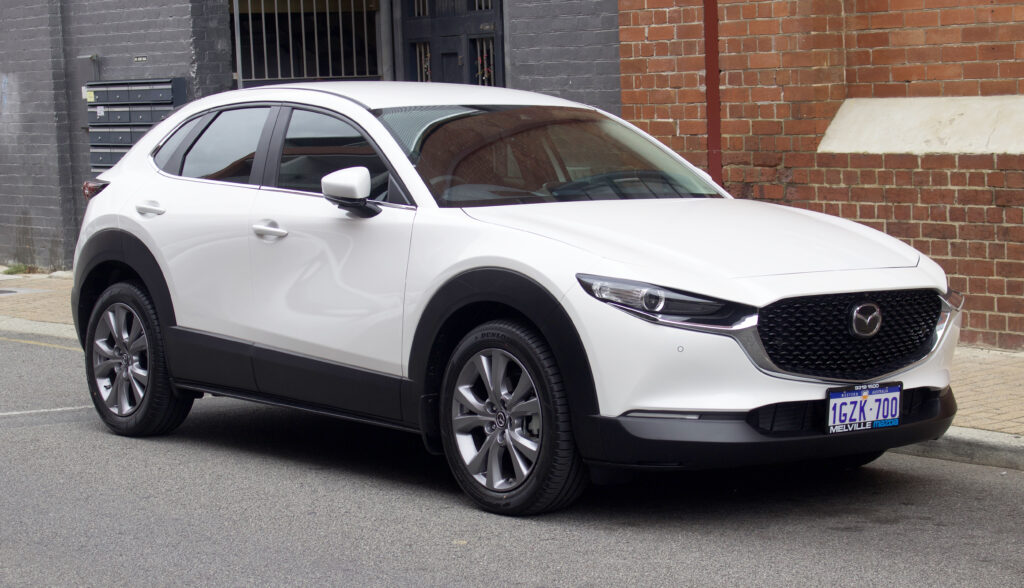
The Mazda CX-30 hybrid MPG is an important consideration for drivers who want a stylish compact SUV without excessive fuel costs. Mazda combines efficient petrol engines with mild-hybrid technology, offering a balance between performance, comfort, and everyday fuel economy.
But how efficient is the Mazda CX-30 hybrid? Does its fuel economy match official figures? And is it genuinely economical compared with a traditional hybrid SUV?
In the United Kingdom, the Mazda CX-30 mild-hybrid range delivers an official 42.8 to 49.6 MPG (UK) on the WLTP combined test cycle. That is approximately 35.6 to 41.3 MPG (US), or 5.7 to 6.6 L/100 km.
However, actual fuel consumption varies depending on the engine, transmission, drivetrain, road conditions, and driving habits.
In this guide, we'll explore the Mazda CX-30 hybrid's fuel economy, compare its available engines, examine real-world MPG results, calculate potential fuel costs, and explain whether this compact SUV is a good choice for fuel-conscious drivers.
Content in this publication
- Mazda CX-30 Hybrid MPG: Quick Overview
- Is the Mazda CX-30 a Hybrid?
- Mazda CX-30 Hybrid MPG by Engine and Transmission
- Mazda CX-30 Hybrid Real-World MPG
- Mazda CX-30 Hybrid MPG: UK vs US Figures
- Is There a Mazda CX-30 Hybrid in the USA?
- Mazda CX-30 Hybrid MPG in Australia and Other Markets
- Mazda CX-30 Hybrid Fuel Tank Capacity and Range
- Mazda CX-30 Hybrid Fuel Cost Calculator
- What Affects Mazda CX-30 Hybrid Fuel Economy?
- How to Improve Mazda CX-30 Hybrid MPG
- Mazda CX-30 Mild Hybrid vs Full Hybrid MPG
- Mazda CX-30 Hybrid MPG by Model Year
- Mazda CX-30 Hybrid Fuel Economy: Pros and Cons
- Who Should Buy a Mazda CX-30 Mild Hybrid?
- Frequently Asked Questions About Mazda CX-30 Hybrid MPG
- Final Verdict: Is the Mazda CX-30 Hybrid Fuel Efficient?
Mazda CX-30 Hybrid MPG: Quick Overview
Before exploring the details, let's review the most important fuel economy figures.
| Specification | Mazda CX-30 Mild Hybrid |
|---|---|
| Official combined fuel economy (UK range) | 42.8–49.6 UK MPG |
| Equivalent US fuel economy | 35.6–41.3 US MPG |
| Combined fuel consumption | 5.7–6.6 L/100 km |
| Hybrid technology | 24V mild-hybrid system |
| Main UK hybrid engines | 2.5L e-Skyactiv G and 2.0L e-Skyactiv X |
| Transmission options | 6-speed manual or automatic |
| Drivetrain options | FWD or AWD, depending on engine |
| External battery charging | Not required |
| Electric-only driving | No |
| Fuel type | Petrol |
These figures reflect Mazda's published UK WLTP range and relevant engine specifications. Figures and configurations vary by country, model year, and trim.
The key takeaway is that the Mazda CX-30 hybrid provides respectable fuel economy, particularly with the e-Skyactiv X engine and front-wheel drive.
However, the CX-30 is a mild hybrid rather than a conventional full hybrid. Understanding that distinction helps explain its fuel efficiency.
Is the Mazda CX-30 a Hybrid?
Yes, the Mazda CX-30 is available with mild-hybrid technology in several markets, including the UK and parts of Europe.
The system is called Mazda M Hybrid.
Unlike a full hybrid, which can sometimes propel the vehicle using electricity alone, the Mazda CX-30 mild hybrid primarily relies on its petrol engine.
Its electric system supports the combustion engine rather than replacing it.
How Does the Mazda CX-30 Mild-Hybrid System Work?
Mazda's mild-hybrid technology uses several important components:
- A 24-volt lithium-ion battery.
- An integrated starter generator (ISG).
- Regenerative energy recovery during deceleration.
- Electrical assistance to reduce the petrol engine's workload.
- Automatic engine stop-start technology.
When the vehicle slows down, the system recovers some kinetic energy that would otherwise be wasted.
That recovered energy is stored in the battery.
The stored electricity can then support the engine and supply electrical systems, reducing the amount of petrol needed in certain driving conditions.
Can the Mazda CX-30 Hybrid Drive on Electricity Alone?
No.
The Mazda CX-30 M Hybrid cannot operate as a fully electric vehicle.
Its small battery and starter generator are designed to support the petrol engine, not independently drive the wheels.
Consequently, drivers should not expect the same electric-only operation offered by some Toyota or Honda full hybrids.
Does the Mazda CX-30 Hybrid Need Charging?
No external charging is required.
The vehicle automatically replenishes its mild-hybrid battery by recovering energy during deceleration and through its onboard energy-management system.
There is no charging cable, charging port, or requirement to visit an EV charging station.
Mazda CX-30 Hybrid MPG by Engine and Transmission
The Mazda CX-30's fuel consumption changes depending on which powertrain we choose.
Mazda's UK technical specifications provide the following WLTP combined consumption figures.
| Engine and configuration | UK MPG | L/100 km |
|---|---|---|
| 2.5 e-Skyactiv G 140 FWD manual | 47.1 | 6.0 |
| 2.5 e-Skyactiv G 140 FWD automatic | 42.8–43.5 | 6.5–6.6 |
| 2.0 e-Skyactiv X 186 FWD manual | 48.7–49.6 | 5.7–5.8 |
| 2.0 e-Skyactiv X 186 FWD automatic | 44.8–45.6 | 6.2–6.3 |
| 2.0 e-Skyactiv X 186 AWD manual | 45.6 | 6.2 |
| 2.0 e-Skyactiv X 186 AWD automatic | 42.8 | 6.6 |
Source: Mazda UK variant-level technical specifications published in September 2024. These provide a useful comparison, while current model-year homologation figures should be checked for individual vehicles.
Mazda CX-30 2.5 e-Skyactiv G MPG
The 2.5-litre e-Skyactiv G is designed to offer smooth acceleration, useful torque, and reasonable fuel efficiency.
Despite its relatively large engine displacement, Mazda employs technologies such as cylinder deactivation to reduce fuel consumption during suitable cruising conditions.
With the manual gearbox and front-wheel drive, official combined fuel economy reaches approximately 47.1 UK MPG.
Automatic versions are less economical on the published test cycle, achieving around 42.8–43.5 UK MPG.
For drivers prioritising affordability and everyday usability, this engine offers a practical balance.
Is the 2.5 e-Skyactiv G Fuel Efficient?
For a naturally aspirated petrol-powered compact SUV, its official economy is respectable.
However, we should not expect full-hybrid levels of urban efficiency.
Short journeys, frequent acceleration, and heavy traffic can substantially increase fuel consumption.
Mazda CX-30 2.0 e-Skyactiv X MPG
The 2.0-litre e-Skyactiv X is particularly interesting because it combines Mazda's innovative combustion technology with mild-hybrid assistance.
In the UK specifications, it produces 186 PS and achieves up to 49.6 UK MPG with front-wheel drive and a manual transmission.
This makes it the most economical configuration in the published range.
The engine's Spark Controlled Compression Ignition technology, commonly called SPCCI, allows highly efficient combustion under appropriate operating conditions.
In simple terms, Mazda aims to extract more useful energy from petrol while maintaining responsive performance.
The result is an engine that offers comparatively strong power without a dramatic fuel economy penalty.
Why Is e-Skyactiv X More Economical?
Several technologies contribute to its efficiency.
Firstly, SPCCI enables lean combustion during suitable operating conditions.
Secondly, the mild-hybrid system recovers energy during deceleration.
Thirdly, the engine management system optimises combustion and fuel delivery.
Together, these systems can reduce fuel consumption, particularly during steady driving.
However, cold starts, aggressive acceleration, and demanding driving conditions can reduce the benefits.
Mazda CX-30 Hybrid Real-World MPG
Official fuel economy figures are useful for comparing vehicles, but they do not guarantee identical results on public roads.
Actual Mazda CX-30 hybrid MPG depends heavily on individual circumstances.
Independent testing by Auto Express has reported approximately 40–41 UK MPG from the e-Skyactiv X engine in specific real-world evaluations.
Its testing of the e-Skyactiv G returned approximately 36.7 UK MPG during a journey involving substantial urban driving.
These results illustrate why official and actual fuel economy can differ.
They are individual test outcomes, not guaranteed averages for every model.
Mazda CX-30 Hybrid MPG in City Driving
Urban driving can be demanding for petrol-powered vehicles.
Frequent stopping, accelerating, and idling increase fuel consumption.
The Mazda mild-hybrid system helps recover energy during deceleration and supports smoother engine restarts.
Nevertheless, it cannot travel through traffic using electric power alone.
Therefore, the CX-30 may consume noticeably more petrol during short urban journeys than a full hybrid that can operate electrically at low speeds.
Our best advice is to avoid judging its city efficiency solely from the official combined MPG figure.
Mazda CX-30 Hybrid MPG on the Highway
The CX-30 can perform more efficiently during steady, moderate-speed journeys.
When the engine operates at a stable load, technologies such as SPCCI and cylinder deactivation, where fitted, can help improve efficiency.
Highway economy still depends on several factors:
- Cruising speed.
- Road gradients.
- Weather and wind.
- Passenger and luggage weight.
- Tyre pressure.
- Roof racks and external accessories.
Driving at a moderate, consistent speed generally consumes less fuel than repeated hard acceleration or sustained high-speed travel.
Mazda CX-30 Hybrid MPG in Mixed Driving
Mixed driving combines urban roads, suburban routes, and highways.
For many owners, this is the most meaningful measure of fuel economy.
The official WLTP combined figure is intended to represent a mixture of driving conditions, although an individual's results may be higher or lower.
For accurate comparisons, we recommend recording fuel use over several full tanks rather than relying on one journey.
Mazda CX-30 Hybrid MPG: UK vs US Figures
One of the biggest sources of confusion is the difference between UK and US miles per gallon.
The two countries use gallons of different sizes.
An imperial gallon contains approximately 4.546 litres, while a US gallon contains approximately 3.785 litres.
Therefore, a vehicle's numerical UK MPG figure is higher than its US MPG figure for exactly the same fuel consumption.
Mazda CX-30 Hybrid MPG Conversion Chart
| UK MPG | US MPG (approx.) | L/100 km (approx.) |
|---|---|---|
| 40 | 33.3 | 7.1 |
| 42.8 | 35.6 | 6.6 |
| 45 | 37.5 | 6.3 |
| 47.1 | 39.2 | 6.0 |
| 49.6 | 41.3 | 5.7 |
| 50 | 41.6 | 5.6 |
These are unit conversions, not separate US EPA ratings.
This distinction is particularly important when comparing automotive reviews from different countries.
Is There a Mazda CX-30 Hybrid in the USA?
The 2026 Mazda CX-30 sold in the United States does not offer the same mild-hybrid engine lineup available in the UK.
Instead, the American model uses petrol-powered 2.5-litre engines.
Mazda USA publishes the following EPA fuel economy ratings for 2026:
| 2026 US engine | City MPG | Highway MPG | Combined MPG |
|---|---|---|---|
| 2.5L naturally aspirated AWD | 24 | 31 | 27 |
| 2.5L turbocharged AWD | 22 | 30 | 25 |
These are US MPG values measured under EPA procedures.
They should not be compared directly with European WLTP figures without considering the different testing methodologies.
Why Is the US Mazda CX-30 MPG Lower?
Several factors explain the difference.
The American CX-30 uses different engines from the UK mild-hybrid versions.
It also features standard all-wheel drive for 2026.
Furthermore, EPA and WLTP fuel economy testing use different procedures.
As a result, we cannot attribute the entire difference in fuel economy to hybrid technology alone.
Mazda CX-30 Hybrid MPG in Australia and Other Markets
Mazda's CX-30 engine range differs across international markets.
In Australia, Mazda currently advertises 2.0-litre and 2.5-litre Skyactiv-G petrol engines, with the 2.0-litre model achieving a published combined consumption figure of 6.3 L/100 km.
That corresponds to approximately 37.3 US MPG or 44.8 UK MPG as a unit conversion.
However, this Australian petrol model should not be confused with the UK mild-hybrid powertrain.
Other markets, including parts of Latin America, have offered CX-30 variants with Mazda's mild-hybrid technology.
Before comparing MPG figures internationally, we should verify the exact engine, drivetrain, model year, and local fuel economy testing standard.
Mazda CX-30 Hybrid Fuel Tank Capacity and Range
Fuel efficiency is only part of the story.
Drivers also want to know how far the Mazda CX-30 hybrid can travel before refuelling.
In Mazda's published UK technical specifications, front-wheel-drive configurations have a 51-litre fuel tank, while all-wheel-drive versions have a 48-litre tank.
Using those capacities and official combined consumption rates, we can calculate illustrative driving ranges.
| Configuration | Fuel tank | WLTP consumption | Theoretical range |
|---|---|---|---|
| e-Skyactiv X FWD manual, best published figure | 51 L | 5.7 L/100 km | 895 km / 556 miles |
| e-Skyactiv G FWD manual | 51 L | 6.0 L/100 km | 850 km / 528 miles |
| e-Skyactiv X AWD automatic | 48 L | 6.6 L/100 km | 727 km / 452 miles |
These are mathematical estimates based on consuming an entire nominal tank at the specified WLTP rate.
They are not guaranteed real-world ranges, and drivers should refuel before running the tank empty.
How Many Miles Can a Mazda CX-30 Hybrid Travel on a Full Tank?
The answer depends on the engine and driving conditions.
An economical front-wheel-drive e-Skyactiv X could theoretically travel more than 500 miles under favourable test-equivalent conditions.
However, heavy traffic, cold weather, hills, or high-speed driving may substantially reduce that distance.
We recommend using your own average MPG and actual refuelling data to estimate the range you can realistically expect.
Mazda CX-30 Hybrid Fuel Cost Calculator
Understanding MPG is easier when we translate it into actual fuel costs.
Suppose we drive 10,000 miles annually and petrol costs £1.50 per litre.
The following table shows estimated annual fuel expenses at different average MPG figures.
| Average UK MPG | Annual distance | Estimated fuel cost |
|---|---|---|
| 35 MPG | 10,000 miles | £1,948 |
| 40 MPG | 10,000 miles | £1,705 |
| 45 MPG | 10,000 miles | £1,515 |
| 50 MPG | 10,000 miles | £1,364 |
These figures use an illustrative petrol price rather than a current pump-price quotation.
Improving economy from 40 to 50 UK MPG would save approximately £341 annually under these assumptions.
That difference becomes increasingly meaningful for drivers covering substantial yearly mileage.
How to Calculate Your Own Mazda CX-30 MPG
The most reliable approach is to measure consumption between refuelling stops.
For UK MPG:
UK MPG = Miles driven ÷ Imperial gallons consumed
If your fuel receipt shows litres, divide the litres by 4.546 to obtain imperial gallons.
For example, imagine driving 400 miles using 45 litres of petrol.
First, convert the fuel consumption:
45 ÷ 4.546 = approximately 9.90 imperial gallons.
Then calculate:
400 ÷ 9.90 = approximately 40.4 UK MPG.
This method provides an estimate based on actual fuel added and distance covered.
For better accuracy, fill the tank consistently and calculate the average across multiple refuelling cycles.
What Affects Mazda CX-30 Hybrid Fuel Economy?
Even two identical Mazda CX-30 models can produce substantially different fuel consumption figures.
Understanding the main causes helps us improve everyday efficiency.
1. Driving Style
Hard acceleration requires more fuel.
Frequent braking also wastes energy, even though the mild-hybrid system can recover some of it.
Smooth inputs and anticipating traffic conditions can help improve fuel efficiency.
2. Cold Weather
Petrol engines generally consume more fuel while warming up.
Cabin heating, heated windows, battery management, and winter driving conditions may also affect overall efficiency.
This explains why MPG can decrease during colder months.
3. Short Journeys
Short journeys can be particularly inefficient because the engine may not reach its most efficient operating temperature.
A five-minute journey often produces worse fuel economy than a longer trip under comparable conditions.
4. Tyre Pressure
Underinflated tyres increase rolling resistance.
This means the engine needs additional energy to maintain speed.
Check tyre pressures regularly and use the values recommended for your vehicle and load.
5. Vehicle Weight
Carrying extra passengers, luggage, or equipment increases the energy required during acceleration.
Removing unnecessary items can help reduce fuel consumption.
6. Automatic Transmission and AWD
Mazda's official specifications show that automatic and AWD configurations can consume more fuel than equivalent front-wheel-drive manual versions.
Additional drivetrain components, weight, and mechanical losses can influence efficiency.
However, AWD may still be worth choosing for drivers who regularly encounter challenging road conditions.
How to Improve Mazda CX-30 Hybrid MPG
We can improve the Mazda CX-30's everyday fuel efficiency with some simple driving and maintenance habits.
Maintain a Consistent Speed
Avoid unnecessary acceleration and braking.
On suitable open roads, steady cruising can reduce fuel consumption.
Anticipate Traffic
Look ahead and respond smoothly to changing traffic conditions.
Gradual deceleration also provides opportunities for energy recovery.
Avoid Excessive Idling
The vehicle's automatic stop-start system can reduce fuel consumption during stationary periods when operating conditions allow.
Avoid disabling it unnecessarily if fuel economy is your priority.
Maintain Proper Tyre Pressures
Use the recommended tyre pressures and inspect the tyres regularly.
Correct inflation can improve efficiency and help prevent uneven wear.
Reduce Unnecessary Weight
Remove heavy objects that do not need to remain in the vehicle.
Also consider removing roof racks or external accessories when they are not being used.
Follow the Recommended Maintenance Schedule
Proper maintenance helps the engine operate efficiently.
Pay attention to engine oil specifications, air filters, spark plugs, and any warning lights.
Mechanical problems can increase fuel consumption even if the vehicle remains driveable.
Mazda CX-30 Mild Hybrid vs Full Hybrid MPG
The Mazda CX-30 mild hybrid competes in a market where several manufacturers offer conventional full-hybrid SUVs.
However, these two types of hybrid technology operate differently.
| Feature | Mazda CX-30 Mild Hybrid | Conventional Full Hybrid |
|---|---|---|
| Electric assistance | Yes | Yes |
| Electric-only driving | No | Usually possible for short distances |
| Regenerative braking | Yes | Yes |
| External charging required | No | No |
| Battery size | Relatively small | Usually larger |
| Engine stops during driving | Depending on system operation | Frequently possible |
| City fuel efficiency | Moderate to good | Often stronger |
| Mechanical and electrical complexity | Generally simpler hybrid architecture | More extensive hybrid drivetrain |
Which Is More Fuel Efficient?
Full hybrids often offer an advantage in urban driving because they can operate on electric power at low speeds and recover energy during braking.
The Mazda CX-30 mild hybrid focuses on improving the efficiency of a petrol-powered vehicle without adopting a full electric-drive system.
Consequently, drivers who spend most of their time in heavy traffic may find a full hybrid more economical.
However, the Mazda can still be appealing for drivers who value its responsive petrol engines, conventional driving feel, and refined cabin.
Is the Mazda CX-30 Hybrid Worth It?
That depends on what we expect from a hybrid.
If our main goal is achieving the absolute lowest fuel consumption, especially around town, a conventional full hybrid may offer greater savings.
But if we want an attractive compact crossover with balanced performance and reasonable fuel economy, the CX-30 deserves consideration.
Its strongest attributes go beyond MPG alone.
Mazda CX-30 Hybrid MPG by Model Year
The Mazda CX-30 has undergone engine and specification changes since its original introduction.
We should therefore avoid assuming that every CX-30 hybrid has identical fuel economy.
Mazda CX-30 Hybrid 2020–2022
Earlier European models included 2.0-litre Skyactiv-G and Skyactiv-X engines with mild-hybrid assistance.
Published fuel economy figures differ depending on engine output, transmission, and the applicable test cycle.
When evaluating used examples, look for the exact engine code and official consumption figure rather than relying on a general CX-30 average.
Mazda CX-30 Hybrid 2023–2024
Later versions benefited from updated specifications and engine technology.
The e-Skyactiv X remained particularly interesting for drivers prioritising fuel efficiency without sacrificing responsive acceleration.
Again, equipment and engine availability varied internationally.
Mazda CX-30 Hybrid 2025–2026
More recent UK specifications include the 2.5-litre e-Skyactiv G 140 and 2.0-litre e-Skyactiv X 186 mild-hybrid engines.
Mazda's current UK advertised combined range remains 42.8–49.6 MPG.
However, exact model-year figures should always be verified before purchase.
The American 2026 CX-30 does not feature these UK mild-hybrid powertrains.
Mazda CX-30 Hybrid Fuel Economy: Pros and Cons
The CX-30 mild hybrid has some clear strengths, but also several limitations.
Advantages
- Competitive official MPG for certain petrol-powered compact SUV configurations.
- No need for external battery charging.
- Smooth stop-start operation.
- Energy recovery during deceleration.
- Efficient e-Skyactiv X engine technology.
- Manual and automatic transmission choices in relevant markets.
- A refined driving experience.
Disadvantages
- Cannot drive using electricity alone.
- Urban fuel economy may fall below expectations.
- AWD and automatic versions generally consume more fuel.
- Real-world MPG can be considerably lower than laboratory ratings.
- Hybrid availability differs by country.
- Full hybrids may offer better efficiency in heavy urban traffic.
Who Should Buy a Mazda CX-30 Mild Hybrid?
We think the CX-30 mild hybrid is particularly suitable for drivers who want a compact SUV for commuting, weekend travel, and occasional longer journeys.
Its efficient petrol engines can make sense for drivers who spend a significant proportion of their time on suburban roads and highways.
It may also suit buyers who prefer a familiar petrol driving experience rather than the operating characteristics of some full-hybrid systems.
However, drivers whose primary goal is minimum fuel consumption during stop-and-go city journeys should compare the CX-30 with conventional full-hybrid alternatives.
Likewise, high-mileage motorway drivers should compare real-world consumption figures, not just advertised combined MPG.
The best choice depends on the type of driving we actually do.
Frequently Asked Questions About Mazda CX-30 Hybrid MPG
1. What Is the MPG of the Mazda CX-30 Hybrid?
In the UK, Mazda advertises combined WLTP fuel economy of approximately 42.8–49.6 UK MPG for the CX-30 mild-hybrid range.
That corresponds to approximately 35.6–41.3 US MPG when converting the units, or 5.7–6.6 L/100 km.
Actual consumption depends on the engine, transmission, drivetrain, and driving conditions.
2. Is the Mazda CX-30 Hybrid Good on Fuel?
Yes, the Mazda CX-30 mild hybrid can offer respectable fuel economy, especially with the e-Skyactiv X engine.
However, it is not necessarily as economical in urban driving as a conventional full hybrid.
Drivers should compare real-world consumption and not rely exclusively on official MPG figures.
3. What Is the Real-World MPG of the Mazda CX-30 e-Skyactiv X?
Auto Express has reported approximately 40–41 UK MPG in specific tests of the e-Skyactiv X.
Individual results may vary significantly depending on journey length, temperature, traffic, road conditions, and driving style.
4. Does the Mazda CX-30 Hybrid Need to Be Plugged In?
No. The Mazda CX-30 M Hybrid automatically recovers and stores electrical energy while driving.
It does not require external charging, and its mild-hybrid battery cannot provide conventional electric-only driving.
5. Which Mazda CX-30 Hybrid Engine Has the Best MPG?
Among the published UK specifications examined here, the 2.0-litre e-Skyactiv X 186 with front-wheel drive and a manual gearbox offers the highest combined WLTP fuel economy, reaching up to 49.6 UK MPG.
Automatic transmissions and all-wheel drive generally reduce that figure.
Final Verdict: Is the Mazda CX-30 Hybrid Fuel Efficient?
The Mazda CX-30 hybrid offers a compelling balance between fuel economy, driving enjoyment, and everyday practicality.
With official UK WLTP figures of 42.8–49.6 MPG, it can be economical for a petrol-powered compact SUV, particularly when equipped with the e-Skyactiv X engine.
Nevertheless, it is important to understand what Mazda's mild-hybrid technology actually provides.
The system helps the petrol engine operate more efficiently, but it does not deliver the electric-only driving capabilities of a full hybrid.
For drivers covering a mixture of suburban and highway miles, the CX-30 can offer attractive fuel consumption alongside responsive performance.
Those primarily driving in heavy city traffic may find that a conventional full hybrid delivers lower fuel bills.
Ultimately, the Mazda CX-30 hybrid MPG is competitive for its type of powertrain, but the best version depends on your driving habits.
If maximising fuel economy is our priority, the front-wheel-drive e-Skyactiv X manual stands out in the published UK figures. If comfort, convenience, and traction matter more, an automatic or AWD model may still be worth the additional fuel consumption.
If you want to know other articles similar to Mazda CX-30 Hybrid MPG: Fuel Economy, Real-World Results & 2026 Guide you can visit the category Driving.
Toyota Prius MPG UK: Official and Real Fuel Economy

Mazda CX-5 Real-World MPG: What Drivers Actually Get
Mazda CX-5 0-60: Acceleration Times by Year and Engine
MG HS Fuel Consumption: Complete MPG Guide

Can Nissan Rogue Pull a Boat? Complete Towing Guide
Can Nissan Rogue Be Flat Towed? Complete Towing Guide
Leave a Reply
More content of your interest