
BMW 2 Series Engine Size: Complete Petrol, Diesel and M Guide

The phrase BMW 2 Series engine size sounds straightforward. Yet once we open the bonnet—figuratively or literally—we discover a surprisingly broad family of powertrains.
Depending on the model, generation, country and production year, a BMW 2 Series may use a compact 1.5-litre three-cylinder engine, a familiar 2.0-litre turbocharged four-cylinder, a muscular 3.0-litre straight-six or a plug-in hybrid system combining petrol and electric power.
That variety exists because the 2 Series name does not refer to one single type of car. It covers sporty two-door coupés, four-door Gran Coupés, practical Active Tourers, older seven-seat Gran Tourers and the high-performance BMW M2. These vehicles may share a badge, but mechanically they can feel like relatives who grew up in completely different households.
So, which engine size should we choose? Is the 1.5-litre engine strong enough? Does the 2.0-litre offer the best balance? And is the 3.0-litre six-cylinder worth the extra running costs?
Let’s break down the full BMW 2 Series engine range without drowning in engineering jargon.
Content in this publication
- BMW 2 Series Engine Sizes at a Glance
- What Does Engine Size Actually Mean?
- BMW 2 Series Coupé Engine Size
- BMW M2 Engine Size
- BMW 2 Series Gran Coupé Engine Size
- BMW 2 Series Active Tourer Engine Size
- BMW 2 Series Gran Tourer Engine Size
- Petrol BMW 2 Series Engine Sizes
- Diesel BMW 2 Series Engine Sizes
- Which BMW 2 Series Engine Size Is Best?
- Does a Bigger BMW Engine Last Longer?
- How to Confirm a Used BMW 2 Series Engine Size
- BMW Engine Badges Can Be Misleading
- Running Costs by Engine Size
- Should We Choose Engine Size or Horsepower?
- Common Mistakes When Comparing 2 Series Engines
- Final Verdict: Understanding BMW 2 Series Engine Size
- Frequently Asked Questions
BMW 2 Series Engine Sizes at a Glance
Across its different body styles and generations, the BMW 2 Series has commonly been offered with the following engine capacities:
| Engine size | Typical configuration | Common applications |
|---|---|---|
| 1.5 litres | Three-cylinder turbo petrol or diesel | 216i, 218i, 216d, some hybrid models |
| 2.0 litres | Four-cylinder turbo petrol or diesel | 218d, 220i, 220d, 223i, 225i, 228i, 230i |
| 3.0 litres | Six-cylinder turbo petrol | M235i, M240i and BMW M2 |
| Plug-in hybrid | 1.5-litre petrol plus electric motor | 225e and 230e Active Tourer |
These are rounded marketing descriptions. A “2.0-litre” BMW engine normally measures slightly less than exactly 2,000 cubic centimetres. For example, BMW lists the current UK-market 230i Coupé engine at 1,998cc, despite describing it conventionally as a 2.0-litre unit.
The precise engine selection also varies substantially by market. A model sold in the UK or continental Europe may not be available in the United States, Canada or Australia, while identical badges can occasionally represent different outputs across generations.
What Does Engine Size Actually Mean?
Engine size—also called engine displacement—describes the combined volume swept by all the pistons inside the cylinders.
It is normally expressed in:
- Litres, such as 1.5L, 2.0L or 3.0L
- Cubic centimetres, such as 1,499cc or 1,998cc
- Cubic inches, although this measurement is uncommon for modern BMW specifications
Traditionally, a larger engine could burn more fuel and produce more power. Modern turbocharging complicates that simple rule.
A current turbocharged 2.0-litre BMW engine can generate more power than an older naturally aspirated 3.0-litre engine. Technology has effectively taught smaller engines to punch above their weight. They are like compact athletes: leaner than the old heavyweights, yet capable of delivering a surprisingly powerful blow.
Engine Size Is Not the Same as Power
Two BMW 2 Series models can share the same 1,998cc engine capacity while producing noticeably different horsepower figures.
The difference may come from:
- Turbocharger pressure
- Engine software
- Cooling systems
- Fuel injection calibration
- Exhaust design
- Internal component strength
- Mild-hybrid assistance
- Emissions requirements
- Transmission and drivetrain configuration
This is why a BMW 220i and 230i can both use 2.0-litre four-cylinder engines while delivering different levels of performance.
Why BMW Uses One Engine in Several Models
Developing one modern engine is extraordinarily expensive. Manufacturers therefore create modular engine families and adapt them to several power levels.
For us as buyers, that can bring advantages. A widely used engine is more familiar to independent specialists, replacement parts may be easier to source, and common maintenance procedures tend to be well documented.
However, we should never assume that two engines are identical simply because their capacities match. Their turbochargers, cooling packages, software and supporting components may differ.
BMW 2 Series Coupé Engine Size
The traditional two-door BMW 2 Series Coupé is the model most closely associated with rear-wheel-drive proportions and classic BMW character.
In modern form, its mainstream range revolves primarily around 2.0-litre four-cylinder engines and a 3.0-litre six-cylinder at the performance end.
BMW 220i Coupé Engine Size
The BMW 220i Coupé generally uses a 2.0-litre turbocharged four-cylinder petrol engine.
BMW’s 2024 global model update listed the 220i Coupé with 135kW, equivalent to 184hp, and a 0–100km/h time of 7.5 seconds.
This engine is a sensible middle ground. It offers enough performance to make the Coupé feel genuinely sporty without carrying the purchase price, fuel appetite or insurance implications of a six-cylinder model.
For daily commuting, motorway driving and occasional enthusiastic use, the 220i engine is likely to feel more than adequate.
BMW 230i Coupé Engine Size
The BMW 230i also uses a 2.0-litre turbocharged four-cylinder petrol engine, usually with a displacement of 1,998cc.
Despite having the same basic capacity as the 220i, it is tuned for stronger performance. BMW’s UK technical information lists 245hp and 400Nm for the 230i Coupé, sent through an eight-speed automatic transmission to the rear wheels.
BMW states a 0–62mph time of 5.9 seconds for that specification.
This is where the 2.0-litre engine begins to feel seriously quick rather than merely lively. It is often the sweet spot for drivers who want meaningful acceleration but do not need the theatrical character of the M240i.
BMW M240i Engine Size
The BMW M240i uses a 3.0-litre turbocharged inline-six petrol engine.
The current UK model is described by BMW as having a 3.0-litre six-cylinder engine, with 288kW—or 392hp—in the latest published local specification.
The straight-six layout is central to the car’s appeal. It delivers power more smoothly than many four-cylinder engines and usually produces a deeper, richer soundtrack.
Think of the difference this way: the 230i is a talented electric guitarist playing a sharp solo, while the M240i adds the entire rhythm section. Both can be fast, but the six-cylinder model brings greater depth and drama.
Is the M240i a Full M Car?
The M240i is an M Performance model rather than a full BMW M model.
It sits between ordinary 2 Series variants and the BMW M2. It receives substantial performance upgrades, but the M2 goes further with more specialised chassis tuning, braking, cooling and body components.
For many road users, the M240i may actually be the easier car to live with. It delivers immense straight-line performance without making every routine journey feel like a qualifying lap.
BMW M2 Engine Size
The BMW M2 uses a 3.0-litre turbocharged inline-six petrol engine.
In the current US range, BMW lists the M2 with a turbocharged six-cylinder engine and outputs reaching 473hp in newer versions.
A limited M2 Turbo Design Edition also uses a 3.0-litre BMW M TwinPower Turbo inline-six engine paired with a six-speed manual transmission.
The M2’s engine capacity may sound similar to that of the M240i, but the cars should not be treated as mechanically identical. The M2 uses a more aggressively developed M powertrain and is supported by hardware designed for repeated high-performance driving.
Why the M2’s 3.0-Litre Engine Feels Different
Power output tells only part of the story.
The M2’s character comes from the complete package:
- Rapid throttle response
- Strong mid-range torque
- Sustained high-rpm performance
- More intensive cooling
- Performance-focused transmission calibration
- Active differential behaviour
- Wider tyres and upgraded brakes
- A stiffer, more specialised chassis
Buying an M2 solely because it has a 3.0-litre engine would be like buying a racing bicycle because it has two wheels. Technically correct, yes—but it misses almost everything that makes the machine special.
BMW 2 Series Gran Coupé Engine Size
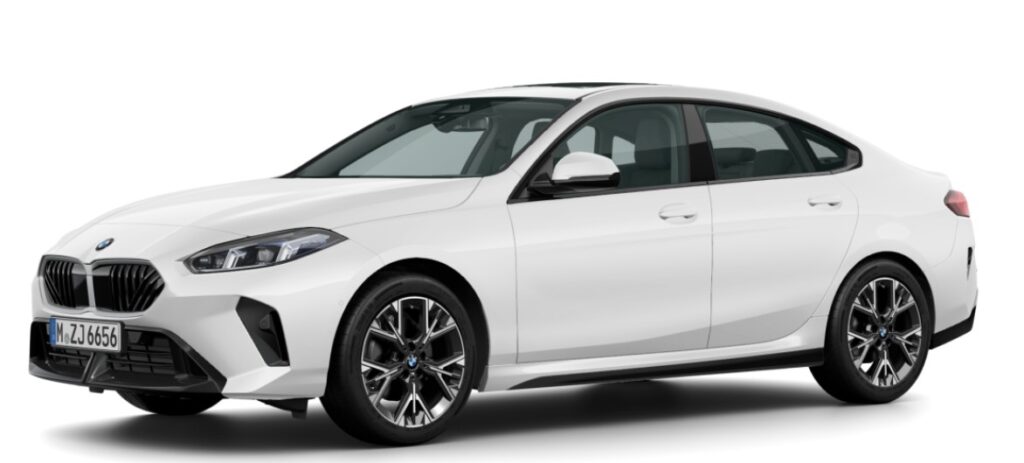
Despite its name, the BMW 2 Series Gran Coupé is not simply a four-door version of the rear-wheel-drive Coupé.
It uses a different vehicle architecture, with front-wheel-drive-based engineering and available all-wheel drive. That layout creates better packaging for passengers but delivers a different driving character.
Current Gran Coupé engine choices depend heavily on region.
1.5-Litre Gran Coupé Engines
Some markets receive entry-level Gran Coupé models with a 1.5-litre three-cylinder turbocharged petrol engine.
For example, BMW introduced the 216 Gran Coupé in Singapore with a 1.5-litre three-cylinder petrol engine producing 122hp and 230Nm.
This engine suits drivers prioritising:
- Lower initial cost
- Urban fuel economy
- Light everyday use
- Lower theoretical emissions
- Comfortable rather than aggressive performance
It may not satisfy someone expecting traditional six-cylinder BMW muscle, but that is not its purpose. It is designed as an efficient entry point into the range.
2.0-Litre Gran Coupé Engines
More powerful Gran Coupé versions commonly use a 2.0-litre turbocharged four-cylinder petrol engine.
The US-market Gran Coupé, for instance, is currently advertised with outputs including 241hp and 295lb-ft of torque in relevant versions.
Earlier and regional versions have carried badges such as:
- 218i
- 220i
- 223
- 228i
- M235i
We need to check the exact model year rather than relying on the badge alone. BMW frequently changes output levels and available derivatives while retaining familiar model names.
BMW M235i Gran Coupé Engine Size
The M235i Gran Coupé uses a 2.0-litre turbocharged four-cylinder petrol engine, not the 3.0-litre six-cylinder found in some other performance-oriented BMWs.
This point catches many buyers by surprise.
Historically, an “M235i” badge may make us think immediately of a six-cylinder engine. Yet the Gran Coupé’s transverse-engine platform uses a high-output four-cylinder unit.
That does not make it slow. It simply means its character is different: more compact, more front-biased and less mechanically connected to the traditional rear-wheel-drive Coupé formula.
BMW 2 Series Active Tourer Engine Size
The BMW 2 Series Active Tourer is designed around practicality. Its taller shape, flexible cabin and front-wheel-drive-based platform make it closer to a compact family vehicle than a low-slung sports coupé.
Its engine range has included 1.5-litre and 2.0-litre petrol and diesel units, mild-hybrid systems and plug-in hybrids.
BMW 218i Active Tourer Engine Size
Depending on the generation and market, the 218i Active Tourer commonly uses a 1.5-litre turbocharged three-cylinder petrol engine.
The original Active Tourer launch helped introduce BMW customers to the idea of a three-cylinder engine in a premium family model. BMW’s early technical material described the 218i’s three-cylinder powertrain and quoted a 0–100km/h time of 9.2 seconds with a manual transmission.
A three-cylinder engine naturally has a slightly different sound and vibration pattern from a four-cylinder. Some drivers find its offbeat note full of character; others prefer the smoother feel of the larger engine.
BMW 220i and 223i Active Tourer Engine Size
The stronger petrol Active Tourer models typically use a 2.0-litre turbocharged four-cylinder engine, sometimes supported by 48-volt mild-hybrid technology.
BMW’s current UK technical data shows that some Active Tourer powertrains include an electric motor contributing 15kW and 55Nm as part of the electrified system.
A mild hybrid is not the same as a plug-in hybrid. We do not plug it into a charger, and it generally cannot travel meaningful distances using electricity alone. Its electric system assists the petrol engine, recovers energy and can improve smoothness or efficiency.
BMW 225e and 230e Active Tourer Engine Size
The 225e and 230e Active Tourer plug-in hybrids pair a petrol engine—commonly a 1.5-litre turbocharged three-cylinder—with an electric motor and rechargeable battery.
Looking only at the petrol engine’s size can therefore be misleading. Total system performance depends on both power sources.
A plug-in hybrid may accelerate more strongly than its small petrol capacity suggests because the electric motor delivers torque immediately. It is a little like having a second runner join the race precisely when extra effort is needed.
However, real-world fuel economy depends heavily on charging habits. Owners who charge regularly and complete many short journeys may use very little petrol. Those who rarely charge can end up carrying a heavy battery without taking full advantage of it.
BMW 2 Series Gran Tourer Engine Size
The discontinued BMW 2 Series Gran Tourer stretched the practical formula further by offering up to seven seats.
Its historical engine range included small three-cylinder units and larger four-cylinder petrol and diesel engines.
One notable example was the BMW 216d Gran Tourer, which used a 1.5-litre three-cylinder diesel engine producing 116hp and 270Nm in its original UK specification.
The wider Gran Tourer range included badges such as:
- 216i
- 218i
- 220i
- 216d
- 218d
- 220d
- 225i
Engine availability changed during the model’s life, so used-car buyers should verify the VIN, registration documents and original specification.
Petrol BMW 2 Series Engine Sizes
Petrol engines dominate many current 2 Series ranges, particularly in the Coupé, Gran Coupé and M models.
1.5-Litre Petrol Engine
The 1.5-litre turbo petrol is usually a three-cylinder unit.
Its main advantages include:
- Compact dimensions
- Lower weight
- Potentially good fuel economy
- Adequate urban performance
- Lower entry price in many markets
Its limitations become more obvious when the vehicle is heavily loaded or frequently driven at high motorway speeds. It will do the job, but it may need to work harder and downshift more often than a 2.0-litre engine.
2.0-Litre Petrol Engine
The 2.0-litre turbo four-cylinder is arguably the backbone of the BMW 2 Series family.
It appears in everything from relatively calm everyday models to rapid performance derivatives. Its broad use reflects its flexibility.
A 2.0-litre engine can offer:
- Strong mid-range acceleration
- Better overtaking ability
- Reasonable refinement
- Manageable fuel consumption
- Broad parts and servicing familiarity
- Substantial tuning potential
For most buyers asking which BMW 2 Series engine size is best, the 2.0-litre petrol will be the most balanced answer.
3.0-Litre Petrol Engine
The 3.0-litre turbocharged inline-six sits at the top of the range.
It is found in models such as the M240i and M2, depending on generation and market. Its strengths include smooth power delivery, effortless acceleration and a distinctive sound.
The compromises are equally clear:
- Higher fuel consumption
- More expensive insurance
- Increased purchase cost
- Potentially higher maintenance bills
- Greater tyre and brake wear
- More performance than many drivers can regularly use
No one buys the six-cylinder engine because it is the most rational option. We buy it because rationality sometimes deserves a day off.
Diesel BMW 2 Series Engine Sizes
Diesel engines have been especially common in European versions of the Active Tourer, Gran Tourer and earlier Coupé.
The range has included 1.5-litre three-cylinder diesels and 2.0-litre four-cylinder diesels.
1.5-Litre Diesel Engine
The 1.5-litre diesel was designed around efficiency rather than outright speed.
It can suit drivers who cover long distances but do not need rapid acceleration. Nevertheless, buyers should consider how the car will actually be used.
Modern diesel engines generally prefer regular longer journeys that allow the exhaust after-treatment system and diesel particulate filter to reach suitable operating temperatures.
Repeated short urban trips can be a poor match.
2.0-Litre Diesel Engine
The 2.0-litre diesel is better suited to heavier use, motorway travel and carrying passengers or luggage.
Its generous low-rpm torque makes the car feel relaxed during overtaking and climbing. Rather than shouting for attention, a good diesel simply rolls up its sleeves and gets on with the work.
For high-mileage drivers, it may still make financial sense. For low-mileage urban owners, a petrol or electrified model will often be easier to live with.
Which BMW 2 Series Engine Size Is Best?
There is no universal winner. The right answer depends on how we drive.
Best for City Driving
A 1.5-litre petrol engine can be a practical option for:
- Short commutes
- Light annual mileage
- Congested urban roads
- Drivers who value economy over speed
A plug-in hybrid may work even better when home or workplace charging is available.
Best All-Round Choice
The 2.0-litre petrol engine is the strongest all-rounder.
It offers enough power for motorway driving and enjoyable acceleration without the larger financial appetite of the 3.0-litre models.
In the rear-wheel-drive Coupé, the 220i prioritises sensible ownership, while the 230i adds considerably more urgency.
Best for Long-Distance Driving
A 2.0-litre diesel may be ideal for drivers completing substantial motorway mileage.
Its low-end torque and potentially lower fuel consumption can make long journeys feel effortless. However, changing taxation, emissions rules and local restrictions must be considered before buying.
Best for Performance
The 3.0-litre six-cylinder is the obvious choice when emotion and performance take priority.
The M240i offers exceptional road-car pace, while the M2 delivers the more focused experience.
Neither is necessary. That is precisely why they are so appealing.
Does a Bigger BMW Engine Last Longer?
Not automatically.
A larger engine may operate with less effort during ordinary driving, but longevity depends far more on:
- Oil-change history
- Correct oil specification
- Cooling-system condition
- Driving style
- Warm-up habits
- Previous modifications
- Quality of repairs
- Mileage pattern
- Manufacturing revisions
- Preventive maintenance
A well-maintained 1.5-litre engine can outlast a neglected 3.0-litre engine. Capacity alone is a poor predictor of reliability.
Service history is the real storyteller. The badge may introduce the car, but the invoices reveal its biography.
How to Confirm a Used BMW 2 Series Engine Size
Never rely entirely on an online advertisement.
To verify the engine, we should check:
- Registration documents: These usually list engine capacity in cubic centimetres.
- VIN information: A BMW dealer or reputable decoding service can identify the original powertrain.
- Service history: Workshop invoices often contain the model, engine code or displacement.
- Engine-bay labels: Emissions and identification labels can provide useful information.
- Manufacturer specifications: Match the production date and market, not merely the registration year.
- Insurance database: Insurers often identify the exact derivative through the registration number.
- Physical inspection: A BMW specialist can confirm whether the powertrain appears original.
This matters because cars may be registered months after production, imported from another market or incorrectly described by sellers.
BMW Engine Badges Can Be Misleading
Once upon a time, BMW badges closely reflected engine capacity. A 220i might reasonably suggest a 2.0-litre engine, while a 230i might suggest something larger.
Today, badges mainly indicate a model’s position and performance level.
For example:
- A 218i may use a 1.5-litre engine.
- A 220i may use a 2.0-litre engine.
- A 230i may also use a 2.0-litre engine.
- An M235i Gran Coupé can use a 2.0-litre four-cylinder.
- An M240i Coupé uses a 3.0-litre six-cylinder.
The numbers now behave more like ranks than measurements. They tell us where the car sits in the hierarchy, not necessarily what sits under the bonnet.
Running Costs by Engine Size
Engine capacity influences running costs, but it is only one piece of the puzzle.
Fuel Consumption
A smaller engine often uses less fuel under gentle conditions. However, a heavily loaded small engine may consume more than expected because it must work harder.
A larger engine driven calmly can sometimes return respectable figures, but the temptation to use its performance rarely helps.
Insurance
Higher-output models normally cost more to insure, even when they share the same engine capacity with a lower-powered version.
An insurer considers:
- Horsepower
- Acceleration
- Vehicle value
- Theft data
- Repair costs
- Driver profile
- Location
- Claims history
The 220i and 230i may both have 2.0-litre engines, yet their premiums can differ significantly.
Servicing and Repairs
Routine servicing may not differ dramatically between some four-cylinder variants. The major cost gap often appears in the supporting hardware.
Performance models can require:
- Larger tyres
- More expensive brakes
- Additional cooling components
- Greater quantities of premium fluids
- More complex drivetrain parts
- Higher labour costs
This is why we should budget for the whole car, not merely its engine.
Should We Choose Engine Size or Horsepower?
We should consider both, along with torque, vehicle weight and intended use.
Engine size tells us something about the mechanical foundation. Horsepower indicates how rapidly the engine can perform work. Torque helps explain how strongly the car pulls, particularly at lower engine speeds.
Yet even those numbers cannot fully communicate driving feel.
A test drive reveals qualities a specification sheet cannot:
- Throttle response
- Gearbox behaviour
- Engine sound
- Low-speed smoothness
- Overtaking confidence
- Cabin vibration
- Real-world flexibility
A car is not a spreadsheet on wheels. Numbers narrow the shortlist, but experience makes the final decision.
Common Mistakes When Comparing 2 Series Engines
Buyers frequently make several avoidable mistakes.
Assuming Every 2 Series Uses the Same Platform
The Coupé, Gran Coupé and Active Tourer are mechanically distinct vehicles.
Treating Every 2.0-Litre Engine as Identical
Power output, software, cooling and hardware can differ.
Choosing Diesel for Short Urban Journeys
Low annual mileage may not justify the potential complexity of modern diesel emissions systems.
Ignoring the Production Year
Engine choices and outputs can change during a model’s life.
Buying the Largest Engine Without Budgeting
Fuel is only the beginning. Insurance, tyres, brakes and maintenance can rise sharply.
Believing the Badge Reveals Capacity
Modern BMW naming does not consistently correspond to engine displacement.
Final Verdict: Understanding BMW 2 Series Engine Size
The BMW 2 Series engine range stretches from efficient 1.5-litre three-cylinder units to potent 3.0-litre turbocharged straight-sixes.
The basic pattern is simple:
- 1.5 litres: Best suited to economy-focused urban and family models
- 2.0 litres: The broadest and most balanced choice
- 3.0 litres: Designed for serious performance and emotional appeal
- Plug-in hybrid: Ideal when regular charging fits our routine
For most drivers, a 2.0-litre petrol engine offers the strongest compromise between speed, refinement, flexibility and manageable ownership costs. Drivers covering substantial motorway mileage may prefer a 2.0-litre diesel, while those chasing the classic BMW six-cylinder experience should look toward the M240i or M2.
The most important lesson is not to shop by badge alone. We should verify the body style, production year, market, exact derivative and engine specification before buying.
After all, the BMW 2 Series badge is merely the cover. The engine beneath it writes the story.
Frequently Asked Questions
1. What engine size does the BMW 2 Series have?
The BMW 2 Series has been offered with 1.5-litre, 2.0-litre and 3.0-litre engines. The exact size depends on the body style, derivative, production year and country. Plug-in-hybrid Active Tourer models also combine a petrol engine with an electric motor.
2. Is the BMW 2 Series a 1.5-litre or 2.0-litre car?
It can be either. Entry-level versions such as certain 216i and 218i models may use a 1.5-litre three-cylinder engine, while many 220i, 228i and 230i versions use a 2.0-litre four-cylinder engine.
3. Which BMW 2 Series has a 3.0-litre engine?
The BMW M240i Coupé and BMW M2 use 3.0-litre turbocharged inline-six petrol engines. Some earlier performance derivatives also used six-cylinder powertrains, although specifications vary by generation.
4. Does the BMW 230i have a 3.0-litre engine?
No. Modern BMW 230i Coupé models generally use a 2.0-litre turbocharged four-cylinder petrol engine. The “30” in the badge indicates its performance position rather than an exact 3.0-litre capacity.
5. What is the best BMW 2 Series engine size?
For most buyers, the 2.0-litre petrol engine is the best all-round choice because it balances performance, refinement and running costs. A 1.5-litre engine may suit city driving, while the 3.0-litre six-cylinder is better for drivers prioritising performance.
If you want to know other articles similar to BMW 2 Series Engine Size: Complete Petrol, Diesel and M Guide you can visit the category Service and Parts.
Land Rover Defender 90 Tyre Pressure: Complete Guide
Land Rover Defender 90 Weight: Kerb Weight, GVW and Payload Explained
Land Rover Defender 90 Towing Capacity: Complete Guide
Land Rover Defender 90 Boot Space: Size, Dimensions and Practicality
Toyota Hilux Key Battery Replacement: Complete DIY Guide
Toyota Hilux Windscreen Replacement Cost: Prices, Factors, and Money-Saving Tips
Leave a Reply
More content of your interest