
Land Rover Defender 90 Weight: Kerb Weight, GVW and Payload Explained

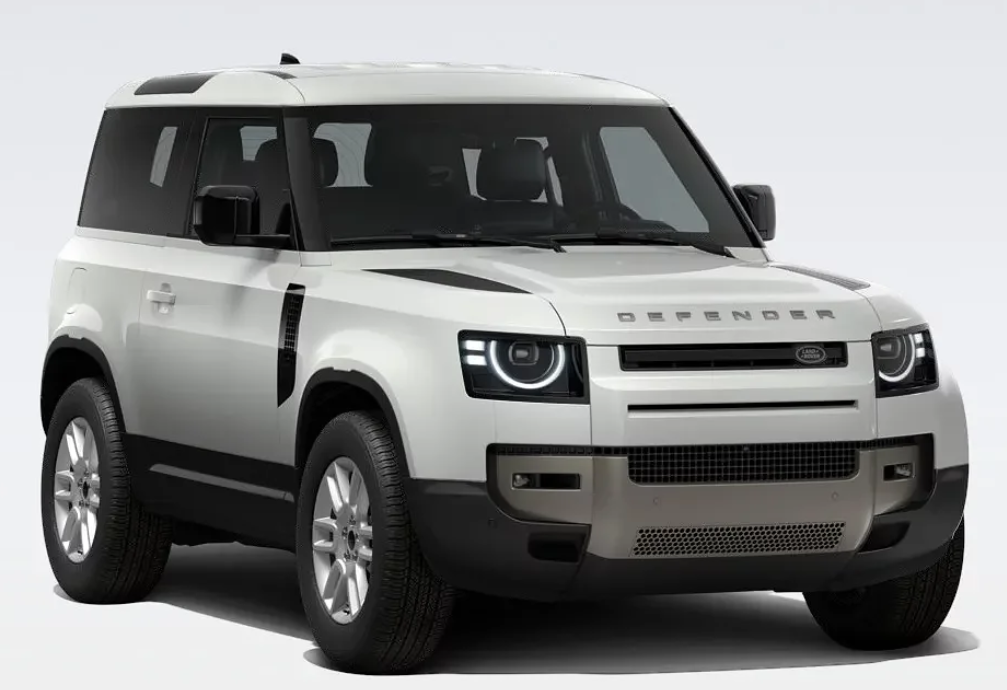
The Land Rover Defender 90 weight is one of those specifications that looks simple until we actually start comparing figures. Search for the answer and we might see 2,225 kg on one page, 2,300 kg on another, and more than 2,500 kg somewhere else. None of those numbers is necessarily wrong.
The reason is simple: there is no single Defender 90 weight.
Engine choice, seating configuration, equipment, measurement standard, wheels, accessories, and model year can all change the figure. Even two visually identical Defender 90s may not weigh exactly the same.
For current Defender 90 specifications, Land Rover lists DIN unladen weights starting around 2,225–2,241 kg for some versions, while EU unladen figures can sit around 2,300–2,316 kg because the EU measurement includes a 75 kg driver. The heavier Defender 90 V8 is listed at approximately 2,471 kg DIN or 2,546 kg EU.
That means we're dealing with a serious chunk of machinery. The Defender 90 may be the short-wheelbase member of the Defender family, but calling it lightweight would be rather like calling a rhinoceros compact because it is shorter than an elephant.
Let's break the numbers down properly.
Content in this publication
- How Much Does a Land Rover Defender 90 Weigh?
- Defender 90 DIN Weight Explained
- Land Rover Defender 90 Weight in Pounds
- Land Rover Defender 90 V8 Weight
- Defender 90 Gross Vehicle Weight
- Land Rover Defender 90 Payload Capacity
- Does the Six-Seat Defender 90 Weigh More?
- How Heavy Is the Defender 90 Compared With Its Size?
- Defender 90 Weight vs Defender 110
- How Weight Affects Defender 90 Fuel Economy
- How Weight Affects Defender 90 Handling
- Does Defender 90 Weight Help Off-Road?
- Defender 90 Roof Load and Vehicle Weight
- How Defender 90 Weight Affects Towing
- How Optional Equipment Changes Defender 90 Weight
- How to Find the Exact Weight of Your Defender 90
- Kerb Weight vs Gross Weight: The Easy Way to Remember It
- Is the Land Rover Defender 90 Too Heavy?
- Land Rover Defender 90 Weight: Key Takeaways
- Conclusion: A Compact Defender With Heavyweight Numbers
- Frequently Asked Questions
How Much Does a Land Rover Defender 90 Weigh?
For many current versions of the Defender 90, we can broadly expect an unladen weight of around 2.2 to 2.5 tonnes, depending on engine and configuration.
A useful snapshot looks like this:
| Defender 90 specification | Approximate weight |
|---|---|
| Diesel DIN unladen weight | 2,241–2,264 kg |
| Diesel EU unladen weight | 2,316–2,339 kg |
| P425 petrol DIN weight | 2,225–2,248 kg |
| P425 petrol EU weight | 2,300–2,323 kg |
| V8 P525 DIN weight | 2,471 kg |
| V8 P525 EU weight | 2,546 kg |
| Typical GVW | Around 2,970–3,050 kg |
The numbers above should be treated as specification-guide figures rather than universal numbers for every Defender 90. Land Rover specifically notes that published weights represent vehicles in standard specification and that optional equipment can increase vehicle weight.
So when someone asks, "What does a Defender 90 weigh?" the most accurate short answer is:
Roughly 2,200–2,550 kg unladen, depending on version and the measurement method used.
Why Do Defender 90 Weight Figures Differ?
Most of the confusion comes from terminology.
Car manufacturers don't always quote vehicle weight using exactly the same measurement standard. Consequently, one website might display DIN weight, another might use EU unladen weight, and a registration document might show yet another legally defined figure.
The result? We can appear to gain or lose 75 kg without changing a single component.
That isn't magic. It's simply the driver allowance.
Defender 90 DIN Weight Explained
DIN unladen weight generally includes the vehicle with:
- Necessary operating fluids
- Approximately 90% fuel
- Standard equipment
- No 75 kg driver allowance
For example, Land Rover's published figures list approximately 2,241 kg DIN for a five-seat D250 configuration and 2,264 kg for the six-seat equivalent in current technical data.
Think of DIN weight as a useful approximation of the vehicle sitting ready to operate before we climb aboard.
Defender 90 EU Unladen Weight
EU unladen weight adds a 75 kg driver to the calculation.
That explains why the same D250 example can move from approximately 2,241 kg DIN to approximately 2,316 kg EU.
Nothing about the SUV changed.
We've simply added the standardized driver used by the measurement system. Land Rover confirms that its EU figure includes a 75 kg driver, full fluids and 90% fuel, while the DIN measurement excludes the driver.
Why This Matters When Comparing Cars
If we're comparing the Defender against a Jeep Wrangler, Toyota Land Cruiser, Ford Bronco or another SUV, checking which weight standard is being quoted matters enormously.
Comparing one vehicle's DIN figure with another vehicle's EU figure is essentially starting a race with one runner already carrying a backpack.
Always compare like with like.
Land Rover Defender 90 Weight in Pounds
For drivers who prefer imperial measurements, the numbers become even more striking.
A 2,241 kg Defender weighs roughly 4,940 lb.
A 2,471 kg Defender 90 V8 is around 5,448 lb before adding occupants and cargo.
And the EU figure of 2,546 kg for the V8 works out at approximately 5,613 lb.
So despite being the shortest modern Defender bodystyle, the 90 comfortably sits in heavyweight SUV territory.
This also explains part of the driving experience. There is always a sense of substance beneath us. The vehicle feels planted, deliberate and dense rather than feather-light or nervous.
Land Rover Defender 90 V8 Weight
The Defender 90 V8 sits at the heavier end of the spectrum.
Land Rover lists the P525 V8 at:
- 2,471 kg DIN
- 2,546 kg EU
- 3,040 kg Gross Vehicle Weight
- Payload of up to approximately 550 kg
These numbers relate to standard specification and can change with equipment.
Why the extra bulk?
The supercharged 5.0-litre V8 is obviously a major contributor, but performance-oriented hardware, brakes, wheels, cooling requirements and equipment also matter.
The V8 therefore feels like a particularly interesting contradiction: we get the compact proportions of the Defender 90 wrapped around a vehicle weighing well over 2.4 tonnes.
Does the V8 Weight Hurt Performance?
Not exactly.
Power solves quite a few weight-related problems in a straight line.
Land Rover quotes the 525 PS Defender 90 V8 at 0–100 km/h in 5.2 seconds, despite its substantial mass.
That's remarkably quick for something shaped roughly like an exceptionally expensive garden shed.
Physics never disappears, though.
More mass still matters under hard braking, during rapid direction changes and when tyres are asked to control more than two tonnes of SUV.
Defender 90 Gross Vehicle Weight
Unladen weight tells only half the story.
Another number we need to understand is Gross Vehicle Weight, usually abbreviated to GVW.
GVW represents the maximum permitted total weight of the vehicle when loaded. That includes:
- The Defender itself
- Driver
- Passengers
- Luggage
- Accessories
- Equipment
- Tow-ball load where applicable
Land Rover lists GVW around 2,970 to 3,050 kg for several Defender 90 configurations, with the exact figure depending on seating and powertrain.
Why Gross Vehicle Weight Matters
GVW isn't merely a technical number hidden in a brochure.
It's a legal and safety limit.
Suppose we install heavy accessories, fill the cabin with adults, load camping equipment into the rear and place equipment on the roof. Every kilogram eats into the vehicle's available payload.
The Defender can certainly haul plenty, but "capable" does not mean "unlimited."
Land Rover Defender 90 Payload Capacity
Payload describes how much additional weight the vehicle can legally carry above its base operating weight.
Depending on specification, Land Rover publishes maximum payload figures reaching approximately 650–700 kg for certain Defender 90 configurations, while the V8's published maximum is closer to 550 kg.
Here's the important part: payload isn't simply luggage.
It includes almost everything we add to the vehicle.
What Counts Toward Payload?
Consider a weekend adventure:
- Driver: 85 kg
- Passenger: 75 kg
- Two additional adults: 140 kg combined
- Luggage: 80 kg
- Camping equipment: 60 kg
- Accessories: 50 kg
We've already added 490 kg.
That doesn't automatically mean we're overloaded, but it shows how quickly payload disappears.
Accessories Can Quietly Consume Payload
This catches owners by surprise.
An expedition rack, ladder, side-mounted carrier, winch, underbody protection, larger wheels and other modifications may individually seem harmless.
Together, however, they can swallow a meaningful portion of available carrying capacity.
Land Rover explicitly warns that accessories and items fitted after manufacture affect payload and that Gross Vehicle Weight and maximum axle loads must not be exceeded.
Does the Six-Seat Defender 90 Weigh More?
Yes.
Some Defender 90 configurations can be equipped with the front-row centre jump seat, creating a six-seat layout.
Naturally, the additional seating hardware increases weight.
Current technical data, for example, lists approximately:
- 2,316 kg EU for a five-seat diesel configuration
- 2,339 kg EU for a six-seat configuration
The difference is about 23 kg.
It's hardly transformational, but it illustrates why we shouldn't assume every Defender 90 with the same engine has an identical kerb weight.
How Heavy Is the Defender 90 Compared With Its Size?
Very.
The modern Defender 90 has relatively compact exterior length, especially when compared with the Defender 110 and 130, but the underlying engineering is robust.
We're dealing with:
- Four-wheel-drive hardware
- A two-speed transfer case
- Strong suspension components
- Significant structural reinforcement
- Large wheels and tyres
- Substantial engines
- Extensive electronics
- Off-road hardware
- Heavy safety equipment
- Luxurious interior equipment on upper trims
So the Defender 90 is short, but not light.
That's an important distinction.
Why the Defender 90 Is So Heavy
Modern vehicles have gained weight across the board.
Crash structures, emissions systems, sound insulation, electric motors, cameras, sensors, infotainment equipment, larger brakes and comfort features all add kilograms.
An SUV engineered for serious off-road work needs even more strength.
The Defender therefore combines the equipment level of a premium vehicle with the mechanical hardware expected from a serious 4x4.
That combination is never going to produce Lotus-like numbers on the scales.
Defender 90 Weight vs Defender 110
One common assumption is that the Defender 90 must be dramatically lighter than the 110.
It is lighter in many equivalent configurations, but the difference may not feel as enormous as the visual size difference suggests.
Why?
Because both vehicles still need the same fundamental architecture: driveline components, four-wheel-drive systems, substantial suspension hardware, safety structures and similar engines.
The 110 adds wheelbase, body structure, seating and cargo capacity, but much of the heavy mechanical core already exists in the 90.
That's why choosing the 90 should primarily be about its shorter proportions, manoeuvrability, styling and personality rather than expecting a truly lightweight SUV.
How Weight Affects Defender 90 Fuel Economy
There is no escaping physics.
Every time we accelerate, the engine has to move the Defender's considerable mass.
That means weight influences:
- Urban fuel consumption
- Acceleration energy requirements
- Braking demand
- Tyre wear
- Suspension load
- Overall efficiency
At steady motorway speeds, aerodynamics become increasingly important, and the Defender's brick-like profile hardly cheats the wind.
Around town, however, repeatedly accelerating more than two tonnes becomes particularly relevant.
Does Extra Cargo Noticeably Affect MPG?
It can.
Adding 100 or 200 kg might not transform the Defender overnight, but heavier loads demand more energy during acceleration and climbing.
Roof-mounted equipment can have an even larger real-world influence because it adds weight and aerodynamic drag.
A heavy roof tent is therefore a double hit: we're carrying extra mass while also disturbing airflow.
How Weight Affects Defender 90 Handling
Heavy vehicles aren't automatically bad-handling vehicles.
Modern suspension systems, electronic stability controls, wide tyres and clever torque management can disguise mass surprisingly well.
The Defender 90 can therefore feel much more composed than its weight figure might suggest.
But weight never completely leaves the room.
Push hard into a corner and more than two tonnes still need to change direction.
Under heavy braking, that mass still needs to lose momentum.
On a tight road, the shorter wheelbase gives the 90 a sense of agility relative to larger Defenders, but this isn't a featherweight sports SUV.
The Positive Side of Its Weight
Mass has advantages too.
On the motorway, the Defender 90 often feels substantial and planted.
Crosswinds, broken surfaces and uneven roads don't toss it around like a light hatchback.
That sensation contributes to the Defender's personality. We sit high, surrounded by a vehicle that feels carved from something dense.
It inspires confidence.
Does Defender 90 Weight Help Off-Road?
Sometimes.
Weight can improve tyre loading and traction on certain surfaces, but too much weight can become an enemy in mud, sand or soft terrain.
A heavy vehicle:
- Sinks more easily on soft surfaces
- Requires more traction to climb
- Carries more momentum downhill
- Places greater loads on tyres and recovery equipment
- Is harder to recover when stuck
This is why tyre pressures, line choice and careful throttle control matter enormously off-road.
The Defender's electronic systems are remarkably sophisticated, but software cannot repeal gravity.
Weight Distribution Matters Too
Total weight is only one part of the equation.
Where that weight sits matters just as much.
Adding heavy items high on the roof raises the vehicle's centre of gravity, which can affect stability.
Land Rover's own guidance notes that roof loads affect vehicle weight and raise the centre of gravity.
That is worth remembering before transforming the Defender into a rolling equipment catalogue.
Defender 90 Roof Load and Vehicle Weight
For non-V8 Defender 90 models, Land Rover publishes dynamic roof-load figures that can reach 118 kg when configured with suitable off-road tyres and the Expedition Roof Rack, while the static roof load can reach 300 kg in relevant configurations.
Dynamic means driving.
Static means parked.
Those are very different scenarios.
Interestingly, Land Rover states that Defender V8 models have no dynamic roof-loading capacity, although a static load allowance is published.
So we should never assume that because one Defender 90 can carry a roof tent while moving, every version can.
How Defender 90 Weight Affects Towing
The Defender 90's substantial mass can be helpful when towing because a heavy tow vehicle generally feels more stable against a sizeable trailer.
Many Defender 90 configurations are rated to tow up to 3,500 kg braked, depending on market and specification.
But towing introduces another weight consideration: nose weight.
Trailer nose weight acts on the vehicle and contributes to load calculations.
So we shouldn't look exclusively at the headline 3,500 kg towing figure.
We need to consider:
- Vehicle GVW
- Payload
- Axle limits
- Trailer weight
- Tow-ball or nose weight
- Gross train weight
That's the difference between simply attaching a trailer and setting up a vehicle correctly.
Gross Train Weight Explained
Gross Train Weight describes the maximum permitted combined weight of the loaded vehicle and trailer.
For certain Defender 90 configurations, Land Rover lists maximum vehicle-and-trailer combination figures around 6,470–6,550 kg.
Again, exact figures depend on specification.
When towing anything close to maximum capacity, the vehicle identification plate and owner's documentation should take priority over generic online figures.
How Optional Equipment Changes Defender 90 Weight
This is where brochure figures begin drifting away from the actual vehicle parked in our driveway.
Optional equipment may include:
- Larger alloy wheels
- Tow equipment
- Side steps
- Expedition roof rack
- Roof ladder
- Mud flaps
- Protection systems
- Winch equipment
- Storage carriers
- Additional interior equipment
One option might make little difference.
A dozen options can.
If accurate weight genuinely matters—perhaps we're building an overland vehicle or towing near legal limits—the safest approach is to weigh the finished vehicle on a certified weighbridge.
How to Find the Exact Weight of Your Defender 90
If we need the precise weight limits for a particular vehicle, generic internet tables shouldn't be our final authority.
Check:
- The vehicle identification or VIN plate
- Owner's manual
- Registration documentation
- Official Land Rover specification for the exact model year
- A certified weighbridge for actual loaded weight
A weighbridge is particularly valuable because it tells us what our specific vehicle weighs after accessories, fuel and equipment have been added.
That's the number that really matters before a major expedition or heavy towing trip.
Kerb Weight vs Gross Weight: The Easy Way to Remember It
The terminology can feel unnecessarily complicated, so here's the simplest mental shortcut.
Kerb/unladen weight: What the Defender itself weighs in an operating-ready condition under a defined measurement standard.
Gross Vehicle Weight: The maximum the entire loaded Defender is allowed to weigh.
Payload: The usable difference available for people, luggage, equipment and other permitted loads.
Imagine a backpack.
The empty backpack has a weight.
The manufacturer sets a maximum loaded weight.
Everything we place inside consumes carrying capacity.
A Defender is obviously more complicated, but the principle is essentially identical.
Is the Land Rover Defender 90 Too Heavy?
That depends entirely on what we expect from it.
If we're looking for something nimble, minimal and economical, a vehicle weighing well above two tonnes clearly isn't ideal.
But that's not what the Defender 90 is trying to be.
It combines luxury-SUV comfort with genuine off-road equipment, considerable towing ability, strong crash structures and a substantial four-wheel-drive system.
Heavy?
Absolutely.
Unreasonably heavy for its mission?
Not necessarily.
Its mass is partly the price we pay for capability.
Who Should Care Most About Defender 90 Weight?
The specification matters particularly if we:
- Tow caravans or heavy trailers
- Carry several adults regularly
- Install overlanding equipment
- Fit heavy accessories
- Transport tools
- Use roof-mounted equipment
- Drive on soft sand
- Need to stay beneath licensing or regulatory limits
- Regularly load the Defender near capacity
For someone commuting alone with a laptop in the back, the exact difference between 2,300 and 2,340 kg probably won't change their life.
For someone towing 3.5 tonnes with a fully loaded cabin, it absolutely can.
Land Rover Defender 90 Weight: Key Takeaways
Let's strip everything back to the numbers that matter.
The modern Land Rover Defender 90 typically weighs around 2.2 to 2.5 tonnes unladen, depending on engine, seating configuration, equipment and measurement method.
Current official data shows examples including:
- Around 2,225–2,248 kg DIN for the P425
- Around 2,241–2,264 kg DIN for some diesel configurations
- Around 2,300–2,339 kg EU for those lighter configurations
- Around 2,471 kg DIN for the Defender 90 V8
- Around 2,546 kg EU for the Defender 90 V8
- GVW of roughly 2,970–3,050 kg, depending on configuration
The key point is not to become obsessed with one universal figure because there isn't one.
Instead, identify the exact model, engine, seats and measurement standard being quoted.
Conclusion: A Compact Defender With Heavyweight Numbers
The Defender 90 looks compact beside the stretched 110 and enormous 130, but the scales tell another story.
Underneath those short, iconic proportions sits a seriously substantial 4x4.
Depending on specification, we're looking at roughly 2.2–2.5 tonnes before loading the vehicle with passengers and cargo. That weight influences fuel economy, handling, towing, payload, tyre wear and off-road behaviour.
Yet it also contributes to the Defender's reassuring solidity.
We don't drive a Defender 90 and think, "This feels delicate."
It feels more like a vault learned how to climb mountains.
Understanding the Land Rover Defender 90 weight therefore isn't merely a matter of memorising a number. We need to know which number we're looking at—DIN weight, EU unladen weight, GVW or payload—and how our particular configuration changes it.
Do that, and the confusing collection of specifications suddenly makes perfect sense.
Frequently Asked Questions
1. How much does a Land Rover Defender 90 weigh in kg?
Most current Defender 90 versions weigh approximately 2,200–2,550 kg unladen, depending on engine, seating configuration and measurement standard. For example, Land Rover lists some versions around 2,225–2,264 kg using DIN measurements, while the V8 can reach approximately 2,471 kg DIN.
2. How much does a Defender 90 weigh in pounds?
Depending on specification, a modern Defender 90 generally weighs roughly 4,900–5,600 lb before passengers and cargo. The V8 is among the heaviest versions.
3. Why are there different Defender 90 weight figures online?
Different sources may quote DIN weight, EU unladen weight, kerb weight or Gross Vehicle Weight. Engine choice, optional equipment and seating configuration also alter the number. EU unladen weight includes a standardized 75 kg driver, while Land Rover's DIN figure does not.
4. What is the gross vehicle weight of a Defender 90?
Depending on specification, current official Defender 90 data lists GVW around 2,970–3,050 kg. Owners should check the identification plate or documentation for their specific vehicle rather than relying on a generic figure.
5. Is the Defender 90 V8 heavier than other Defender 90 models?
Yes. Land Rover lists the Defender 90 P525 V8 at approximately 2,471 kg DIN and 2,546 kg EU, making it significantly heavier than some diesel and smaller petrol configurations.
If you want to know other articles similar to Land Rover Defender 90 Weight: Kerb Weight, GVW and Payload Explained you can visit the category Service and Parts.
Volvo S90 Engine Oil: Type, Capacity & Change Guide
Volvo S90 Boot Space: Size, Capacity and Practicality
SEO Title: Volvo S90 Oil Capacity: Complete Guide by Engine

Kia Sorento Oil Type: Complete Guide by Year & Engine
Kia Sorento Engine Capacity: Complete Guide by Year
Peugeot 308 Clutch Replacement Cost: Complete UK Guide for 2026
Leave a Reply
More content of your interest