Kia Picanto dashboard warning lights help us understand what the car needs, from fastening a seat belt to stopping for a serious engine fault. The most useful clues are the symbol, its colour, whether it stays on or flashes, and any message beside it. A red oil can and a green AUTO STOP indicator need very different responses.
This guide explains the main Picanto warning lights and what we should do next. It covers common features across generations, with particular attention to later petrol models and their driver-assistance systems. Equipment differs by year, market, engine and transmission, so not every Picanto has every indicator shown here.
The images are representative recognition aids. Their artwork and colour may differ from your instrument cluster. Use the written descriptions and the handbook for your exact vehicle, especially before attempting a particulate-filter cleaning drive or a transmission cooling procedure.
Identify the symbol immediately. Stop safely for oil pressure, overheating or a serious brake fault.
Amber or yellow
A malfunction, disabled system or condition needing attention
Read the message and check how the car is behaving.
Green or white
A function is selected, ready or operating
Check that its operation is intended.
Blue
Usually high-beam headlights
Dip the lights when necessary.
Flashing
Normal operation or a specific warning
Use the individual symbol’s meaning rather than assuming one urgency level.
Colour alone does not tell us whether driving is safe. An amber engine warning with severe shaking needs more urgent attention than an amber rear fog-light indicator. Likewise, a red belt reminder is not an engine fault, but it still needs correcting before the journey continues.
Why do several lights appear before the engine starts?
Many lamps illuminate briefly when we switch on the ignition so the car can perform its checks. Oil-pressure and charging lights can remain on before starting because the engine has not yet established running oil pressure or charging output.
Look for a lamp that stays on unexpectedly after the engine starts, returns during driving or appears with a warning message. If an indicator fails to perform a check specified in the handbook, that may also need investigation. A dashboard photograph with the engine stopped does not, by itself, prove multiple faults.
Red warning lights and urgent engine conditions
Engine oil pressure warning
Urgency: stop safely and switch off the engine.The oil-can symbol warns that engine oil pressure is low. It is not a service-interval reminder. Continued driving can cause engine failure, even if the car still feels normal.Move to the nearest safe stopping place and switch off. Check the oil level according to the handbook when safe, and add the correct oil only if needed. If the warning remains, oil is unavailable or the engine sounds abnormal, obtain assistance rather than continuing. A normal dipstick level does not rule out a pressure problem, and repeated restarting is not a safe diagnostic test.
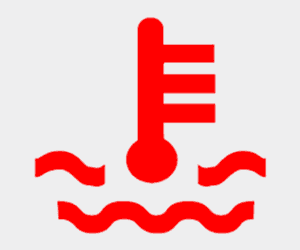
Engine coolant temperature or overheating warning
Urgency: stop safely and follow the overheating instructions.A thermometer symbol, abnormal gauge reading or “Engine overheated” message indicates excessive engine temperature. The exact display differs by generation; some cars use a gauge or message rather than a separate lamp.Stop out of traffic and follow the handbook’s overheating procedure. Never open a hot coolant cap because pressurised coolant can cause burns. Keep clear of fans and moving belts. If there is steam, leakage or continuing overheating, arrange assistance. Adding coolant repeatedly without finding the cause is not a reliable repair.
Parking brake and brake-fluid warning
Urgency: release the handbrake; stop if the warning remains.The red brake lamp normally appears when the parking brake is applied. If it stays on with the lever fully released, it can indicate a low brake-fluid level or a brake-system problem.Stop safely and check for abnormal pedal feel or visible leakage. If the warning persists, fluid is low, a leak is found or braking is not normal, do not continue driving. Adding fluid alone does not explain why the level fell. We should have the cause inspected and arrange recovery when braking safety is uncertain.
Battery charging-system warning
Urgency: stop at the nearest safe location and switch off.The battery symbol with the engine running indicates a fault in the alternator or electrical charging system. It does not automatically identify the battery as the failed component.Stop safely and switch off. A belt check should be performed only with the engine stopped and when conditions are safe. Arrange charging-system diagnosis before relying on the vehicle again. Do not assume a longer drive will recharge the battery when the system responsible for charging it is malfunctioning.
Airbag and SRS warning
Urgency: arrange prompt safety-system inspection.The airbag lamp should clear after its startup check. If it remains illuminated or appears while driving, the supplemental restraint system may have a fault. An airbag or seat-belt pretensioner may not provide its intended protection in a collision.We should have the system diagnosed even if the car runs normally. Avoid unplugging airbag connectors or fitting bypass devices to extinguish the warning. A proper repair identifies the cause and verifies that the restraint system operates correctly.
Seat-belt reminder
Urgency: secure occupied-seat belts before driving.The seated-person-and-belt symbol reminds the driver or passenger to fasten a belt. Depending on the version, the cluster can also display belt information for other seating positions. A chime may accompany it.Check that each occupant is using the correct buckle. Remove objects from an empty passenger seat if they are affecting occupancy detection. If a correctly fastened belt still triggers the warning, have the buckle or sensing system checked rather than bypassing the reminder.
Door or tailgate open warning
Urgency: stop safely and close the opening securely.The Picanto can show a door-ajar light, a separate tailgate warning or a vehicle graphic identifying an open panel. A bonnet-open message may also appear on equipped displays. The representative image groups these opening warnings.Confirm that every opening is properly latched before moving. If the warning appears while driving, stop somewhere safe before investigating. A persistent warning despite correct closure can indicate a latch or switch problem. A bonnet that is not securely latched must be resolved before continuing.
ABS, steering and tyre-pressure warnings
Anti-lock Braking System warning
Urgency: arrange inspection and allow greater safety margins.A persistent ABS light means the anti-lock system has detected a fault. Conventional hydraulic braking can remain available, but the car may not regulate wheel lock during hard braking.Avoid abrupt braking and unnecessary high-speed driving. If a red brake warning also appears or the brake pedal feels abnormal, stop safely and obtain assistance. We should not assume every ABS warning is a minor sensor fault without proper diagnosis.
ABS and brake warnings together: EBD
Urgency: assess braking immediately and seek assistance.When the ABS and parking-brake/brake-fluid lights illuminate together, Electronic Brake Force Distribution may not work correctly. Normal braking behaviour can be affected, particularly during sudden braking.Stop safely and seek advice before continuing. Arrange recovery if the brakes feel abnormal, fluid is low or safety is uncertain. Associated faults can also affect steering assistance or instrument readings, so the combination of lights matters more than interpreting each one in isolation.
Motor Driven Power Steering warning
Urgency: check steering control and arrange diagnosis.A steering-wheel, EPS or MDPS warning indicates a problem with the electric steering assistance. Steering effort can increase or otherwise change, particularly at low speeds.Keep control of the car and stop safely if steering becomes difficult or unpredictable. A persistent warning needs inspection. Adding hydraulic power-steering fluid is not a remedy for an electric-assistance fault; the actual electrical or mechanical cause must be identified.
Low tyre pressure and TPMS warning
Urgency: inspect the tyres and check cold pressures.The horseshoe-shaped symbol with an exclamation mark usually indicates that one or more tyres are significantly underinflated. Check for damage or a puncture and measure pressures against the vehicle’s label for the tyre size and load.A flashing-then-steady sequence can indicate a TPMS malfunction. That does not prove the tyres are correctly inflated. Correct the tyre condition first, then follow your model’s monitoring or reset procedure. Do not overinflate a tyre to force the lamp off, and do not assume every Picanto uses the same reset method.
Electronic Stability Control indicator
Urgency: ease off during intervention; diagnose persistent illumination.A flashing skidding-car symbol normally means ESC is actively helping manage traction or stability. Reduce speed and use smooth steering and pedal inputs. The system cannot overcome the limits of available grip.A lamp that stays on can indicate a fault. Arrange inspection, especially if ABS or steering warnings accompany it. Normal intervention on a slippery surface should be distinguished from a warning that remains on throughout an ordinary journey.
ESC OFF indicator
Status: the relevant stability function has been deactivated.ESC OFF confirms that the system has been switched off using the vehicle’s control. It is different from the flashing skidding-car indication showing active intervention.Restore the normal setting when the reason for deactivation has passed. If the OFF indication appears without explanation or cannot be cancelled, check the handbook and have the car inspected. Switching a system off does not repair a fault within it.
Engine, exhaust and general warning lights
Check-engine light or malfunction indicator
Urgency: prompt diagnosis; stop for severe running symptoms.The engine-shaped symbol relates to an engine, emissions or powertrain fault. It cannot identify a particular failed sensor or component on its own. Continued driving can affect fuel economy, driveability or emissions equipment.Arrange prompt diagnosis even if the car seems normal. If the lamp flashes, the engine shakes, power drops severely or there is a strong fuel smell, reduce load and stop safely. A serious misfire can damage the catalytic converter. Any accompanying red oil-pressure or overheating warning takes priority.
Petrol particulate filter warning: PPF or GPF
Urgency: follow the instructions for the exact petrol engine.An exhaust-filter warning on an equipped petrol Picanto concerns its petrol particulate filter. Kia uses the abbreviation PPF; GPF is another common name for the same general type of petrol exhaust filter. This is not a diesel fuel-filter warning.The prescribed cleaning drive depends on the version. The MY24 handbook describes a sustained drive with specified speed, gear and engine-speed conditions, provided the road is safe. Do not apply a generic rule to every Picanto. If the warning flashes despite the prescribed procedure, a related message remains or another engine fault appears, arrange inspection. Continuing for a long time with a flashing PPF warning can damage the system.
Low fuel warning
Urgency: refuel as soon as possible.The fuel-pump symbol means the tank is nearly empty. Estimated distance to empty depends on recent consumption and conditions; it is not a guaranteed reserve distance.Refuel with the correct fuel before the tank runs dry. Fuel starvation can cause misfiring and damage the catalytic converter. If the warning remains after a meaningful refill, the fuel-level measurement may need checking. Do not keep driving until the display reaches zero simply to test its accuracy.
Master warning triangle
Urgency: read the accompanying message.The triangle with an exclamation mark draws attention to another condition. Depending on equipment, examples include a forward-safety fault, a blocked assistance sensor or a tyre-pressure-related warning.The triangle alone does not explain the cause or establish whether driving is safe. Read the complete message and check other illuminated lights. Correct a simple obstruction only when parked safely; a persistent malfunction needs diagnosis. Recording the wording while stationary helps a workshop investigate intermittent alerts.
Immobiliser and smart-key indicator
Urgency: check recognition and the displayed instructions.A key or car-and-key light can illuminate normally when the Picanto recognises an authorised key. Its expected timing depends on whether the vehicle has a conventional ignition key or a smart-key system.Flashing, a key-not-detected message or failure to start can indicate a recognition problem. Check that the correct key is present and use the handbook’s backup starting method if its battery is weak. A known working spare key can help isolate the issue. Persistent recognition faults require diagnosis rather than repeated starting attempts.
Driver assistance and operating indicators
Forward Safety or Forward Collision-Avoidance Assist
Urgency: respond to traffic and read any availability message.On equipped later Picantos, yellow can indicate that Forward Safety is deselected, disabled or malfunctioning. A red flashing warning can accompany Forward Collision-Avoidance Assist operation. Neither colour should be interpreted without the driving situation and message.Maintain control and brake when necessary. If the display reports a blocked sensor, check the relevant camera or radar area when safely parked. If the yellow light persists after the obstruction is removed and the function is enabled, arrange inspection. Automatic braking does not guarantee that every collision will be avoided.
Lane Safety or Lane Keeping Assist indicator
Status: distinguish readiness from a malfunction.On versions covered by the MY24 handbook, green indicates that Lane Keeping Assist operating conditions are satisfied, white that they are not, and yellow a malfunction. Other model years may use different displays or supplementary messages.Keep hands on the wheel and steer actively. Poor markings, weather and an obstructed camera can limit operation. Do not assume a visible lane symbol proves that assistance is currently available. A persistent fault indication needs inspection.
Driver Attention Warning
Urgency: take a proper break when tired or advised to rest.A coffee-cup graphic or rest suggestion prompts the driver to take a break. The feature uses available driving information to estimate attention; it is not a medical assessment and cannot detect every case of fatigue.Stop somewhere safe for a rest whenever tired, even if the car does not warn us. If the message reports a malfunction rather than suggesting a break, follow the message and arrange inspection as needed.
Icy road warning
Status: an environmental warning rather than a vehicle fault.A snowflake or icy-road indication warns that outside temperatures are low enough for slippery conditions to be possible. On relevant versions, the warning appears around 4°C, but the actual road surface may be colder than the displayed air temperature.Reduce speed, increase following distance and avoid sudden steering or pedal inputs. Bridges and shaded areas can freeze before other surfaces. No snowflake does not mean that the road is guaranteed to be ice-free.
AUTO STOP and Idle Stop and Go
Status: usually normal temporary engine shutdown.AUTO STOP indicates that the engine has entered the idle-stop mode of ISG. A brief flashing indication during automatic restart can be normal. Operation depends on conditions such as battery state, engine temperature and heating or cooling demand.An engine that remains running at a junction is not automatically faulty. Read any persistent failure message. Some warning lamps may appear briefly during a low-voltage restart, but continuing warnings still deserve attention. Before maintenance or leaving the car, switch it off fully rather than relying on AUTO STOP.
Cruise control and SET indicators
Status: enabled and actively set are different states.CRUISE or the cruise symbol shows that the function has been enabled. SET indicates that a cruise speed has been stored. Availability and presentation vary by specification.Check the selected speed and remain ready to brake. Conventional cruise control does not automatically maintain a safe gap from the car ahead. Cancel it when traffic, visibility or road conditions make automatic speed control unsuitable.
Passenger airbag OFF indicator
Status: confirm the intended airbag setting.The passenger-airbag OFF lamp confirms deactivation on vehicles equipped with that facility. It is separate from the general SRS warning lamp.Match the setting to the occupant and child-restraint instructions. Never place a rear-facing child seat in front of an active passenger airbag. If the displayed status does not agree with the switch setting or cannot be confirmed, resolve the issue before using that seating position.
Press brake indicator on AMT versions
Status: follow the pedal instruction before starting or shifting.On a Picanto with Automated Manual Transmission, the press-brake indicator can appear when we try to start the engine or change gear position without pressing the brake pedal. It is normally an operating prompt, not proof of a brake-system fault.Press the pedal and follow the displayed selector instructions. If the correct conditions are met but starting or shifting is still prevented, a switch or interlock may need diagnosis. Do not force the gear selector or bypass the safety function.
Exterior lighting symbols
High-beam indicator
Status: main-beam headlights are on.The blue headlamp symbol illuminates when high beams are selected or the headlight-flash function is used. It is a normal lighting indication.Dip the beams when necessary to avoid dazzling oncoming drivers or those ahead through their mirrors. If the displayed setting does not match the actual lights, check the exterior lamps and arrange repair.
High Beam Assist indicator
Status: automatic beam switching is selected or operating.The headlamp-with-A symbol relates to automatic switching between dipped and main beams on equipped Picantos. It should not be confused with the separate blue confirmation that the high beams are actually illuminated.Watch the road and override the system when necessary. Detection can be affected by visibility, weather and unusual light sources. We remain responsible for avoiding glare to other road users.
Low-beam indicator
Status: dipped headlights are on where this indicator is fitted.The dipped-headlamp symbol confirms normal low-beam lighting. Some versions provide a separate lamp, while others communicate lighting mode differently.Use suitable headlights when visibility requires them. Daytime running lights are not necessarily equivalent to full night-time lighting, and an illuminated instrument cluster does not prove that all required exterior lights are on.
Lights-on indicator
Status: tail lights or headlights are switched on.The paired-lamp symbol confirms the relevant exterior-lighting setting. It describes normal operation rather than a mechanical fault.Check the actual lamps and switch position if the indication seems inconsistent. Position lights alone do not provide adequate road illumination for night driving. The automatic setting also needs driver supervision when visibility changes.
Front fog-light indicator
Status: fitted front fog lamps are on.The front fog symbol appears when the lamps are selected. Not every trim has the same fog-light equipment, so the absence of this symbol is not necessarily a fault.Use the lamps only in appropriate visibility conditions and according to local rules. Switch them off when no longer needed. The operating indicator by itself does not mean that a bulb has failed.
Rear fog-light indicator
Status: the bright rear fog lamp is illuminated.The amber rear fog symbol normally identifies a selected lighting function. Its colour can resemble a fault warning, but it does not usually indicate an engine or safety-system malfunction.Switch the lamp off when visibility improves. Leaving it on unnecessarily can dazzle drivers behind. Check the lighting control before assuming that this amber symbol requires a repair.
Turn signals and hazard indicators
Status: direction indicators are operating.A flashing arrow shows the selected turn signal; both arrows flash with the hazard lights. Rapid flashing, steady illumination or no indication can suggest a fault in the turn-signal system.Check the exterior lamps safely and have faults repaired. During a breakdown, hazard lights warn others but do not make an unsafe stopping place safe. Move away from traffic danger when circumstances permit.
Kia Picanto AMT warning messages
Transmission temperature high or clutch overheating
An Automated Manual Transmission operates a clutch automatically. Repeated creeping, steep uphill traffic and holding the car on the accelerator can generate excessive clutch heat. A flashing gear-position display, chime and temperature message need attention.
For the AMT overheating procedure described in the MY24 handbook, pull over safely, keep the engine running, apply the brakes and follow the cooling instructions. The more severe overheating instruction specifies N and waiting for the display to confirm cooling. Do not substitute a DCT procedure requiring P: an AMT is a different transmission. A separate engine-oil, overheating or fire emergency can require a different response.
Parking-brake reminder when switching off
On equipped AMT versions, an indicator can briefly remind us that the engine has been switched off without applying the parking-brake lever. This is a parking reminder, not automatically a fault in an electronic parking brake.
Secure the car according to the handbook before leaving it. Confirm the brake is applied and use the recommended parking gear or selector position. Do not assume that switching off the engine alone prevents the car from rolling.
Starting prompts and key messages
Messages such as press clutch, press brake, key not detected or select the required gear position describe different starting conditions. Follow the instruction for the transmission and ignition system actually fitted.
If a message conflicts with the vehicle’s equipment or repeatedly appears despite correct operation, record it while parked and arrange diagnosis. Do not force the selector or assume that a generic internet reset sequence applies to every Picanto.
Speed warnings, service reminders and additional assistance messages
Some versions display a speed-limit setting, detected road sign or an overspeed warning. These are not interchangeable: a selected limiter, a recognition system and a market-specific overspeed chime serve different purposes. Observe the actual road signs and traffic conditions rather than treating a displayed speed as permission to drive at that speed.
Service-interval information concerns maintenance scheduling. It is separate from a live oil-pressure fault, and resetting the interval does not repair a warning light. Newer equipment may also provide blind-spot, rear cross-traffic, lane-following or sensor-obstruction messages. Read the complete wording and continue to check the surroundings directly when assistance is unavailable.
What if several Picanto warning lights appear together?
Prioritise the most urgent light and any change in braking, steering or engine operation. Connected systems can display multiple alerts because of one underlying electrical or control-system fault, but that does not mean every group of warnings is harmless.
Once safely parked, record the messages and the circumstances: startup, braking, rain, a tyre change or a recent battery problem. Preserve diagnostic codes before clearing them. A workshop can identify the primary fault and confirm which secondary warnings disappear after the repair.
Can we reset Kia Picanto warning lights ourselves?
Correct the cause first. Closing a door, fastening a belt or refuelling normally resolves the relevant reminder. A tyre-pressure warning requires an actual tyre and pressure check, followed by the appropriate procedure for the monitoring system.
Battery disconnection and code clearing are not universal repairs. They can remove useful diagnostic information, and a basic engine reader may not access ABS, airbags, steering or assistance systems. Use suitable equipment and verify the repair. A light disappearing temporarily is not proof that the fault has gone.
Conclusion
The best way to understand Kia Picanto dashboard warning lights is to combine the symbol with its colour, behaviour and message. We can then distinguish normal lighting and AUTO STOP status from a fault requiring diagnosis or an immediate safe stop. Follow the exact handbook for your year, market and transmission, particularly for AMT cooling and PPF cleaning, and address the cause before attempting a reset.
Frequently Asked Questions
1. Can we drive a Kia Picanto with the check-engine light on?
A steady light still needs prompt diagnosis. Avoid heavy engine loads and do not ignore it. If the lamp flashes, the engine runs roughly, power falls severely or another urgent warning appears, stop safely and obtain assistance. The symbol alone cannot guarantee that continued driving is safe.
2. Why does the Picanto tyre-pressure light flash first?
Flashing before steady illumination can indicate a TPMS fault rather than only low pressure. Check the actual tyres and cold pressures as well. A monitoring fault does not prove that the tyres are safe, and resetting the system cannot repair a puncture.
3. Is the green AUTO STOP light a fault?
Usually not. It generally means Idle Stop and Go has temporarily stopped the engine. Operation depends on several conditions, so it will not activate at every junction. Read any accompanying failure message if the behaviour is unexpected or the engine fails to restart correctly.
4. What should we do if the AMT transmission overheats?
Stop safely and follow the display’s cooling instructions. On the relevant Picanto AMT, these can require leaving the engine running, applying the brakes and selecting N. Wait for confirmation that driving can resume. Persistent warnings need assistance, and other serious vehicle faults take priority.
5. Does every Kia Picanto have the same dashboard symbols?
No. Equipment varies by generation, market, engine and transmission. Later assistance systems and petrol particulate filters introduce indicators absent from many earlier cars. Identify the warning using the handbook matched to the exact vehicle rather than assuming a symbol from another Kia applies.
If you want to know other articles similar to Kia Picanto Dashboard Warning Lights & Symbols: Complete Guide you can visit the category Service and Parts.
Auto Guide
I show you the best reviews of all car brands, the information we collect and show is verified by our mechanics, we hope that everything you read here is useful to buy the car of your dreams




















More content of your interest