

Mazda BT-50 vs Mitsubishi Triton: Which Ute Is Better?

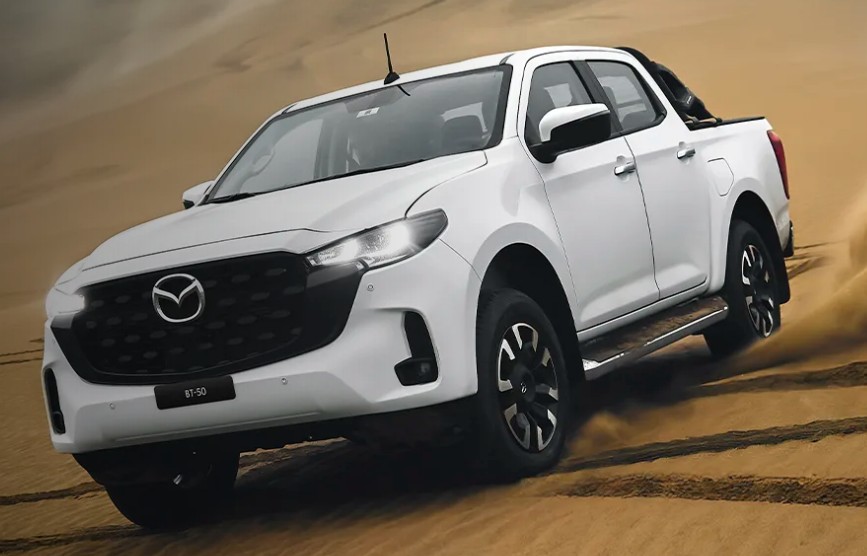
Choosing between the Mazda BT-50 vs Mitsubishi Triton is harder than it first appears. These two utes sit in roughly the same corner of the market, promise serious towing ability, offer genuine four-wheel-drive hardware, and can serve as work trucks Monday through Friday before turning into family adventure machines on Saturday morning.
Yet they approach that job differently.
The Mazda BT-50 feels like the more traditional, polished diesel ute. It combines rugged underpinnings with a cabin and exterior that try to move slightly closer to SUV territory. The Mitsubishi Triton takes a more aggressive route, particularly in its latest generation, with a stronger bi-turbo engine, sophisticated four-wheel-drive technology on higher grades, and an ownership package that can be very attractive.
So, which one would we put in the driveway?
For buyers wanting maximum engine output and flexible 4WD capability, the Triton makes an extremely persuasive case. For those who appreciate simple muscular performance, mature road manners, a handsome cabin, and the proven 3.0-litre BT-50 formula, Mazda remains difficult to dismiss.
Let's pull both apart and find out where each one wins.
Content in this publication
- Mazda BT-50 vs Mitsubishi Triton at a Glance
- Engine Performance: Triton Has the Bigger Punch
- Transmission and Everyday Drivability
- Towing Capacity: BT-50 vs Triton
- Payload and Worksite Practicality
- Off-Road Ability: Mitsubishi Changes the Game
- Fuel Economy: Which Ute Uses Less Diesel?
- Interior Quality and Cabin Comfort
- Rear Seat and Family Friendliness
- Safety Technology
- Design: Which One Looks Better?
- Warranty and Ownership Costs
- Reliability: BT-50 or Triton?
- BT-50 vs Triton for Towing a Caravan
- BT-50 vs Triton for Off-Road Touring
- BT-50 vs Triton as a Daily Driver
- BT-50 vs Triton for Tradies
- Mazda BT-50 Advantages
- Mitsubishi Triton Advantages
- Where the BT-50 Beats the Triton
- Where the Triton Beats the BT-50
- Which Is Better Value for Money?
- Mazda BT-50 vs Mitsubishi Triton: Our Verdict
- Frequently Asked Questions
Mazda BT-50 vs Mitsubishi Triton at a Glance
Before diving into the details, here is the basic picture.
| Category | Mazda BT-50 | Mitsubishi Triton |
|---|---|---|
| Main diesel engine | 3.0L turbo-diesel* | 2.4L bi-turbo diesel |
| Maximum power | 140 kW* | 150 kW |
| Maximum torque | 450 Nm* | 470 Nm |
| Transmission | 6-speed automatic* | 6-speed automatic |
| Maximum braked towing | Up to 3,500 kg | Up to 3,500 kg |
| Maximum payload | Up to around 1.2 tonnes, variant dependent | Up to around 1.1 tonnes, variant dependent |
| 4WD system | Part-time 4WD | Easy Select or Super Select 4WD-II, grade dependent |
| Main personality | Refined, straightforward workhorse | Powerful, tech-focused all-rounder |
| Best suited to | Touring, work and mixed daily use | Off-road versatility, towing and value |
*Mazda specifications vary by model and market. Mazda Australia currently advertises the BT-50 with outputs of up to 140 kW and 450 Nm, maximum towing of 3.5 tonnes, and payload of up to approximately 1.2 tonnes.
Mitsubishi's current Australian Triton uses a 2.4-litre bi-turbo diesel producing 150 kW and 470 Nm, while maximum braked towing reaches 3,500 kg.
Straight away, the Triton holds an advantage on the specification sheet. But numbers tell only part of the story.
Engine Performance: Triton Has the Bigger Punch
This is one of the clearest differences between these utes.
Mazda BT-50 3.0-Litre Diesel Performance
The familiar 3.0-litre turbo-diesel used across much of the BT-50 range produces 140 kW and 450 Nm. It isn't chasing sports-car acceleration, nor should it.
Instead, it gives us the lazy, low-speed muscle that works brilliantly in a ute.
Press the accelerator and the BT-50 generally delivers its strength progressively rather than theatrically. That matters when we're pulling a trailer, crawling along a rough track or carrying hundreds of kilograms in the tray.
Mazda's Australian specification confirms that the 3.0-litre engine produces 140 kW and 450 Nm.
Why the BT-50's 3.0-Litre Still Works
There is something pleasingly uncomplicated about the Mazda's personality. It feels like an engine designed around the job rather than the brochure.
We get good low-speed torque, respectable highway performance, and enough reserve for overtaking without needing to constantly wring the engine's neck.
Mazda has also broadened the BT-50 range in Australia, including smaller-engine variants, so buyers should pay close attention to the engine fitted to the exact version they're considering rather than assuming every BT-50 has identical performance. Current Australian listings include a newer 2.2-litre option on some 2026 variants, for example.
Mitsubishi Triton 2.4 Bi-Turbo Performance
The Triton counters with a 2.4-litre bi-turbo diesel producing 150 kW and 470 Nm.
That means it beats the 3.0-litre BT-50 on both headline power and torque despite having less engine displacement.
Mitsubishi uses twin-stage turbocharging to broaden the engine's usable performance, with peak torque delivered low in the rev range. The company quotes 470 Nm between 1,500 and 2,750 rpm.
In everyday driving, those extra numbers matter most when the ute is working hard.
Think steep highway grades, loaded trays and heavy trailers. Twenty additional Newton-metres will not transform the Triton into a rocket ship, but the stronger output gives it more breathing room.
Performance Winner: Mitsubishi Triton
For outright engine performance, we give the Triton the win.
Its 150 kW and 470 Nm outputs beat the main 3.0-litre BT-50's 140 kW and 450 Nm.
The difference isn't enormous, but when two vehicles are this closely matched elsewhere, small advantages matter.
Transmission and Everyday Drivability
Both models rely heavily on conventional automatic transmissions rather than attempting to win the gearbox arms race with eight, nine or ten ratios.
That isn't necessarily a weakness.
A good six-speed automatic can feel more predictable under load than a transmission constantly hunting between closely stacked gears.
How the BT-50 Feels on the Road
The BT-50 traditionally lands toward the more polished end of the dual-cab ute spectrum.
Its steering is manageable around town, highway stability is reassuring, and ride quality can be relatively composed by ladder-frame ute standards.
It is still a ute, though.
An empty rear tray means leaf-sprung versions can feel firm over broken surfaces. Nobody is going to mistake it for a Mazda CX-5 after hitting the first pothole.
Independent testing of the current BT-50 has nevertheless found its unladen ride reasonably composed, particularly compared with some work-oriented versions of the Triton.
How the Triton Feels on the Road
The latest Triton feels significantly more substantial than older generations.
It has grown up.
The steering, body control and chassis all give the impression that Mitsubishi wanted to create something more competitive against modern Ranger, D-Max, HiLux and BT-50 rivals rather than simply producing a cheap work ute.
Heavy-duty versions can still feel busy at the rear without cargo, however. That is almost unavoidable when suspension is engineered partly around payload.
For long-distance driving, both are perfectly usable. We'd simply recommend testing the exact specification you're considering because wheel size, tyres and rear suspension tune can dramatically change how a ute feels.
Towing Capacity: BT-50 vs Triton
This round produces a draw—at least according to the headline figure.
Both vehicles can offer up to 3,500 kg of braked towing capacity, depending on specification and equipment. Mazda states up to 3.5 tonnes for the BT-50, while Mitsubishi likewise quotes 3.5 tonnes for the Triton.
That's serious towing capability.
A large caravan, horse float, boat or equipment trailer falls within that territory.
But here's the trap: a 3,500 kg towing rating does not automatically mean we can load the ute to its maximum payload while simultaneously towing 3.5 tonnes.
Why GVM and GCM Matter More Than the Advertisement
We need to consider Gross Vehicle Mass, Gross Combination Mass, tow-ball download, passengers, accessories and cargo.
Mazda itself stresses the importance of understanding both GVM and GCM when towing heavy loads.
A bull bar, winch, canopy, drawers, fridge, passengers and tow-ball weight can eat into available payload surprisingly quickly.
It's like ordering a huge pizza and discovering six other people have already claimed slices. The number on the box looked generous; the amount actually available to us isn't always quite so impressive.
Which Is Better for Heavy Towing?
On engine output alone, we'd lean toward the Triton because its 470 Nm gives it slightly more torque.
However, buyers planning to tow near the limit should compare the exact variant's GVM, GCM, kerb weight and rear-axle limits rather than choosing from the 3,500 kg headline alone.
For serious caravan touring, specification beats badge loyalty every time.
Payload and Worksite Practicality
Here's where ute shopping becomes complicated.
Payload varies enormously between cab styles, drivetrains and trim levels.
A stripped-out cab-chassis designed for builders may carry substantially more than a luxury dual cab packed with equipment.
Mazda advertises BT-50 payload capability of up to roughly 1.2 tonnes, depending on variant.
Mitsubishi advertises maximum Triton payload figures reaching approximately 1,111 kg within its Australian ute range.
For traditional work use, therefore, both can be formidable tools.
If we're carrying concrete bags, generators, tools or agricultural supplies every week, the BT-50's strongest payload variants deserve close attention.
If we're buying a high-spec dual cab for family life, though, the usable payload of the specific model matters far more than the maximum figure advertised for the range.
Off-Road Ability: Mitsubishi Changes the Game
This might be the most interesting chapter of the entire comparison.
BT-50 Four-Wheel-Drive Capability
The 4x4 Mazda BT-50 provides the essential ingredients expected from a serious ute: proper four-wheel drive, low-range gearing on relevant models and hardware designed for difficult terrain.
The BT-50 generation developed alongside the Isuzu D-Max has established itself as a credible off-road platform.
We're not dealing with a soft crossover wearing hiking boots.
The Mazda can handle mud, ruts, sand, rocky tracks and steep climbs when properly equipped and driven.
Triton Super Select 4WD-II
Then Mitsubishi pulls out its ace card.
Higher-grade Tritons offer Super Select 4WD-II, which includes a 4H full-time four-wheel-drive setting that can be used on sealed surfaces.
Mitsubishi specifically promotes 4H for improved stability on wet roads and even dry sealed surfaces.
That is hugely useful.
Many traditional part-time 4WD systems are designed to remain in two-wheel drive on high-grip sealed roads. Mitsubishi's setup gives us another option between ordinary rear-wheel drive and locked off-road configurations.
Seven Terrain Modes Add More Flexibility
GLS and GSR Triton models can also offer seven drive modes, helping tailor the vehicle's systems to different surfaces.
Do we absolutely need seven modes?
You may be interested in reading Mazda BT-50 vs Ford Ranger: Which Pickup Is Better?
Probably not.
A skilled driver managed perfectly well before terrain-mode selectors existed.
But when we're driving through changing conditions—wet tarmac, gravel, mud and loose climbs—the Triton's broader electronic toolbox genuinely improves versatility.
Off-Road Winner: Mitsubishi Triton
We'd choose the Triton, particularly a Super Select-equipped model.
The BT-50 remains a capable four-wheel-drive ute, but Mitsubishi's system gives us more flexibility, especially for drivers who encounter wet roads, gravel and changing surfaces rather than spending every trip crawling through extreme terrain.
Fuel Economy: Which Ute Uses Less Diesel?
Fuel economy is difficult to compare perfectly because figures change with body style, transmission, drivetrain and test cycle.
Mitsubishi lists combined consumption around 7.6 L/100 km for portions of its Australian Triton range, while individual specifications can vary.
Mazda's current BT-50 range spans approximately 6.6 to 7.8 L/100 km according to its Australian product page, reflecting the different engines and variants available.
Real life will be another matter.
Add all-terrain tyres, a canopy, roof rack, bull bar and two tonnes of caravan, and official laboratory numbers disappear faster than snacks on a road trip.
Driving style matters too.
A lightly loaded BT-50 travelling at a relaxed highway pace may return very sensible diesel consumption. A Triton repeatedly accelerating through traffic or towing into a headwind will naturally use considerably more.
Fuel Economy Winner
There isn't a universal winner because the comparison changes depending on which BT-50 engine and drivetrain we select.
For buyers prioritising economy above everything else, comparing the exact variant—not merely “BT-50 versus Triton”—is essential.
Interior Quality and Cabin Comfort
Mazda has an advantage that appears before we even turn the key: brand personality.
Mazda has spent years building cars and SUVs around stylish cabins, attractive materials and clean design.
Some of that philosophy reaches the BT-50.
BT-50 Interior
Higher-grade BT-50 models can feel pleasantly premium for a commercial vehicle.
Switchgear is logically arranged, driving position is comfortable, and the cabin doesn't scream “work truck” every second we're inside it.
Some Isuzu D-Max DNA is naturally visible underneath because the vehicles are closely related mechanically, but Mazda has worked to create its own visual personality.
The result suits buyers moving into a ute from an SUV.
Triton Interior
The newest Triton is dramatically more modern than previous generations.
The dashboard is functional, upright and heavily focused on usability.
Mitsubishi has also loaded variants with useful technology rather than making every convenience feature the exclusive territory of expensive flagship models. Current Australian GLX specifications, for example, can include features such as wireless Apple CarPlay, Android Auto, parking sensors, a reversing camera, tyre-pressure monitoring and adaptive cruise control.
It isn't trying quite as hard to imitate a luxury SUV, though.
Interior Winner: Mazda BT-50
For visual sophistication and perceived polish, our preference is the BT-50.
For equipment and rugged practicality, the Triton is right behind it—and could easily win depending on trim level.
Rear Seat and Family Friendliness
Dual-cab utes now spend far more time outside schools and supermarkets than old-school pickup buyers might like to admit.
So rear-seat space matters.
Children grow. Car seats consume huge amounts of room. Teenagers complain. Adults complain even louder.
Both vehicles can work as family transport, but neither gives us the enormous rear compartment of a large SUV.
The Triton's newer platform and expanded cabin make it considerably more family-friendly than older Tritons, while the BT-50 provides a comfortable enough second row for normal use.
Our recommendation here is wonderfully unscientific: take the family to the dealership.
Install the actual child seats if necessary. Put the driver's seat in your normal position. Sit behind it.
Ten minutes doing that tells us more than fifty paragraphs of dimensional data.
Safety Technology
Modern utes have transformed from relatively simple work vehicles into rolling sensor networks.
Both Mazda and Mitsubishi offer extensive driver-assistance systems.
Depending on variant, we can find adaptive cruise control, autonomous emergency braking, blind-spot monitoring, lane-assistance technologies, rear cross-traffic alert and other active safety features.
Mazda has offered systems such as adaptive cruise control, autonomous emergency braking, blind-spot monitoring and lane-keeping assistance across the modern BT-50 generation.
Mitsubishi similarly equips current Tritons with a substantial active-safety package, with features differing by grade.
What About Driver Monitoring?
One controversial element of the modern Triton is its driver-monitoring technology.
Reviewers and some owners have found the system intrusive at times, particularly when it interprets normal glances away from the road as distraction. Independent reviews have specifically highlighted the driver-monitoring system as a downside.
That's not necessarily a reason to reject the ute.
But it is absolutely something we would test during a decent test drive.
A safety system should feel like a quiet co-driver, not a nervous driving instructor sitting six centimetres from our ear.
Design: Which One Looks Better?
Beauty is subjective, but these two aren't remotely identical.
BT-50 Styling
The BT-50 takes the softer, more sophisticated route.
Its front-end treatment ties it visually to Mazda's passenger-car range more successfully than we'd expect from a ladder-frame commercial vehicle.
It looks smart without trying to intimidate every hatchback in the supermarket parking lot.
For buyers who want a ute but don't necessarily want the visual aggression associated with one, the BT-50 works beautifully.
Triton Styling
The Triton is the opposite.
It looks ready for combat.
Its upright front end, squared proportions and tough detailing give it much more road presence than earlier generations.
Park the two together and the Mazda arrives wearing a fitted jacket; the Mitsubishi turns up wearing steel-capped boots.
Neither philosophy is wrong.
We simply choose the Mazda for elegance and the Triton for aggression.
Warranty and Ownership Costs
Ownership support can shift the entire buying decision.
Mitsubishi Australia promotes a 10-year warranty, 10 years of capped-price servicing and up to 10 years of roadside assistance, although eligibility and conditions apply.
That is a powerful proposition for someone planning to keep a vehicle long term.
The details matter, of course. Long warranty programs typically have servicing requirements and conditions, so buyers should read the current terms rather than assuming every vehicle automatically receives maximum coverage under every circumstance.
Still, Mitsubishi's ownership package is one of the Triton's biggest weapons.
Ownership Winner: Mitsubishi Triton
If long-term factory-backed coverage carries heavy weight in our decision, the Triton has the stronger argument in Australia.
Warranty conditions vary between countries, however, so buyers outside Australia should check their local Mazda and Mitsubishi terms.
Reliability: BT-50 or Triton?
Now we arrive at the question everyone asks and nobody can answer with one magic number.
Both vehicles have respectable pedigrees.
The current BT-50 shares much of its mechanical architecture with the Isuzu D-Max rather than the Ford Ranger-based BT-50 generations of the past. That distinction matters tremendously when researching used vehicles.
The latest Triton is also substantially different from previous generations.
We therefore wouldn't judge a 2026 BT-50 based entirely on stories about a 2014 model, nor would we assume everything written about a 2012 Triton applies to today's truck.
Which Should Last Longer?
Long-term durability depends on servicing, workload, driving conditions and maintenance quality.
A ute towing three tonnes through heat and dust every week experiences a very different life from one commuting 20 kilometres to an office.
For long ownership, we'd focus on:
You may be interested in readingMazda BT-50 vs Ford Ranger: Which Pickup Is Better?You may be interested in reading
 Renault Koleos vs Nissan X-Trail: Which SUV Is Better?
- documented servicing and correct fluids;
- sensible oil-change intervals;
- DPF operating conditions;
- cooling-system condition;
- transmission servicing where appropriate;
- suspension and steering wear;
- signs of hard towing or off-road abuse;
- modifications and whether they were professionally installed.
On a new vehicle, we'd call reliability reasonably close and give Mitsubishi an advantage in ownership reassurance where its extended warranty conditions can be met.
On used vehicles, condition and service history are far more important than the badge.
BT-50 vs Triton for Towing a Caravan
If our primary mission involves caravan touring, we'd lean slightly toward the Triton because of the stronger 150 kW/470 Nm engine and excellent 4WD flexibility.
The ability to use Mitsubishi's full-time 4H mode on suitable Super Select versions can also be reassuring when travelling on wet highways or changing road surfaces.
However, the 3.0-litre BT-50 is hardly weak.
Its 450 Nm diesel delivers the kind of relaxed low-speed pull that suits caravan work, and Mazda offers a 3,500 kg maximum braked towing rating on appropriate models.
The bigger issue is payload.
A heavy caravan with substantial tow-ball download plus two adults, children, accessories, luggage and touring equipment can turn a seemingly generous payload allowance into a tight calculation.
We'd run the numbers before buying either.
BT-50 vs Triton for Off-Road Touring
For a vehicle that will spend considerable time exploring remote tracks, our choice becomes clearer.
Triton wins.
Super Select 4WD-II is simply too useful to ignore.
Traditional low-range hardware remains crucial when things get difficult, but Mitsubishi gives drivers additional flexibility across mixed surfaces.
The BT-50 is perfectly capable off-road, especially with suitable tyres and sensible modifications, but its approach is more conventional.
The Triton has the deeper bag of tricks.
BT-50 vs Triton as a Daily Driver
Reverse the situation and Mazda starts fighting back.
If we're commuting five days per week and exploring dirt roads occasionally, the BT-50's styling, cabin atmosphere and general road polish can make it easier to live with.
This is important.
We often buy utes based on the 10 percent of journeys we dream about rather than the 90 percent we actually make.
Do we really need the most elaborate four-wheel-drive system for a vehicle spending 300 days per year on asphalt?
Maybe.
But if not, Mazda's refinement becomes a stronger selling point.
BT-50 vs Triton for Tradies
For work, the answer depends on configuration.
A tradie buying a cab-chassis needs payload, durability, storage solutions and operating costs.
A self-employed contractor using a dual cab as both business vehicle and family transport may care far more about cabin comfort, technology and towing.
Both manufacturers offer different body and grade combinations.
The BT-50 has particularly strong maximum payload claims across selected variants, while Mitsubishi combines impressive carrying capacity with its 150 kW bi-turbo diesel.
We wouldn't select the flashiest trim automatically.
Luxury equipment adds weight and cost. Sometimes the best work ute is sitting two grades below the flagship.
Mazda BT-50 Advantages
The Mazda makes the most sense when we value cabin presentation, mature styling, straightforward diesel performance and a generally polished everyday personality.
Its 3.0-litre engine is strong enough for serious work, 3.5-tonne towing is competitive, payload can be impressive in the right version, and its appearance is arguably one of the least agricultural in the segment.
The BT-50 also benefits from its relationship with the Isuzu D-Max, giving buyers access to a broad ecosystem of knowledge, servicing experience and aftermarket equipment.
Mitsubishi Triton Advantages
The Triton's strongest cards are easier to identify.
It offers more headline power and torque from its 2.4-litre bi-turbo diesel, a highly versatile Super Select 4WD-II system on relevant grades, 3.5-tonne towing capability and a very appealing Australian ownership program.
It also feels like the fresher engineering package.
Mitsubishi has clearly aimed higher with this generation.
The result is no longer merely the ute we choose because it's cheaper than the segment favourites. It deserves consideration on capability alone.
Where the BT-50 Beats the Triton
We'd put Mazda ahead for cabin ambience, restrained styling and everyday refinement.
Some drivers will also prefer the uncomplicated nature of its 3.0-litre single-turbo diesel configuration compared with the Triton's smaller bi-turbo approach.
Its maximum advertised payload across selected Australian configurations is another strong point.
Finally, there's an emotional factor.
The BT-50 simply feels less utilitarian inside and outside. If our ute is also our family vehicle, that matters.
Where the Triton Beats the BT-50
Performance is the obvious victory.
150 kW and 470 Nm beats 140 kW and 450 Nm.
Then comes four-wheel-drive technology.
Super Select 4WD-II gives appropriate Triton variants a flexibility the BT-50's more traditional part-time system cannot completely replicate.
Add seven selectable drive modes on higher grades, strong towing capacity and Mitsubishi's long Australian ownership package, and the Triton begins stacking up victories quickly.
Which Is Better Value for Money?
Value depends heavily on the trim levels being compared.
A low-spec work-focused BT-50 against a high-grade Triton tells us very little, as does comparing advertised prices without considering dealer offers, standard equipment and drivetrain.
The Mitsubishi traditionally competes aggressively on price, and its combination of engine performance, 4WD hardware and warranty coverage makes it particularly difficult to ignore.
Mazda counters with presentation and perceived quality.
If two equivalent versions cost roughly the same, we'd argue the Triton generally gives us more mechanical capability for the money.
But buyers wanting something that feels a touch more polished may happily pay for the BT-50.
Mazda BT-50 vs Mitsubishi Triton: Our Verdict
So, after comparing the Mazda BT-50 vs Mitsubishi Triton, which one would we choose?
For the broadest range of buyers, the Mitsubishi Triton narrowly wins.
The reason isn't one spectacular feature. It's the accumulation of smaller victories.
Its 2.4-litre bi-turbo diesel produces more power and torque. Its 3.5-tonne maximum towing capacity matches the Mazda's headline figure. Higher grades offer the excellent Super Select 4WD-II system. Its latest chassis feels thoroughly modern, and the Australian warranty and servicing proposition is difficult to overlook.
But this isn't a knockout.
The BT-50 remains our pick for somebody who wants a ute with a more sophisticated personality.
Its 3.0-litre diesel offers useful low-speed muscle, its 3,500 kg towing capability remains highly competitive, payload can exceed one tonne depending on specification, and the cabin feels more welcoming than many traditional work trucks.
Think of it this way.
The Triton is the multitool. It gives us a wider collection of mechanical tricks and excellent value.
The BT-50 is the quality pocketknife. Simpler in certain areas perhaps, but polished, satisfying and extremely useful.
For serious off-road touring, changing road conditions and buyers chasing the strongest specification-per-dollar equation, we'd take the Mitsubishi Triton.
For daily driving, touring, towing and drivers who care about cabin feel as much as off-road hardware, we'd happily own the Mazda BT-50.
There really isn't a bad choice here.
There is simply a better choice for the way we intend to use it.
Frequently Asked Questions
Is the Mazda BT-50 better than the Mitsubishi Triton?
The Mazda BT-50 may be better for buyers prioritising interior presentation, restrained styling and refined everyday road manners. The Mitsubishi Triton has the advantage in outright engine output and, on higher grades, four-wheel-drive versatility. Overall, we'd give the latest Triton a narrow win for capability and value.
Which has more power, Mazda BT-50 or Mitsubishi Triton?
The current Australian Mitsubishi Triton's 2.4-litre bi-turbo diesel produces 150 kW and 470 Nm. Mazda's established 3.0-litre BT-50 diesel produces 140 kW and 450 Nm, although the BT-50 range now contains different engine options depending on specification.
Which is better off-road, BT-50 or Triton?
Both are genuine off-road-capable utes, but we'd choose the Mitsubishi Triton, particularly in a grade equipped with Super Select 4WD-II. Its full-time 4H setting and multiple terrain modes provide extra flexibility across sealed roads, gravel and difficult off-road conditions.
Can the Mazda BT-50 and Mitsubishi Triton tow 3,500 kg?
Yes, appropriate versions of both utes are rated to tow up to 3,500 kg braked. However, owners must also remain within GVM, GCM, axle-load and tow-ball limits. Maximum towing capacity should therefore never be considered in isolation.
You may be interested in readingMazda BT-50 vs Ford Ranger: Which Pickup Is Better?You may be interested in reading
Renault Koleos vs Nissan X-Trail: Which SUV Is Better?You may be interested in reading
Renault Koleos vs Audi Q5: Which SUV Makes More Sense?Which should we buy, Mazda BT-50 or Mitsubishi Triton?
Choose the Mitsubishi Triton if engine performance, sophisticated four-wheel-drive technology, towing capability and long-term ownership coverage are priorities. Choose the Mazda BT-50 if you prefer a polished cabin, cleaner styling, straightforward 3.0-litre diesel performance and comfortable mixed daily use. For most new-ute buyers comparing equivalent current models, we'd narrowly favour the Triton.
If you want to know other articles similar to Mazda BT-50 vs Mitsubishi Triton: Which Ute Is Better? you can visit the category Models.
Kia Sorento Models: Complete Guide to Trims, Engines and Versions
BYD Shark 6 vs Ranger vs HiLux: Which Ute Makes the Most Sense in 2026?
BYD Shark 6 vs MG U9: Which Ute Makes More Sense in 2026?
BYD Shark 6 vs Ford Ranger Raptor: Which Performance Ute Is Better in 2026?
BYD Shark 6 vs Kia Tasman: Which Ute Is Better?
BYD Shark 6 vs 7: What We Know So Far
Leave a Reply
More content of your interest