
BYD Shark 6 vs Kia Tasman: Which Ute Is Better?

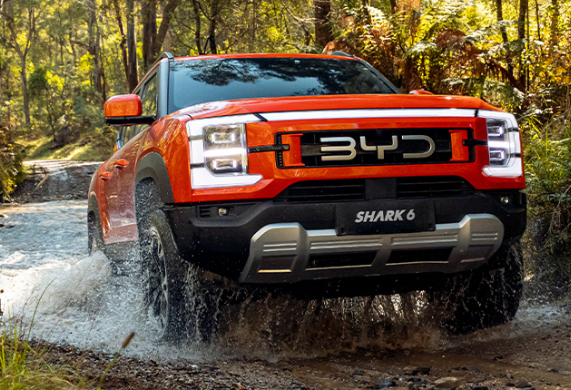
The BYD Shark 6 vs Kia Tasman comparison is one of the most interesting matchups in the Australian ute market. Both are relatively new players, both are designed to challenge established names such as the Ford Ranger, Toyota Hilux and Isuzu D-Max, but they approach the job from completely different directions.
The BYD Shark 6 uses a powerful plug-in hybrid drivetrain combining petrol and electric power. The Kia Tasman follows a much more traditional formula with a 2.2-litre turbo-diesel engine, an eight-speed automatic transmission and a conventional 4x4 system.
So, which one makes more sense?
For buyers who prioritise acceleration, refinement, electric driving and technology, the Shark 6 has some obvious attractions. Buyers who regularly tow heavy trailers, carry large payloads or travel far from charging infrastructure may find the Tasman's traditional diesel setup more familiar and practical.
Let's compare them in detail.
Content in this publication
- BYD Shark 6 vs Kia Tasman Specifications
- BYD Shark 6 vs Kia Tasman Engine and Performance
- Which Is Faster?
- BYD Shark 6 vs Kia Tasman Towing Capacity
- Payload Capacity
- BYD Shark 6 vs Kia Tasman Fuel Consumption
- BYD Shark 6 Electric Range
- BYD Shark 6 vs Kia Tasman Range
- Size and Dimensions
- Tray and Cargo Space
- BYD Shark 6 vs Kia Tasman Off-Road
- Ride Comfort
- Interior and Technology
- Vehicle-to-Load Capability
- Shark 6 vs Tasman for Daily Driving
- Shark 6 vs Tasman for Tradies
- Shark 6 vs Tasman for Family Use
- BYD Shark 6 vs Kia Tasman Price
- BYD Shark 6 Performance vs Kia Tasman
- BYD Shark 6 Advantages
- Kia Tasman Advantages
- BYD Shark 6 vs Kia Tasman for Long-Distance Touring
- BYD Shark 6 vs Kia Tasman Reliability
- Who Should Buy the BYD Shark 6?
- Who Should Buy the Kia Tasman?
- BYD Shark 6 vs Kia Tasman: Main Differences
- Frequently Asked Questions
- Final Thoughts
BYD Shark 6 vs Kia Tasman Specifications
The differences become immediately obvious when we put the main specifications side by side.
| Specification | BYD Shark 6 Premium | Kia Tasman 4x4 |
|---|---|---|
| Engine | 1.5L turbo PHEV | 2.2L turbo diesel |
| Drivetrain | AWD | 4x4 |
| Maximum power | 321 kW | 154 kW |
| Maximum torque | 650 Nm | 440 Nm |
| Transmission | Hybrid electric drivetrain | 8-speed automatic |
| 0-100 km/h | 5.7 sec | Not performance-focused |
| Braked towing capacity | 2,500 kg | 3,500 kg |
| Fuel tank | 60 L | 80 L |
| Electric range | Up to 100 km* | None |
| Battery | Approx. 29.6 kWh | None |
| Length | 5,457 mm | 5,410 mm |
| Width | 1,971 mm | 1,930 mm |
| Wheelbase | 3,260 mm | 3,270 mm |
| Shark Premium payload | About 790 kg | Up to around 1,000 kg on dual-cab pick-up models |
BYD quotes 321 kW and 650 Nm for the Shark 6 Premium, along with a claimed 5.7-second 0-100 km/h time and 100 km NEDC electric range. Kia's Australian Tasman uses a 154 kW/440 Nm 2.2-litre turbo-diesel and offers up to 3,500 kg of braked towing capacity.
There is also an important new consideration: the BYD Shark 6 Performance. This version increases maximum output to 350 kW and offers a 3,500 kg braked towing rating, significantly closing the capability gap with the Tasman.
BYD Shark 6 vs Kia Tasman Engine and Performance
This is perhaps the biggest difference between the two utes.
BYD Shark 6 Plug-In Hybrid Powertrain
The Shark 6 Premium combines:
- A 1.5-litre turbo petrol engine
- Front electric motor
- Rear electric motor
- BYD Blade Battery
- Electric AWD
- 321 kW combined power
- 650 Nm combined torque
The result is performance closer to a quick SUV than a traditional diesel work ute.
BYD claims 0-100 km/h in just 5.7 seconds for the Premium.
That is exceptionally quick for a large dual-cab pickup.
Electric motors also provide immediate torque, meaning the Shark can respond almost instantly when we press the accelerator.
Kia Tasman Diesel Engine
The Australian Kia Tasman takes a more conventional approach.
Its 2.2-litre four-cylinder turbo-diesel develops:
- 154 kW
- 440 Nm
- Eight-speed automatic transmission
Kia pairs the diesel with a traditional four-wheel-drive system on 4x4 versions.
The numbers are nowhere near those of the BYD, but outright acceleration isn't really the Tasman's purpose.
The diesel is designed around predictable torque delivery, towing, payload and long-distance touring.
Which Is Faster?
The BYD Shark 6 is considerably faster.
Its 321 kW hybrid system provides more than twice the maximum power of the Australian Tasman's 154 kW diesel.
The difference is immediately noticeable when:
- Overtaking
- Merging onto highways
- Accelerating uphill
- Driving without a load
- Pulling away from intersections
There is also the Shark 6 Performance, which raises output to 350 kW and has a claimed 0-100 km/h time of 5.5 seconds.
For drivers interested in performance, there really isn't much similarity between the two.
BYD Shark 6 vs Kia Tasman Towing Capacity
Towing is where the comparison becomes much more interesting.
BYD Shark 6 Towing Capacity
The Shark 6 Premium has an official braked towing capacity of:
2,500 kg
Its unbraked towing capacity is 750 kg.
That's enough for many:
- Small caravans
- Boats
- Jet skis
- Box trailers
- Camping trailers
However, traditional diesel utes commonly offer 3,500 kg.
BYD has addressed that limitation with the newer Shark 6 Performance, which is rated to tow 3,500 kg braked.
Kia Tasman Towing Capacity
The Kia Tasman offers:
3,500 kg braked towing capacity
It also has a maximum 350 kg tow-ball download rating.
An integrated trailer brake controller is available as part of the Tasman's towing-focused setup.
If we're comparing the regular Shark 6 Premium with the Tasman, the difference is straightforward.
The Kia can legally tow considerably more.
However, when comparing the Shark 6 Performance vs Kia Tasman, both can reach a claimed 3,500 kg braked towing rating.
Serious towing buyers should still consider GVM, GCM, tow-ball load, passengers, accessories and payload rather than looking only at headline towing capacity.
Payload Capacity
Payload is another major consideration.
The original Shark 6 Premium has a kerb weight of approximately 2,710 kg and a gross vehicle mass of 3,500 kg, which leaves roughly 790 kg of theoretical payload before accessories and other considerations.
The Tasman has been designed much more explicitly as a one-tonne work ute.
Kia advertises up to 1,000 kg payload on its dual-cab pick-up range.
Cab-chassis versions can go higher. Kia lists up to 1,185 kg for certain dual-cab chassis configurations.
For tradespeople carrying tools and materials every day, that difference matters.
BYD Shark 6 vs Kia Tasman Fuel Consumption
This comparison isn't as simple as looking at two fuel economy numbers.
The Shark 6 is a plug-in hybrid.
The Tasman is diesel-only.
BYD lists fuel consumption of approximately 2.0 L/100 km for the Shark 6 Premium under its test conditions when the battery has sufficient charge.
With the battery at a low state of charge, BYD lists approximately 7.9 L/100 km.
That distinction is extremely important.
If we recharge frequently and complete many journeys within the electric range, petrol consumption can potentially be very low.
If we rarely charge it, the vehicle becomes a heavy petrol-hybrid ute carrying a large battery around.
Kia Tasman Fuel Economy
The 2.2-litre diesel Tasman has an official combined fuel consumption figure of around 7.6 L/100 km for relevant Australian configurations.
Real consumption will naturally depend on:
- Driving speed
- Payload
- Towing
- Terrain
- Tyres
- Driving style
- Accessories
Which Is Cheaper to Run?
It depends heavily on how the Shark is used.
A Shark 6 owner who plugs in every night and drives relatively short distances can use significantly less liquid fuel.
You may be interested in reading BYD Shark 6 vs Ford Ranger Raptor: Which Performance Ute Is Better in 2026?
Someone who regularly drives hundreds of kilometres on highways without charging may see a much smaller advantage.
The Tasman is simpler: fill the diesel tank and drive.
BYD Shark 6 Electric Range
The Shark 6 Premium uses a battery of approximately 29.6 kWh.
BYD quotes up to around 100 km of electric driving under the NEDC test standard.
We wouldn't assume that every owner will get exactly 100 km in everyday conditions.
Electric range can decrease because of:
- Highway speeds
- Cold or hot weather
- Towing
- Heavy payloads
- Aggressive acceleration
- Air-conditioning use
- Terrain
Nevertheless, even a shorter real-world electric range could allow many owners to complete their daily commute largely on electricity.
The Kia Tasman has no electric-only mode.
BYD Shark 6 vs Kia Tasman Range
BYD advertises up to approximately 800 km combined range for the Shark 6 Premium under its applicable test conditions.
Its fuel tank holds 60 litres.
The Tasman has a larger 80-litre diesel tank.
For remote touring, the diesel system has an obvious practical advantage: filling an 80-litre tank takes only minutes and diesel is widely available across Australia.
The Shark compensates by allowing us to use both electricity and petrol.
Size and Dimensions
Both are substantial utes.
The Shark 6 Premium measures approximately:
- Length: 5,457 mm
- Width: 1,971 mm
- Height: 1,925 mm
- Wheelbase: 3,260 mm
The Kia Tasman measures approximately:
- Length: 5,410 mm
- Width: 1,930 mm
- Height: 1,870 mm on standard versions
- Wheelbase: 3,270 mm
The Shark is therefore slightly longer and wider, while the wheelbases are almost identical.
Both will feel substantial in narrow city parking spaces.
Tray and Cargo Space
The Shark 6 Premium has a quoted tray volume of around 1,200 litres.
Kia places considerable emphasis on Tasman cargo capacity.
The Tasman's tub offers up to approximately 1,336 litres SAE and can accommodate an Australian standard pallet.
Kia also offers both pick-up and cab-chassis configurations, making the Tasman especially flexible for commercial users.
BYD Shark 6 vs Kia Tasman Off-Road
Both vehicles are designed to travel beyond sealed roads, but they use very different mechanical philosophies.
The Shark 6 has:
- AWD
- 230 mm unladen ground clearance
- 31-degree approach angle
- 19.3-degree departure angle
- 17-degree ramp-over angle
- Up to 700 mm wading depth
- Mud mode
- Sand mode
- Snow mode
Its electric motors can distribute torque rapidly, giving the Shark interesting potential on slippery surfaces.
The independent double-wishbone rear suspension also contributes to a more comfortable ride than the traditional leaf-spring arrangement used by many work utes.
Kia Tasman Off-Road Capability
The Tasman uses a more conventional off-road layout.
Depending on trim, equipment includes:
- 4x4 transfer system
- Mechanical or electronic rear differential lock
- Mud mode
- Sand mode
- Snow mode
- Rock mode on X-Pro
- X-Trek mode
- All-terrain tyres on X-Pro
- Underbody protection
- Ground View Monitor
For serious recreational off-roading, the Tasman X-Pro is particularly interesting because Kia has designed it specifically around that purpose.
Ride Comfort
This could be one of the strongest reasons to consider the Shark.
Unlike many conventional utes, the Shark 6 has double-wishbone suspension at both the front and rear.
That helps give it a more SUV-like feel.
The Tasman uses a double-wishbone front setup but retains a rigid rear axle with leaf springs in work-focused configurations.
Leaf springs have advantages when carrying heavy loads, but they can create a firmer unloaded ride.
If our ute spends most of its time carrying people rather than cement bags, tools and building materials, the Shark's suspension concept is attractive.
Interior and Technology
Both manufacturers have made cabin technology a major selling point.
BYD Shark 6 Interior
The Shark 6 Premium features a large 15.6-inch rotating touchscreen.
It also offers the sort of technology buyers have come to expect from modern BYD vehicles, including an extensive digital interface and driver-assistance technology.
The interior feels closer to a contemporary electrified SUV than an old-school commercial pickup.
Kia Tasman Interior
The Tasman also takes technology seriously.
Its dashboard includes an integrated panoramic display combining large digital displays, while selected versions add features such as:
- Surround View Monitor
- Blind-spot View Monitor
- Wireless charging
- Heated seats
- Ventilated seats
- Harman Kardon audio
- Digital connectivity
- Second-row slide and recline functionality
Kia also claims generous rear passenger space, with selected Tasman versions offering sliding and reclining second-row seats.
Vehicle-to-Load Capability
One particularly useful Shark feature is vehicle-to-load, or V2L.
The Shark's battery can effectively act as a portable power source.
That makes it useful for:
- Camping
- Power tools
- Portable refrigerators
- Lighting
- Laptops
- Outdoor equipment
For people who camp frequently or work away from mains electricity, this is more useful than it might initially sound.
The Tasman SX+ and higher grades offer 240V power outlets, including an outlet in the tub, providing its own solution for powering equipment.
For ordinary commuting, we'd expect many buyers to appreciate the Shark's hybrid system.
Electric driving provides:
- Smooth acceleration
- Low noise
- Immediate torque
- Reduced fuel consumption when regularly charged
- No diesel vibration during electric operation
The Tasman feels more conventional.
For some buyers, that's exactly what they want.
There is no need to think about charging. We simply refuel and continue driving.
Tradies should pay particularly close attention to payload.
A ute may produce enormous horsepower and torque, but that doesn't automatically mean it is the best vehicle for carrying a heavy load every day.
The Tasman's higher available payload, cab-chassis options and broad tray choices make it particularly well suited to commercial work.
Kia even offers single-cab and dual-cab chassis variants in addition to the regular pick-up.
The Shark 6 is arguably more lifestyle-oriented, although BYD now also offers a Dynamic Cab Chassis version.
You may be interested in readingBYD Shark 6 vs Ford Ranger Raptor: Which Performance Ute Is Better in 2026?You may be interested in reading
BYD Shark 6 vs MG U9: Which Ute Makes More Sense in 2026?The balance changes if the ute doubles as the family car.
The Shark's independent suspension, enormous performance, quiet electric driving and technology package make it an appealing alternative to a large SUV.
The Tasman isn't basic, though.
Higher trim levels have been designed to make it substantially more comfortable than traditional commercial vehicles.
Features such as reclining rear seats, rear air vents, heated seats and advanced cameras can make the Tasman perfectly suitable for family duties.
BYD Shark 6 vs Kia Tasman Price
Australian pricing changes regularly with trim level, model year and promotional offers, so buyers should always verify the current drive-away figure.
As of September 2026, BYD Australia advertises the Shark 6 Premium from approximately A$57,900 drive-away under its current offer.
The Tasman range covers a wider range of prices and configurations. Kia's September 2026 offers list examples ranging from the lower-spec S models through SX, SX+, X-Line and X-Pro variants.
This broad range means Tasman buyers can choose between a more work-oriented model and a heavily equipped lifestyle ute.
BYD Shark 6 Performance vs Kia Tasman
The arrival of the Shark 6 Performance makes this comparison even more interesting.
The Performance version uses a 2.0-litre turbo hybrid engine and increases combined output to:
350 kW
It can accelerate from 0-100 km/h in a claimed:
5.5 seconds
Most importantly for ute buyers, its rated braked towing capacity increases to:
3,500 kg
That removes one of the biggest specification advantages the Tasman holds over the standard Shark 6 Premium.
However, towing capacity alone still doesn't make the two vehicles identical.
The Kia remains built around a conventional diesel work-ute architecture, while the BYD Performance focuses on combining serious capability with extremely strong hybrid performance.
BYD Shark 6 Advantages
The Shark 6 makes a particularly strong case for buyers who value:
- Extremely strong acceleration
- Plug-in hybrid efficiency
- Electric-only commuting
- Smooth and quiet operation
- Advanced cabin technology
- Independent rear suspension
- Vehicle-to-load functionality
- High combined power and torque
It represents a fundamentally different interpretation of what a ute can be.
Kia Tasman Advantages
The Tasman has several important strengths of its own:
- 3,500 kg braked towing capacity
- Up to one-tonne payload on dual-cab pick-ups
- Higher payload available on some cab-chassis models
- Traditional diesel drivetrain
- 80-litre fuel tank
- Multiple cab and tray configurations
- Dedicated off-road X-Pro model
- Integrated trailer brake controller
- Large cargo tub
- Extensive work-focused accessories
For buyers who want a conventional workhorse, those are meaningful advantages.
BYD Shark 6 vs Kia Tasman for Long-Distance Touring
For remote Australian travel, the Tasman's diesel setup has a compelling simplicity.
Diesel is easy to find, the tank is large and refuelling takes minutes.
The BYD can certainly travel long distances using its petrol engine once the battery charge falls, but owners won't obtain the same fuel-saving benefits they get from frequent charging.
If we're mostly travelling between cities with charging available at home or accommodation, the Shark makes more sense.
If we're regularly travelling through remote regions while towing a large caravan, the Tasman's conventional setup may be easier to live with.
BYD Shark 6 vs Kia Tasman Reliability
It's still too early to make definitive long-term reliability comparisons.
Both models are relatively new, meaning we don't yet have the decade of ownership data available for vehicles such as the Toyota Hilux or Ford Ranger.
There are also very different technologies involved.
The Tasman uses a diesel engine and conventional automatic transmission.
The Shark combines:
- Petrol engine
- High-voltage battery
- Electric motors
- Power electronics
- Plug-in charging hardware
That doesn't automatically mean one will be more or less reliable. It simply means their long-term maintenance profiles are likely to be different.
BYD lists an eight-year/160,000 km traction battery warranty and a six-year/150,000 km vehicle warranty, subject to its warranty terms and exclusions.
Who Should Buy the BYD Shark 6?
The Shark 6 makes the most sense if we:
- Can charge at home
- Mainly use the ute for commuting and recreation
- Want very strong performance
- Prefer a comfortable SUV-like ride
- Rarely exceed 2,500 kg towing with the Premium
- Like modern technology
- Want to reduce petrol use on shorter trips
The Performance version becomes even more attractive for buyers who need 3,500 kg towing.
Who Should Buy the Kia Tasman?
The Tasman makes more sense for buyers who:
- Regularly tow heavy caravans or trailers
- Carry heavy equipment
- Want approximately one-tonne payload capability
- Need a cab-chassis
- Travel into remote areas
- Prefer diesel
- Need numerous work-specific accessories
- Want traditional low-range-style 4x4 capability and dedicated off-road equipment
It follows a more familiar Australian ute formula.
BYD Shark 6 vs Kia Tasman: Main Differences
Ultimately, this isn't simply an argument between two similar utes.
They represent two different philosophies.
The BYD Shark 6 is essentially a high-performance electrified lifestyle ute capable of doing serious work.
The Kia Tasman is fundamentally a traditional diesel work and touring ute that incorporates modern SUV-style comfort and technology.
For urban driving, family duties and owners who can recharge regularly, the Shark's plug-in hybrid system has significant appeal.
For carrying heavy loads, commercial work and long-distance towing, the Tasman's payload capability, diesel drivetrain and broader commercial configuration range remain major considerations.
The newer 3,500 kg-capable Shark 6 Performance narrows that divide considerably, making the comparison even more competitive.
Frequently Asked Questions
Is the BYD Shark 6 better than the Kia Tasman?
They target slightly different buyers. The Shark 6 emphasises plug-in hybrid efficiency, strong acceleration, technology and comfort, while the Tasman places greater emphasis on traditional diesel capability, towing, payload and commercial versatility.
Which can tow more, the Kia Tasman or BYD Shark 6?
The Kia Tasman is rated to tow up to 3,500 kg braked. The Shark 6 Premium is rated to 2,500 kg, while the newer Shark 6 Performance increases the rating to 3,500 kg.
Is the BYD Shark 6 faster than the Kia Tasman?
Yes. The Shark 6 Premium produces 321 kW and can reach 100 km/h in a claimed 5.7 seconds. The newer Performance produces 350 kW and is claimed to reach 100 km/h in 5.5 seconds.
Which has better fuel economy, BYD Shark 6 or Kia Tasman?
The Shark 6 can use considerably less petrol when regularly charged because many shorter journeys can use electric power. Once its battery reaches a low state of charge, the difference becomes smaller. The Tasman's official diesel consumption is around 7.6 L/100 km in relevant Australian specifications.
Which is better for towing a caravan?
For heavier caravans, the Tasman's 3,500 kg towing capacity and work-focused diesel platform make it a natural option. The Shark 6 Premium is limited to 2,500 kg, but the Shark 6 Performance is now rated to 3,500 kg. Buyers should calculate payload, tow-ball mass, GVM and GCM for their specific vehicle and caravan rather than relying on maximum towing capacity alone.
Final Thoughts
The BYD Shark 6 vs Kia Tasman battle shows how rapidly the ute market is changing.
A few years ago, choosing a dual-cab ute generally meant deciding between several turbo-diesel engines with broadly similar specifications. The Shark 6 changes that equation by offering plug-in charging, electric driving and sports-car-like acceleration in a full-size ute.
The Tasman takes another route.
It combines a familiar 2.2-litre diesel drivetrain with 3,500 kg towing capability, serious payload capacity, a large cargo area and multiple configurations aimed at both lifestyle users and working professionals.
For predominantly urban and suburban driving with regular access to charging, the BYD Shark 6 offers a compelling combination of performance, refinement and potential running-cost savings.
For heavy-duty commercial use, regular long-distance towing or buyers wanting a traditional diesel ute, the Kia Tasman offers a highly practical alternative.
You may be interested in readingBYD Shark 6 vs Ford Ranger Raptor: Which Performance Ute Is Better in 2026?You may be interested in reading
BYD Shark 6 vs MG U9: Which Ute Makes More Sense in 2026?You may be interested in reading
BYD Shark 6 vs Ranger vs HiLux: Which Ute Makes the Most Sense in 2026?And with the Shark 6 Performance now bringing 350 kW and a 3,500 kg towing rating into the equation, the gap between electrified lifestyle utes and conventional workhorses is becoming smaller than ever.
If you want to know other articles similar to BYD Shark 6 vs Kia Tasman: Which Ute Is Better? you can visit the category Models.
Honda Passport vs Toyota 4Runner: Which SUV Is Better?
Honda Passport vs Ford Bronco: Which SUV Is Better?
Honda Passport vs Ford Explorer: Which SUV Is Better?
Honda Passport or Pilot: Which SUV Is Better?
Honda Passport vs Jeep Grand Cherokee: Which SUV Is Better?
Honda Passport vs Nissan Pathfinder: Which SUV Is Better?
Leave a Reply
More content of your interest