
BMW M4 Trims: Complete Guide to Every Version

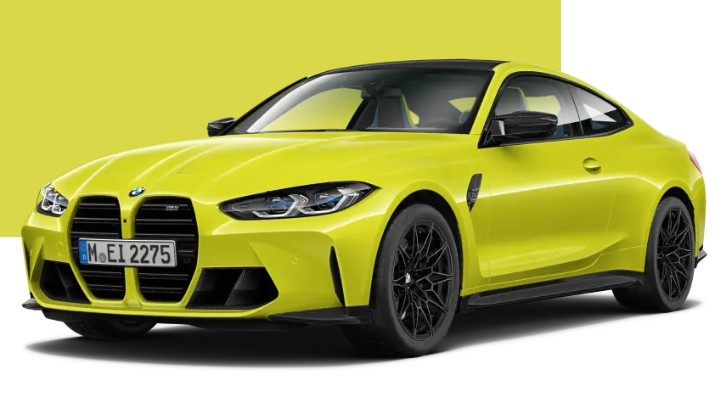
Choosing between BMW M4 trims sounds simple until we start digging into the details. Then things get interesting.
There is the regular M4 Coupe, the M4 Competition, the M4 Competition xDrive, the open-top Competition xDrive Convertible, and special cars such as the M4 CS and M4 CSL that occasionally sit above the mainstream range. Add different transmissions, horsepower figures, drivetrains, suspension setups, and option packages, and suddenly the M4 family feels more like a performance ladder than a traditional trim lineup.
Fortunately, the differences make much more sense once we understand what BMW is trying to accomplish with each version.
At the entry point, the M4 is the enthusiast's choice: rear-wheel drive and a manual gearbox. Move into the Competition and BMW exchanges some analog involvement for additional performance. Step into Competition xDrive territory and acceleration becomes genuinely ferocious. Meanwhile, cars carrying CS or CSL badges push the concept toward the racetrack.
For the current U.S. coupe lineup, BMW lists three core versions: M4 Coupe, M4 Competition Coupe, and M4 Competition xDrive Coupe. BMW currently rates them at 473, 503, and 523 horsepower respectively.
So which BMW M4 trim should we actually buy?
Let's break down the range without drowning ourselves in brochure language.
Content in this publication
- BMW M4 Trim Levels at a Glance
- BMW M4 Coupe: The Purist's Trim
- BMW M4 Competition Coupe: More Muscle, Less Manual Work
- BMW M4 Competition xDrive Coupe: The Performance Sweet Spot
- BMW M4 Competition xDrive Convertible
- BMW M4 CS: Turning Up the Intensity
- BMW M4 CSL: The Extreme M4
- BMW M4 Trims Comparison
- Which BMW M4 Trim Is Fastest?
- Which BMW M4 Trim Has a Manual Transmission?
- Which BMW M4 Trim Has AWD?
- M4 vs M4 Competition: Is the Upgrade Worth It?
- BMW M4 Trim Prices
- Do BMW M4 Packages Count as Trims?
- How BMW M4 Trims Changed Between Generations
- F82 M4 Trims vs G82 M4 Trims
- Best BMW M4 Trim for Daily Driving
- Best BMW M4 Trim for Enthusiasts
- Best BMW M4 Trim for Track Driving
- Best BMW M4 Trim for Bad Weather
- Which BMW M4 Trim Holds Its Value Best?
- Used BMW M4 Trims: What Should We Check?
- BMW M4 vs M440i: Don't Confuse the Two
- Which BMW M4 Trim Should We Buy?
- Conclusion: Understanding the BMW M4 Trim Hierarchy
- Frequently Asked Questions About BMW M4 Trims
BMW M4 Trim Levels at a Glance
The current M4 hierarchy is surprisingly logical once we strip away the branding.
The M4 Coupe is the traditional driver's car. It combines rear-wheel drive with the manual transmission and delivers the least horsepower of the group—but calling 473 horsepower "least" feels slightly ridiculous.
The M4 Competition Coupe retains rear-wheel drive while increasing output and replacing the manual with BMW's eight-speed M Steptronic automatic.
The M4 Competition xDrive Coupe adds the M xDrive all-wheel-drive system and receives an additional power increase. BMW currently quotes 523 horsepower and a 3.4-second 0-to-60-mph time for this version.
Convertible shoppers get a more focused selection. BMW's current U.S. lineup offers the M4 Competition xDrive Convertible, rated at 523 horsepower and equipped with M xDrive.
Then there are special editions. The M4 CS, CSL, and other limited-production derivatives aren't permanent stepping stones in every model year. Instead, they're sharper, rarer interpretations of the M4 formula.
Think of the regular lineup as coffee strength settings. The M4 is espresso. Competition is a double espresso. Competition xDrive adds another shot.
CS and CSL?
Those are what happens when someone forgets we're supposed to sleep.
BMW M4 Coupe: The Purist's Trim
There is something wonderfully stubborn about the base BMW M4 Coupe.
Performance cars have become increasingly digital, automatic, electrified, and complicated. Yet the standard M4 continues to offer the formula many enthusiasts grew up dreaming about: a turbocharged inline-six engine, rear-wheel drive, and a manual gearbox.
BMW currently rates the U.S.-market M4 Coupe at 473 horsepower, with a manufacturer-estimated 0-to-60-mph time of 4.1 seconds.
Those numbers don't make it the fastest M4.
That's precisely why some people will want it.
Why the Base M4 Is More Than an Entry-Level Model
Calling it a "base" M4 almost gives the wrong impression.
We aren't talking about cloth seats, tiny wheels, and an engine waiting for an upgrade. This is already a full-fledged BMW M car engineered around serious performance hardware.
Its biggest differentiator is involvement.
Instead of chasing the quickest possible launch, the standard M4 encourages us to participate in what is happening. We choose the gear. We manage the clutch. We control how aggressively power reaches the rear tires.
The experience can be slower on paper yet more entertaining from behind the steering wheel.
That's an important distinction.
Numbers measure performance beautifully. They don't always measure fun.
Who Should Buy the M4 Coupe?
The standard M4 makes the most sense for drivers who prioritize interaction over outright acceleration.
If we love manual transmissions, the decision becomes considerably easier. It is also attractive to enthusiasts who prefer rear-wheel-drive behavior and don't feel the need to win every traffic-light acceleration contest.
The M4 Coupe may actually be the sweet spot for long-term enthusiasts because its configuration feels increasingly unusual in a world moving toward automatic transmissions.
BMW M4 Competition Coupe: More Muscle, Less Manual Work
The BMW M4 Competition Coupe moves the formula toward outright speed.
BMW currently rates it at 503 horsepower, compared with 473 horsepower in the regular M4 Coupe. Its official 0-to-60-mph estimate falls to 3.8 seconds.
But horsepower isn't the biggest philosophical difference.
The Competition Coupe uses BMW's automatic M Steptronic transmission rather than the manual gearbox available in the regular car.
That completely changes its personality.
M4 vs M4 Competition
Imagine two exceptionally talented athletes.
One loves doing everything manually and enjoys the process. The other uses every available tool to chase a faster result.
That's essentially M4 versus M4 Competition.
The regular M4 feels more traditional. The Competition feels more ruthless.
With the automatic gearbox handling shifts rapidly, we can concentrate on braking points, steering inputs, and throttle placement rather than coordinating the clutch and shifter.
In everyday traffic, that automatic transmission also makes life considerably easier.
Rear-Wheel Drive Keeps the Competition Playful
Importantly, the Competition Coupe does not automatically mean all-wheel drive.
BMW currently offers the M4 Competition Coupe with rear-wheel drive, while the separate Competition xDrive Coupe introduces the performance-oriented AWD system.
That makes the rear-drive Competition particularly interesting.
We get more horsepower and an automatic transmission without giving up the classic rear-wheel-drive configuration.
For some drivers, that's the perfect compromise.
BMW M4 Competition xDrive Coupe: The Performance Sweet Spot
Now we reach the version that arguably makes the strongest case as the all-around M4.
The BMW M4 Competition xDrive Coupe combines the high-output engine with BMW's performance all-wheel-drive technology.
In the current U.S. specification, BMW advertises 523 horsepower and a 3.4-second 0-to-60-mph time.
That's supercar-like acceleration from a coupe that can still carry passengers and luggage.
What Does M xDrive Change?
Ordinary all-wheel drive often exists primarily for traction.
M xDrive goes further.
BMW describes the system as adjustable between 4WD, 4WD Sport, and 2WD modes, giving drivers substantial control over how the drivetrain behaves.
That's important because one of the traditional fears surrounding AWD performance cars is that extra traction will sanitize the experience.
The M4 Competition xDrive doesn't simply glue itself to the pavement and call the job finished.
It allows us to alter the character of the car.
Want maximum confidence?
Use all four wheels.
Want something more playful?
The system provides more aggressive configurations for that too.
Why xDrive Makes the M4 So Fast
Power only matters if the tires can use it.
A rear-wheel-drive car sending more than 500 horsepower toward two tires can quickly become a traction management exercise. M xDrive spreads that workload across four contact patches.
Instead of turning horsepower into tire smoke, the car converts more of it into forward motion.
That's a major reason why the Competition xDrive produces the quickest acceleration among the regular M4 Coupe variants.
BMW M4 Competition xDrive Convertible
Want M4 performance with the roof down?
BMW has an answer, although the Convertible lineup is considerably simpler.
The current U.S.-market M4 Competition xDrive Convertible produces 523 horsepower and carries an official BMW 0-to-60 estimate of 3.6 seconds. BMW currently lists the convertible exclusively in Competition xDrive form rather than mirroring all three Coupe variants.
That means we can't simply order the convertible equivalent of the manual rear-wheel-drive M4.
BMW has positioned the open-top model as the powerful, automatic, all-wheel-drive grand-touring member of the family.
Coupe or Convertible?
Performance purists will usually gravitate toward the Coupe.
But life isn't always a lap-time competition.
Drop the convertible roof on a coastal highway, let the turbocharged inline-six sing behind us, and suddenly a few extra pounds seem considerably less important.
The Convertible is for buyers who want M4 drama in a more theatrical package.
It's less race helmet, more sunglasses.
BMW M4 CS: Turning Up the Intensity
The letters CS carry substantial weight in BMW M history.
Rather than simply installing more horsepower and calling the job done, BMW typically uses CS models to bridge the gap between regular Competition variants and hardcore limited-production machines.
The recent M4 CS illustrates the formula perfectly.
The 2025 BMW M4 CS was rated at 543 horsepower and used M xDrive. BMW also confirmed that this model was offered exclusively with all-wheel drive and adaptive M suspension.
You may be interested in reading BMW M4 Models by Year: Complete 2015–2026 Guide
But raw engine output tells only part of the story.
What Makes the M4 CS Different?
The CS philosophy is essentially optimization.
Weight receives more attention. Chassis tuning becomes sharper. Carbon-fiber components become more prominent. The atmosphere feels more serious.
Yet a CS isn't supposed to become an unusable racing car.
That balance makes it fascinating.
We can think of the Competition xDrive as an extremely fast road car capable of attacking a circuit. The CS reverses the priorities slightly: it feels like a track-focused machine that remains civilized enough for public roads.
That's a subtle distinction until we drive hard.
Then it becomes obvious.
Is the M4 CS a Trim or Special Edition?
Technically, it's better to view the M4 CS as a special high-performance derivative rather than a permanent mainstream trim.
Availability changes according to model year and market.
That's important when searching online for "BMW M4 trims." A comparison page may list the CS alongside regular variants, creating the impression that buyers can always walk into a dealer and order one.
That's not necessarily the case.
BMW currently places the M4 CS among its limited-edition performance vehicles rather than the three-car core M4 Coupe lineup.
BMW M4 CSL: The Extreme M4
If CS means serious, CSL means BMW has stopped worrying about compromise.
The M4 CSL occupies a different universe from the regular M4.
BMW's limited-edition M4 CSL was rated at 543 horsepower and incorporated extensive lightweight carbon-fiber engineering.
The goal wasn't merely to create an expensive M4.
It was to extract as much performance as possible from the platform.
Why the CSL Badge Matters
BMW uses CSL sparingly.
That rarity gives the badge enormous enthusiast appeal.
Where the M4 Competition xDrive might be the version we'd happily drive every morning, the CSL is the one we'd probably stare at in the garage before deciding whether today's grocery-store parking lot deserves it.
It's sharper, rarer, and much more specialized.
For used-car shoppers, however, CSL deserves inclusion in any complete discussion of M4 variants because it represents the upper extreme of what the platform can become.
BMW M4 Trims Comparison
For shoppers trying to make sense of everything quickly, the M4 family can be summarized like this:
- M4 Coupe: rear-wheel-drive enthusiast model, 473 hp in the current U.S. lineup, and the choice for drivers who want the manual-transmission experience.
- M4 Competition Coupe: 503 hp, rear-wheel drive, automatic transmission, and a stronger emphasis on outright performance.
- M4 Competition xDrive Coupe: 523 hp, M xDrive AWD, automatic transmission, and the fastest acceleration among the mainstream Coupe variants.
- M4 Competition xDrive Convertible: 523 hp with M xDrive and an open roof, making it the lifestyle-oriented grand-touring alternative.
- M4 CS: limited, sharper, lighter-minded and more track focused, with the recent 2025 version producing 543 hp.
- M4 CSL: an even more specialized limited-production interpretation aimed heavily at maximum performance and reduced weight.
The important takeaway is that there isn't a universally "best" M4.
Each version solves a slightly different problem.
Which BMW M4 Trim Is Fastest?
Among the current mainstream U.S. M4 Coupe trims, the answer is straightforward: M4 Competition xDrive Coupe.
BMW currently quotes 0-to-60-mph figures of 4.1 seconds for the M4 Coupe, 3.8 seconds for the M4 Competition Coupe, and 3.4 seconds for the Competition xDrive Coupe.
But here's where performance comparisons become tricky.
The fastest car in a straight line isn't automatically the most exciting car.
A manual M4 can demand more participation. A rear-wheel-drive Competition may feel livelier at sane speeds. A CS can produce a deeper sense of connection when attacking corners.
Buying purely from an acceleration chart would be like choosing a guitar based entirely on maximum volume.
There's more to the experience.
Which BMW M4 Trim Has a Manual Transmission?
This question may decide the entire comparison for enthusiasts.
In the mainstream lineup, the standard BMW M4 Coupe is the manual-oriented choice.
Moving into Competition territory means moving toward the automatic M Steptronic transmission.
For drivers who learned to love performance cars through a clutch pedal and gear lever, that makes the regular M4 unusually desirable despite being the least powerful mainstream version.
And that's the beautiful irony of the M4 lineup.
Paying more doesn't necessarily produce more involvement.
Sometimes it produces more speed.
Which BMW M4 Trim Has AWD?
Look for xDrive in the name.
The M4 Competition xDrive Coupe uses BMW's M xDrive performance AWD system, while the regular M4 Coupe and rear-wheel-drive M4 Competition Coupe send power through the rear wheels. BMW currently separates these configurations explicitly in its U.S. model catalog.
The Competition xDrive Convertible also uses M xDrive.
This distinction matters for people who live where rain, cold temperatures, or occasional snow are part of everyday driving.
High horsepower is wonderful.
High horsepower plus traction is considerably easier to exploit.
M4 vs M4 Competition: Is the Upgrade Worth It?
This isn't really a question of whether Competition is "better."
It's about priorities.
If our priority is acceleration, effortless shifting, and higher output, Competition makes enormous sense.
If our priority is mechanical involvement, the regular M4 may actually be preferable.
That's why prospective buyers shouldn't treat the model hierarchy like smartphone storage tiers where paying more simply gets us more of the same product.
These cars have distinct personalities.
Choose the M4 Coupe If...
We want the manual experience, love rear-wheel-drive sports cars, and care more about driver involvement than achieving the quickest acceleration number.
Choose the M4 Competition If...
We want more power and automatic-shifting convenience but still prefer a traditional rear-drive layout.
Choose the Competition xDrive If...
We want the strongest combination of acceleration, traction, everyday usability, and performance.
Choose CS or CSL If...
We already know exactly why we want one.
That's not a joke.
Special M cars appeal to enthusiasts willing to pay significantly more for relatively small changes that completely alter how the car feels at the limit.
If we're asking whether those changes matter, a Competition xDrive probably provides more performance than we'll ever realistically need.
BMW M4 Trim Prices
Pricing changes by model year, options, destination charges, and market, so any number should be checked when shopping.
As a useful snapshot, BMW's current U.S. site lists the 2027 M4 Coupe from $82,200, M4 Competition Coupe from $86,600, and M4 Competition xDrive Coupe from $91,700. The M4 Competition xDrive Convertible starts at $98,600.
Options can push those figures considerably higher.
Carbon-ceramic brakes, special paint, carbon-fiber components, premium upholstery, wheels, driver-assistance technology, and other equipment can transform the final sticker.
So we'd avoid evaluating an M4 solely from base MSRP.
The difference between two actual dealer cars can be much larger than the official trim gap suggests.
Do BMW M4 Packages Count as Trims?
No, and this causes plenty of confusion.
An option package modifies a particular trim. It doesn't necessarily create another trim.
For example, an aggressively optioned M4 Competition xDrive might look dramatically different from a more basic example parked beside it. Different seats, carbon components, paint, wheels, and brakes can almost make them seem like separate models.
Underneath those options, however, they're still the same fundamental trim.
When buying used, this distinction becomes particularly important.
Don't stop at the badge on the trunk.
Decode the equipment.
How BMW M4 Trims Changed Between Generations
The M4 story doesn't begin with today's G82-generation car.
BMW introduced the M4 name when the company separated the coupe version of the M3 family into the 4 Series lineage. That gave us the F82 M4 Coupe and, eventually, today's G82 generation.
Over time, BMW expanded the family with Competition models and increasingly specialized derivatives.
That means a phrase such as "M4 Competition" doesn't describe exactly the same specification across every year.
Horsepower changed.
Technology changed.
Suspension tuning changed.
You may be interested in readingBMW M4 Models by Year: Complete 2015–2026 GuideYou may be interested in reading
 Subaru Impreza vs XV: Which Subaru Is Better for You?
Infotainment changed.
Even the meaning of the trim hierarchy evolved.
This is why used M4 shoppers should compare model year plus trim, not trim name alone.
F82 M4 Trims vs G82 M4 Trims
The previous F82 generation established many of the patterns we recognize today, but the G82 expanded the differences between variants dramatically.
Modern Competition and xDrive configurations offer extraordinary acceleration and sophistication.
The regular manual G82 M4, meanwhile, almost plays the role of heritage model—keeping alive the classic rear-drive, three-pedal M-car recipe while its siblings chase increasingly serious performance numbers.
Design also separates the generations immediately.
The G82's enormous vertical kidney grille remains unmistakable. Love it or hate it, nobody is likely to confuse it with an ordinary coupe in a parking lot.
Best BMW M4 Trim for Daily Driving
For daily use, we'd give the advantage to the M4 Competition xDrive Coupe.
Why?
Its automatic transmission simplifies commuting. M xDrive provides additional traction. The performance ceiling is absurdly high, yet the car remains fundamentally usable.
We don't have to exploit 523 horsepower every morning.
Sometimes we simply want heated seats, music, and a comfortable drive to work.
Then Saturday arrives.
The road opens.
The M4 changes personality.
That's where this trim becomes compelling.
Best BMW M4 Trim for Enthusiasts
The standard M4 Coupe deserves serious consideration.
Yes, the Competition versions are faster.
Yes, xDrive launches harder.
But a manual transmission changes our relationship with the machine.
Every gear change becomes something we do rather than something the vehicle does for us.
A decade from now, when manual performance cars are even rarer, that characteristic may matter more than an extra few tenths in the sprint to 60 mph.
Best BMW M4 Trim for Track Driving
This depends on budget and availability.
Among ordinary production variants, the Competition models provide formidable performance, while xDrive adds extraordinary corner-exit traction.
When special editions enter the conversation, the M4 CS becomes especially attractive because it was developed with a stronger track emphasis while retaining reasonable road usability.
And then there is the CSL.
That's the choice for someone who wants the most specialized interpretation rather than the most sensible one.
"Sensible M4 CSL" is almost an oxymoron anyway.
Best BMW M4 Trim for Bad Weather
This one is easy.
Choose M4 Competition xDrive.
Rear-wheel drive can absolutely work in poor weather with proper tires and sensible driving, but M xDrive gives us another layer of traction and flexibility.
Still, let's remember something fundamental: AWD doesn't magically create grip.
Tires do much of the work.
An M4 xDrive wearing inappropriate summer tires in winter conditions isn't suddenly invincible because four wheels receive power.
Physics always gets the final vote.
Which BMW M4 Trim Holds Its Value Best?
Predicting depreciation is messy, but rarity usually changes the equation.
Limited-production models such as CS and especially CSL variants can attract collectors because supply is constrained and their place in BMW M history is clearer.
Mainstream M4s follow more conventional depreciation patterns.
However, specification matters enormously in enthusiast cars.
Desirable colors, documented maintenance, accident-free history, tasteful factory options, low mileage, and manual transmissions can all influence demand.
If we're buying an M4 primarily as transportation, we shouldn't obsess over future collector value.
If we're buying a special edition, however, provenance suddenly matters much more.
Used BMW M4 Trims: What Should We Check?
Shopping used requires more homework than selecting a new configuration.
First, identify the exact year and trim. Then verify factory equipment rather than relying on seller descriptions. Performance cars attract modifications, so we also want to understand whether the ECU, exhaust, suspension, wheels, brakes, or drivetrain software have been changed.
Service history becomes critical.
A beautifully photographed M4 with questionable maintenance is not a bargain.
It's a surprise invoice waiting patiently.
Pre-purchase inspections from specialists familiar with BMW M cars can be worth every cent.
BMW M4 vs M440i: Don't Confuse the Two
Here's another common misunderstanding.
The M440i is not an M4 trim.
The M440i is an M Performance model within the regular 4 Series family, while the M4 is a full BMW M vehicle.
Both are fast.
Both can wear aggressive styling.
Both carry an M badge somewhere.
Yet they occupy different positions.
The M440i emphasizes rapid everyday performance with greater comfort and accessibility. The M4 receives much more extensive high-performance engineering.
For many commuters, the M440i is actually the smarter car.
For buyers specifically chasing the M experience, however, the M4 is the real destination.
Which BMW M4 Trim Should We Buy?
There is no wrong M4 here, only mismatched priorities.
If we want involvement and a manual gearbox, take the M4 Coupe.
If we want more horsepower while retaining rear-wheel drive, the M4 Competition Coupe makes sense.
If we want maximum mainstream performance, serious traction, and astonishing launches, choose the M4 Competition xDrive Coupe.
If top-down driving matters more than ultimate purity, the M4 Competition xDrive Convertible provides enormous speed with extra theater.
And if we want something rarer and more track focused—and have the budget and opportunity—the M4 CS or CSL occupies another level altogether.
Don't simply buy the most expensive badge we can afford.
Buy the M4 whose compromises match the way we'll actually use it.
That's usually how we end up with the better car.
Conclusion: Understanding the BMW M4 Trim Hierarchy
The BMW M4 range works because its versions aren't merely different equipment packages.
They represent different philosophies.
The regular M4 preserves the old-school formula with rear-wheel drive and manual involvement. Competition sharpens the weapon with greater output and an automatic gearbox. Competition xDrive turns that power into devastating real-world acceleration. The Convertible exchanges some purity for open-air excitement.
Then CS and CSL models push the M4 deeper into enthusiast territory.
Our favorite part?
The cheapest mainstream M4 isn't automatically the least desirable one.
In an era when numbers dominate performance-car marketing, BMW still gives us a genuine choice between interaction and acceleration.
And that's exactly what makes choosing between BMW M4 trims so interesting.
Frequently Asked Questions About BMW M4 Trims
1. What are the main BMW M4 trims?
In the current U.S. Coupe lineup, BMW offers the M4 Coupe, M4 Competition Coupe, and M4 Competition xDrive Coupe. The lineup also includes an M4 Competition xDrive Convertible, while models such as the CS and CSL are limited or special high-performance derivatives rather than permanent mainstream trims.
2. What is the difference between M4 and M4 Competition?
The standard M4 emphasizes traditional driver involvement and currently produces 473 horsepower, while the M4 Competition increases output to 503 horsepower and uses an automatic transmission. The Competition xDrive version goes farther with 523 horsepower and M xDrive AWD.
3. Which BMW M4 trim is the fastest?
Among the current regular Coupe models, the M4 Competition xDrive is quickest. BMW quotes a 3.4-second 0-to-60-mph time, compared with 3.8 seconds for the rear-wheel-drive Competition and 4.1 seconds for the standard M4.
You may be interested in readingBMW M4 Models by Year: Complete 2015–2026 GuideYou may be interested in reading
Subaru Impreza vs XV: Which Subaru Is Better for You?You may be interested in reading
Subaru Impreza or Similar: Best Alternatives Compared4. Is the BMW M4 Competition AWD?
Not necessarily. The M4 Competition Coupe is available in rear-wheel-drive form, while the M4 Competition xDrive Coupe uses BMW's M xDrive AWD system. The distinction is important, so don't assume every Competition badge means AWD.
5. What is the best BMW M4 trim?
For most drivers seeking maximum everyday capability and speed, the M4 Competition xDrive is arguably the sweet spot. Enthusiasts who prioritize involvement may prefer the manual M4 Coupe, while serious collectors and track-focused buyers may gravitate toward limited CS or CSL versions.
If you want to know other articles similar to BMW M4 Trims: Complete Guide to Every Version you can visit the category Models.
Haval Jolion vs Omoda C5: Which SUV Is Better?
Haval Jolion vs Chery Tiggo 4 Pro: Full Comparison
Haval Jolion vs H6: Which SUV Is Better in 2026?
Haval Jolion vs Toyota Corolla Cross: Which SUV Is Better?
Haval Jolion vs Jaecoo J5: Which SUV Is Better?
Volkswagen T-Cross vs Volkswagen T-Roc: Which Is Better?
Leave a Reply
More content of your interest