
Kia Carnival vs Honda Odyssey: Which Family Minivan Wins?

Choosing between the Kia Carnival vs Honda Odyssey is a little like choosing between two excellent family homes. Both give us plenty of space, comfortable seating, sliding doors, strong safety technology, and enough cargo capacity to handle everything from groceries to cross-country vacations. Yet they approach the family-vehicle formula from noticeably different directions.
The Honda Odyssey sticks closely to the traditional minivan recipe. It is practical, smooth, spacious, easy to drive, and packed with clever features developed around families. The Kia Carnival takes a slightly more adventurous path. Kia calls it an MPV, gives it styling that resembles a large SUV, loads higher trims with premium technology, and—most importantly—offers a fuel-saving hybrid powertrain.
For many buyers, there isn't a universally correct answer.
If we prioritize proven minivan practicality, clever second-row seating, strong V6 performance, and enormous maximum cargo capacity, the Odyssey makes a compelling case. If we want fresher styling, stronger technology, excellent value, available luxury-style second-row seating, or hybrid fuel economy, the Carnival becomes difficult to ignore.
Let's break down the Kia Carnival vs Honda Odyssey comparison category by category and figure out which one deserves a place in our driveway.
Content in this publication
- Kia Carnival vs Honda Odyssey at a Glance
- Exterior Design: Carnival Looks More Like an SUV
- Interior Design and Cabin Quality
- Seating Capacity and Passenger Space
- Third-Row Comfort
- Cargo Space: Honda Odyssey vs Kia Carnival
- Performance: Two Strong V6s and One Clever Hybrid
- Fuel Economy: Carnival Hybrid Wins Easily
- Ride Comfort and Driving Experience
- Family-Friendly Features
- Safety and Driver Assistance
- Towing Capacity
- Kia Carnival vs Honda Odyssey Reliability
- Price and Value
- Kia Carnival vs Honda Odyssey for Road Trips
- Kia Carnival vs Honda Odyssey for Large Families
- Kia Carnival Hybrid vs Honda Odyssey
- Honda Odyssey Advantages
- Kia Carnival Advantages
- Potential Reasons to Choose the Honda Odyssey
- Potential Reasons to Choose the Kia Carnival
- Kia Carnival vs Honda Odyssey: Pros and Cons
- Which One Should We Buy?
- Final Thoughts
- Frequently Asked Questions
Kia Carnival vs Honda Odyssey at a Glance
The current Honda Odyssey keeps things refreshingly simple under the hood. Every 2026 Odyssey uses a 3.5-liter V6 producing 280 horsepower and 262 lb-ft of torque, paired with a 10-speed automatic transmission. Honda rates it at 19 mpg city, 28 mpg highway, and 22 mpg combined.
The Kia Carnival gives us more choice.
The gasoline Carnival uses a 3.5-liter V6 producing 287 horsepower, while the Carnival Hybrid combines a turbocharged 1.6-liter engine with electric assistance. The current hybrid system produces 242 combined horsepower and 271 lb-ft of torque. Kia's hybrid is therefore less powerful on paper than either V6, but its electric torque and dramatically better fuel economy make the tradeoff interesting.
The basic personalities are already obvious.
The Odyssey says, "We've spent decades figuring out how families use minivans."
The Carnival says, "What if a minivan didn't have to feel like one?"
And that difference runs through almost every part of these vehicles.
Exterior Design: Carnival Looks More Like an SUV
We'll address the elephant in the parking lot first: plenty of buyers love minivan practicality but don't necessarily love the traditional minivan appearance.
That's where the Carnival lands its first punch.
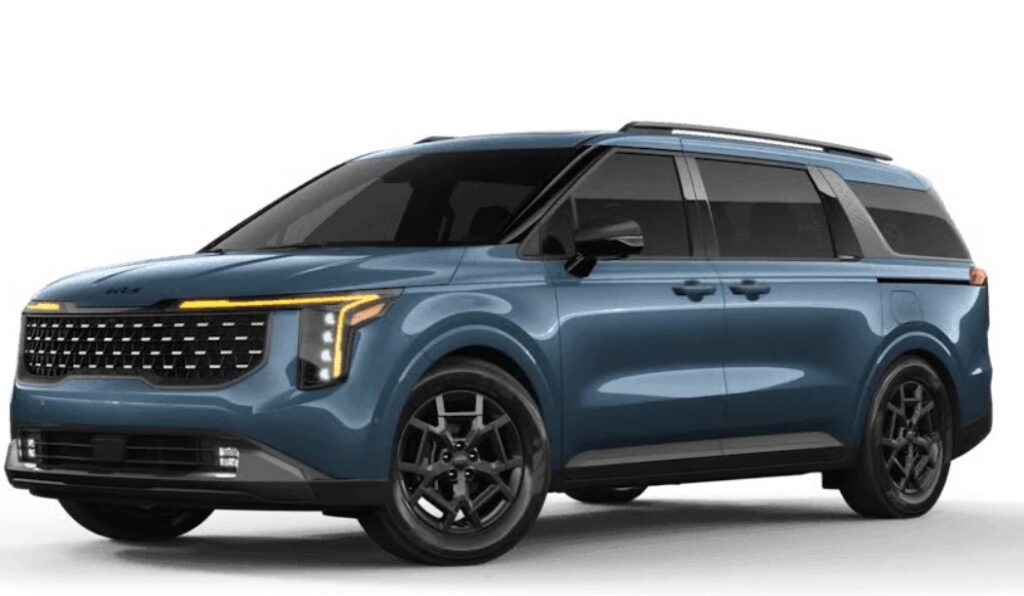
Kia intentionally gives the Carnival a more squared-off, SUV-inspired silhouette. The upright grille, sharper lighting, sculpted sides, chunky rear styling, and relatively muscular proportions make it look more like a three-row crossover from several angles.
Nobody will mistake it for a sports coupe, of course. Sliding rear doors reveal its family-hauler mission immediately. Still, the disguise works surprisingly well.
The Honda Odyssey looks exactly like what it is: a sophisticated modern minivan.
That's not necessarily a criticism. Its sweeping profile and relatively low beltline help make the vehicle look long and sleek rather than enormous. But compared with the Carnival, the Odyssey is visually more conventional.
Which One Looks Better?
Style will always be subjective, but we would give the Carnival the exterior-design advantage.
It simply has more visual personality.
The Odyssey favors function over theater, while the Carnival makes a deliberate attempt to give family transportation some curb appeal.
If you've always said, "I need a minivan, but I don't want something that screams minivan," the Kia probably speaks your language.
Interior Design and Cabin Quality
Open the doors and the competition becomes closer.
The Odyssey's cabin has one overriding mission: make family life easier. Controls are positioned logically, visibility is excellent, storage spaces are everywhere, and the cabin avoids unnecessary complexity.
Honda understands that a minivan dashboard isn't supposed to impress us for five minutes at a dealership. It needs to remain intuitive while we're driving home at night with three tired children, two backpacks, a grocery bag rolling around somewhere behind us, and somebody asking for Wi-Fi.
The Carnival takes a more luxurious approach.
Its wide displays, contemporary dashboard design, available ambient lighting, upscale trim materials, and higher-end seating options create a more premium first impression. Higher Carnival trims can feel closer to a luxury crossover than an ordinary people mover.
Technology Gives Kia an Edge
Honda equips the 2026 Odyssey with a 9-inch touchscreen featuring wireless Apple CarPlay and Android Auto. Higher trims add features such as the available rear entertainment system, CabinWatch rear-seat monitoring, CabinTalk, navigation, and Wi-Fi hotspot capability.
Those are useful family-focused features, but Kia pushes harder on screen size and visual technology.
Depending on trim, the Carnival can offer dual 12.3-inch panoramic displays, navigation, a surround-view monitor, Blind-Spot View Monitor, passenger-view camera, head-up display, digital rearview mirror, Bose audio, wireless phone charging, and numerous driver-assistance technologies. The 2026 Carnival Hybrid SX, for example, includes dual 12.3-inch displays and available surround-view technology.
If we're comparing cabins based purely on digital wow factor, the Carnival wins.
If we value simplicity and family-friendly ergonomics above giant screens, Honda remains exceptionally convincing.
Seating Capacity and Passenger Space
Both models can accommodate large families.
Depending on configuration, the Carnival offers seating for up to eight passengers. Kia's Slide-Flex second-row setup allows the middle seat to move forward and backward, creating several useful passenger configurations.
The Odyssey can also seat up to eight.
But Honda's real party trick is its Magic Slide second-row seating system.
Honda Magic Slide Seats Are Brilliant
Remove the second-row center seat and the remaining captain's chairs can slide laterally.
That sounds minor until we actually use it.
We can move a child closer to the center of the vehicle, slide one seat toward the middle to create easier third-row access, separate siblings who have suddenly decided they cannot coexist within three feet of each other, or reposition passengers without climbing around seats.
It's one of those features that sounds slightly gimmicky in a brochure and becomes incredibly useful in daily life.
Carnival VIP Lounge Seats Fight Back
Kia has another idea.
Upper Carnival configurations can offer VIP Lounge Seating with relaxation functions, reclining seatbacks, raised power footrests, headrests, and heating and ventilation.
They're wonderfully indulgent.
Imagine airline business-class seats inside a family van and you're getting close.
The problem is that maximum luxury doesn't always equal maximum versatility. Buyers who frequently remove seats or transform the cabin for cargo may prefer the more functional Honda approach.
So the winner depends on our priorities.
For flexibility, Odyssey.
For second-row luxury, Carnival.
Third-Row Comfort
A third row can mean two very different things.
In some SUVs, it's essentially a padded shelf where adults negotiate with their knees.
Minivans do things differently.
Both the Carnival and Odyssey provide legitimately usable third rows, which is one reason large families should think twice before automatically choosing a three-row SUV.
The lower floor and boxier rear body give passengers more natural seating positions and better access. Sliding doors also make climbing into the back much easier in tight parking spaces.
For occasional adult passengers, either vehicle works well. Children and teenagers should have few complaints during everyday driving.
The Odyssey feels particularly optimized around moving people between rows, while the Carnival's generous cabin dimensions make it similarly family-friendly.
Neither turns row three into punishment.
That's already a major victory over many crossovers.
Cargo Space: Honda Odyssey vs Kia Carnival
Cargo capacity is one of the biggest reasons to buy a minivan in the first place.
Honda says the 2026 Odyssey offers up to 158 cubic feet of maximum cargo space when configured appropriately, using removable second-row seats and its folding 60/40 third-row Magic Seat.
That's enormous.
Think furniture, bicycles, camping equipment, luggage for an entire family, home-improvement supplies, or enough warehouse-store purchases to make us reconsider our budgeting decisions.
The Carnival is also extremely practical. Kia lists around 40.2 cubic feet behind the third row on most configurations, an impressive amount of space before we even start folding seats.
Which Minivan Is Better for Cargo?
For sheer maximum hauling flexibility, we favor the Honda Odyssey.
Its removable second-row chairs and disappearing third-row seat allow us to transform it into something approaching a cargo van.
The Kia remains excellent for everyday luggage and family duty, but certain luxury seating configurations place more emphasis on passenger comfort than absolute cargo flexibility.
If hauling bulky objects is a regular part of our life, Honda's cabin architecture makes more sense.
Performance: Two Strong V6s and One Clever Hybrid
This category is especially interesting because Kia gives us two completely different answers.
Honda Odyssey V6 Performance
Every current Odyssey uses Honda's naturally aspirated 3.5-liter V6.
It develops 280 horsepower and sends its output through a 10-speed automatic transmission.
The engine suits the Odyssey beautifully.
Acceleration is strong enough that a fully loaded van doesn't feel exhausted merging onto the interstate. Power delivery is smooth, highway passing requires little drama, and the V6 has a natural responsiveness that smaller turbocharged engines sometimes struggle to replicate.
Kia Carnival V6 Performance
The gasoline Carnival uses its own 3.5-liter V6, producing 287 horsepower.
You may be interested in reading Kia Carnival vs Hyundai Palisade: Which Family Hauler Wins?
That's slightly more peak horsepower than the Odyssey, although the difference is small enough that we wouldn't choose one solely because of seven horsepower.
Both gasoline vans provide more than enough muscle for normal family driving.
Carnival Hybrid Changes the Conversation
The Carnival Hybrid uses a turbocharged 1.6-liter engine plus electric assistance, producing 242 combined horsepower and 271 lb-ft of torque.
It's slower on paper than the V6 versions, but the electric motor helps produce useful low-speed response.
Rather than thinking of the hybrid as the performance model, we should view it as the efficiency specialist.
And efficiency is where Kia opens a substantial gap.
Fuel Economy: Carnival Hybrid Wins Easily
Honda's V6-only strategy keeps purchasing simple, but it leaves a large hole in the lineup: there is no Odyssey Hybrid.
The 2026 Odyssey is EPA-rated at 19 mpg city, 28 mpg highway, and 22 mpg combined.
Those numbers are reasonable for a large V6-powered vehicle, especially on long highway trips.
But the Carnival Hybrid plays in another league.
Kia lists the hybrid at roughly 34 mpg city, 31 mpg highway, and 32 mpg combined.
That's approximately 10 additional combined mpg compared with the Odyssey.
Why That Difference Matters
Suppose we drive 15,000 miles per year.
At 22 mpg, we'd use roughly 682 gallons of fuel.
At 32 mpg, we'd use around 469 gallons.
That's more than 200 gallons saved annually before accounting for driving style, weather, traffic, or real-world conditions.
Over five or ten years, the difference becomes meaningful.
Urban families may see the biggest advantage because hybrid systems thrive in stop-and-go driving, where regenerative braking and electric assistance can recover energy that conventional vehicles waste as heat.
So if fuel economy sits near the top of our priority list, this category isn't close.
Carnival Hybrid wins.
Ride Comfort and Driving Experience
Nobody buys a minivan expecting Porsche-like steering.
Still, these vehicles spend thousands of hours carrying families, so driving character matters more than we might think.
The Odyssey has traditionally been one of the more satisfying minivans from behind the wheel. Honda tends to tune its vehicles with well-controlled body motions, predictable steering, and responsive power delivery.
It doesn't magically shrink around us, but it feels remarkably manageable for something capable of carrying eight people and their luggage.
The Carnival is also easy to drive and relaxed on highways. Its SUV-like driving position may appeal to crossover owners moving into a minivan for the first time.
The hybrid version has another advantage around town: electric assistance can make low-speed movement feel quiet and smooth.
Which Is More Fun to Drive?
We would narrowly choose the Honda Odyssey.
Its V6 and 10-speed automatic combination feels polished, and its chassis manages the balance between comfort and driver confidence particularly well.
The Carnival isn't clumsy—far from it.
Honda simply hides the size and weight of its minivan slightly better.
Family-Friendly Features
Here's where minivans embarrass SUVs.
Power sliding doors allow children to climb aboard without smashing those doors into the car parked beside us.
Low step-in heights help younger kids and older relatives.
Deep cargo wells swallow strollers.
Cupholders reproduce like rabbits.
Second- and third-row climate controls prevent endless arguments about temperature.
Both manufacturers understand the assignment.
Honda offers CabinWatch on upper trims, allowing the driver to monitor rear passengers through an interior camera, while CabinTalk can project the driver's voice through rear speakers or connected headphones.
Kia counters with its own Passenger View Monitor on selected trims, along with dual-screen entertainment availability, multiple charging options, sunshades, and numerous convenience features.
For parents with young children, these aren't novelty gadgets.
They're tiny pieces of sanity.
Safety and Driver Assistance
Modern family vehicles need more than airbags.
Both vans offer extensive active-safety equipment including automatic emergency braking technologies, blind-spot monitoring, rear cross-traffic systems, lane-related driver assistance, adaptive cruise-control functions, parking technology, and numerous warning systems depending on configuration.
Honda's 2026 Odyssey includes systems such as Collision Mitigation Braking, Road Departure Mitigation, blind-spot information with cross-traffic monitoring, and adaptive cruise control with low-speed follow.
Kia also makes a broad suite of driver-assistance features available across the Carnival range, with higher trims adding tools such as Blind-Spot View Monitor and a surround-view camera.
Rather than declaring a universal safety winner based only on the number of electronic systems, we'd compare the exact trims we're considering.
Safety packages increasingly vary by equipment level, and real crash-test results should always matter more than marketing terminology.
Towing Capacity
Families who occasionally tow a lightweight trailer have another reason to consider these vans.
Kia rates the gasoline Carnival for up to 3,500 pounds of towing capacity when properly equipped.
That isn't pickup-truck territory, but it can be enough for smaller trailers, lightweight recreational equipment, or similar loads.
Minivans are fundamentally designed around passengers and cargo rather than heavy towing, however.
If our regular weekend involves a large travel trailer or heavy boat, neither vehicle should automatically be our first choice. A properly configured body-on-frame SUV or truck may be more appropriate.
For occasional light-duty towing, the Carnival's published capability adds useful versatility.
Kia Carnival vs Honda Odyssey Reliability
Reliability is more complicated than simply asking which badge has the better reputation.
Honda has spent decades developing the Odyssey, and the model has a huge ownership history. Its naturally aspirated V6 and conventional automatic transmission are familiar technologies.
That familiarity can be reassuring to long-term owners.
Kia's gasoline Carnival likewise uses a conventional V6 setup, but the hybrid introduces additional components including a turbocharged engine, electric motor, hybrid battery, and related power electronics.
That doesn't automatically mean the hybrid will be unreliable. Hybrids can prove extremely durable. It simply means buyers planning to keep the vehicle for 15 years may evaluate long-term complexity differently.
Kia also backs its hybrid powertrain with a lengthy warranty; its current Carnival Hybrid marketing highlights a 10-year/100,000-mile hybrid powertrain limited warranty, subject to warranty terms and eligibility.
For conservative buyers prioritizing a long-established formula, the Odyssey remains appealing.
For buyers who value warranty coverage and fuel savings, the Carnival Hybrid makes a strong counterargument.
Price and Value
Price can move quickly with model year, trim, destination fees, options, and dealer inventory, so shoppers should compare transaction prices rather than just brochure numbers.
For reference, Honda lists the 2026 Odyssey EX-L from $42,795 MSRP, while the range-topping Elite starts at $51,695 before destination and other charges.
Kia's 2026 Carnival Hybrid lineup included an LXS starting at $41,390 before destination, while higher hybrid trims moved into the upper-$40,000 and low-$50,000 range.
What matters more than the lowest sticker price is what we receive for the money.
Kia generally makes a particularly aggressive case through technology, screen size, premium cabin features, hybrid availability, and upscale design.
Honda answers with highly refined ergonomics, excellent cabin versatility, the Magic Slide seat system, a powerful standard V6, and a mature minivan platform.
Which Offers Better Value?
We would give the Carnival a slight overall value advantage, especially for technology-focused shoppers.
But value changes dramatically by trim.
A heavily optioned Carnival can become expensive quickly, while an Odyssey EX-L already provides many desirable comfort and convenience features without requiring us to climb to the top of the range.
Comparing feature-for-feature is essential.
Kia Carnival vs Honda Odyssey for Road Trips
Both are outstanding road-trip vehicles.
You may be interested in readingKia Carnival vs Hyundai Palisade: Which Family Hauler Wins?You may be interested in reading
Kia Carnival vs Hyundai Staria: Which MPV Is Better?The Odyssey brings smooth V6 performance, massive cargo capacity, excellent passenger flexibility, available rear entertainment, comfortable seating, and strong highway fuel economy for a naturally aspirated V6.
The Carnival counters with abundant passenger space, refined cruising manners, excellent technology, and the possibility of substantially lower fuel consumption with the hybrid.
Which would we choose for a 2,000-mile vacation?
For maximum cargo flexibility, probably the Odyssey.
For minimizing fuel stops and giving passengers a more premium-feeling environment, probably the Carnival Hybrid.
Either beats cramming six people into a midsize crossover and pretending everyone is comfortable.
Kia Carnival vs Honda Odyssey for Large Families
For families with three or more children, details matter.
Car-seat positioning, third-row access, sliding-door operation, interior cameras, rear climate controls, seat flexibility, charging ports, cargo volume, and cupholders can become more important than horsepower.
Honda's Magic Slide seating system gives the Odyssey a particularly useful advantage here.
Being able to reposition second-row seats laterally can dramatically improve access to children or the third row.
Kia's eight-passenger Slide-Flex arrangement remains clever, though, and buyers with older children may prefer the Carnival's more upscale interior experience.
Our preference?
Odyssey for families with multiple young children.
Carnival for families prioritizing technology, style, and passenger luxury.
Kia Carnival Hybrid vs Honda Odyssey
This might be the most important version of the comparison.
Honda currently offers only the V6 Odyssey, while Kia offers both gasoline and hybrid Carnival variants.
The Carnival Hybrid sacrifices some horsepower but returns roughly 32 mpg combined rather than the Odyssey's 22 mpg combined EPA rating.
That's a major efficiency improvement.
For drivers covering substantial annual mileage—particularly in cities—the financial difference could become significant.
The Odyssey fights back with stronger acceleration, straightforward mechanical character, and Honda's excellent 10-speed/V6 pairing.
So ask ourselves one question:
Would we rather have 280 horsepower and traditional V6 performance, or significantly lower fuel consumption?
Our answer may decide the entire comparison.
Honda Odyssey Advantages
The Odyssey remains one of the smartest family vehicles on the market because Honda concentrates heavily on usability.
Its major strengths include the ingenious Magic Slide second-row seats, enormous maximum cargo volume, smooth 280-horsepower V6, 10-speed automatic transmission, excellent passenger accessibility, intuitive interior design, and family-centered features such as CabinWatch and CabinTalk.
It's a vehicle designed around real chaos rather than showroom glamour.
And there's something refreshing about that.
Kia Carnival Advantages
The Carnival's strengths are different.
Its SUV-inspired styling has broader visual appeal, its dashboard looks more contemporary, upper trims feel unusually luxurious, and available technologies can make it feel a generation newer than some competitors.
Then there's the hybrid.
That single option changes the competitive landscape because it addresses one of the biggest weaknesses of large family vehicles: fuel consumption.
Add available VIP Lounge Seats, large displays, advanced camera technology, premium audio, eight-passenger capability, and excellent cargo space, and the Carnival becomes much more than an Odyssey alternative.
It becomes a serious argument for reinventing what a minivan should be.
Potential Reasons to Choose the Honda Odyssey
Choose the Odyssey if our priorities lean toward maximum practicality.
The Honda is particularly compelling when we frequently rearrange seats, carry bulky items, transport young children, value naturally aspirated V6 performance, or simply prefer a vehicle that places family usability above flashy design.
Its biggest weakness in this comparison is equally clear: Honda doesn't currently offer an Odyssey Hybrid.
For buyers concerned about fuel consumption, that's becoming harder to overlook.
Potential Reasons to Choose the Kia Carnival
Choose the Carnival if we want our family vehicle to feel less conventional.
Its exterior styling is bolder, its cabin technology is more dramatic, and higher trims bring genuine luxury touches.
More importantly, the Carnival Hybrid gives efficiency-minded buyers something Honda simply doesn't.
The Kia makes particular sense for urban drivers, high-mileage households, tech-focused shoppers, and anyone who wants the practicality of sliding doors without the stereotypical minivan look.
Kia Carnival vs Honda Odyssey: Pros and Cons
| Category | Kia Carnival | Honda Odyssey |
|---|---|---|
| Styling | SUV-inspired and modern | Traditional minivan design |
| Gas engine | 287-hp 3.5L V6 | 280-hp 3.5L V6 |
| Hybrid option | Yes | No |
| Fuel economy advantage | Excellent with hybrid | Average for class |
| Second-row flexibility | Very good | Outstanding Magic Slide system |
| Luxury seating | Available VIP Lounge Seats | More practicality-focused |
| Maximum cargo versatility | Excellent | Outstanding |
| Interior technology | Strong advantage | Functional and intuitive |
| Driving experience | Comfortable and refined | Slightly more engaging |
| Family practicality | Excellent | Exceptional |
| Best for | Tech, efficiency, style | Flexibility, cargo, young families |
Which One Should We Buy?
There is no bad choice here, which makes the decision more interesting.
For pure minivan excellence, the Honda Odyssey still sets an incredibly high standard.
Its cabin is brilliantly thought out, the Magic Slide seats are genuinely useful, its V6 feels effortless, and its huge cargo capacity allows one vehicle to function as family transporter, road-trip machine, grocery hauler, and occasional moving van.
But the Kia Carnival is the more versatile proposition overall.
Why?
Because Kia gives us choices Honda doesn't.
Want a traditional V6? There's a Carnival for that.
Want hybrid efficiency? There's a Carnival for that.
Want eight seats? Available.
Want luxury-style second-row lounge chairs? Available.
Want huge panoramic digital displays and surround-view cameras? Available.
That range allows the Carnival to appeal to more types of buyers.
Our Overall Winner: Kia Carnival
If we had to choose one winner for the broadest number of modern families, the Kia Carnival takes the crown by a narrow margin.
The available hybrid powertrain is the deciding factor.
Fuel prices fluctuate, but efficiency never stops being useful. Getting around 32 mpg combined from a vehicle capable of carrying a large family is a significant advantage over a V6-only rival rated around 22 mpg combined.
Add modern styling, competitive cabin space, strong technology, available luxury seating, and impressive value, and the Carnival becomes exceptionally well rounded.
However, don't interpret that as an Odyssey defeat.
For buyers prioritizing maximum seat flexibility, cargo versatility, V6 responsiveness, and proven minivan ergonomics, we'd happily recommend the Honda instead.
The winner depends less on which vehicle is "better" and more on what kind of family we are.
Final Thoughts
The Kia Carnival vs Honda Odyssey battle perfectly illustrates why minivans deserve more attention.
Three-row SUVs may dominate family-car marketing, but they often can't match the packaging efficiency, sliding-door convenience, usable third rows, cargo flexibility, and passenger comfort these vehicles deliver.
The Odyssey represents the mature, highly refined version of the traditional minivan formula.
The Carnival represents its evolution.
Honda gives us outstanding practicality and one of the cleverest interiors in the segment. Kia adds bold styling, premium technology, greater powertrain choice, and hybrid efficiency.
For young families constantly rearranging car seats and hauling oversized gear, the Odyssey may still be the better tool.
For buyers who want efficiency, technology, upscale styling, and broader configuration choices, the Carnival has the advantage.
Either way, we're getting one of the most rational family vehicles money can buy.
And sometimes being rational doesn't have to be boring.
Frequently Asked Questions
1. Which is better, Kia Carnival or Honda Odyssey?
The Kia Carnival is arguably the better all-around choice for buyers who prioritize technology, modern styling, and fuel economy because it offers an available hybrid powertrain. The Honda Odyssey is better for buyers prioritizing second-row flexibility, maximum cargo versatility, and traditional V6 performance.
2. Is the Kia Carnival bigger than the Honda Odyssey?
Both vehicles are large three-row family vans with spacious passenger compartments and substantial cargo capacity. Their dimensions vary by measurement, but the practical difference is more about interior configuration than simply exterior size. Honda's removable second-row seats and folding third row give the Odyssey particularly impressive maximum cargo flexibility.
3. Which has better fuel economy, Kia Carnival or Honda Odyssey?
The Kia Carnival Hybrid wins decisively. Kia's hybrid is rated around 34 mpg city, 31 mpg highway, and 32 mpg combined, while the 2026 Honda Odyssey is rated at 19 mpg city, 28 mpg highway, and 22 mpg combined.
You may be interested in readingKia Carnival vs Hyundai Palisade: Which Family Hauler Wins?You may be interested in reading
Kia Carnival vs Hyundai Staria: Which MPV Is Better?You may be interested in reading
Kia Carnival vs Hyundai Santa Fe: Which Family Car Makes More Sense?4. Which is better for families with children?
Both are excellent, but the Honda Odyssey may have a slight advantage for families with several young children because its Magic Slide second-row seats make it easier to reposition passengers and access the third row. The Carnival counters with excellent passenger technology, available camera systems, and flexible eight-passenger seating.
5. Does the Honda Odyssey have a hybrid version?
No. The current U.S.-market Honda Odyssey uses a 3.5-liter V6 with a 10-speed automatic transmission. Kia offers both gasoline V6 and hybrid Carnival variants, making the Carnival the stronger choice for buyers specifically seeking a fuel-efficient electrified minivan.
If you want to know other articles similar to Kia Carnival vs Honda Odyssey: Which Family Minivan Wins? you can visit the category Models.
Volkswagen T-Cross vs Volkswagen T-Roc: Which Is Better?
Hyundai Tucson Weight: Complete Guide to Curb, Gross, and Payload Specs

Honda Passport vs Toyota 4Runner: Which SUV Is Better?
Honda Passport vs Ford Bronco: Which SUV Is Better?
Honda Passport vs Ford Explorer: Which SUV Is Better?
Honda Passport or Pilot: Which SUV Is Better?
Leave a Reply
More content of your interest