
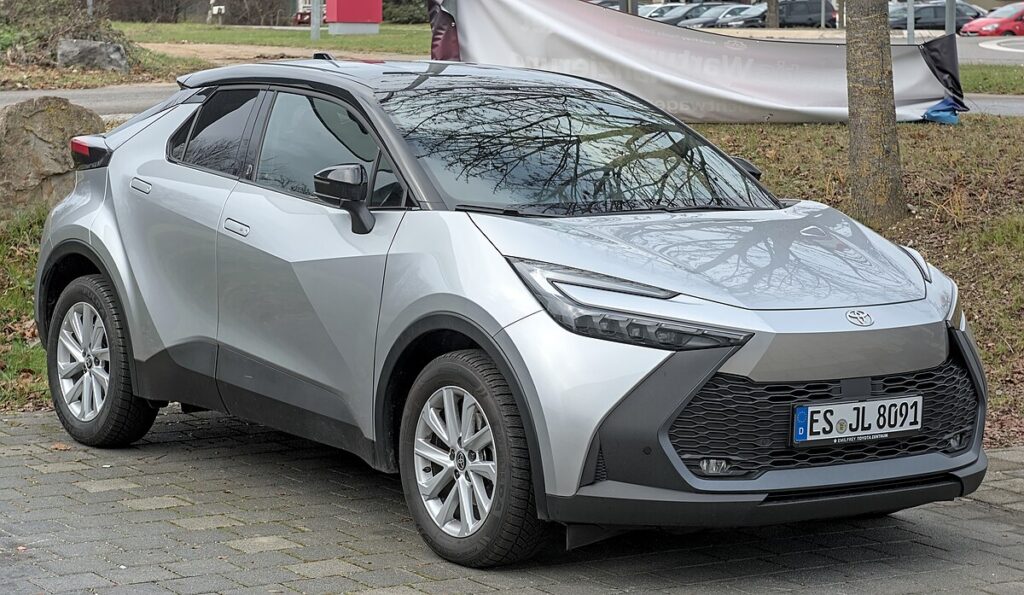
Nissan Juke vs Toyota C-HR: Complete Comparison of Specs, Performance, Efficiency, Space, and Cost

Content in this publication
- Overview: Nissan Juke or Toyota C-HR – Which SUV Fits You Better?
- Dimensions and Road Presence
- Luggage Capacity and Practical Space
- Powertrain Lineup and Performance
- Transmission and Drivetrain Technology
- Fuel Consumption, Battery, and Running Costs
- Price Positioning and Budget Impact
- Cabin Experience and Interior Technology
- Everyday Usability and Comfort
- CO₂ Classes and Environmental Positioning
- Target Driver Profiles (Who Should Choose Which?)
- Nissan Juke Technical Summary (Key Specs)
- Toyota C-HR Technical Summary (Key Specs)
- Final Verdict
Overview: Nissan Juke or Toyota C-HR – Which SUV Fits You Better?
We compare the Nissan Juke and the Toyota C-HR in depth: power output (up to 143 HP vs up to 223 HP), boot capacity (422 L vs 447 L), fuel consumption (from 4.7 L/100 km vs from 0.8 L/100 km equivalent in plug-in hybrid mode), and starting price (26,600 € vs 34,600 €). We also look at size, driving tech, hybrid systems, everyday usability, and running costs.
This guide shows exactly where each SUV wins.
 Best Nissan Juke Alternatives: 12 Compact SUVs Worth Considering in 2025
Dimensions and Road Presence
Nissan Juke Dimensions
- Length: 4,210 mm
- Width: 1,800 mm
- Height: 1,593 mm
- Kerb weight: 1,274 – 1,405 kg
- Doors / Seats: 5 / 5
Toyota C-HR Dimensions
- Length: 4,362 mm
- Width: 1,832 mm
- Height: 1,558 – 1,564 mm
- Kerb weight: 1,505 – 1,755 kg
- Doors / Seats: 5 / 5
Size Analysis
- The Toyota C-HR is longer (+152 mm) and wider (+32 mm). That extra footprint translates into more cabin presence and more rear comfort.
- The Nissan Juke is taller in stance, which helps with visibility in traffic and gives that “sit high” SUV feeling.
- Weight matters: the Juke is significantly lighter. This benefits low-speed agility, parking, and manoeuvrability in dense urban areas.
Luggage Capacity and Practical Space
Boot Space (Seats Up)
- Nissan Juke: 354 – 422 litres
- Toyota C-HR: 350 – 447 litres
What This Means
- Both are genuinely usable daily-family crossovers, not just style pieces.
- Juke reaches up to 422 L, which is strong for its class given its shorter body.
- C-HR goes up to 447 L, so it can swallow more weekend luggage when specified in its most cargo-friendly configuration.
- If you carry pushchairs, sports bags, or camera/storage gear, the C-HR offers a slight edge in absolute capacity.
- If you mainly drive solo or in pairs and want compact footprint + still respectable boot space, the Juke delivers a strong balance of size vs practicality.
Powertrain Lineup and Performance
Nissan Juke Engine Options
- Petrol (1.0 DIG-T):
- Power: 114 HP
- Cylinders: 3
- Gearbox: manual or dual-clutch automatic
- 0–100 km/h: ~10.1 – 11.8 s
- Top speed: 166 – 180 km/h
- Combined fuel use: approx. 5.8–6.0 L/100 km depending on spec
- Full Hybrid (1.6 Full Hybrid):
- Power: 143 HP
- Cylinders: 4
- Gearbox: automatic
- 0–100 km/h: ~10–11 s
- Top speed: up to 180 km/h
- Combined fuel use: from 4.7 L/100 km
- CO₂: from 107 g/km
Toyota C-HR Engine Options
- Full Hybrid:
- Power: ~140+ HP
- Cylinders: 4
- Transmission: automatic CVT
- Drivetrain: front-wheel drive or available all-wheel drive
- 0–100 km/h: ~9.9 s
- Top speed: ~175 – 180 km/h
- CO₂: from 115 g/km down to very low values depending on spec
- Plug-in Hybrid:
- Power: up to 223 HP
- Transmission: automatic CVT
- Drivetrain: typically front-wheel drive (AWD also offered in hybrid variants)
- 0–100 km/h: from 7.4 s
- Official combined consumption: as low as 0.8 L/100 km (thanks to electric running)
- Electric-only range: up to 68 km
- CO₂: from 17 g/km
Acceleration and Real-World Pace
- Juke is tuned for balanced urban response, not outright speed.
- C-HR Plug-in Hybrid is genuinely quick for this segment. A 7.4 s 0–100 km/h sprint puts it in “hot-hatch torque surge” territory.
Transmission and Drivetrain Technology
Nissan Juke
- Manual gearbox available on petrol engines.
- Dual-clutch automatic (DCT) offered, delivering fast, efficient shifts without the rubber-band feel of some CVTs.
- Front-wheel drive across the range.
- This setup appeals to drivers who still want a manual or a sporty-feeling DCT without going premium.
Toyota C-HR
- Automatic only.
- CVT-based hybrid system prioritises smoothness and fuel efficiency.
- Available with front-wheel drive or with all-wheel drive (in selected hybrid variants), giving more traction in poor weather or on wet/uneven roads.
- This is attractive if all-season stability matters.
Fuel Consumption, Battery, and Running Costs
Nissan Juke Efficiency
- Fuel consumption: 4.7 – 6.0 L/100 km depending on engine
- Fuel tank: 46 L
- Hybrid battery capacity: approx. 0.60 kWh (self-charging hybrid)
- CO₂ output: 107 – 136 g/km
- No plug-in charging; you refuel with petrol like normal.
Toyota C-HR Efficiency
- Fuel consumption (full hybrid): 5.1 L/100 km or better, depending on tune
- Fuel consumption (plug-in hybrid): as low as 0.8 L/100 km in official testing because it can run on electricity alone for short trips
- Electric-only range (plug-in hybrid): up to 68 km
- Fuel tank: 43 L
- CO₂ output: as low as 17 g/km in plug-in configuration
- For short commutes, many daily journeys can be completed largely on electric drive, drastically cutting petrol usage.
Running Cost Positioning
- Juke Hybrid is efficient without charging cables. It suits drivers who just want to fill up and go.
- C-HR Plug-in Hybrid is built for drivers who can recharge at home or work and want to slash fuel bills.
Price Positioning and Budget Impact
Nissan Juke Pricing
- From ~26,600 €
- Upper end around ~35,700 € depending on spec and equipment
Toyota C-HR Pricing
- From ~34,600 €
- Upper end around ~50,800 € for high-output plug-in hybrid versions with advanced tech
Value Analysis
- The Juke undercuts the C-HR by several thousand euros at entry level.
- Even a well-equipped Juke Hybrid often sits below the cost of a mid/high-spec C-HR.
- The C-HR asks more but returns more performance headroom, more tech capability, and the possibility of near-electric commuting.
Cabin Experience and Interior Technology
Nissan Juke Interior Focus
- Bold, youthful design language that mirrors the exterior
- Driver-centric cockpit feel
- Intuitive physical controls for core functions, which many daily drivers still prefer
- Strong sense of personality, highly customisable look and trim
- Taller cabin profile helps deliver that upright “SUV feel” and good forward visibility
Toyota C-HR Interior Focus
- Sophisticated, almost coupe-like environment
- High-tech safety and driver-assistance systems baked in at a very mature level
- Seamless integration of infotainment, connectivity, and driver aids
- Feels more premium and more “grown up,” especially in higher trims
Everyday Usability and Comfort
Nissan Juke Everyday Strengths
- Compact exterior footprint + light weight = easy to park, easy to place in traffic, confidence in narrow streets
- Ride height and visibility boost driver confidence in urban environments
- Practical boot for its size (up to 422 L), enough for groceries, luggage, light gear
- Manual gearbox option for drivers who still want that mechanical engagement
Toyota C-HR Everyday Strengths
- Cabin width and length give passengers a bit more room, especially in the back
- More boot volume in certain trims (up to 447 L) for family travel or bulk shopping
- Available all-wheel drive improves stability in bad weather and light adventure scenarios
- Plug-in variant offers silent electric starts, low-vibration city driving, and instant torque
CO₂ Classes and Environmental Positioning
Nissan Juke
- CO₂ efficiency classes reported as D, E, C depending on configuration
- Hybrid version significantly improves efficiency and emissions compared to the pure petrol units
Toyota C-HR
- CO₂ efficiency classes reported as C, B in its latest forms
- Plug-in hybrid versions achieve extremely low tailpipe CO₂ figures thanks to electric-only capability
This matters if you drive in cities with emissions-based taxation, clean-air zones, or company-car benefit rules that reward lower CO₂.
You may be interested in readingBest Nissan Juke Alternatives: 12 Compact SUVs Worth Considering in 2025You may be interested in reading
 Is the Nissan Juke a Good First Car? A Complete UK Buyer’s Guide
Target Driver Profiles (Who Should Choose Which?)
Nissan Juke: Ideal Buyer Profile
We recommend the Nissan Juke if you:
You may be interested in readingBest Nissan Juke Alternatives: 12 Compact SUVs Worth Considering in 2025You may be interested in reading
Is the Nissan Juke a Good First Car? A Complete UK Buyer’s GuideYou may be interested in reading
 MG HS Full Price, Versions, and Specifications Guide (2025 Update)
- Want a more affordable entry price
- Prefer a compact, agile SUV that’s easy in tight city streets
- Like having a manual gearbox or a snappy-feeling dual-clutch automatic
- Want distinctive styling and a higher seating position without committing to a large footprint
- Are comfortable with front-wheel drive and do not need all-wheel drive capability
Toyota C-HR: Ideal Buyer Profile
We recommend the Toyota C-HR if you:
- Want maximum efficiency and the option of plug-in hybrid tech
- Like the idea of driving most weekdays on near-electric power (up to ~68 km EV range in the plug-in variant)
- Value stronger acceleration (as quick as 7.4 s 0–100 km/h) and up to 223 HP
- Need slightly more cargo flexibility (up to 447 L) and rear passenger comfort
- Are willing to invest more upfront to access premium tech, refinement, and (in some configurations) all-wheel drive
Nissan Juke Technical Summary (Key Specs)
- Body style: SUV
- Seats / Doors: 5 / 5
- Model year: 2024
- Engines: petrol / full hybrid
- Power: 114 – 143 HP (84 – 105 kW)
- Cylinders: 3 or 4
- Displacement: 999 – 1,598 cm³
- Gearboxes: manual, dual-clutch automatic, conventional automatic on hybrid
- Driven wheels: front-wheel drive
- 0–100 km/h: 10.1 – 11.8 s
- Top speed: 166 – 180 km/h
- Fuel use: 4.7 – 6.0 L/100 km
- CO₂: 107 – 136 g/km
- Fuel tank: 46 L
- Boot capacity: 354 – 422 L
- Length / Width / Height: 4,210 / 1,800 / 1,593 mm
- Payload capacity: 405 – 427 kg
- Kerb weight: 1,274 – 1,405 kg
- CO₂ efficiency class: D, E, C
- Price range: ~26,600 € – 35,700 €
- Brand: Nissan
Toyota C-HR Technical Summary (Key Specs)
- Body style: SUV
- Seats / Doors: 5 / 5
- Model year: 2024 – 2025
- Engines: full hybrid / plug-in hybrid
- Power: 140 – 223 HP (103 – 164 kW)
- Cylinders: 4
- Displacement: 1,798 – 1,987 cm³
- Transmission: automatic CVT
- Driven wheels: front-wheel drive or all-wheel drive (depending on variant)
- 0–100 km/h: 7.4 – 9.9 s
- Top speed: 175 – 180 km/h
- Fuel use (hybrid): ~5.1 L/100 km
- Fuel use (plug-in hybrid): from 0.8 L/100 km (with regular charging)
- Electric-only range (plug-in hybrid): up to 68 km
- CO₂: 17 – 115 g/km
- Fuel tank: 43 L
- Boot capacity: 350 – 447 L
- Length / Width / Height: 4,362 / 1,832 / 1,558–1,564 mm
- Payload capacity: 375 – 425 kg
- Kerb weight: 1,505 – 1,755 kg
- CO₂ efficiency class: C, B
- Price range: ~34,600 € – 50,800 €
- Brand: Toyota
Final Verdict
- Choose the Nissan Juke if you want standout styling, a taller driving position, a lighter and more compact body for city life, access to both manual and dual-clutch automatic gearboxes, and a significantly lower entry price. Its hybrid version delivers genuinely respectable efficiency (from 4.7 L/100 km) without asking you to ever plug in.
- Choose the Toyota C-HR if you want next-level hybrid technology, the option of a plug-in hybrid with up to 223 HP and rapid acceleration, the ability to cover short trips almost fully on electric power, slightly more usable rear space and boot volume, available all-wheel drive, and a premium-feeling interior. It costs more, but it also gives more in performance headroom, tech depth, and long-term efficiency potential.
In simple terms: the Juke is the smart-money urban crossover with personality; the C-HR is the tech-loaded efficiency weapon that can replace a traditional petrol car for a lot of daily driving.
If you want to know other articles similar to Nissan Juke vs Toyota C-HR: Complete Comparison of Specs, Performance, Efficiency, Space, and Cost you can visit the category Blog.
Volvo S90 Reliability: Problems, Costs & Best Years
Is Haval Jolion a Good Car? Honest Review, Reliability, Pros and Cons
How to Start Haval Jolion With Spare Key: Complete Guide
How to Calculate Per Diem on an Auto Loan

How to Calculate the Residual Value of a Car

Is the Honda Passport Selling Well? Sales Numbers Tell the Story
Leave a Reply
More content of your interest