
Ford Edge vs Hyundai Santa Fe: Which SUV Is Better?

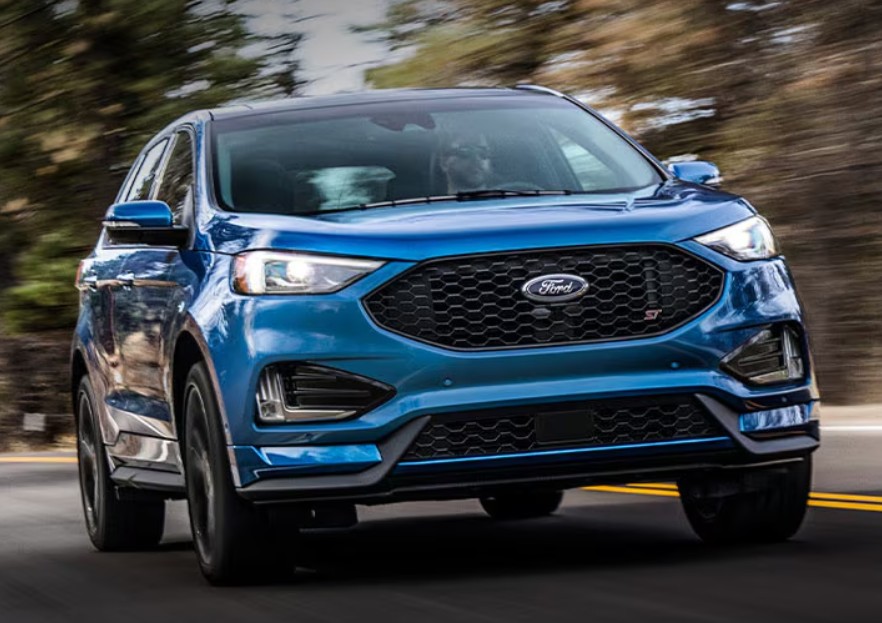
The Ford Edge vs Hyundai Santa Fe comparison looks straightforward at first. Both are midsize crossover SUVs with comfortable cabins, useful cargo space, turbocharged power available, and enough versatility to handle everything from commuting to road trips.
Dig a little deeper, though, and these two vehicles are surprisingly different.
The Ford Edge ended its North American production run after the 2024 model year, making it primarily a used-car choice today. The Hyundai Santa Fe, meanwhile, has evolved into a dramatically redesigned three-row SUV with current gasoline and hybrid powertrains.
That distinction changes the buying conversation.
The Edge remains appealing because it gives us a spacious two-row cabin, standard all-wheel drive in its final model year, straightforward usability, and — particularly in ST trim — genuinely strong performance. The Santa Fe approaches the family-SUV formula from another angle. It offers three rows, considerably newer technology, clever packaging, hybrid availability, and more maximum cargo room.
So, which SUV deserves your driveway?
For most families shopping new, the Santa Fe is the stronger all-around choice. But if we're hunting for a comfortable used SUV, don't need a third row, or crave the punch of the Edge ST's V6, the Ford still has plenty going for it.
Let's break it down.
Content in this publication
- Ford Edge vs Hyundai Santa Fe at a Glance
- The Biggest Difference: Two Rows vs Three Rows
- Exterior Size and Everyday Maneuverability
- Ford Edge vs Hyundai Santa Fe Interior Quality
- Cargo Space: Which SUV Carries More?
- Ford Edge vs Hyundai Santa Fe Engine Performance
- Driving Experience: Comfort vs Personality
- Fuel Economy: Santa Fe Has the Bigger Ace
- Towing Capacity: A Surprisingly Close Fight
- All-Wheel Drive and Poor-Weather Driving
- Safety Technology
- Reliability and Long-Term Ownership
- Warranty: Santa Fe Holds an Obvious New-Car Advantage
- Ford Edge vs Hyundai Santa Fe for Families
- Which SUV Is Better for Couples?
- Which Is Better for Long-Distance Driving?
- Infotainment and Connectivity
- Design: Sporty Edge or Boxy Santa Fe?
- Price and Value: New vs Used Changes Everything
- Ford Edge ST vs Hyundai Santa Fe: The Fun Choice
- Ford Edge vs Santa Fe Hybrid
- Advantages and Disadvantages
- Which One Should We Buy Used?
- Which One Should We Buy New?
- Which SUV Is Better Overall?
- Conclusion: Ford Edge vs Hyundai Santa Fe Final Verdict
- Frequently Asked Questions
Ford Edge vs Hyundai Santa Fe at a Glance
Before getting buried in details, here's the basic picture.
| Category | Ford Edge | Hyundai Santa Fe |
|---|---|---|
| Seating | 5 | Up to 7, depending on configuration |
| Layout | Two-row midsize SUV | Three-row midsize SUV |
| Base engine in comparison | 2.0L turbo four-cylinder | 2.5L turbo four-cylinder |
| Performance option | 2.7L twin-turbo V6 Edge ST | Hybrid powertrain available |
| Drivetrain | AWD on final 2024 models | FWD or available HTRAC AWD |
| Maximum cargo space | About 73.4 cu. ft. | 79.6 cu. ft. |
| Maximum towing | Up to 3,500 lb properly equipped | Up to 4,500 lb on certain versions |
| Best trait | Two-row comfort and ST performance | Versatility, technology and efficiency |
| Current status | Used/discontinued in North America | Current production model |
Hyundai lists 79.6 cubic feet of maximum cargo volume behind the front seats for the current Santa Fe, 40.5 cubic feet behind the second row, and 14.6 cubic feet behind the third. Ford's Edge has approximately 73.4 cubic feet behind its front seats.
Already, we can see the philosophical split: the Edge concentrates its space around five people, while the Santa Fe stretches its usefulness across passengers and cargo.
The Biggest Difference: Two Rows vs Three Rows
If we're shopping for a family SUV, this may settle the argument immediately.
The Ford Edge is strictly a five-seat, two-row crossover. Rather than squeezing another row into the back, Ford devoted its footprint to generous first- and second-row accommodation plus a large cargo area.
And there's something refreshing about that approach.
A family of four doesn't necessarily need seven seats. Sometimes we'd rather have a roomy back seat where teenagers aren't sitting with their knees against the front seatbacks.
The Santa Fe takes the opposite path.
Its current configuration includes a third row, turning it into a much more flexible family vehicle. Hyundai lists approximately 30 inches of third-row legroom, compared with a very generous 42-plus inches available in the second row depending on configuration.
That third row isn't limousine territory, naturally. Adults may prefer the first two rows on longer journeys. But when cousins, grandparents, children's friends, or extra passengers suddenly appear, those additional seats can feel like finding another room in your house.
Which Has the Better Interior Layout?
It depends entirely on what we need.
For five passengers, we'd argue that the Edge's simpler two-row configuration remains extremely pleasant. Nobody has to think about climbing into the back, folding seats, or sacrificing luggage space to carry additional passengers.
For growing families, the Santa Fe wins.
That third row may stay folded 80% of the time, but having it available for the other 20% can make an enormous difference.
Ford Edge Wins for Simplicity
There's also less compromise in a dedicated two-row SUV.
The Edge feels wide, open and conventional. The rear seat is genuinely useful rather than merely existing on a specification sheet.
If our household consists of two adults, one or two children, and perhaps a dog, the Edge makes plenty of sense.
Santa Fe Wins for Flexibility
The Santa Fe behaves almost like a multitool.
Monday morning? School run.
Friday afternoon? Grocery hauling.
Saturday? Seven passengers.
Sunday? Fold the rear seats and load bicycles, camping equipment, boxes, or home-improvement supplies.
That adaptability is one of its biggest advantages.
Exterior Size and Everyday Maneuverability
Here's something interesting: adding a third row hasn't turned the Santa Fe into an enormous SUV.
The current Santa Fe measures roughly 190.2 inches long, according to Hyundai. The Edge has historically occupied roughly the same general size class.
In other words, Hyundai's packaging does much of the heavy lifting.
The Santa Fe's boxier body also makes its dimensions easier to exploit. Instead of an aggressively sloped roofline stealing rear space in the name of style, Hyundai has embraced a nearly squared-off silhouette.
The Edge looks softer and sportier.
The Santa Fe looks like someone drew an adventure SUV using a ruler.
Which design is better? That's subjective. But functionally, the Hyundai's squared proportions pay dividends.
Ford Edge vs Hyundai Santa Fe Interior Quality
Walk inside both SUVs and the age difference becomes more noticeable.
The Edge's cabin is comfortable and reasonably straightforward, particularly in its later years. Its large portrait-oriented center touchscreen gives the dashboard a modern focal point.
Yet surrounding materials and design details reveal that the basic Edge architecture dates back considerably further than the newest Santa Fe.
The Hyundai interior feels like a newer generation of vehicle because, well, it is.
Its dashboard favors horizontal surfaces, wide displays, open storage solutions, and a more architectural design. There is a little Range Rover flavor in the shape without simply becoming a copy.
Technology Gives the Santa Fe an Advantage
Digital displays have become central to the modern SUV experience, and Hyundai clearly designed the current Santa Fe around that expectation.
Connectivity, driver information and infotainment are integrated more naturally into the cabin than they are in the older Ford platform.
That doesn't make the Edge unusable — far from it.
In fact, some owners may prefer its relatively familiar arrangement. Huge technological jumps aren't always improvements if we're buried beneath menus just to change ordinary settings.
Still, anyone jumping from an older SUV into a current Santa Fe will probably perceive the Hyundai as the more contemporary machine.
Cargo Space: Which SUV Carries More?
This contest is closer than the seating configuration might suggest.
The Ford Edge has always been good at swallowing luggage. With the rear seats folded, approximately 73.4 cubic feet of cargo capacity becomes available.
That's a lot.
Because there is no third row, everyday cargo space behind the second row is also one of the Edge's strengths.
The current Santa Fe counters with 79.6 cubic feet behind the front seats and 40.5 cubic feet behind the second row. With all three rows upright, cargo volume falls to 14.6 cubic feet.
Here's the practical interpretation: if we're regularly carrying seven occupants, the Santa Fe's cargo area becomes relatively modest. Fold that third row, though, and it transforms into an excellent five-person cargo hauler.
Which Is Better for Road Trips?
Five people plus luggage?
Both work beautifully.
Six or seven people plus luggage?
The Santa Fe can carry the passengers, but external storage or careful packing may become necessary.
The Edge can't carry seven at all.
That makes this category another victory for Hyundai's versatility rather than an outright knockout in raw everyday storage.
Ford Edge vs Hyundai Santa Fe Engine Performance
Now things get interesting.
The final Ford Edge lineup generally revolved around a turbocharged 2.0-liter four-cylinder engine, while the performance-oriented Edge ST used a 2.7-liter EcoBoost V6.
That V6 is the wild card in this entire comparison.
Ford rated the 2.7-liter EcoBoost in the Edge ST at 335 horsepower and 380 lb-ft of torque in published specifications.
For a practical two-row crossover, that's serious muscle.
Press the accelerator and the ST doesn't merely gather speed politely; it lunges forward with the enthusiasm of a family SUV that has secretly been drinking espresso.
Santa Fe 2.5 Turbo Performance
The gasoline Santa Fe uses a turbocharged 2.5-liter four-cylinder producing 277 horsepower and 311 lb-ft of torque in Hyundai's current U.S. specifications.
That's plenty for everyday driving.
Its torque makes highway merging, overtaking and climbing grades feel effortless enough for the segment. Few families will step out thinking it desperately needs more power.
But compared directly with an Edge ST?
Ford wins the horsepower contest.
Edge ST Is the Enthusiast's Choice
Among these two nameplates, the Edge ST is unquestionably the more compelling option for drivers who place acceleration and performance high on the priority list.
It isn't a sports car wearing an SUV costume, but there's considerably more swagger underneath its hood than the ordinary family-crossover formula requires.
If the morning school run needs a little hot sauce, the ST provides it.
Driving Experience: Comfort vs Personality
Power figures only tell us how hard an engine can punch.
What happens when the road starts bending?
You may be interested in reading Ford Edge vs Kuga: Which Ford SUV Is the Better Choice?
The Edge generally feels planted and substantial. Its wide stance and two-row proportions give it a reassuring demeanor on highways. The ST tightens that formula considerably and delivers a more enthusiastic experience.
The Santa Fe feels different.
Its mission prioritizes family transportation, refinement, passenger space and versatility. The boxy shape suggests ruggedness, but beneath the adventurous styling we're still dealing with a road-focused unibody crossover.
That's not criticism.
Most owners spend vastly more time navigating traffic, parking garages and highways than crawling across rocks.
Which Is More Comfortable?
For relaxed highway cruising, both are strong.
The Edge offers a comfortable seating position and spacious second row, while the Santa Fe benefits from a newer interior design and exceptionally generous passenger packaging.
Families carrying adults in both front and rear seats should be satisfied with either.
Families needing occasional third-row transportation will obviously find the Santa Fe far more useful.
Fuel Economy: Santa Fe Has the Bigger Ace
Here's where age catches the Ford.
The current Santa Fe isn't limited to a conventional gasoline engine. Hyundai also offers a hybrid powertrain, providing shoppers with an efficiency-focused alternative that the Edge never matched with an equivalent hybrid version in its final U.S. lineup.
Hyundai publishes EPA estimates as high as roughly 36 mpg combined for front-wheel-drive Santa Fe Hybrid configurations, with AWD versions also comfortably ahead of conventional performance-oriented SUVs.
That's meaningful.
Drive 15,000 miles annually and differences in fuel consumption compound year after year.
For commuters, families with long school runs, and anyone staring suspiciously at the gas station price board, the Santa Fe Hybrid is arguably the most rational drivetrain in this comparison.
What About the Edge ST?
Nobody buys a 335-horsepower twin-turbo V6 because they've declared war on fuel pumps.
Performance costs something.
The Edge ST's appetite is simply part of the bargain. If efficiency sits above acceleration on our shopping list, the Hyundai Hybrid is playing an entirely different — and more sensible — game.
Towing Capacity: A Surprisingly Close Fight
Neither SUV replaces a body-on-frame pickup, but both can handle modest recreational towing.
Ford rates a properly equipped 2024 Edge for up to 3,500 pounds of maximum loaded trailer weight. The appropriate Class II Trailer Tow Package is required on relevant 2.0-liter configurations, while Ford's documentation indicates the Edge ST included the necessary package.
The gasoline Santa Fe can also tow 3,500 pounds with trailer brakes in many configurations.
Certain Santa Fe versions raise that number to 4,500 pounds, according to Hyundai.
So Hyundai takes the maximum-capacity trophy.
That said, buyers planning frequent towing should always evaluate payload, tongue weight, trailer brakes, equipment packages and actual loaded trailer weight rather than relying on the headline number alone.
All-Wheel Drive and Poor-Weather Driving
One appealing characteristic of the final 2024 Ford Edge lineup is standard all-wheel drive.
For buyers living where winters resemble a six-month argument with the weather, that's useful.
Hyundai takes a more flexible approach.
Front-wheel drive remains available on various Santa Fe versions, while HTRAC all-wheel drive can be selected on applicable trims and comes standard on certain configurations.
There are advantages to both strategies.
Ford keeps the decision simple.
Hyundai lets buyers who don't need AWD potentially avoid its added cost and mechanical complexity.
Remember, however, that AWD isn't a magic cloak of invincibility. Good tires remain enormously important for braking and cornering on snow and ice.
Safety Technology
Modern SUVs are essentially rolling collections of cameras, sensors and computers.
The late-model Edge offers a useful suite of driver-assistance technologies, while the newer Santa Fe pushes further into today's generation of active safety and convenience features.
Depending on trim, expect functions such as forward-collision assistance, lane-related aids, blind-spot monitoring, adaptive cruise functionality and parking assistance to influence the comparison.
The key phrase is depending on trim.
When buying used, particularly with an Edge, we shouldn't assume that two visually similar vehicles carry identical equipment. Packages and model years matter.
Always verify the actual vehicle identification and option list before purchasing.
Reliability and Long-Term Ownership
This section deserves nuance.
People love asking, “Which one is more reliable?” as though every vehicle leaves the factory carrying a predetermined expiration date.
Real ownership isn't that simple.
Service history matters. Driving conditions matter. Previous ownership matters. Manufacturing revisions matter. Even how frequently fluids were changed matters.
For a used Edge, maintenance documentation becomes especially important because we're evaluating a vehicle that may already have accumulated years of use.
Buying a Used Ford Edge
We'd check service history carefully, test every electronic feature, inspect the cooling system, verify transmission behavior, listen for suspension noises, check for fluid leaks and scan for stored trouble codes.
A professional pre-purchase inspection is money well spent.
The bargain Edge with a questionable past can become more expensive than the slightly pricier example with immaculate records.
Service History Beats a Shiny Detail Job
A spotless dashboard tells us almost nothing about what happened under the hood.
Receipts do.
Give us the SUV with documented oil changes, proper maintenance and a boring folder full of invoices over the suspiciously cheap example wearing fresh tire shine.
Warranty: Santa Fe Holds an Obvious New-Car Advantage
Because the Edge is no longer a new mainstream U.S.-market purchase, Hyundai naturally has the advantage for shoppers wanting a factory-fresh vehicle backed by a new-car warranty.
That distinction matters more than it initially seems.
Used Edge pricing may save thousands of dollars upfront, but we should budget for maintenance and repairs as the vehicle ages.
A new Santa Fe costs more to acquire but delivers greater warranty protection and removes much of the mystery surrounding prior ownership.
Neither approach is automatically cheaper.
One lowers the purchase price.
The other lowers uncertainty.
Ford Edge vs Hyundai Santa Fe for Families
For a family with three or more children, the Santa Fe makes the stronger argument.
No complicated explanation required.
Three rows beat two.
For a household with one or two children, however, the answer becomes much less obvious.
The Edge's spacious second row, substantial cargo area and straightforward layout can actually make daily life wonderfully easy.
Do we really need seven seats if we use seats six and seven twice per year?
That's the question worth asking.
Buying the most seats isn't always the same thing as buying the right vehicle.
Which SUV Is Better for Couples?
Couples without regular third-row needs may actually find the Edge appealing — especially on the used market.
We get a roomy cabin, strong cargo utility and potentially a much lower purchase price than a new Santa Fe.
The ST adds another temptation.
Few things make an ordinary grocery run unnecessarily entertaining quite like 335 horsepower.
Still, the Santa Fe's newer technology, efficient hybrid option and more versatile interior could justify the additional investment for buyers planning to keep their SUV for many years.
Which Is Better for Long-Distance Driving?
For traditional highway road trips, we'd call this close.
The Edge's five-seat interior gives passengers room to stretch out, while its cargo area handles luggage easily.
The Santa Fe counters with a newer cabin and more flexible seating.
Fuel economy ultimately pushes Hyundai ahead — particularly in hybrid form.
When we're covering hundreds of highway miles regularly, every gallon saved starts to matter.
Infotainment and Connectivity
Technology dates faster than exterior styling.
A well-maintained 2024 Edge can still look contemporary parked outside a restaurant, but the moment we compare cabin electronics directly with a new-generation Santa Fe, the age gap becomes clearer.
You may be interested in readingFord Edge vs Kuga: Which Ford SUV Is the Better Choice?You may be interested in reading
Ford Edge Versus Jeep Grand Cherokee: Which SUV Is Better?Ford's large SYNC interface remains functional and visually prominent, but Hyundai's current interior architecture integrates displays and modern connectivity more cohesively.
Tech-heavy buyers should favor the Santa Fe.
People who mainly need navigation, smartphone integration, music and straightforward climate controls may find the Edge entirely adequate.
Not everyone needs their dashboard to impersonate a command center.
Design: Sporty Edge or Boxy Santa Fe?
Few comparison categories are this subjective.
The Edge uses rounded crossover proportions. It looks planted, broad and somewhat athletic, particularly as an ST.
The latest Santa Fe makes almost no attempt to blend into traffic.
Its squared body, vertical tail and upright details create a rugged visual identity that's dramatically different from its predecessor.
Some people love it.
Others look at it and wonder whether someone accidentally stretched a camping cooler into an SUV.
That's design. It should provoke a reaction.
Which Design Will Age Better?
Predicting automotive fashion is dangerous.
Today's controversial design often becomes tomorrow's classic, while today's safe design can become invisible surprisingly quickly.
The Edge is less adventurous, which may help it age gracefully.
The Santa Fe makes a statement.
Choose whichever statement we'd still enjoy seeing every morning five years from now.
Price and Value: New vs Used Changes Everything
This isn't a normal same-year showroom comparison anymore.
That's crucial.
The Santa Fe can be purchased as a current new vehicle. The Edge, following the conclusion of North American production, now makes most sense as a used or remaining-inventory proposition.
Consequently, Edge depreciation can work in our favor.
A late-model Edge may deliver a remarkable amount of passenger room, power, equipment and comfort for the money compared with buying a brand-new crossover.
But lower purchase price doesn't mean lower total cost automatically.
We need to consider financing rates, warranty coverage, maintenance requirements, tires, brakes, insurance, expected repair costs and eventual resale value.
Sometimes the cheapest vehicle to buy isn't the cheapest vehicle to own.
Ford Edge ST vs Hyundai Santa Fe: The Fun Choice
This deserves its own section because the Edge ST changes the personality of the comparison.
With the 2.7-liter EcoBoost V6 producing 335 hp and 380 lb-ft, the ST is substantially more performance-focused than the typical family crossover.
Hyundai's 277-hp gasoline Santa Fe is hardly slow, but performance isn't its central mission.
The Hyundai wants to carry people efficiently.
The Ford ST occasionally wants to behave badly.
For enthusiasts who still need a practical SUV, that's a meaningful distinction.
Ford Edge vs Santa Fe Hybrid
Reverse the priorities and Hyundai immediately takes control.
The Edge has no direct final-generation hybrid answer to the Santa Fe Hybrid.
That's significant for high-mileage drivers.
A hybrid drivetrain makes far more sense for someone commuting through dense traffic every weekday than 335 horsepower they'll exploit for approximately six seconds while entering the freeway.
That's not as exciting.
It is, however, difficult to argue with at the fuel pump.
Advantages and Disadvantages
If we strip the comparison down to the factors that will actually influence ownership, the strengths become clear:
- Choose the Ford Edge if: we want a spacious five-seat cabin, are shopping used, value straightforward two-row practicality, prefer standard AWD on a final-year model, or specifically want the much stronger Edge ST.
- Choose the Hyundai Santa Fe if: we need up to three rows, want a brand-new SUV, prioritize newer cabin technology, need maximum cargo flexibility, want hybrid fuel economy, or could use towing capacity as high as 4,500 pounds on an appropriate configuration.
- Think carefully before choosing the Edge if: factory warranty coverage and cutting-edge interior technology are priorities, because the model is now effectively a used-market proposition.
- Think carefully before choosing the Santa Fe if: we don't need the third row and are mainly comparing value against a depreciated late-model Edge. Paying more for flexibility we never use isn't automatically smart.
- Test-drive both whenever possible: specifications can describe dimensions and horsepower, but seating comfort, visibility, throttle response and ride quality are personal.
Which One Should We Buy Used?
This is where the Edge becomes most dangerous to the Santa Fe.
Not dangerous in performance — dangerous in value.
Depreciation can turn a well-equipped Ford Edge into a compelling bargain.
Imagine comparing a new Santa Fe against an Edge that's only a few years old but costs materially less. Suddenly we'd have money left for insurance, maintenance, fuel or simply keeping cash in the bank.
A lightly used Santa Fe can obviously produce the same advantage, so compare actual local transaction prices rather than MSRP alone.
Used-car shopping is where spreadsheets become far more useful than brochures.
Which One Should We Buy New?
Santa Fe.
This isn't really a contest anymore because Ford ended North American Edge production.
More importantly, Hyundai's current model isn't merely the winner by default. It offers genuine advantages: three-row flexibility, modern technology, strong cargo capacity, available hybrid efficiency and competitive towing capability.
If we're walking into a dealership specifically wanting a new midsize SUV, the Santa Fe is the logical vehicle of these two.
Which SUV Is Better Overall?
For most buyers today, the Hyundai Santa Fe wins the Ford Edge vs Hyundai Santa Fe comparison.
It has moved the formula forward.
The current Santa Fe offers up to three rows of seating, 79.6 cubic feet of maximum cargo volume, modern technology, available AWD, gasoline and hybrid choices, and up to 4,500 pounds of towing capacity in certain configurations.
But that verdict needs an asterisk.
The Ford Edge remains a very good used two-row SUV proposition.
If we don't need seven seats and can find a clean late-model Edge at the right price, dismissing it simply because production ended would be foolish. A well-kept Edge gives us lots of room without the bulk or complexity of a third row.
And if performance matters?
The Edge ST keeps its own special crown.
The Santa Fe is the better family multitool.
The Edge is the simpler five-seat cruiser.
The Edge ST is the one that occasionally makes us grin for no responsible reason whatsoever.
Conclusion: Ford Edge vs Hyundai Santa Fe Final Verdict
Comparing the Ford Edge vs Hyundai Santa Fe illustrates just how quickly the SUV market has evolved.
The Edge represents a straightforward formula that still works: five seats, plenty of cargo space, comfortable highway manners, available serious performance and, on final models, AWD as standard equipment.
There's nothing wrong with simplicity.
The Santa Fe simply gives us more possibilities.
Its third row dramatically increases passenger flexibility. Its squared design creates excellent cargo utility. Its hybrid option answers today's efficiency concerns, while its turbo gasoline engine still supplies healthy performance. Hyundai even manages towing capability of up to 4,500 pounds on certain variants.
So our recommendation comes down to the buying situation.
Buying new? Choose the Hyundai Santa Fe.
Buying used and only need five seats? Compare the Ford Edge carefully because it could offer excellent value.
Want maximum fuel economy? Santa Fe Hybrid.
Need seven seats? Santa Fe.
Want the most horsepower and the most entertaining acceleration? Edge ST.
Ultimately, the best SUV isn't the one that wins the most specification categories. It's the one whose strengths match the things we actually do every week.
Buy for that reality, not for imaginary adventures.
Frequently Asked Questions
1. Is the Hyundai Santa Fe bigger than the Ford Edge?
They're relatively close in overall vehicle class and footprint, but the current Santa Fe makes more aggressive use of its interior packaging. Hyundai lists a length of approximately 190.2 inches and provides three rows of seating. The Edge is a two-row SUV, so its interior focuses on five-passenger comfort rather than maximizing seating capacity.
2. Does the Ford Edge or Hyundai Santa Fe have more cargo space?
The current Santa Fe offers more maximum cargo volume. Hyundai lists 79.6 cubic feet behind the front seats, compared with approximately 73.4 cubic feet for the Edge. However, the Edge's lack of a third row makes its cargo arrangement straightforward when all five passenger seats are being used.
3. Which is faster, the Ford Edge or Hyundai Santa Fe?
The Ford Edge ST is the performance winner. Its 2.7-liter EcoBoost V6 was rated at 335 horsepower and 380 lb-ft of torque. The gasoline Santa Fe's 2.5-liter turbocharged four-cylinder produces 277 horsepower and 311 lb-ft of torque in current U.S. specifications.
4. Which can tow more, Ford Edge or Hyundai Santa Fe?
A properly equipped Ford Edge can tow up to 3,500 pounds. Many gasoline Santa Fe versions are also rated for 3,500 pounds with trailer brakes, while certain configurations reach 4,500 pounds. Therefore, the Santa Fe has the higher maximum rating when appropriately configured.
5. Is the Ford Edge or Hyundai Santa Fe better for a family?
For most larger families, we'd choose the Hyundai Santa Fe because its third row provides substantially greater seating flexibility. For families that never need more than five seats, a late-model used Edge can make excellent sense because it provides a roomy second row, generous cargo capacity and potentially attractive used-market pricing.
You may be interested in readingFord Edge vs Kuga: Which Ford SUV Is the Better Choice?You may be interested in reading
Ford Edge Versus Jeep Grand Cherokee: Which SUV Is Better?You may be interested in reading
Ford Edge Versus Honda CR-V: Which SUV Is Better?If you want to know other articles similar to Ford Edge vs Hyundai Santa Fe: Which SUV Is Better? you can visit the category Models.
Haval Jolion vs Omoda C5: Which SUV Is Better?
Haval Jolion vs Chery Tiggo 4 Pro: Full Comparison
Haval Jolion vs H6: Which SUV Is Better in 2026?
Haval Jolion vs Toyota Corolla Cross: Which SUV Is Better?
Haval Jolion vs Jaecoo J5: Which SUV Is Better?
Volkswagen T-Cross vs Volkswagen T-Roc: Which Is Better?
Leave a Reply
More content of your interest