
Best Engine Oil for Volkswagen Golf: Complete Guide

Choosing the best engine oil for a Volkswagen Golf is one of the simplest ways to protect its engine, maintain performance, and reduce the risk of expensive mechanical problems. However, with different Golf generations, petrol and diesel engines, turbocharged variants, and several Volkswagen oil specifications, finding the right lubricant can be surprisingly confusing.
Should we use 0W-20, 5W-30, or 5W-40? Is synthetic oil necessary? Does a Volkswagen Golf GTI require the same engine oil as a regular 1.5 TSI? And what about diesel-powered Golf TDI models?
The answers depend on the engine, model year, market, and Volkswagen approval specified for the vehicle.
In this comprehensive guide, we'll compare some of the best engine oils for Volkswagen Golf models, explain the different oil specifications, examine the requirements of popular Golf engines, and discuss how often we should change the oil.
Most importantly, we'll explain how to choose a lubricant that meets Volkswagen's engineering requirements rather than simply picking a popular brand.
Content in this publication
- What Is the Best Engine Oil for a Volkswagen Golf?
- Best Engine Oils for Volkswagen Golf: Top 8 Options
- 1. Castrol EDGE 0W-20 LL IV – Best for Compatible Modern Golf Engines
- 2. Mobil 1 ESP X2 0W-20 – Best Alternative for VW 508 00 Engines
- 3. LIQUI MOLY Top Tec 6200 0W-20 – Best for Modern VW Compatibility
- 4. Castrol EDGE 5W-30 LL – Best for Many Golf TDI Engines
- 5. Mobil 1 ESP 5W-30 – Best All-Round 5W-30 Alternative
- 6. LIQUI MOLY Top Tec 4200 5W-30 – Best for Compatible LongLife Applications
- 7. Motul 8100 X-CESS GEN2 5W-40 – Best for Older Compatible Petrol Engines
- 8. Shell Helix Ultra Professional AV-L 0W-30 – Best Approved 0W-30 Option
- Understanding Volkswagen Engine Oil Specifications
- Volkswagen Golf 0W-20 vs 5W-30 vs 5W-40
- Best Engine Oil for Volkswagen Golf by Generation
- Best Oil for Volkswagen Golf GTI
- Best Oil for Volkswagen Golf R
- Best Engine Oil for Volkswagen Golf TDI
- How Often Should We Change Volkswagen Golf Engine Oil?
- How Much Engine Oil Does a Volkswagen Golf Need?
- Synthetic vs Conventional Oil for Volkswagen Golf
- Common Mistakes When Choosing Volkswagen Golf Oil
- How to Choose the Best Engine Oil for Your Volkswagen Golf
- Frequently Asked Questions About Volkswagen Golf Engine Oil
- Conclusion: Which Engine Oil Should We Choose for a Volkswagen Golf?
What Is the Best Engine Oil for a Volkswagen Golf?
The best engine oil for a Volkswagen Golf is one that carries the correct Volkswagen manufacturer approval for its specific engine.
For many newer Golf engines, the recommended lubricant is a fully synthetic 0W-20 oil meeting VW 508 00 or VW 509 00. Meanwhile, numerous older petrol and diesel engines require oils meeting VW 502 00, VW 504 00, VW 505 01, or VW 507 00.
The critical distinction is that the viscosity rating alone does not determine compatibility.
For example, two bottles of 5W-30 synthetic oil may look almost identical, but only one might meet Volkswagen's required VW 504 00/507 00 specification.
Volkswagen Golf Engine Oil Recommendations by Engine
The following table provides a practical starting point. These are common applications, not universal specifications for every engine or model year.
| Volkswagen Golf Engine | Common VW Approval | Typical Viscosity |
|---|---|---|
| Golf Mk8 1.0 TSI / 1.5 TSI | VW 508 00 on applicable engines | 0W-20 |
| Golf Mk8 2.0 TDI | VW 509 00 or VW 507 00, depending on engine | 0W-20 or approved alternative |
| Golf Mk8 GTI 2.0 TSI | VW 508 00 on many versions | 0W-20 |
| Golf Mk8 R 2.0 TSI | Check engine-specific approval; VW 508 00 is common | Often 0W-20 |
| Golf Mk7 1.2 / 1.4 TSI | VW 502 00 or VW 504 00 | 5W-30, 5W-40 or approved alternative |
| Golf Mk7 1.6 / 2.0 TDI with DPF | VW 507 00 | Usually 5W-30 or 0W-30 |
| Golf Mk7 GTI 2.0 TSI | VW 502 00 or other specified approval | Commonly 5W-40 |
| Golf Mk5 / Mk6 petrol | Often VW 502 00 or VW 504 00 | 5W-30 or 5W-40 |
| Older Golf TDI PD engines | Often VW 505 01 | Engine-specific |
Important: The vehicle's owner's manual, engine oil label and applicable service documentation always take priority over this table. Specification requirements can vary even between vehicles from the same Golf generation.
Best Engine Oils for Volkswagen Golf: Top 8 Options
Several established lubricant manufacturers produce oils carrying genuine Volkswagen approvals.
Rather than treating every product as interchangeable, we've organised the following recommendations according to the VW standards each oil meets.
1. Castrol EDGE 0W-20 LL IV – Best for Compatible Modern Golf Engines
Viscosity: SAE 0W-20
Volkswagen Approval: VW 508 00 / VW 509 00
Best For: Modern Golf petrol and diesel engines requiring these approvals.
Castrol EDGE 0W-20 LL IV is one of the strongest options for newer Volkswagen Golf engines specifically designed around low-viscosity lubricants.
It uses an advanced synthetic formulation developed for engines requiring stringent manufacturer specifications.
Its main advantages include effective lubrication during cold starts, resistance to friction-related wear, and compatibility with engines designed for modern fuel-efficiency requirements.
For drivers using their Golf in stop-start traffic, these characteristics are particularly relevant because engine components experience repeated changes in temperature and load.
Why we recommend it: It combines the correct VW 508 00/509 00 approval with a widely recognised lubricant brand.
However, this oil should not be used in older engines unless Volkswagen specifically approves the specification.
2. Mobil 1 ESP X2 0W-20 – Best Alternative for VW 508 00 Engines
Viscosity: SAE 0W-20
Volkswagen Approval: VW 508 00 / VW 509 00
Best For: Compatible modern Golf, Golf GTI and Golf R applications.
Mobil 1 ESP X2 0W-20 is another excellent choice for Volkswagen Golf engines requiring the latest low-viscosity approvals.
Its formulation is designed to provide engine protection while supporting the efficiency of modern emissions-control systems.
It offers good low-temperature flow characteristics and is intended for demanding petrol and diesel engine applications.
The ESP designation reflects its emphasis on emissions-system compatibility, which is especially important for vehicles equipped with particulate filters.
Why we recommend it: It is a credible alternative to Castrol EDGE for vehicles requiring VW 508 00 or VW 509 00.
We would choose between the two based on availability, price, and confirmation of the approval on the exact product packaging.
3. LIQUI MOLY Top Tec 6200 0W-20 – Best for Modern VW Compatibility
Viscosity: SAE 0W-20
Volkswagen Approval: VW 508 00 / VW 509 00
Best For: Compatible newer Volkswagen Golf TSI and TDI engines.
LIQUI MOLY Top Tec 6200 0W-20 is developed for modern Volkswagen Group engines requiring a low-viscosity lubricant.
It is formulated to support rapid oil circulation after starting, protect moving engine components, and maintain efficiency under normal operating conditions.
Its Volkswagen approvals make it a suitable option when those specifications are explicitly required.
It is also worth considering for owners who prefer specialist European lubricant brands.
Why we recommend it: It provides a manufacturer-approved alternative for modern Golf engines without requiring us to compromise on Volkswagen's oil specifications.
4. Castrol EDGE 5W-30 LL – Best for Many Golf TDI Engines
Viscosity: SAE 5W-30
Volkswagen Approval: VW 504 00 / VW 507 00
Best For: Golf diesel engines with DPFs and compatible petrol engines.
Castrol EDGE 5W-30 LL is a strong all-round choice for many Volkswagen Golf models using VW 504 00 or VW 507 00.
Unlike conventional 5W-30 oils that may lack European manufacturer approvals, this formulation is designed around the requirements of engines using these standards.
For diesel Golf owners, its VW 507 00 approval is particularly relevant because many engines with diesel particulate filters require an appropriately formulated low-ash lubricant.
This type of oil helps support the durability of emissions-control equipment while providing the lubrication needed by turbocharged engines.
Why we recommend it: It offers broad compatibility across many Golf engines that specifically require VW 504 00/507 00.
It is not automatically suitable for Golf engines specifying VW 508 00/509 00.
5. Mobil 1 ESP 5W-30 – Best All-Round 5W-30 Alternative
Viscosity: SAE 5W-30
Volkswagen Approval: VW 504 00 / VW 507 00
Best For: Compatible Golf TSI and TDI engines.
Mobil 1 ESP 5W-30 is another high-quality engine oil with relevant Volkswagen approvals.
It is formulated to deliver engine protection while helping maintain the efficiency of exhaust aftertreatment equipment.
For diesel engines equipped with a DPF, using a compatible low-SAPS oil is especially important. Low-SAPS formulations limit certain ash-forming components that can contribute to particulate filter ash accumulation.
For petrol Golf engines specifying VW 504 00, this oil can also be appropriate.
Why we recommend it: It offers the necessary approvals for numerous VW 504 00/507 00 applications and makes a practical alternative to Castrol EDGE 5W-30 LL.
6. LIQUI MOLY Top Tec 4200 5W-30 – Best for Compatible LongLife Applications
Viscosity: SAE 5W-30
Volkswagen Approval: VW 504 00 / VW 507 00
Best For: Golf models requiring these approvals, including appropriate LongLife applications.
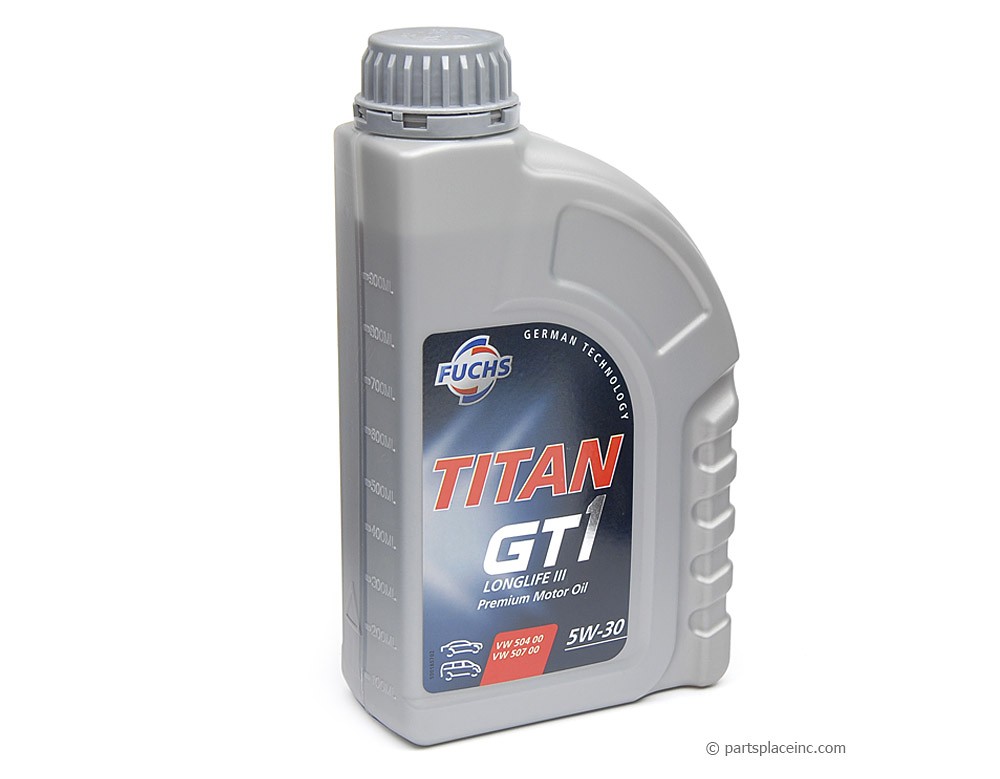
LIQUI MOLY Top Tec 4200 5W-30 New Generation is specifically approved for VW 504 00 and VW 507 00.
It is designed to protect engine components, resist ageing, and support extended maintenance intervals where permitted by the vehicle manufacturer.
This last point is important: an oil suitable for LongLife servicing does not automatically authorise a longer service interval for every vehicle.
The correct interval still depends on the Golf's maintenance programme and operating conditions.
Why we recommend it: It is especially attractive for Golf owners seeking a Volkswagen-approved 5W-30 oil from a specialist European manufacturer.
7. Motul 8100 X-CESS GEN2 5W-40 – Best for Older Compatible Petrol Engines
Viscosity: SAE 5W-40
Volkswagen Approval: VW 502 00 / VW 505 00
Best For: Older Golf petrol engines requiring VW 502 00.
Not every Volkswagen Golf benefits from modern 0W-20 oil.
Many older engines, including certain turbocharged petrol units, specify VW 502 00 lubricants.
Motul 8100 X-CESS GEN2 5W-40 is an option for these applications because it carries the relevant Volkswagen approval.
Its 5W-40 viscosity provides different operating characteristics from a 0W-20 lubricant, but that does not make it inherently better or worse. Its suitability depends on the engine's original design and specifications.
This oil can be particularly relevant to older Golf GTI applications that permit VW 502 00.
Why we recommend it: It is an approved option for engines requiring VW 502 00.
However, its VW 505 00 approval should not be confused with VW 505 01, a separate requirement applicable to certain older TDI engines.
8. Shell Helix Ultra Professional AV-L 0W-30 – Best Approved 0W-30 Option
Viscosity: SAE 0W-30
Volkswagen Approval: VW 504 00 / VW 507 00
Best For: Golf engines specifying these standards and permitting SAE 0W-30.
Shell Helix Ultra Professional AV-L 0W-30 is designed for Volkswagen Group applications requiring VW 504 00 or VW 507 00.
The 0W-30 viscosity provides favourable cold-temperature flow characteristics while meeting the appropriate approval for certain petrol and diesel engines.
It represents another option for drivers who want a fully synthetic lubricant with documented compatibility.
Why we recommend it: It offers a useful alternative to approved 5W-30 products when the vehicle permits this viscosity.
Understanding Volkswagen Engine Oil Specifications
Volkswagen uses its own oil approval system because general SAE viscosity grades and industry specifications do not describe every requirement of its engines.
Each VW standard includes tests and performance requirements relating to particular engine designs and operating conditions.
Understanding these approvals is essential when choosing the best engine oil for a Volkswagen Golf.
VW 508 00 and VW 509 00
VW 508 00 and VW 509 00 are specifications associated with approved low-viscosity engine oils.
VW 508 00 generally applies to compatible petrol engines, while VW 509 00 applies to compatible diesel engines.
These approvals are associated with SAE 0W-20 lubricants intended to support efficient operation.
Importantly, they are not universally backward compatible with older engines.
We should never assume that a 0W-20 oil carrying VW 508 00 can replace an older VW 502 00 lubricant.
VW 504 00 and VW 507 00
These are widely used Volkswagen oil standards.
VW 504 00 covers compatible petrol engines, while VW 507 00 is particularly important for numerous diesel engines with particulate filters.
Many oils carry both approvals because a single formulation can meet the requirements of both categories.
Products with these specifications are commonly available in 5W-30 and 0W-30 viscosities.
VW 502 00
VW 502 00 is commonly associated with older Volkswagen petrol engines and certain fixed-interval maintenance applications.
It appears on approved oils in several viscosities, including 5W-40 and 0W-40.
For older Golf GTI models, this specification may be particularly relevant.
VW 505 00 and VW 505 01
These specifications relate to older diesel engine applications.
VW 505 01 is especially significant for certain Volkswagen Pumpe Düse, or unit-injector, diesel engines.
Although the names look similar, VW 505 00 and VW 505 01 should not be treated as interchangeable.
Some older diesel engines also have additional requirements, so their exact engine codes and service documentation must be checked.
Volkswagen Golf 0W-20 vs 5W-30 vs 5W-40
One of the most common questions is whether 0W-20, 5W-30, or 5W-40 is better for a Volkswagen Golf.
The answer is not simply that one oil is thinner or thicker.
The correct choice must combine the required viscosity with the appropriate manufacturer approval.
| Characteristic | 0W-20 | 5W-30 | 5W-40 |
|---|---|---|---|
| Cold-start viscosity classification | 0W | 5W | 5W |
| High-temperature viscosity grade | 20 | 30 | 40 |
| Common VW approvals | 508 00 / 509 00 | 504 00 / 507 00 | 502 00 / 505 00 |
| Common applications | Newer compatible engines | Many earlier petrol and diesel engines | Certain older petrol engines |
| Suitable for every Golf? | No | No | No |
Is 0W-20 Better for a Volkswagen Golf?
For an engine designed to use VW 508 00 or VW 509 00, 0W-20 can be the correct and most appropriate choice.
Its lower viscosity can help reduce internal friction and support fuel-efficiency targets.
However, using 0W-20 in an engine designed for a different specification may be inappropriate and could compromise protection.
Is 5W-30 the Best All-Round Choice?
5W-30 is an extremely common viscosity among Volkswagen-compatible oils.
It is often suitable for Golf engines requiring VW 504 00 or VW 507 00.
However, not every 5W-30 oil carries those approvals.
A generic 5W-30 product should not be substituted merely because it has the correct viscosity printed on the bottle.
Should We Use 5W-40 in an Older Golf?
Some older Golf petrol engines are approved for 5W-40 lubricants meeting VW 502 00.
In those vehicles, a properly approved 5W-40 oil can be an excellent choice.
But selecting thicker oil simply because the engine has accumulated high mileage is not necessarily the right solution.
If oil consumption increases, we should investigate possible leaks, crankcase ventilation problems, turbocharger wear, or internal engine wear instead of automatically switching to a higher viscosity.
Best Engine Oil for Volkswagen Golf by Generation
Volkswagen has produced many Golf generations, each featuring different engine technologies and lubrication requirements.
For this reason, the best oil for a Golf Mk8 may be unsuitable for a Golf Mk5 or Mk6.
Volkswagen Golf Mk8 Engine Oil
The Volkswagen Golf Mk8 introduced an extensive range of engines, including TSI petrol engines, TDI diesels, mild-hybrid eTSI variants, and performance-focused GTI and R models.
Many modern versions require VW 508 00 or VW 509 00 oils, commonly SAE 0W-20.
For these engines, suitable products may include:
- Castrol EDGE 0W-20 LL IV
- Mobil 1 ESP X2 0W-20
- LIQUI MOLY Top Tec 6200 0W-20
However, not every Mk8 engine has identical oil requirements. Some versions may specify different Volkswagen approvals, particularly across markets and model years.
We should check the engine oil sticker or owner's manual before making a selection.
Volkswagen Golf Mk7 Engine Oil
The Golf Mk7 is available with a broad range of TSI and TDI engines.
Numerous petrol versions use VW 502 00 or VW 504 00 lubricants, depending on their engine and servicing requirements.
Meanwhile, many diesel versions with particulate filters require VW 507 00.
For a Golf Mk7 1.6 TDI or 2.0 TDI specifying VW 507 00, an approved 5W-30 oil is often appropriate.
The Golf Mk7 GTI requires particular attention because its oil requirements may differ from those of ordinary TSI variants and from the newer Mk8 GTI.
Volkswagen Golf Mk6 Engine Oil
The Golf Mk6 features petrol engines such as the 1.2 TSI, 1.4 TSI and 2.0 TSI, alongside several diesel options.
Many petrol versions use oils meeting VW 502 00 or VW 504 00.
Diesel engines with particulate filters commonly require VW 507 00.
When servicing a Mk6, we should pay particular attention to the engine code and whether the vehicle has fixed or flexible maintenance intervals.
Volkswagen Golf Mk5 Engine Oil
The Golf Mk5 is now an older vehicle, but the correct oil specification remains important.
Many petrol engines use VW 502 00 oils, while diesel requirements vary according to the injection system and particulate filter equipment.
Some older TDI unit-injector engines require VW 505 01.
Using an oil approved only to VW 505 00 may not satisfy those requirements.
For these vehicles, the engine code and original servicing documentation are especially valuable.
Best Oil for Volkswagen Golf GTI
The Volkswagen Golf GTI features a turbocharged petrol engine designed to deliver substantially more performance than many standard Golf variants.
Higher engine loads and turbocharger temperatures make proper lubrication particularly important.
However, there is no single GTI oil specification that applies to every generation.
Golf Mk7 GTI Oil Recommendation
Many Golf Mk7 GTI versions specify VW 502 00 oil, with 5W-40 being a common approved viscosity.
An option for those engines is Motul 8100 X-CESS GEN2 5W-40.
Nevertheless, model year, market, and engine-specific requirements must be verified.
Golf Mk8 GTI Oil Recommendation
Many Golf Mk8 GTI versions are designed around VW 508 00 0W-20 oil.
Products carrying this approval include Castrol EDGE 0W-20 LL IV and Mobil 1 ESP X2 0W-20.
We should not switch to 5W-40 simply because the vehicle is a high-performance model.
The correct Volkswagen approval takes precedence over general assumptions about performance engines.
Best Oil for Volkswagen Golf R
The Volkswagen Golf R uses a high-output turbocharged engine, and its lubrication requirements deserve particular attention.
Depending on generation and market, an approved VW 502 00, VW 504 00, or VW 508 00 lubricant may be required.
For compatible newer Golf R engines specifying VW 508 00, an approved 0W-20 product is appropriate.
Earlier versions may have different requirements.
Drivers who regularly use their Golf R for track driving should also consider the manufacturer's guidance for severe operation and consult a qualified Volkswagen performance specialist.
Frequent high-temperature operation may justify more frequent oil inspection and maintenance, but it does not automatically permit the use of a different oil specification.
Best Engine Oil for Volkswagen Golf TDI
Diesel-powered Volkswagen Golf models have particular lubrication requirements, especially when equipped with a diesel particulate filter.
The DPF captures soot particles from exhaust gases, helping control emissions.
However, certain engine oil additives can leave ash deposits that cannot be removed through normal DPF regeneration.
This is why the correct oil formulation matters.
Why VW 507 00 Matters for Diesel Engines
VW 507 00 oils are designed for compatible diesel engines, including many equipped with particulate filters.
These formulations are engineered to provide lubrication while limiting ash-related effects on emissions equipment.
Suitable products for engines specifically requiring VW 507 00 include Castrol EDGE 5W-30 LL, Mobil 1 ESP 5W-30, and LIQUI MOLY Top Tec 4200 5W-30.
Some newer diesel engines instead specify VW 509 00.
For those engines, the correct approved 0W-20 oil should be used.
How Often Should We Change Volkswagen Golf Engine Oil?
Regular oil changes are essential for maintaining engine protection, particularly in turbocharged engines.
However, Volkswagen Golf oil change intervals vary depending on model year, market, engine, and maintenance programme.
Some vehicles use fixed servicing intervals, while others operate under flexible or LongLife servicing schedules.
In the United States, Volkswagen commonly recommends maintenance every 10,000 miles or 12 months, whichever comes first, for applicable recent models.
In certain other markets, eligible vehicles may have longer flexible service intervals.
We should always follow the schedule specified for our particular Golf.
When Should We Change the Oil Earlier?
The manufacturer's normal maintenance schedule may not fully reflect every driver's operating conditions.
More demanding driving can include frequent short journeys, repeated cold starts, extensive idling, dusty environments, and prolonged operation under heavy loads.
These conditions can increase contamination, fuel dilution, or lubricant degradation.
If our Golf operates primarily under severe conditions, a shorter oil change interval may be appropriate, subject to the manufacturer's guidance.
Signs That Your Volkswagen Golf Needs Attention
Possible warning signs include:
- An oil level or oil pressure warning.
- Increasing oil consumption.
- An overdue oil service indicator.
- Unusual engine noises.
- Visible oil leaks.
- Evidence of oil contamination.
An oil pressure warning requires particular care. If a red oil pressure warning appears, we should stop safely, switch off the engine, and follow the owner's manual instructions. Continuing to drive can cause severe engine damage.
Also, dark engine oil is not automatically proof that the oil needs replacing. Modern detergent additives can darken oil during normal operation.
How Much Engine Oil Does a Volkswagen Golf Need?
Volkswagen Golf oil capacity varies considerably between engines.
A small petrol engine does not necessarily require the same quantity as a 2.0-litre turbocharged engine.
Oil capacity may also differ depending on whether the oil filter is replaced.
For this reason, there is no universal oil capacity for every Golf.
The correct approach is to consult the vehicle's technical documentation using its engine code.
How to Check and Top Up Volkswagen Golf Engine Oil
Checking the oil level regularly helps us detect excessive consumption before it becomes a serious problem.
For vehicles with a conventional dipstick, the general procedure is straightforward.
- Park the vehicle on level ground and switch off the engine.
- Follow the manual's instructions for engine temperature and waiting time.
- Locate and remove the oil dipstick.
- Wipe it clean with a lint-free cloth.
- Reinsert it fully, then remove it to inspect the level.
- If the oil is below the permitted range, add small quantities of the correct approved lubricant.
- Recheck the level and avoid exceeding the maximum mark.
Some newer versions use electronic oil level monitoring, so the exact checking procedure may differ.
We should never overfill the engine. Excessive oil can contribute to mechanical problems and may affect exhaust emissions equipment.
Synthetic vs Conventional Oil for Volkswagen Golf
Modern Volkswagen Golf engines commonly require sophisticated synthetic or synthetic-technology oils that satisfy demanding VW approvals.
Synthetic lubricants generally provide strong oxidation resistance, good low-temperature performance, and effective protection under challenging engine operating conditions.
These characteristics are particularly valuable in turbocharged engines.
However, the phrase fully synthetic on a bottle does not guarantee Volkswagen compatibility.
An inexpensive oil carrying the correct VW approval is generally a more appropriate choice than a premium synthetic oil that does not meet the required specification.
The manufacturer's approval remains the deciding factor.
Common Mistakes When Choosing Volkswagen Golf Oil
Choosing engine oil becomes much easier when we avoid a few common mistakes.
Selecting oil based only on viscosity: A 5W-30 bottle is not necessarily suitable for a Golf requiring VW 507 00 unless it carries the correct approval.
Assuming newer oil is always better: VW 508 00/509 00 lubricants are not universal replacements for older engine oils.
Ignoring diesel particulate filters: Using an unsuitable oil in a DPF-equipped diesel can contribute to problems with emissions equipment.
Choosing thicker oil because the engine is older: High mileage does not automatically justify changing viscosity.
Using an incorrect oil to extend service intervals: Longer oil change intervals are only appropriate when the vehicle's maintenance schedule and approved lubricant permit them.
Confusing oil specifications: VW 505 00 and VW 505 01, for example, are different standards.
Adding aftermarket oil treatments unnecessarily: Volkswagen generally advises against introducing additional lubricants or additives into approved engine oil.
Avoiding these mistakes can be just as important as choosing a reputable oil manufacturer.
How to Choose the Best Engine Oil for Your Volkswagen Golf
Before purchasing oil, we should identify the exact requirements of our vehicle.
The most reliable approach involves checking the following information:
| What to Check | Why It Matters |
|---|---|
| Model year | Helps identify the Golf generation |
| Engine code | Determines the specific engine variant |
| Petrol or diesel | Different VW approvals may apply |
| Manufacturer oil standard | Establishes the required oil performance |
| Viscosity | Must match the permitted SAE grade |
| DPF or GPF equipment | May affect lubricant requirements |
| Service programme | Determines appropriate maintenance intervals |
| Product approval label | Confirms the exact oil meets the requirement |
Once we know the required approval, comparing oils becomes considerably simpler.
For example, if the vehicle requires VW 508 00 and SAE 0W-20, we can compare products from Castrol, Mobil 1, and LIQUI MOLY carrying that exact approval.
Price, availability, packaging size, and trusted suppliers can then help us choose between compatible products.
Frequently Asked Questions About Volkswagen Golf Engine Oil
1. What Is the Best Engine Oil for a Volkswagen Golf?
The best engine oil depends on the engine's required Volkswagen approval. For many newer Golf engines specifying VW 508 00/509 00, options include Castrol EDGE 0W-20 LL IV and Mobil 1 ESP X2 0W-20. For compatible older engines requiring VW 504 00/507 00, Castrol EDGE 5W-30 LL and Mobil 1 ESP 5W-30 are strong alternatives.
2. Can I Use 5W-30 Instead of 0W-20 in My Volkswagen Golf?
Not unless Volkswagen specifically permits the alternative for your engine and circumstances. Engines designed for VW 508 00 0W-20 should normally use that specification. Some owner's manuals allow limited emergency top-ups with other oils, but those exceptions should not be interpreted as approval for a complete oil change.
3. What Oil Does a Volkswagen Golf GTI Use?
The answer depends on the GTI generation and engine. Many Mk7 GTI versions use oils meeting VW 502 00, whereas numerous Mk8 GTI versions specify VW 508 00 0W-20. Always consult the model-specific owner's manual before selecting the oil.
4. Is 5W-30 Oil Good for a Volkswagen Golf TDI?
Yes, for many Golf TDI engines that require VW 507 00 and permit 5W-30 viscosity. However, some newer TDI engines require VW 509 00 0W-20, while older diesel engines may have different requirements. We should never assume that every TDI uses the same lubricant.
5. Can I Mix Different Engine Oil Brands in My Volkswagen Golf?
Mixing compatible engine oils from different reputable manufacturers is generally possible when both meet the vehicle's required specifications. However, we should avoid mixing incompatible viscosity grades or Volkswagen approvals. Using the same approved product consistently is the simplest approach, and any emergency top-up must follow the vehicle manufacturer's instructions.
Conclusion: Which Engine Oil Should We Choose for a Volkswagen Golf?
Choosing the best engine oil for a Volkswagen Golf is not about buying the most expensive lubricant or selecting the thickest oil available.
It is about identifying the exact engine requirements and selecting a product that meets Volkswagen's official approval.
For modern Golf engines requiring VW 508 00/509 00, Castrol EDGE 0W-20 LL IV, Mobil 1 ESP X2 0W-20, and LIQUI MOLY Top Tec 6200 0W-20 are strong options.
For Golf engines requiring VW 504 00/507 00, Castrol EDGE 5W-30 LL, Mobil 1 ESP 5W-30, and LIQUI MOLY Top Tec 4200 5W-30 deserve consideration.
Meanwhile, certain older petrol-powered Golf models specifying VW 502 00 may benefit from an approved 5W-40 oil such as Motul 8100 X-CESS GEN2.
Ultimately, the Volkswagen approval matters more than the oil brand.
By using the correct lubricant, maintaining an appropriate service schedule, and checking oil levels regularly, we can help protect our Volkswagen Golf engine, preserve its performance, and enjoy many more miles of reliable driving.
If you want to know other articles similar to Best Engine Oil for Volkswagen Golf: Complete Guide you can visit the category Service and Parts.
Best Engine Oil for Hyundai Tucson: Complete Guide

How to Change the Key Fob Battery in a Ford Puma

Mazda CX-5 Engine Oil Guide: Types and Capacity

Volvo S90 Engine Oil: Type, Capacity & Change Guide
Volvo S90 Boot Space: Size, Capacity and Practicality
SEO Title: Volvo S90 Oil Capacity: Complete Guide by Engine
Leave a Reply
More content of your interest