
Ford Edge Engine Size: Complete Guide by Year and Engine

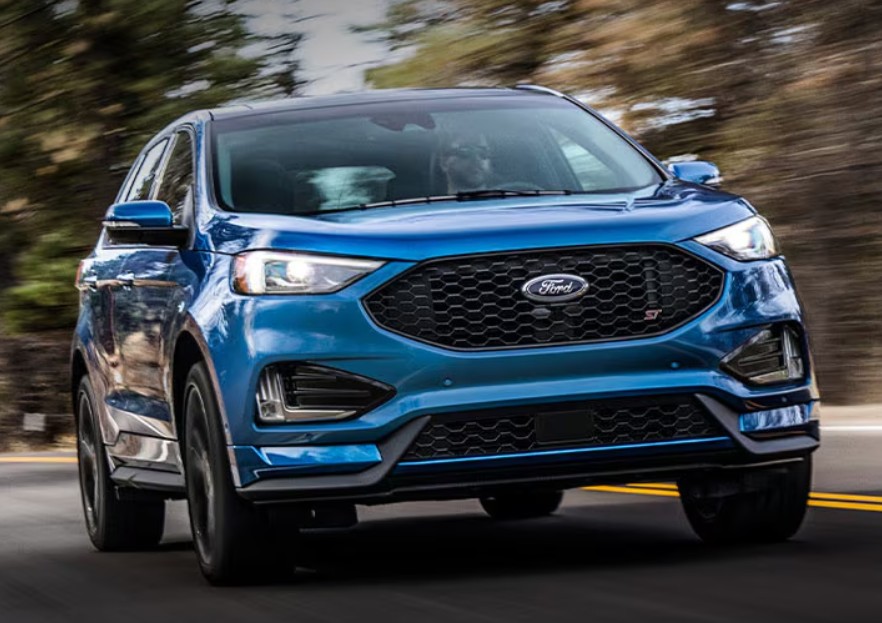
When we talk about Ford Edge engine size, there is no single answer that applies to every model year. Over its long production run, the Edge used everything from naturally aspirated V6 engines to smaller turbocharged four-cylinders and a surprisingly muscular twin-turbo V6.
That evolution tells us quite a bit about how the SUV market changed. Early Ford Edge models leaned heavily on displacement. Bigger engines were the straightforward route to respectable power. Later versions followed the downsizing trend, using turbocharging to squeeze more horsepower and torque from smaller engines while improving fuel efficiency.
For most North American shoppers, the important Ford Edge engine sizes are 2.0 liters, 2.7 liters, 3.5 liters, and 3.7 liters, although availability depends heavily on model year and trim.
By the final 2024 model year, the choice had become especially simple: most Edge trims used a 2.0-liter EcoBoost four-cylinder, while the performance-focused Edge ST received a 2.7-liter EcoBoost V6. Ford's own 2024 inventory information confirms those two engine choices.
Let's break down what those numbers actually mean and which Ford Edge engine makes the most sense for different drivers.
Content in this publication
- What Engine Size Does the Ford Edge Have?
- Ford Edge Engine Size at a Glance
- 2024 Ford Edge Engine Size
- Ford Edge 2.0-Liter EcoBoost Engine
- Ford Edge 2.7-Liter V6 Engine
- Ford Edge 3.5-Liter V6 Engine
- Ford Edge 3.7-Liter Engine
- 2015 Ford Edge Engine Sizes
- 2019 Ford Edge Engine Size Changes
- Ford Edge Engine Size by Generation
- Is the Ford Edge a 4-Cylinder or 6-Cylinder?
- Which Ford Edge Engine Is the Biggest?
- Which Ford Edge Engine Has the Most Horsepower?
- 2.0L vs 2.7L Ford Edge: Which Is Better?
- Does a Bigger Ford Edge Engine Mean Better Towing?
- Does the 2.0L Ford Edge Feel Underpowered?
- Is the 2.7L Ford Edge Fast?
- Naturally Aspirated vs EcoBoost Ford Edge Engines
- What Ford Edge Engine Size Is Best for Fuel Economy?
- What Ford Edge Engine Size Is Best for Reliability?
- Does Engine Size Affect Ford Edge Insurance Costs?
- What Engine Should We Choose When Buying a Used Ford Edge?
- Does the Ford Edge Have a V8?
- Did Ford Make a Diesel Edge?
- Ford Edge Engine Size and Driving Personality
- Why Ford Moved Toward Smaller Engines
- Final Thoughts on Ford Edge Engine Size
- Frequently Asked Questions
What Engine Size Does the Ford Edge Have?
The Ford Edge has been sold with several engines during its lifespan.
The most important ones include:
- 2.0-liter turbocharged EcoBoost inline-four
- 2.7-liter twin-turbo EcoBoost V6
- 3.5-liter naturally aspirated V6
- 3.7-liter naturally aspirated V6
The exact engine depends on the year, market, and trim.
For example, a late-model Edge SEL or Titanium generally uses the 2.0-liter turbo engine, while an Edge ST uses the larger 2.7-liter V6.
Go back farther in time, though, and things become more interesting. Buyers could find 3.5-liter V6 engines in mainstream versions and even a 3.7-liter V6 in certain Sport models.
So, when someone asks, "What size engine is in a Ford Edge?" our first response should really be: Which year?
Ford Edge Engine Size at a Glance
Here's the simplified North American picture.
| Ford Edge era | Common engine sizes | Typical configuration |
|---|---|---|
| Early first generation | 3.5L | Naturally aspirated V6 |
| Later first generation | 2.0L, 3.5L, 3.7L | Turbo I4 or naturally aspirated V6 |
| 2015–2018 | 2.0L, 2.7L, 3.5L | Turbo I4, twin-turbo V6, or V6 |
| 2019–2024 | 2.0L, 2.7L | Turbo I4 or twin-turbo V6 |
| 2024 | 2.0L, 2.7L | EcoBoost I4 or EcoBoost V6 |
The table shows the Edge's transformation neatly. It went from a V6-heavy crossover to one dominated by turbocharged engines.
2024 Ford Edge Engine Size
The 2024 Ford Edge was available with two engine sizes in the U.S.:
2.0-Liter EcoBoost Four-Cylinder
This was the mainstream engine.
Ford listed the Twin-Scroll 2.0L EcoBoost engine for the Edge SE and other non-ST versions. A 2024 Edge SE listing from Ford identifies the engine specifically as a twin-scroll 2.0-liter EcoBoost with Auto Start-Stop technology.
Its output in recent Edge models was approximately:
250 horsepower
280 lb-ft of torque
For everyday driving, that is plenty.
A 2.0-liter engine might sound modest for a midsize SUV, but turbocharging changes the equation dramatically. Rather than behaving like an old-school four-cylinder struggling to move a heavy crossover, the EcoBoost produces a strong wave of torque relatively low in the rev range.
Around town, that translates into effortless acceleration without constantly pushing the engine toward redline.
2.7-Liter EcoBoost V6
The hotter Edge ST uses the much more powerful 2.7-liter twin-turbocharged EcoBoost V6.
Recent versions produce approximately:
335 horsepower
380 lb-ft of torque
Ford documentation for the Edge lists the 2.7-liter V6 alongside the 2.0-liter EcoBoost, with the larger engine reserved for the ST performance model.
That engine fundamentally changes the personality of the Edge.
The 2.0-liter feels like a practical family crossover with healthy power. The 2.7-liter feels like somebody slipped running shoes onto the same SUV.
Ford Edge 2.0-Liter EcoBoost Engine
For many buyers, the 2.0L EcoBoost is the most relevant Ford Edge engine because it became the standard powerplant across much of the lineup.
How Big Is a 2.0-Liter Engine?
Engine displacement measures the total volume displaced by the pistons inside the cylinders.
A 2.0-liter engine has roughly 2,000 cubic centimeters of displacement, often written as 2,000 cc.
The Ford Edge version uses four cylinders arranged inline.
That makes it considerably smaller physically and in displacement than an older 3.5-liter V6.
Yet displacement alone doesn't tell us how powerful an engine is.
Why the 2.0L Feels Stronger Than Its Size Suggests
Turbocharging forces additional air into the engine. More air allows more fuel to be burned, creating more power.
Think of it as giving a smaller engine a set of mechanical lungs.
That's why a modern 2.0-liter turbo Edge can produce power comparable to—or better than—some older naturally aspirated engines with significantly larger displacement.
Ford rated the 2019 2.0-liter Edge at 250 horsepower and 280 lb-ft of torque.
Those numbers are particularly useful because torque arrives where everyday drivers can actually use it.
You don't need to floor the accelerator simply to merge onto the highway.
Ford Edge 2.7-Liter V6 Engine
The 2.7L EcoBoost V6 sits at the opposite end of the Edge spectrum.
It is still relatively small by traditional V6 standards, but two turbochargers help it produce serious performance.
Ford introduced the engine to the Edge Sport before eventually using it in the Edge ST.
How Much Power Does the 2.7L Ford Edge Have?
The 2019 Edge ST's 2.7-liter EcoBoost produced:
335 hp at 5,500 rpm
380 lb-ft of torque at 3,250 rpm
according to Ford's 2019 Edge brochure.
Those figures remained representative of later Edge ST models.
And that's a considerable jump over the 2.0L.
We're talking about roughly 85 additional horsepower and 100 extra lb-ft of torque.
You feel that difference immediately when accelerating from a stop or overtaking at highway speeds.
Who Should Choose the 2.7L?
The larger V6 makes sense if we prioritize:
- Strong acceleration
- Highway passing power
- A sportier driving character
- Maximum Edge performance
- Towing capability
- The Edge ST trim itself
It isn't necessarily the logical choice for someone simply commuting through traffic every day.
But logic isn't always why people buy faster cars, is it?
Sometimes we want the accelerator pedal to feel like a light switch.
The Edge ST gets much closer to that experience.
Ford Edge 3.5-Liter V6 Engine
Before turbocharged engines completely took over the Edge lineup, the 3.5-liter V6 was one of its defining engines.
It was used extensively throughout the first generation and survived into the second-generation Edge for several years.
The 2015 Edge is a perfect example of the transition period.
Ford offered three distinct engines:
2.0-liter EcoBoost four-cylinder
2.7-liter EcoBoost V6
3.5-liter naturally aspirated V6
Ford's 2015 technical specifications list the 3.5-liter V6 at 280 horsepower and 250 lb-ft of torque.
3.5L V6 vs 2.0L EcoBoost
On paper, this comparison can surprise people.
The bigger engine doesn't necessarily dominate.
For 2015, Ford rated the engines at approximately:
| Engine | Horsepower | Torque |
| 2.0L EcoBoost I4 | 245 hp | 275 lb-ft |
| 3.5L V6 | 280 hp | 250 lb-ft |
| 2.7L EcoBoost V6 | 315 hp | 350 lb-ft |
Ford's published technical data supports those figures.
Notice something unusual?
The little 2.0-liter produced more torque than the 3.5-liter V6.
That's turbocharging at work.
The 3.5L still provided more peak horsepower and delivered its power in a smooth, linear fashion, but the 2.0L offered stronger low-end torque despite being 1.5 liters smaller.
Ford Edge 3.7-Liter Engine
The 3.7-liter V6 is less commonly mentioned because it wasn't used across the entire Edge range.
Instead, it appeared mainly in performance-oriented versions of earlier models, particularly certain Edge Sport years.
With larger displacement and a naturally aspirated design, it represented the old-school route to more performance.
No turbocharger theatrics. No waiting for boost.
Press the accelerator, open the throttle, and let six cylinders do the work.
Is the 3.7L Better Than the 2.7L EcoBoost?
Not necessarily.
The 3.7L has simplicity on its side because it doesn't depend on turbocharging for performance.
But the newer 2.7-liter EcoBoost produces considerably more torque and makes the vehicle feel faster in real-world driving.
It's another illustration of why engine displacement cannot be used alone to judge performance.
A smaller turbocharged engine can outperform a bigger naturally aspirated one quite comfortably.
2015 Ford Edge Engine Sizes
The 2015 model year deserves special attention because it marked the beginning of the second-generation Edge.
Ford offered three engines:
2.0L EcoBoost
Ford rated it at approximately 245 hp and 275 lb-ft of torque.
3.5L V6
The naturally aspirated V6 generated around 280 hp and 250 lb-ft.
2.7L EcoBoost V6
Initially aimed at buyers wanting serious performance, the 2.7-liter produced roughly 315 hp and 350 lb-ft of torque.
That's an impressively varied engine lineup for one crossover.
Buyers could effectively choose efficiency, traditional V6 smoothness, or turbocharged performance.
2019 Ford Edge Engine Size Changes
The 2019 refresh simplified things considerably.
Ford eliminated the naturally aspirated 3.5-liter V6 from the U.S. lineup.
That left two EcoBoost engines.
Standard 2.0L EcoBoost
The engine produced approximately 250 hp and 280 lb-ft.
ST 2.7L EcoBoost V6
The performance model generated 335 hp and 380 lb-ft.
Ford paired both with automatic transmissions and marketed the ST as the performance flagship.
From here onward, the Edge's identity was firmly turbocharged.
Ford Edge Engine Size by Generation
Looking at generations makes the evolution even clearer.
First-Generation Ford Edge
The original Edge arrived when naturally aspirated V6 engines were still the default choice for midsize crossovers.
For much of this generation, the 3.5-liter V6 played the starring role.
Later, Ford introduced smaller EcoBoost technology and offered a larger 3.7-liter V6 in performance-focused configurations.
What Defined the First Generation?
Large displacement.
Simple naturally aspirated engines.
Smooth V6 power delivery.
Turbocharging gradually entering the picture.
It represents the bridge between two eras.
Second-Generation Ford Edge
The second generation launched for the 2015 model year and brought a much broader engine strategy.
Ford itself described the redesigned 2015 Edge as an all-new model when production began in Oakville, Ontario.
Initially, buyers could choose among 2.0L, 2.7L, and 3.5L engines.
After the 2019 refresh, Ford streamlined the lineup around the 2.0L EcoBoost and 2.7L EcoBoost.
That arrangement continued through the final U.S. model years.
Is the Ford Edge a 4-Cylinder or 6-Cylinder?
It can be either.
Later standard Ford Edge models generally use a four-cylinder engine.
The Edge ST uses a six-cylinder engine.
More specifically:
2.0L EcoBoost = inline-four
2.7L EcoBoost = V6
Older Edge models were often powered by naturally aspirated V6 engines as well.
So if you're shopping used, don't assume every Edge uses the same basic powertrain.
Two Edge SUVs parked side by side could look almost identical while having completely different engines under their hoods.
Which Ford Edge Engine Is the Biggest?
Among the commonly offered North American Edge engines, the 3.7-liter V6 has the greatest displacement.
That doesn't make it the most powerful Ford Edge engine, though.
The twin-turbocharged 2.7-liter EcoBoost demonstrates why.
Despite losing a full liter of displacement compared with the 3.7, forced induction allows it to generate stronger torque and serious horsepower.
This is where traditional engine-size logic breaks down.
Thirty years ago, bigger displacement usually meant more power.
Today, turbocharging, direct injection, engine management systems, intercooling, and sophisticated transmissions complicate that relationship.
Engine size is still important.
It's simply no longer the whole story.
Which Ford Edge Engine Has the Most Horsepower?
For mainstream U.S.-market Edge models, the 2.7-liter EcoBoost V6 in the Edge ST sits at the top of the later lineup with approximately 335 horsepower.
Ford promoted the 2019 ST engine with 335 hp and 380 lb-ft of torque.
Interestingly, the strongest Edge engine isn't the biggest one.
That alone summarizes modern engine development rather nicely.
The 3.5L and 3.7L motors may win the displacement contest, but the turbocharged 2.7L wins the performance battle.
2.0L vs 2.7L Ford Edge: Which Is Better?
This is probably the most useful comparison for shoppers looking at newer used Edge models.
Choose the 2.0L If You Want Everyday Practicality
For most drivers, we'd lean toward the 2.0L.
Why?
It delivers respectable power without turning the Edge into something it was never really intended to be.
It's comfortable in traffic, capable on highways, and strong enough for normal family duties.
The engine also appeared across far more trims, which gives used-car shoppers a larger pool of vehicles to choose from.
Choose the 2.7L If Performance Matters
The 2.7L transforms the Edge.
Where the 2.0L says, "We'll get there comfortably," the V6 says, "Why don't we get there quickly?"
The difference is especially noticeable during:
Highway merging.
Passing slower vehicles.
Hard acceleration.
Driving with several passengers.
Climbing steep grades.
The trade-off is that performance generally comes with greater fuel consumption and potentially greater mechanical complexity.
Does a Bigger Ford Edge Engine Mean Better Towing?
Not automatically, but the larger performance engine helps.
Ford's 2024 towing guide lists both the 2.0L EcoBoost I4 and 2.7L EcoBoost V6 with AWD. Properly equipped configurations can reach a 3,500-pound maximum loaded trailer rating, although the towing package and exact configuration matter.
That last part is crucial.
Never determine towing capacity solely from engine size.
The vehicle's:
Cooling system
Axle configuration
Hitch
Brakes
Transmission
Gross combined weight rating
Factory towing equipment
all matter.
Two Ford Edge vehicles with the same engine can therefore have different practical towing limits depending on equipment.
Does the 2.0L Ford Edge Feel Underpowered?
Generally, no.
We can see why someone might worry about it.
A midsize crossover is relatively heavy, and "2.0-liter four-cylinder" doesn't exactly sound like muscle-car material.
But the turbocharger makes all the difference.
With around 280 lb-ft of torque in many later models, the engine has enough low-end pull to move the Edge convincingly.
This isn't a tiny naturally aspirated economy-car engine being asked to drag an SUV uphill.
It's an engine engineered specifically around forced induction.
For normal driving, we'd call it adequately powerful rather than thrilling.
And for most people, adequate power accompanied by reasonable efficiency is precisely the sweet spot.
Is the 2.7L Ford Edge Fast?
For a two-row mainstream crossover, yes.
The 2.7-liter twin-turbo V6 gives the Edge ST performance that can catch unsuspecting drivers off guard.
It's not a dedicated sports car, of course.
There's still substantial SUV mass to move around.
But abundant torque means the Edge ST responds rapidly when you press the accelerator.
The appeal isn't simply outright speed, either.
Torque makes everyday driving feel easier.
You squeeze the pedal, and the vehicle surges forward without drama.
It's like walking through an airport with a moving walkway underneath you. You're doing the same basic thing—just much faster than expected.
Naturally Aspirated vs EcoBoost Ford Edge Engines
Understanding this distinction helps immensely when comparing older models.
Naturally Aspirated Engines
Older 3.5L and 3.7L Ford Edge engines rely on atmospheric pressure to fill their cylinders.
Their benefits include:
Predictable power delivery
No turbocharger system
Linear throttle response
Traditional V6 character
EcoBoost Engines
The 2.0L and 2.7L engines use turbocharging.
Their advantages include:
Higher torque per liter
Strong low-rpm performance
More power from smaller displacement
Potential efficiency advantages
The downside is increased complexity.
Turbochargers, intercoolers, additional plumbing, boost-management systems, and related hardware add components that don't exist on a basic naturally aspirated engine.
That doesn't automatically make an EcoBoost unreliable.
It simply means maintenance history becomes especially important when shopping for a high-mileage used example.
What Ford Edge Engine Size Is Best for Fuel Economy?
Generally speaking, the 2.0-liter EcoBoost four-cylinder is the engine we'd choose when fuel economy is a priority.
Ford's 2019 brochure rated the front-wheel-drive 2.0L Edge at an EPA-estimated 22 mpg city, 29 highway, and 25 combined, while the AWD 2.7L ST was rated at 19 city, 26 highway, and 21 combined.
Actual consumption obviously varies with driving style, weather, traffic, tires, maintenance, and load.
But the basic hierarchy makes sense.
The smaller four-cylinder has less performance potential but uses less fuel under typical conditions.
The 2.7L gives us more smiles per mile.
The 2.0L generally asks us to buy fewer gallons along the way.
What Ford Edge Engine Size Is Best for Reliability?
This question is trickier because engine size by itself doesn't determine reliability.
A well-maintained turbocharged engine can outperform a neglected naturally aspirated engine by a huge margin.
When buying used, we'd prioritize:
Service records.
Regular oil changes.
Correct oil specifications.
Cooling-system condition.
Absence of overheating history.
Smooth cold starts.
No warning lights.
No unexplained coolant loss.
No unusual exhaust smoke.
No turbocharger whine on EcoBoost models.
A pre-purchase inspection is far more valuable than simply saying, "The bigger engine must be more reliable."
Maintenance History Beats Engine Size
Imagine two vehicles.
One has a supposedly desirable engine but received oil changes whenever its owner remembered.
The other has a more complicated turbo engine with immaculate maintenance records.
We'd rather buy the second vehicle.
Engines don't read internet reputations.
They respond to oil, temperature, operating conditions, maintenance, and previous treatment.
Does Engine Size Affect Ford Edge Insurance Costs?
Potentially.
Insurance companies consider far more than displacement, but performance can influence premiums.
An Edge ST with a 335-hp twin-turbo V6 may cost more to insure than a standard Edge with the 2.0L engine because insurers assess factors including:
Vehicle value
Repair costs
Trim level
Horsepower
Claim history
Driver profile
Location
Annual mileage
Safety features
So while engine size isn't the only variable, the performance-oriented ST can land in a different risk category from an ordinary Edge SE or SEL.
What Engine Should We Choose When Buying a Used Ford Edge?
For most buyers, the 2.0L EcoBoost represents the sensible choice in later Edge models.
It's widely available, sufficiently powerful, and generally more economical than the ST's V6.
The 2.7L EcoBoost is our pick if performance is one of the main reasons we're considering the vehicle.
For older models, naturally aspirated 3.5L and 3.7L engines can still be attractive, especially for shoppers who value traditional V6 behavior.
But we wouldn't choose solely by displacement.
Look at the complete vehicle.
Our Used Ford Edge Engine Checklist
Before buying, we should check:
- Model year and exact engine code
- Maintenance history
- Oil-change intervals
- Coolant level and condition
- Signs of leaks
- Cold-start behavior
- Turbo performance on EcoBoost versions
- Transmission operation
- Diagnostic trouble codes
- Vehicle-specific recall and service history
That ten-minute conversation with the seller can reveal more than staring at the displacement badge for an hour.
Does the Ford Edge Have a V8?
No factory Ford Edge was offered as a regular production model with a V8 engine.
The Edge has traditionally used four-cylinder and V6 engines.
That makes sense considering its architecture and purpose.
The Edge sits in the midsize crossover world, where packaging efficiency and fuel consumption matter much more than stuffing a giant V8 under the hood.
If you're looking for rumbling eight-cylinder theatrics, you're shopping in the wrong Ford aisle.
Did Ford Make a Diesel Edge?
Yes, in some international markets.
European versions of the Edge were offered with diesel engines, including 2.0-liter EcoBlue powertrains.
Ford's European information described a 2.0-liter EcoBlue bi-turbo diesel producing up to 238 PS, along with another 190 PS version.
Those engines were very different from the gasoline-heavy North American lineup.
That's why market matters whenever we're researching Ford Edge engine specifications.
An Edge sold in the United States may have an entirely different powertrain from one originally sold in Europe.
Ford Edge Engine Size and Driving Personality
Engine specifications are numbers.
Driving personality is what those numbers actually feel like.
The 2.0L EcoBoost feels calm, responsive, and practical.
The 3.5L V6 feels smoother and more traditional.
The 3.7L V6 brings an old-school, larger-displacement character.
The 2.7L EcoBoost feels aggressive and muscular.
None is universally better.
They're simply different flavors of the same basic recipe.
Think of the Edge like coffee.
The 2.0L is the dependable morning brew.
The 3.5L is the classic drip coffee you've known for years.
And the 2.7L ST?
That's the double espresso you ordered despite knowing perfectly well it was already 8 p.m.
Why Ford Moved Toward Smaller Engines
The Edge's engine history mirrors the broader automotive industry's transition toward downsizing.
Automakers increasingly realized they could use:
Turbocharging
Direct fuel injection
Variable valve timing
Advanced transmissions
Electronic engine management
to generate serious power without relying on huge displacement.
The transformation from the Edge's old 3.5L V6 to its later 2.0L EcoBoost is an excellent example.
The engine got dramatically smaller, yet usable torque remained strong.
And when Ford wanted serious performance, it didn't return to a huge naturally aspirated engine.
Instead, it took a relatively compact 2.7-liter V6 and added twin turbochargers.
That's modern powertrain engineering in a nutshell.
Final Thoughts on Ford Edge Engine Size
The Ford Edge engine lineup is more interesting than it first appears.
Early models relied heavily on 3.5-liter and 3.7-liter naturally aspirated V6 engines, while later generations embraced 2.0-liter and 2.7-liter EcoBoost turbocharged engines.
For shoppers looking at the newest traditional North American Edge models, the decision is straightforward.
The 2.0L EcoBoost is the sensible all-rounder. It provides around 250 horsepower and strong everyday torque without chasing outright performance.
The 2.7L EcoBoost V6 is the enthusiast's choice. With roughly 335 horsepower and 380 lb-ft of torque in the ST, it turns the Edge into a genuinely quick family crossover. Ford's own specifications confirm that dramatic difference between the two engines.
Older 3.5L and 3.7L engines remain worth considering on the used market, particularly if we prefer naturally aspirated V6 power delivery.
The key takeaway?
Don't judge a Ford Edge engine only by its displacement.
A 2.0-liter turbo can produce more usable low-end torque than an older 3.5-liter V6, while a 2.7-liter turbocharged V6 can outperform engines with substantially more displacement.
Engine size tells us how big the engine is.
Turbocharging, tuning, transmission design, and technology tell us what it can actually do.
And when we're choosing a Ford Edge, that second question matters much more.
Frequently Asked Questions
What size engine does a Ford Edge have?
Ford Edge engine size varies by year. Common North American engines include a 2.0L EcoBoost four-cylinder, 2.7L EcoBoost V6, 3.5L V6, and 3.7L V6. Later models primarily used the 2.0L EcoBoost, while the Edge ST received the 2.7L twin-turbo V6.
Is the Ford Edge a 4-cylinder or V6?
It can be either. Most later standard Edge trims use a turbocharged 2.0-liter four-cylinder engine, while the Edge ST uses a twin-turbocharged 2.7-liter V6. Older Edge models were also commonly equipped with 3.5L or 3.7L V6 engines.
Which Ford Edge engine is the most powerful?
Among later North American models, the 2.7-liter EcoBoost V6 found in the Edge ST is the performance leader. Ford rated the 2019 ST engine at approximately 335 horsepower and 380 lb-ft of torque.
Is the 2.0L Ford Edge engine powerful enough?
For most drivers, yes. Later versions produce roughly 250 horsepower and 280 lb-ft of torque, providing enough performance for commuting, highway driving, carrying passengers, and normal family use.
What is the best Ford Edge engine size?
The 2.0L EcoBoost is arguably the best choice for drivers prioritizing everyday usability and fuel economy, while the 2.7L EcoBoost V6 suits buyers who want stronger acceleration and the Edge ST's sportier character. For older used models, the condition and maintenance history of the individual vehicle matter more than displacement alone.
If you want to know other articles similar to Ford Edge Engine Size: Complete Guide by Year and Engine you can visit the category Service and Parts.
Volvo S90 Engine Oil: Type, Capacity & Change Guide
Volvo S90 Boot Space: Size, Capacity and Practicality
SEO Title: Volvo S90 Oil Capacity: Complete Guide by Engine

Kia Sorento Oil Type: Complete Guide by Year & Engine
Kia Sorento Engine Capacity: Complete Guide by Year
Peugeot 308 Clutch Replacement Cost: Complete UK Guide for 2026
Leave a Reply
More content of your interest