
How Does BYD Shark 6 Work? DMO Hybrid System Explained

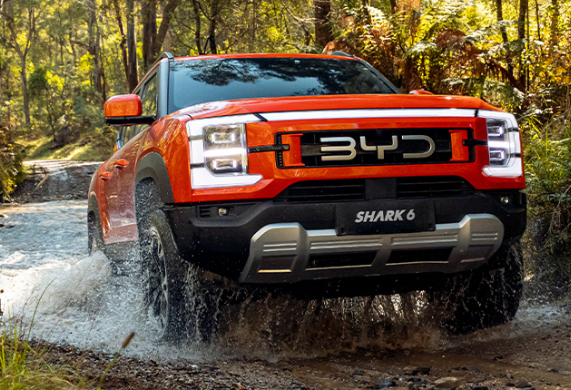
The BYD Shark 6 looks like a conventional pickup from the outside, but underneath it works very differently from the diesel and gasoline trucks we are used to. Instead of relying mainly on an internal-combustion engine and a traditional mechanical four-wheel-drive system, the Shark 6 uses BYD's DMO plug-in hybrid technology, where electric motors play the leading role.
So, how does the BYD Shark 6 work? In simple terms, it combines a turbocharged gasoline engine, a BYD Blade Battery, and two powerful electric motors. Most of the time, the electric motors are responsible for moving the truck. The gasoline engine can generate electricity, assist the electric motors, or drive the vehicle directly when the system determines that doing so is more efficient.
That sounds complicated, but from behind the steering wheel it is surprisingly simple. We charge it, add gasoline when necessary, select our driving mode, and the truck's computer handles most of the energy management automatically.
BYD calls the system DMO, or Dual Mode Off-road, an architecture specifically designed to combine EV-like driving with the range, towing ability, and off-road capability expected from a pickup.
Let's break down exactly what happens beneath the floor.
Content in this publication
- What Type of Vehicle Is the BYD Shark 6?
- What Does DMO Mean on the BYD Shark 6?
- How Does the BYD Shark 6 Hybrid System Work?
- 1. EV Mode: The Shark 6 Drives on Electricity
- 2. HEV Series Mode: The Gasoline Engine Generates Electricity
- 3. HEV Parallel Mode: Engine and Electric Motors Work Together
- 4. High-Speed Cruising: The Engine Can Drive the Vehicle Directly
- How Do the Two Electric Motors Work?
- What Does the 1.5-Liter Turbo Engine Actually Do?
- How Does the BYD Blade Battery Work in the Shark 6?
- How Do You Charge a BYD Shark 6?
- Does the BYD Shark 6 Charge While Driving?
- How Does Regenerative Braking Work?
- How Does the BYD Shark 6 Work Off-Road?
- How Fast Is the BYD Shark 6?
- How Far Can the BYD Shark 6 Travel?
- How Does Fuel Consumption Work in a Plug-In Hybrid?
- What Happens When the Battery Is Low?
- Does the BYD Shark 6 Need to Be Plugged In?
- How Does Towing Affect the Hybrid System?
- How Does Vehicle-to-Load Work?
- BYD Shark 6 Operating Modes at a Glance
- Is the BYD Shark 6 More Like an EV or a Gasoline Pickup?
- Conclusion
- Frequently Asked Questions
What Type of Vehicle Is the BYD Shark 6?
The BYD Shark 6 is a plug-in hybrid electric vehicle (PHEV) rather than a conventional hybrid or a fully electric pickup.
A normal hybrid has a relatively small battery that is charged mainly by the gasoline engine and regenerative braking. We generally cannot plug it into an external charger.
A battery-electric vehicle goes to the opposite extreme. It relies entirely on electricity and has no gasoline engine.
The Shark 6 sits between those two ideas.
It has a substantial high-voltage battery that we can charge from an external power source, but it also carries a gasoline engine and fuel tank. That gives us the possibility of completing shorter trips largely on electricity while still being able to travel long distances without depending entirely on charging stations.
That combination is particularly interesting in a pickup. Trucks may be driven around town during the week, tow trailers at the weekend, cross remote areas, or spend hours away from public charging infrastructure.
Instead of forcing one power source to handle every situation, the Shark 6 lets its computers choose between several combinations.
What Does DMO Mean on the BYD Shark 6?
DMO stands for Dual Mode Off-road.
BYD developed the architecture specifically for vehicles that require more performance and off-road capability than its road-oriented DM-i hybrid models.
At its heart are three major components:
- A turbocharged gasoline engine
- A high-voltage BYD Blade Battery
- Electric motors on both the front and rear axles
The important part is that the architecture is electric-motor focused.
BYD describes the Shark's DMO system as providing an EV-first driving experience. The engine therefore does not need to behave like the engine in a traditional pickup all the time.
We can think of it almost like having an electric truck that carries its own gasoline-powered electricity generator — except that the system is more sophisticated because the gasoline engine can also help propel the vehicle directly.
Why BYD Uses an Electric-First Layout
Electric motors have several useful characteristics for pickups.
They provide torque almost immediately. There is no need to wait for an engine to climb through its rev range or for a multi-speed transmission to select the right gear.
That quick response can be useful when:
- Pulling away with a heavy load
- Climbing a steep hill
- Driving through loose sand
- Negotiating slippery surfaces
- Accelerating onto a highway
- Moving slowly over difficult terrain
The electric motors also allow the vehicle to control the front and rear axles electronically.
Instead of depending entirely on mechanical driveshafts and traditional transfer cases, the system can rapidly alter torque distribution according to available traction.
How Does the BYD Shark 6 Hybrid System Work?
The easiest way to understand the system is to follow the energy.
Electricity stored inside the Blade Battery can power the front and rear electric motors.
The gasoline engine can create additional electricity.
Under some driving conditions, the gasoline engine can also contribute mechanical power directly.
Regenerative braking can then recover some kinetic energy while we slow down and send it back into the battery.
The vehicle continuously decides which combination makes sense.
There are essentially four important operating situations.
1. EV Mode: The Shark 6 Drives on Electricity
When sufficient battery charge is available and conditions allow it, the Shark 6 can drive using its electric motors without needing propulsion from the gasoline engine.
This is the closest the truck gets to behaving like a full EV.
Press the accelerator and electricity flows from the high-voltage battery through the power electronics to the motors. Those motors convert electrical energy into mechanical rotation at the axles.
For commuting, urban traffic, or relatively short journeys, this can dramatically reduce how often the gasoline engine needs to operate.
BYD's official figures vary by country and certification cycle. For example, current Australian specifications list a 29.6 kWh Blade Battery and up to 100 km of electric range on the NEDC cycle for certain Shark 6 versions, while BYD's European specification quotes up to 90 km of pure-electric range for its version.
Real-world range will naturally depend on speed, temperature, terrain, payload, towing, air-conditioning use, and driving style.
What Happens When We Accelerate in EV Mode?
The process is immediate.
There is no conventional automatic gearbox shuffling through several gears before the vehicle responds.
The electric motors receive increasing electrical current, producing more torque as we press the accelerator.
That is a major reason the Shark 6 can feel quicker than we might expect from a large pickup.
2. HEV Series Mode: The Gasoline Engine Generates Electricity
Once the battery reaches a lower state of charge or operating conditions require additional energy, the gasoline engine can start.
But here is the unusual part.
It does not necessarily start because it needs to turn the wheels directly.
During HEV Series operation, the gasoline engine acts primarily as an electricity generator.
Energy can then be supplied to the electric drive system or used to help maintain the battery's charge.
BYD says this arrangement is commonly used under city-driving conditions.
Imagine carrying a small power station under the hood. The wheels can remain electrically driven while the gasoline engine produces the electricity needed to keep that process going.
Of course, the actual system is considerably more sophisticated, but the analogy makes the concept easier to understand.
Why Not Simply Drive the Wheels With the Engine?
Efficiency.
Internal-combustion engines are not equally efficient at every engine speed and load.
By allowing the gasoline engine to operate within a favorable operating range while electric motors handle propulsion, the hybrid control system can avoid some of the inefficiencies associated with making a conventional engine follow every movement of the accelerator pedal.
This is one of the fundamental ideas behind BYD's Dual Mode technology.
3. HEV Parallel Mode: Engine and Electric Motors Work Together
Ask for strong acceleration and another configuration becomes useful.
During HEV Parallel Mode, both the combustion engine and electrical drive system can contribute propulsion.
This is where the Shark 6 can unleash considerably more performance.
Think of the electric system and gasoline engine as two people pushing the same heavy object. Neither has to perform the entire job alone.
BYD says the system can enter this configuration when stronger acceleration is required.
That ability matters in a pickup because vehicle mass, passengers, cargo, hills, and trailers can dramatically increase power demand.
Instead of installing an enormous combustion engine and running it inefficiently during lighter driving, BYD can combine several power sources when maximum output is necessary.
4. High-Speed Cruising: The Engine Can Drive the Vehicle Directly
There is one more clever trick.
At sustained higher speeds, such as highway cruising, converting gasoline into electricity and then electricity back into mechanical motion is not always the most efficient option.
You may be interested in reading Is BYD Shark 6 a Good Car? An Honest 2026 Review
Every conversion introduces some energy loss.
Therefore, under suitable conditions, the gasoline engine can directly contribute to driving the Shark 6.
BYD specifically describes high-speed cruising as one situation where the system can determine that direct engine propulsion is more efficient.
The transition is controlled electronically.
From the driver's perspective, we usually do not need to decide which operating strategy should be used. The vehicle does the calculations in the background.
How Do the Two Electric Motors Work?
One of the most interesting parts of the Shark 6 is its dual-motor layout.
There is an electric motor associated with the front axle and another with the rear.
In the Australian 1.5-liter Shark 6 specification, for example, the front permanent-magnet synchronous motor produces up to 170 kW and 310 Nm, while the rear motor produces up to 150 kW and 340 Nm. The complete system is rated at up to 321 kW and 650 Nm in the Premium version.
Numbers vary among specifications and markets, but the principle remains the same.
Having powered front and rear axles gives the truck intelligent all-wheel drive.
How Does the AWD System Work?
Conventional 4x4 pickups commonly transfer engine torque mechanically through a transmission, driveshafts, differentials, and a transfer case.
The Shark 6 approaches the problem differently because electrical power can be distributed between its electric drive units.
Sensors constantly monitor factors such as:
- Wheel speed
- Accelerator position
- Vehicle movement
- Available traction
- Selected terrain mode
The control system can then adjust torque delivery rapidly.
BYD says its intelligent electric AWD system can manage front-to-rear torque distribution according to road conditions.
For us, the result is that the complicated work happens invisibly underneath the vehicle.
What Does the 1.5-Liter Turbo Engine Actually Do?
This is probably the most misunderstood part of the Shark 6.
Someone reading the specification sheet might see a 1.5-liter turbocharged gasoline engine and wonder how such a relatively small engine moves a large pickup so quickly.
The answer is that it does not have to perform that job alone.
On the widely sold 1.5-liter Shark 6, the engine works alongside the large electric propulsion system.
Depending on conditions, it can:
- Remain switched off.
- Generate electricity.
- Supply energy while the electric motors propel the truck.
- Join the electric motors during heavy acceleration.
- Contribute direct propulsion during efficient cruising conditions.
That flexibility is the reason looking only at engine displacement tells us very little about how the Shark performs.
How Does the BYD Blade Battery Work in the Shark 6?
The Blade Battery is the energy reservoir for the electric side of the powertrain.
BYD uses lithium iron phosphate, commonly abbreviated LFP, chemistry in its Blade Battery technology.
Inside the Shark 6, electrical energy stored in the battery feeds the traction motors through the vehicle's power electronics.
When we plug the pickup into a charger, energy from the electrical grid replenishes the battery.
When we brake or decelerate, regenerative braking can send some energy back to it.
And when the gasoline engine operates as a generator, it can supply electricity to the hybrid system as well.
Battery Integration Into the Chassis
The battery is not simply treated like luggage placed underneath the truck.
BYD uses Cell-to-Chassis technology, integrating the battery into the vehicle structure.
BYD says this approach contributes to structural rigidity while helping package the hybrid system into the pickup platform.
That integration is especially important in a truck, where ground clearance, structural loads, cabin space, cargo capacity, and underbody protection all compete for room.
How Do You Charge a BYD Shark 6?
Because this is a plug-in hybrid, we get the most benefit from the system when we actually plug it in.
Depending on market specification, the Shark 6 supports both AC and DC charging.
Current Australian specifications, for example, list 7 kW AC charging and up to 55 kW DC charging.
That creates two basic charging scenarios.
At home, we can connect the vehicle to an appropriate AC charging source and replenish the battery between journeys.
Away from home, compatible DC charging stations can replenish energy more quickly.
The beauty of a PHEV pickup, though, is that reaching a charger is not mandatory before every long journey. If the battery becomes depleted, the gasoline side of the hybrid system allows the truck to continue operating.
Does the BYD Shark 6 Charge While Driving?
Yes, but we should understand what that means.
The Shark 6 can obtain battery energy while driving through two processes.
First, the combustion engine can operate as part of the hybrid system and generate electrical energy.
Second, regenerative braking recovers energy during deceleration.
Neither process creates free energy.
The gasoline engine consumes fuel to produce its contribution, while regenerative braking simply captures some energy that would otherwise be lost as heat at the brakes.
Therefore, plugging the vehicle into an external charger remains important if we want to maximize electric driving.
How Does Regenerative Braking Work?
Normally, pressing the brake pedal causes friction brakes to turn motion into heat.
An electrified vehicle has another option.
When decelerating, its electric motors can operate as generators.
Instead of taking electricity from the battery and turning it into motion, the process reverses: movement turns the motor, and electricity is sent back toward the battery.
It is rather like filling part of our fuel tank every time we slow down — except we are recovering electrical energy rather than gasoline.
The Shark 6 still has conventional friction brakes because regenerative braking cannot handle every situation, but the two systems can work together.
How Does the BYD Shark 6 Work Off-Road?
The Shark 6's hybrid technology is not only about fuel consumption.
The entire DMO concept was developed with off-road use in mind.
Electric drive provides extremely precise torque control, while the dual-motor architecture gives the system control over both axles.
Depending on specification and market, selectable terrain settings include modes for conditions such as Mud, Sand and Snow, with other regional versions also offering Gravel or Mountain-related settings.
When a mode is selected, the software can alter how power and vehicle-control systems respond.
Why Electric Motors Can Help Off-Road
Off-road driving often requires control rather than simply enormous horsepower.
Suppose one axle reaches loose sand while another still has traction.
An electrically controlled AWD system can rapidly alter torque delivery without waiting for a conventional drivetrain to react mechanically.
The smooth low-speed torque of electric motors also helps when we want controlled movement rather than sudden bursts of engine power.
You may be interested in readingIs BYD Shark 6 a Good Car? An Honest 2026 ReviewYou may be interested in reading
 Vauxhall Agila Insurance Group UK: Complete Guide to Insurance Costs
What About the Suspension?
The DMO platform combines its hybrid drivetrain with independent double-wishbone suspension at the front and rear.
BYD says this arrangement was chosen to balance road comfort with off-road capability.
That differs from the leaf-sprung rear suspensions traditionally found on many work-oriented pickups.
Whether that trade-off suits a particular buyer will depend on how the truck is used, but mechanically it reflects the Shark 6's positioning as both a lifestyle vehicle and an off-road-capable pickup.
How Fast Is the BYD Shark 6?
Electric assistance makes the Shark surprisingly quick for something of its size.
The 1.5-liter DMO version sold in several markets produces around 321 kW and 650 Nm, with BYD quoting a 0–100 km/h time of 5.7 seconds.
That performance does not come from the gasoline engine alone.
It is the combined output of the hybrid system.
Current Australian specifications also include a more powerful Shark 6 Performance using a 2.0-liter turbo hybrid setup producing up to 350 kW and 700 Nm, with a claimed 0–100 km/h time of 5.5 seconds.
This is a good reminder that Shark 6 specifications are increasingly market- and version-dependent.
How Far Can the BYD Shark 6 Travel?
Range is where the plug-in hybrid concept becomes particularly useful.
We effectively have two energy stores:
Electricity in the battery + gasoline in the fuel tank.
Once the initial electric energy has been used, the hybrid system does not suddenly become useless. The gasoline engine continues supporting propulsion.
BYD Australia currently quotes up to 800 km of combined NEDC range for the 1.5-liter Premium and Dynamic versions, while other regions publish different figures based on their versions and homologation cycles. BYD's European Shark, for example, is quoted at 675 km combined under its applicable testing specification.
That is why comparing range figures from different countries without checking the testing cycle can be misleading.
How Does Fuel Consumption Work in a Plug-In Hybrid?
This deserves special attention because PHEV fuel-consumption numbers can look almost impossibly low.
A plug-in hybrid begins official testing with electrical energy available in its battery. Part of the journey can therefore be completed without consuming gasoline.
If we regularly charge the Shark 6 and mostly drive short distances, our fuel usage may be dramatically lower than someone who rarely plugs it in.
But once the battery reaches a low state of charge, gasoline consumption becomes much more important.
Current Australian specifications illustrate that difference: the 1.5-liter versions are listed at 2.0 L/100 km with battery state of charge above 25% on the NEDC test, while the figure rises to 7.9 L/100 km below 25% SOC under the stated test conditions.
So the headline number should never be interpreted as a guaranteed everyday fuel economy figure.
What Happens When the Battery Is Low?
The truck does not simply stop behaving normally.
Once battery charge decreases, the hybrid management system relies more heavily on the gasoline engine.
The engine can generate electricity, support propulsion, and help preserve sufficient battery energy for hybrid operation.
This distinction is important.
A plug-in hybrid battery typically does not behave as though every usable electron disappears when the dashboard reaches the bottom of the normal EV range. The vehicle's control system manages reserves necessary for hybrid operation.
From our perspective, it transitions from being highly dependent on externally charged electricity to behaving more like a gasoline-electric hybrid.
Does the BYD Shark 6 Need to Be Plugged In?
Technically, the vehicle can continue operating without plugging it in because it has a gasoline engine.
Practically, however, consistently refusing to charge it defeats much of the point of buying a plug-in hybrid.
The electric range allows us to replace gasoline with grid electricity for suitable journeys.
If we start every morning with useful battery charge, commuting may involve relatively little engine operation.
If we never charge it, we are carrying a large battery and charging hardware without exploiting their biggest advantage.
A Shark 6 owner with convenient home charging will therefore experience the vehicle differently from someone relying almost entirely on gasoline.
How Does Towing Affect the Hybrid System?
Towing increases energy demand considerably.
More mass requires additional energy to accelerate, while aerodynamic drag can rise substantially depending on the trailer.
The hybrid system responds by using whatever combination of electric and gasoline power is appropriate.
Electric torque can be particularly useful when pulling away, but we should expect battery range and overall efficiency to decline when towing.
Towing ratings also differ between Shark 6 versions. Current Australian specifications list 2,500 kg braked towing capacity for the 1.5-liter versions and up to 3,500 kg for the newer 2.0-liter Performance version.
Always use the specifications for the exact version sold in your country rather than assuming every Shark 6 has the same towing limit.
How Does Vehicle-to-Load Work?
Another interesting consequence of carrying a large high-voltage battery is Vehicle-to-Load, or V2L.
V2L allows stored battery energy to power compatible external electrical equipment.
That could be useful at:
- Campsites
- Work sites
- Outdoor events
- Remote locations
- Road trips
Depending on the market, the truck provides external power through its V2L equipment and onboard outlets.
BYD's 2026 European Shark specification, for example, promotes up to 6 kW of Vehicle-to-Load capability.
In that sense, the truck's battery does more than move the vehicle. It becomes a mobile energy source.
BYD Shark 6 Operating Modes at a Glance
| Operating situation | Gasoline engine | Electric motors | Main purpose |
|---|---|---|---|
| EV Mode | Usually off | Drive vehicle | Quiet electric driving |
| HEV Series | Generates electricity | Drive vehicle | Efficient hybrid operation |
| HEV Parallel | Helps propel vehicle | Drive vehicle | High power demand |
| High-speed direct drive | Can drive vehicle directly | Assist as required | Efficient cruising |
| Regenerative braking | Usually not required | Act as generators | Recover energy |
This table gives us the simplest answer to how the BYD Shark 6 works: it continually moves between different energy strategies rather than relying on one fixed drivetrain configuration. BYD officially describes EV, HEV Series, HEV Parallel, and engine-direct high-speed operation within its DMO strategy.
Is the BYD Shark 6 More Like an EV or a Gasoline Pickup?
Mechanically, it sits somewhere in between, but its driving philosophy leans toward an EV.
The electric motors are central to the experience.
The gasoline engine is there to extend range, provide energy, and support the system when conditions demand it.
That is why calling the Shark 6 simply a "gasoline pickup with an electric motor" misses the point.
The opposite description comes closer: it behaves much of the time like an electrified pickup with a gasoline engine integrated into the propulsion system for additional flexibility.
And that distinction explains almost everything unusual about it — the instant acceleration, lack of a conventional 4x4 drivetrain feel, electric commuting capability, long-distance range, and ability to recover braking energy.
Conclusion
The answer to how does BYD Shark 6 work is surprisingly elegant once we strip away the technical terminology.
Its DMO plug-in hybrid system places electric motors at the center of the drivetrain. The Blade Battery supplies energy to motors on the front and rear axles, giving the pickup responsive electric propulsion and intelligent all-wheel drive.
When battery energy alone is not enough, the gasoline engine joins the equation. It may generate electricity, work alongside the electric motors during demanding acceleration, or contribute direct propulsion when that is the more efficient solution.
Regenerative braking recovers energy when we slow down, external charging replenishes the battery, and the gasoline tank gives the pickup long-distance flexibility that a pure EV may not provide in every environment.
In other words, the Shark 6 does not force us to choose between an electric vehicle and a traditional pickup. Its entire engineering philosophy is about switching intelligently between both worlds.
Frequently Asked Questions
1. How does the BYD Shark 6 hybrid system work?
The BYD Shark 6 uses a DMO plug-in hybrid system combining a Blade Battery, front and rear electric motors, and a turbocharged gasoline engine. The electric motors usually handle propulsion, while the gasoline engine can generate electricity or contribute directly to propulsion depending on driving conditions.
2. Can the BYD Shark 6 drive without gasoline?
Yes. When sufficient battery charge is available, the Shark 6 can operate in EV mode using only its electric motors. The available electric range depends on the version, market, test cycle, weather, load, terrain, and driving conditions.
3. Does the BYD Shark 6 engine charge the battery?
Yes. In HEV Series operation, the gasoline engine can generate electricity for the hybrid system. The vehicle also recovers some energy through regenerative braking. Plugging the Shark 6 into an external electricity source is still the most effective way to replenish its usable plug-in battery capacity.
You may be interested in readingIs BYD Shark 6 a Good Car? An Honest 2026 ReviewYou may be interested in reading
Vauxhall Agila Insurance Group UK: Complete Guide to Insurance CostsYou may be interested in reading
Vauxhall Agila Reliability: Common Problems, Best Engines and What to Check4. Is the BYD Shark 6 always four-wheel drive?
Shark 6 DMO versions use electric drive units at the front and rear to provide intelligent AWD. The system electronically manages torque distribution according to traction requirements and the selected driving or terrain mode.
5. What happens when the BYD Shark 6 battery runs low?
The truck continues operating as a hybrid. The gasoline engine becomes more involved, generating electricity and contributing propulsion as required. The control system automatically manages the remaining battery energy, so reaching a low EV state of charge does not mean the vehicle suddenly stops.
If you want to know other articles similar to How Does BYD Shark 6 Work? DMO Hybrid System Explained you can visit the category Blog.
Volvo S90 Reliability: Problems, Costs & Best Years
Is Haval Jolion a Good Car? Honest Review, Reliability, Pros and Cons
How to Start Haval Jolion With Spare Key: Complete Guide
How to Calculate Per Diem on an Auto Loan

How to Calculate the Residual Value of a Car

Is the Honda Passport Selling Well? Sales Numbers Tell the Story
Leave a Reply
More content of your interest