A Kia EV6 warning light can mean anything from “your headlights are on” to “stop and arrange recovery”. The quickest way to judge the situation is to read the symbol together with the accompanying message, then consider how the car is behaving. Colour helps, but it does not make the decision for us.
This illustrated Kia EV6 dashboard warning lights guide explains the major symbols, their urgency levels and the correct next action. We cover the high-voltage battery, 12-volt supply, turtle mode, charging problems, brakes and driver assistance. We also explain the normal indicators that can look worrying when we first switch to an electric car.
Coverage: common EV6 instrument-panel symbols and messages, using Kia EV6 handbook illustrations and representative Kia READY, EPB, AUTO HOLD and smart-key symbols. Some handbook icons are monochrome; use the actual dashboard colour and message to assess urgency. Availability, colours, wording and operating thresholds vary by model year, country, software and trim, including GT versions. Match the guide to the handbook for your vehicle; not every EV6 has every feature shown.
A stop instruction, electrical supply failure, battery overheating or seriously impaired braking
Leave traffic safely, secure the vehicle and follow the shutdown instruction. Arrange assistance when required.
Prompt attention
A persistent system warning, low tyre pressure or unavailable safety assistance
Read the message, address the condition promptly and avoid driving if the vehicle cannot operate safely.
Act now: charge or adjust
Low traction battery, charging connection issue or limited power
Take the relevant action immediately; do not stretch the remaining range or force a connector.
Status only
READY, headlights, turn signals or normal assistance status
Confirm the expected function. No repair is needed simply because the indicator is on.
These are practical action categories, not Kia diagnostic fault codes. A yellow warning can still require recovery when its message says to stop. A red seat-belt reminder, meanwhile, calls for fastening the belt rather than diagnosing the propulsion system. If braking, steering or acceleration changes abruptly, prioritise safe control of the vehicle over reading the screen.
Startup checks versus a warning that stays on
Several lamps briefly illuminate when the EV button is switched on. That is part of the system check. A lamp that stays on unexpectedly, appears while driving or returns with a fault message needs further attention. Normal status indicators, such as lighting or a deliberately selected mode, can remain on.
The EV6 does not have a combustion engine to listen for. We should check READY rather than deciding the car has started because the screens are illuminated. Accessory mode and a drive-ready vehicle are different states.
EV system, battery and power warnings
EV service warning: car with an exclamation mark
Urgency: prompt diagnosis; stop if the message instructs it.This symbol relates to the electric-vehicle control system. It is different from a scheduled maintenance reminder and does not identify one particular failed component. Sensors, control functions and other EV-system parts can be involved.If it remains after startup or appears while driving, read the accompanying message and arrange inspection. Do not assume it means the traction battery must be replaced. If the display also tells us to check the EV system or stop, follow that stronger instruction rather than continuing because the symbol is amber.
Check electric vehicle system
Urgency: stop safely and arrange recovery.Kia’s EV6 handbook treats this message more seriously than a routine service appointment. A problem has been detected in the EV control system, and the instruction is to refrain from driving, park safely and have the vehicle transported for inspection.Move out of traffic without abrupt manoeuvres, secure the vehicle and contact assistance. Record the exact message after stopping. Repeated power cycles, a cleared app notification or a normal-looking battery percentage do not establish that the fault has been repaired.
12-volt charging-system warning
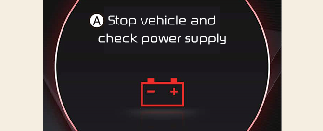
Urgency: urgent attention; follow any stop instruction.The familiar battery-shaped lamp concerns the low-voltage electrical charging system, including the DC-DC supply. It does not mean the large traction battery is simply running low. An EV can have plenty of driving-battery charge while its 12-volt system is in trouble.Read the message and find a safe place to stop if the warning persists or electrical functions are affected. Do not assume plugging into a charger will resolve it. If “Stop vehicle and check power supply” appears, arrange recovery rather than attempting to finish the journey.
Stop vehicle and check power supply
Urgency: stop safely and request recovery.This message indicates a fault in the 12-volt power-supply system. The correct response is a safe stop and professional inspection, with recovery to a Kia workshop as directed by the handbook.We should not treat this as a low-charge reminder or keep driving to see how much time remains. A temporary restart does not prove the electrical supply is stable. Tell roadside assistance the exact warning and that the vehicle is an EV6 so they can follow the appropriate recovery procedure.
Turtle or power-down indicator
Urgency: act immediately according to the cause.The turtle means available propulsion power is limited to protect the vehicle. Low traction-battery charge, a battery that is too cold or too hot, or high motor temperature can trigger a restriction. The symbol alone does not prove a component has failed.Avoid hard acceleration, overtaking and situations that need strong performance. Read the message and charge if low battery is the cause. If performance is inadequate for safe traffic flow, stop safely. A service warning alongside the turtle needs diagnosis rather than assuming it is normal low-charge protection.
High-voltage battery low-level warning
Urgency: charge immediately.This warning concerns the energy available for propulsion. Check the state of charge and remaining range, then use a suitable reachable charger. The precise warning threshold differs between versions, so we should not wait for a percentage quoted for somebody else’s EV6.Range is an estimate affected by speed, temperature, gradients and climate use. Do not plan to use every displayed kilometre. If a safe charging point cannot be reached, arrange assistance before the car loses the ability to keep up with traffic.
Charge immediately: power limited
Urgency: immediate charging or a safe stop.The vehicle is restricting performance because the traction battery is very low. This is a stronger instruction than an early low-battery reminder. It may be accompanied by both the battery warning and the turtle.Head only to a safely reachable charger, using gentle acceleration. Do not enter a motorway or attempt a demanding climb with severely restricted power. If no safe charging option is within reach, stop in a suitable location and call assistance instead of continuing until the vehicle becomes immobilised.
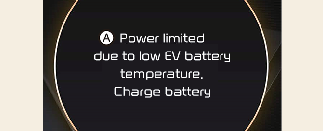
Power limited due to low battery temperature
Urgency: follow the charging instruction and reassess performance.A cold traction battery, particularly with low charge after being parked outside, can restrict available power. Charging as directed can warm the battery and help restore performance. This temperature-related restriction is different from a battery-overheating warning.Avoid sudden acceleration while power is limited. Do not attempt to heat components yourself or use improvised equipment. If the warning remains when conditions are no longer cold, or another system fault appears, arrange inspection. A normal-looking cabin temperature does not tell us the battery’s internal temperature.
EV battery overheated: stop vehicle
Urgency: stop safely and switch off.This warning means the high-voltage battery temperature is excessive. Bring the car to a safe stop, secure it and switch off as instructed so the system can cool. Do not continue driving simply to reach a preferred destination.If the message remains after sufficient cooling time, do not resume driving; contact assistance. Smoke, unusual heat, a strong chemical smell or fire calls for leaving the vehicle, moving away and contacting emergency services. Never open a battery enclosure or touch high-voltage components to investigate.
Refill coolant
Urgency: stop driving and check safely.The EV6 uses coolant even though it has no petrol or diesel engine. Its thermal-management circuits protect electrical equipment. A refill warning should not be dismissed as an irrelevant engine-car message.Stop safely and follow the handbook’s level-check procedure only when the system is cool. Do not open a hot reservoir or add a generic fluid based on colour. Coolant specifications and service requirements must match the vehicle. A leak, recurring warning or uncertain level requires professional help before continuing.
Brake, steering and restraint warning lights
Parking brake and brake-fluid warning
Urgency: normal when parked; urgent if it remains after release.The red brake warning can confirm that the parking brake is applied. If it remains after release, it can indicate low brake fluid or a braking-system problem. Its meaning depends on the operating state and any accompanying warning.Do not drive against an applied parking brake. If the warning persists with the brake released, stop safely and have the system checked. A soft pedal, longer stopping distance or visible fluid leak makes further driving unsafe. Topping up fluid alone does not demonstrate that the brake system is sound.
Check regenerative brakes
Urgency: prompt inspection; stop if braking is impaired.A regenerative-braking fault is different from ordinary changes in deceleration caused by battery conditions or a selected regeneration level. The handbook warns that a fault can make the brake pedal harder to operate and increase stopping distance.Use the foot brake deliberately, leave additional space and move to a safe stopping place if performance is abnormal. Red and yellow brake warnings together deserve particular attention. Do not rely on i-Pedal or paddles to compensate for a fault, and request recovery if braking cannot be trusted.
ABS warning light
Urgency: prompt inspection; greater urgency with other brake warnings.An isolated ABS warning means anti-lock braking may be unavailable. Conventional braking may remain, but emergency braking on a slippery road will not have the same protection. Avoid abrupt braking and have the system checked promptly.If ABS appears together with the red brake warning, electronic brake-force distribution may also be affected. Do not treat that combination as an ordinary isolated ABS fault. Stop safely if braking is abnormal and arrange assistance; the warning alone cannot identify a particular wheel sensor as the cause.
Electric power steering warning
Urgency: prompt attention; stop if control is affected.This warning indicates a problem with electric power steering. Steering effort can change, particularly at lower speeds. Keep a firm grip and avoid sudden changes of direction while reaching a safe place.If the wheel becomes unexpectedly heavy, inconsistent or difficult to control, do not continue the journey. Have the car inspected. A restart that temporarily clears the symbol is useful information for diagnosis, but it is not proof that the underlying condition is resolved.
Airbag or SRS warning
Urgency: arrange inspection promptly.The restraint-system warning can involve airbags, seat-belt pretensioners or their monitoring circuits. It normally illuminates during the startup check and then clears. Persistent illumination requires diagnosis because some protection may not work as intended in a collision.Do not disconnect under-seat plugs or probe airbag wiring to clear the light. Record when it began, especially after seat movement or interior work, and give that information to the technician. A warning reset alone does not restore a malfunctioning restraint system.
Seat-belt warning
Urgency: fasten the required belt before moving.This warning identifies an unfastened belt or a belt released during a journey. Check every occupied seating position and ensure the belts are latched and routed properly. Stop safely before adjusting a passenger’s restraint.An object on a seat can sometimes affect occupancy detection, but first check the occupants. Never use a dummy buckle to silence the reminder. If the warning persists when the seats and belts are correctly used, arrange inspection of the relevant buckle or detection system.
EPB: electronic parking-brake fault indication
Urgency: prompt inspection and secure the vehicle.EPB is the electronic parking-brake fault indication, not simply confirmation that the brake is applied. Read the message, keep the vehicle secure and arrange inspection if it stays on unexpectedly. Kia notes that an EPB warning can accompany an ESC fault without proving a separate parking-brake defect.
AUTO HOLD indicator
Urgency: status-dependent; inspect a yellow fault indication.AUTO HOLD uses colour to show its state: white typically means selected and waiting, green means it is holding the stopped car, and yellow indicates a fault. Keep the foot brake applied if holding is uncertain. AUTO HOLD is not a substitute for parking and securing the vehicle properly before getting out.
Tyres, traction and general warnings
Tyre pressure warning and TPMS fault
Urgency: inspect and correct pressures promptly.A steady low-pressure warning can mean one or more tyres are significantly underinflated. Stop safely, check for damage and measure pressures against the vehicle’s cold-pressure label. A tyre can look normal while being too low.Flashing followed by continued illumination can indicate a TPMS malfunction. That means pressure monitoring may be unavailable, not that the tyres are necessarily correctly inflated. Do not use a generic reset procedure from another brand. Repair punctures and pressure problems first, and follow the EV6 handbook if the warning remains.
Electronic Stability Control indicator
Urgency: normal when intervening; prompt inspection when persistently faulty.A flashing skidding-car symbol during loss of grip can mean ESC is actively helping stabilise the car. Ease off and adapt speed to the road. It is a signal to respect available traction, not a reason to accelerate harder.A persistent warning with a fault message needs inspection. ESC can share information with other systems, so several warnings may have one underlying cause. Avoid assuming that every illuminated symbol represents an independent failure before the vehicle is properly diagnosed.
ESC OFF indicator
Urgency: check the selected setting.This usually confirms that stability or traction-control assistance has been deliberately reduced or deactivated through the relevant control. The exact functions affected depend on the setting and version.Restore normal assistance when the reason for deactivation has passed. Do not use ESC OFF as a cure for a persistent ESC fault. On GT versions, special driving modes can change vehicle behaviour substantially; follow the specific handbook rather than treating every OFF indication as identical.
AWD or 4WD system warning
Urgency: prompt inspection on an equipped vehicle.This applies to versions with the relevant all-wheel-drive system. It indicates a fault rather than merely showing that both axles are available. The warning does not establish which motor, control function or associated component is responsible.Avoid demanding acceleration and conditions that rely on maximum traction. Read the message and seek diagnosis. If reduced power or an EV stop instruction accompanies it, follow the more urgent instruction. Do not apply this warning’s meaning to a rear-wheel-drive EV6 without checking the actual symbol.
Master warning triangle
Urgency: determined by the accompanying message.The triangle is a general attention signal for conditions that need explanation on the display. It does not identify one universal fault, and it should not be interpreted as a specific battery or motor diagnosis.Open or read the warning message after stopping safely. The required action may be simple, such as correcting a condition, or may involve workshop inspection. Clearing the display does not clear the underlying cause. If several alerts appear, address the one with the strongest safety instruction first.
Icy-road warning
Urgency: adjust driving immediately.The snowflake or icy-road indication is a temperature-related caution rather than proof that a vehicle component has failed. It warns that road conditions may require extra care.Reduce speed where appropriate, increase following distance and avoid abrupt acceleration, braking or steering. Ice can occur before or after the warning threshold, especially on bridges and shaded roads. The outside-temperature reading cannot confirm the grip available at every point on the route.
Smart key or immobiliser indicator
Urgency: check the key and displayed instruction.The symbol can confirm key recognition, report that the key is not detected or indicate an immobiliser problem, depending on its behaviour. A weak key battery is only one possible explanation for a detection issue.Check that the correct key is inside and follow the handbook’s backup starting method if needed. Do not assume the traction battery is flat because the car will not become READY. Persistent detection problems with a known working key need diagnosis rather than repeated attempts to bypass the immobiliser.
Driver-assistance symbols and limitations
Forward Safety warning
Urgency: drive manually and arrange inspection if persistent.A persistent Forward Safety warning can indicate a problem with Forward Collision-Avoidance Assist. Read the message because deactivation, a blocked sensor and a system fault require different follow-up actions.Maintain your own following distance and braking decisions. If instructed, park safely and clean the relevant camera or radar area without dismantling anything. If the warning returns or remains after an obstruction is removed, have it checked. Never test the system by deliberately approaching an obstacle.
Lane Keeping Assist indicator
Urgency: status-dependent; inspect a persistent yellow fault.On the covered display, green indicates that operating conditions are met, white indicates that they are not, and yellow can indicate a malfunction. The exact appearance can vary with instrument-panel generation.Keep control of lane position regardless of the colour. Faded markings, weather and camera visibility can limit assistance. A persistent fault message needs attention, but a standby indication alone does not prove broken hardware. Lane assistance is not permission to look away from the road.
Lane Following Assist indicator
Urgency: status-dependent.The steering-assistance symbol describes Lane Following Assist, which is distinct from Lane Keeping Assist. Green indicates active assistance on the covered version; grey indicates unmet operating conditions, while yellow can signal a fault.Keep your hands on the wheel and respond to driver-input warnings. If assistance disengages, steer normally and assess the message when safe. Do not confuse this status symbol with a separate power-steering fault lamp, especially if steering effort has actually changed.
Highway Lane Change Assist indicator
Urgency: status only unless a fault is reported.On equipped vehicles, the indicator distinguishes readiness, standby, an active lane change and cancellation. Colour and flashing behaviour are meaningful, and the feature is not present on every EV6.Continue checking mirrors, blind spots and surrounding traffic. A readiness indication does not mean the system has accepted every possible manoeuvre. If assistance cancels, maintain control and complete or abandon the manoeuvre safely according to traffic conditions, rather than waiting for the vehicle to decide for you.
Charging indicators and charging-fault messages
Charging indicator
Urgency: normally status only.The charging indication relates to the high-voltage charging connection or process. Check the charging screen and charger status to confirm that energy is actually being delivered; a connected cable alone does not guarantee an active session.A schedule, charge limit or charger authorisation step can explain why charging has not started. If an error message appears, follow that message rather than repeatedly reconnecting. The charging-port lights, dashboard indicators and app display provide different pieces of information.
Charging stopped: check the AC charger
Urgency: inspect the session and equipment before retrying.This message can follow a problem or interruption at the AC charger or cable. It does not automatically establish a fault with the vehicle. End the session normally and check the charger’s instructions and visible condition.Do not reuse damaged, scorched or unusually hot equipment. If safe and permitted, try a known working compatible charger. A problem that repeats with functioning equipment requires vehicle inspection. Avoid improvised adapters or wiring changes as a way to keep the session running.
Charging stopped: check the DC charger
Urgency: follow charger instructions and investigate recurrence.A DC charging interruption can result from the external charger stopping the session or a charging problem. Record the charger’s error information and contact its operator when appropriate.If no damage or safety issue is present, another compatible working charger can help distinguish a site problem from a recurring vehicle issue. If the EV6 also displays an EV-system fault or a stop instruction, do not treat changing chargers as a substitute for the required inspection or recovery.
Charging stopped: check the cable connection
Urgency: correct the connection safely.The connector may not be properly seated, or its release control may have interrupted the session. Stop the charging session using the normal process before disconnecting and reconnecting.Inspect only for visible damage or foreign material without touching electrical contacts or inserting tools. Never force a locked connector. If the warning persists with a sound compatible cable, seek assistance. Heat damage, smoke or an electrical smell means stopping use of the equipment, not attempting another connection.
Unplug vehicle to start
Urgency: normal operating instruction.The EV6 prevents normal driving with the charging cable connected. This message is usually an instruction to complete disconnection rather than evidence of a propulsion fault.End the session, unlock and remove the connector according to the handbook and charger instructions, then close the charging flap. Do not pull against the cable lock or try to drive away to release it. A connector that will not unlock requires the specified release procedure or professional assistance.
Battery conditioning indicator
Urgency: normally status only.This confirms operation of the battery-conditioning feature on equipped versions. Conditioning manages battery temperature under the system’s operating conditions; it is not itself a battery-overheating fault.Availability can depend on equipment, software, settings, temperature and charge level. Follow the handbook for activation and navigation-related requirements where applicable. Do not assume the feature has failed simply because the indicator is absent on one journey, or expect a fixed charging speed in every weather condition.
Normal lighting indicators and lighting faults
LED headlight warning
Urgency: inspect promptly; avoid driving without adequate visibility.A steady or flashing warning can indicate an LED lamp or associated component problem. Check the message and the actual exterior lights when safely parked. The symbol does not tell us which part requires replacement.If lighting is insufficient for the conditions, do not continue a night journey. Arrange inspection and use the correct repair procedure. Automatic or matrix-lighting equipment can need specialist diagnosis, so a generic bulb replacement is not always the appropriate solution.
Blue main-beam indicator
Urgency: status only; dip when necessary.The blue headlamp symbol means main beams are on. It is not a battery-temperature or charging warning. Check the stalk position if it appears unexpectedly.Dip the lights to avoid dazzling approaching or preceding traffic. Even with automatic assistance selected, remain ready to override it where reflections, bends or unusual road lighting require manual control.
Dipped-beam indicator
Urgency: status only.This confirms dipped-beam headlights are on. It is normally expected during night driving and does not need resetting.If visibility remains poor, check the controls, lamp cleanliness and actual operation after stopping safely. A normal dashboard indicator does not guarantee that every exterior lighting component is functioning correctly.
Exterior lights indicator
Urgency: status only.This confirms the relevant exterior lighting selection. Do not assume that an illuminated dashboard alone means the correct lights are operating outside the car.Review the selected mode when entering fog, heavy rain or spray. Automatic lighting helps with changing ambient light but does not remove the driver’s responsibility to provide appropriate visibility to other road users.
High Beam Assist indicator
Urgency: status only unless accompanied by a fault.This shows that automatic high-beam assistance or the relevant intelligent lighting function has been selected, depending on equipment. It is distinct from the blue symbol indicating that main beams are actually illuminated.Watch the road and override the automatic system when needed. Keep the camera area clear and arrange inspection for a persistent lighting or camera fault. Feature selection and actual availability are not always the same thing.
Rear fog-lamp indicator
Urgency: status only.The rear fog indicator confirms that the lamp is on, where fitted. Its amber colour does not make it a malfunction warning.Use it only when visibility and local rules justify it, then switch it off as conditions improve. A bright rear fog lamp can dazzle following traffic in normal conditions. Equipment and controls differ between markets.
Turn signals and hazard indicators
Urgency: status only unless operation is abnormal.Flashing arrows normally confirm direction indicators; both sides flashing generally accompany the hazard warning lights. Cancel the turn signal when the manoeuvre is complete.An unusual flash rate or a lighting warning calls for checking the exterior lamps. Do this while safely parked rather than relying only on the dashboard arrows. Hazard lights warn other road users but do not make an unsafe stopping place safe.
READY and other word-based displays
READY: the EV6 can move without making engine noise
Urgency: status only when steady; investigate unexpected flashing or loss of READY.READY indicates the drive-ready state. Screens being on is not enough. If READY does not appear after a valid start request, check the accompanying instructions, such as the brake pedal, key or connected charging cable. A flashing indicator, or an unexpected loss of READY while operating, requires inspection.Before leaving the driver’s seat, select P, apply the parking brake and switch off correctly. Silence is normal in an EV and cannot tell us whether propulsion is enabled.
ECO, SPORT, SNOW and GT are mode labels
These labels normally describe a selected driving mode rather than a fault. Available modes depend on the version. They can change response or assistance settings, so check that the selection suits the road conditions. A mode label does not cancel an accompanying fault instruction.
SOS and intelligent-lighting fault text
On equipped vehicles, a persistent SOS warning can indicate an emergency-call system malfunction. Arrange inspection and do not assume the automatic calling function will work. Some lighting systems also use text such as AFS for a fault. Follow the handbook for the specific equipment rather than treating every text abbreviation as a maintenance reminder.
Warning combinations that deserve extra attention
Combination
What it suggests
Correct action
Turtle plus low battery
Reduced power associated with low available energy
Charge immediately if safely reachable; otherwise stop and arrange assistance.
Turtle plus EV service warning
A fault may accompany the power restriction
Read the message and follow its inspection or recovery instruction.
ABS plus red brake warning
More than an isolated anti-lock fault may be present
Avoid abrupt braking, stop safely if control is affected and arrange urgent inspection.
Red and yellow brake warnings
Regenerative or broader braking performance may be impaired
Use the foot brake carefully, allow more distance and seek help.
12-volt warning plus a stop message
A power-supply fault requiring a safe stop
Park safely and request recovery.
Does every electrical warning mean an ICCU failure?
No. A dashboard message is not a component-level diagnosis. A technician needs the stored fault codes, relevant electrical tests and the vehicle’s history before identifying a charging-control, battery, wiring or other problem. A fresh 12-volt battery is not automatically a cure for an underlying charging fault.
Ask Kia to check outstanding campaigns against the VIN in your country. That is more reliable than applying a recall list or repair outcome from another owner’s model year. Completing a campaign and diagnosing a newly displayed warning are separate tasks.
Can we reset Kia EV6 warning lights ourselves?
Correct the cause first. Releasing a parking brake, fastening a belt or correcting tyre pressure can resolve the relevant condition. An EV service warning, brake fault or stop message requires a different response. Clearing codes does not demonstrate that the system is safe.
Avoid disconnecting the 12-volt battery as a universal reset. It may remove useful diagnostic evidence or introduce additional setup requirements. Save the warning wording, the state of charge and what the vehicle was doing when it appeared. Do not open high-voltage components or touch orange cables.
What to tell roadside assistance or the workshop
Exact wording: include any instruction to stop or check the power supply.
Associated lamps: note whether the turtle, brake warnings or EV service symbol appeared together.
Operating state: report whether READY was steady, flashing or absent.
Timing: explain whether it happened during charging, startup or driving.
Vehicle details: provide the model year, drivetrain, GT status where relevant and location.
Use the vehicle’s prescribed recovery method. Tell the operator it is an EV6 rather than assuming ordinary towing with driven wheels on the road is acceptable. If the car cannot maintain a safe speed or braking is compromised, arrange recovery instead of attempting to reach a workshop under its own power.
Conclusion
Kia EV6 dashboard warnings make more sense when we distinguish status indicators from system faults and read the message beside the symbol. Low traction-battery charge, a 12-volt supply fault and an overheated battery require different responses. Act on stop instructions, treat changes in braking or steering seriously, and fix the underlying condition before attempting a reset.
Frequently asked questions
1. Can I drive a Kia EV6 with the turtle light on?
It depends on the cause and available performance. Low battery or extreme temperature can limit power without proving a component failure. Avoid demanding manoeuvres, follow the message and charge if needed. Stop if the car cannot travel safely, or if an accompanying warning instructs you to stop.
2. What does the car with an exclamation mark mean?
It is the EV service warning and indicates a problem in the electric-vehicle control system when it persists beyond startup. It is not simply a scheduled-service reminder. Read the message and arrange diagnosis; a “Check electric vehicle system” instruction requires a safe stop and recovery under the covered handbook.
3. Why does my EV6 show a battery warning when it has plenty of charge?
The warning may concern the separate 12-volt charging system rather than the high-voltage battery’s state of charge. The exact symbol and message distinguish them. A “Stop vehicle and check power supply” message requires a safe stop and recovery, regardless of the displayed traction-battery percentage.
4. Is reduced regenerative braking always a fault?
No. Available regeneration can change with battery conditions and settings. However, a “Check regenerative brakes” message or combined brake warnings indicates a condition needing inspection. If pedal effort or stopping distance changes, move to a safe stop and arrange assistance rather than relying on one-pedal driving.
5. Should all EV6 dashboard lights go out after starting?
Fault-check lamps should normally clear, but status indicators can remain on. READY, selected lighting and other active functions may be displayed during normal use. Investigate a persistent warning lamp or fault message instead of assuming that every illuminated symbol requires a repair.
If you want to know other articles similar to Kia EV6 Dashboard Warning Lights — Complete Meanings, Urgency Levels, and Correct Actions you can visit the category Service and Parts.
Auto Guide
I show you the best reviews of all car brands, the information we collect and show is verified by our mechanics, we hope that everything you read here is useful to buy the car of your dreams
















More content of your interest