
Toyota Estima 8 Seater Boot Space: How Much Room Do You Really Get?

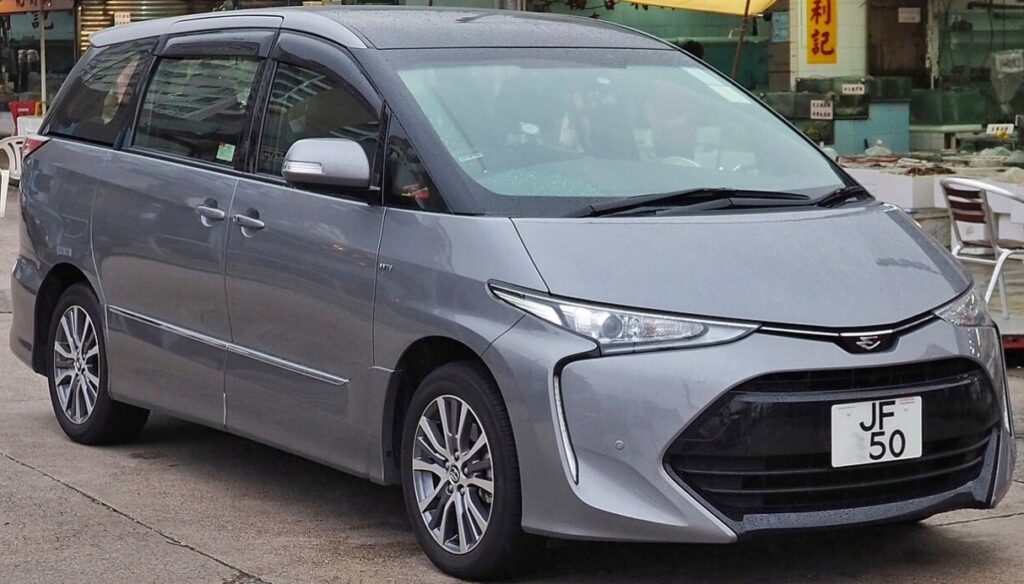
The Toyota Estima 8 seater boot space is one of the biggest reasons this Japanese MPV remains appealing to families, airport-transfer operators, road-trip enthusiasts, and anyone who occasionally needs to move half the contents of their house.
At first glance, though, the question seems almost contradictory. How can a vehicle carry eight people and still have useful luggage space?
That is the challenge with practically every eight-seat MPV. Passenger seats have to live somewhere, and once the third row is occupied, luggage usually gets whatever space is left behind.
The Estima handles the compromise particularly well because Toyota designed its cabin around flexibility rather than simply squeezing extra seats into the rear. On third-generation eight-seat models, Toyota specifically designed the third-row seats to fold into the floor while the second row can tip forward, creating a broad and comparatively flat cargo area when maximum luggage capacity is needed.
So, is there enough room for eight passengers and their luggage? Can we fit suitcases behind the third row? What happens when those rear seats disappear into the floor?
Let's unpack it.
Content in this publication
- Toyota Estima 8 Seater Boot Space at a Glance
- How Big Is the Toyota Estima?
- Toyota Estima Boot Space With All 8 Seats Up
- What Fits Behind the Third Row?
- The Secret Weapon: Third-Row Seats That Fold Into the Floor
- Why a Flat Boot Floor Matters
- Boot Space With Second and Third Rows Rearranged
- Toyota Estima 8 Seater vs 7 Seater Boot Space
- Is the Toyota Estima Good for Airport Runs?
- Toyota Estima Boot Space for Family Holidays
- Can a Pushchair Fit in a Toyota Estima With 8 Seats?
- Can Golf Clubs Fit Behind the Third Row?
- Can You Sleep in a Toyota Estima?
- How the Estima's Long Wheelbase Helps Cargo Room
- Toyota Estima Hybrid Boot Space
- First-Generation Estima Boot Space
- Second-Generation Estima Boot Space
- Third-Generation Estima: The Cargo Champion
- Toyota Estima Boot Opening and Loading Practicality
- How to Maximize Toyota Estima 8 Seater Boot Space
- What to Check Before Buying an 8-Seater Estima
- Is the Toyota Estima 8 Seater Boot Big Enough for Everyday Life?
- Toyota Estima 8 Seater Boot Space: Who Is It Best For?
- Is the Estima Better for Passengers or Luggage?
- Conclusion: How Good Is Toyota Estima 8 Seater Boot Space?
- FAQs About Toyota Estima 8 Seater Boot Space
- 1. Does the Toyota Estima have boot space with all 8 seats up?
- 2. Do Toyota Estima third-row seats fold into the floor?
- 3. Can 8 people and their luggage fit in a Toyota Estima?
- 4. Is the 7-seat or 8-seat Toyota Estima better for luggage?
- 5. Is the Toyota Estima good for families with lots of luggage?
Toyota Estima 8 Seater Boot Space at a Glance
There isn't one universal litre figure that accurately describes every Toyota Estima.
Why?
Because the Estima existed across several generations, drivetrains, seating layouts and trim levels. Japanese-market specifications also weren't always published using the standardized luggage-capacity measurements commonly seen on European cars.
That means we should be suspicious when we encounter an extremely precise boot figure online without a model year or seating configuration attached to it.
What we can say confidently is that the Estima offers three distinctly different cargo configurations:
- All eight seats occupied: limited but useful luggage space behind row three.
- Third row folded: a dramatically larger luggage compartment.
- Second and third rows rearranged: van-like cargo flexibility for larger objects.
The transformation between those configurations matters more than one headline litre number.
How Big Is the Toyota Estima?
Before looking inside the boot, it helps to understand the vehicle surrounding it.
The original first-generation Estima measured approximately 4,750 mm long and 1,800 mm wide, while representative second-generation models were around 4,750 mm long and 1,790 mm wide.
The third-generation Estima grew slightly. Toyota lists representative models at approximately:
| Measurement | Third-Generation Estima |
|---|---|
| Length | 4,795 mm |
| Width | 1,800 mm |
| Height | Around 1,730–1,745 mm |
| Wheelbase | 2,950 mm |
Those dimensions come from Toyota's specifications for representative third-generation models.
The Estima Hybrid was similarly substantial, with Toyota listing a representative 2006 version at 4,800 mm long, 1,800 mm wide and 2,950 mm between the axles.
That long wheelbase is important. Instead of dedicating an enormous proportion of the vehicle to the bonnet, Toyota used much of its footprint for the passenger compartment.
In everyday language?
There is a lot happening inside a vehicle that is still less than five metres long.
Toyota Estima Boot Space With All 8 Seats Up
Here we reach the configuration most buyers worry about.
Imagine eight people climbing aboard for an airport run. Nobody wants to hear, after everyone has buckled up, that three suitcases must stay behind.
With all three seating rows being used, the Estima does retain a luggage area behind the third row, but we shouldn't expect conventional estate-car levels of cargo volume.
The third-row seatbacks sit relatively close to the tailgate. Consequently, the remaining compartment is best suited to things such as:
- grocery bags;
- backpacks;
- several soft travel bags;
- compact cabin suitcases;
- folded pushchairs depending on dimensions;
- sports bags;
- everyday family equipment.
Several large hard-shell suitcases present a much tougher challenge.
Can 8 People and 8 Large Suitcases Fit?
Realistically, we would not buy an Estima expecting to carry eight adults plus eight large checked suitcases entirely behind the third row.
That's asking an MPV to perform magic.
Eight passengers already consume almost the entire seating layout. The residual boot area is useful, but luggage for eight people can quickly overwhelm it.
If every passenger has a large 70-80 cm suitcase, we should plan on needing an alternative arrangement.
Possible solutions include reducing luggage size, using soft bags that stack more efficiently, using fewer passenger seats, or fitting an appropriate external luggage solution where legal and suitable.
Soft Bags Make a Surprisingly Big Difference
This sounds trivial until we pack a minivan.
Rigid suitcases create empty pockets of unusable air between them. Duffel bags bend around wheel arches, seat structures and irregular trim.
Think of it like packing stones versus sand into a bucket.
For a full eight-person Estima journey, flexible luggage can make the available boot considerably easier to use.
What Fits Behind the Third Row?
There is no perfect answer because suitcases vary enormously, but the useful way to approach the Estima boot is by luggage type rather than an uncertain universal litre figure.
With all eight seats available, we would consider the luggage area suitable primarily for everyday family cargo and smaller travel luggage.
A few compact cases or stacked soft bags are far more realistic than an entire family's collection of checked airline luggage.
For airport travel, this distinction is crucial.
An Estima can be an excellent eight-person transporter.
It can also be an excellent luggage transporter.
Doing both at maximum capacity simultaneously is where compromises start.
The Secret Weapon: Third-Row Seats That Fold Into the Floor
This is where the Toyota Estima becomes much more impressive.
Toyota states that the third-row seats in the redesigned 2006 Estima can fold into the floor. In the eight-seat vehicle, Toyota combined that arrangement with second-row seats capable of tipping forward, specifically describing the resulting cargo area as large and flat.
This is substantially more useful than simply folding a seatback down on top of the cushion.
Why?
Because a folded seat that remains above the floor consumes vertical cargo space. A seat disappearing into the floor essentially gives that volume back to us.
Boot Space With the Third Row Folded
Once row three disappears, the character of the Estima changes.
Instead of a narrow luggage zone behind eight seats, we gain most of the area previously occupied by the sixth, seventh and eighth passengers.
Suddenly, larger items become practical:
- several large suitcases;
- multiple travel bags;
- pushchairs and baby equipment;
- camping gear;
- large weekly shopping loads;
- bicycles with suitable preparation;
- boxes;
- household equipment;
- bulky sporting equipment.
For many families, this five-seat configuration is the Estima's sweet spot.
We still have comfortable accommodation for five people while gaining a huge rectangular cargo zone behind them.
Why a Flat Boot Floor Matters
Cargo capacity isn't only about litres.
Shape can be just as important.
Suppose Car A has theoretically more cargo volume than Car B but contains a major hump across its floor, intrusive side trim and seats stacked awkwardly inside the compartment.
On paper, Car A wins.
At IKEA, Car B probably does.
The Estima's ability to hide its third-row seats below floor level helps produce a more useful loading shape. Toyota explicitly promoted the large, flat cargo space created by its eight-seat arrangement.
That makes sliding boxes and suitcases inward considerably easier.
It also allows items to sit more securely instead of balancing on folded seat cushions.
Boot Space With Second and Third Rows Rearranged
Need even more room?
This is when the Estima begins behaving less like a passenger car and more like a compact van wearing nicer clothes.
On the eight-seat third-generation configuration, Toyota designed the second row so it could tip forward while the third row folded away.
With the passenger area rearranged, we can dedicate a huge proportion of the cabin to cargo.
What Can We Carry in Maximum-Cargo Mode?
Depending on the item's exact dimensions, loading angle and vehicle specification, maximum-cargo mode can accommodate significantly bulkier objects than the standard eight-seat configuration.
That makes the Estima useful for:
- flat-packed furniture;
- moving boxes;
- large camping setups;
- bicycles;
- surf or sporting equipment;
- business stock;
- photography equipment;
- luggage for long family holidays.
Naturally, we still need to respect payload limits and properly secure heavy objects.
Cargo space and legal carrying capacity aren't the same thing.
Toyota Estima 8 Seater vs 7 Seater Boot Space
Here things become interesting.
Surely the eight-seater must have less room because it contains another seat?
Not necessarily in the way we might expect.
The bigger distinction between seven- and eight-seat Estimas is typically the second-row seating arrangement.
Toyota's redesigned 2006 seven-seat version used individual second-row seating with extensive sliding adjustment, while the eight-seat version employed a configuration designed to tip forward as part of its cargo transformation. Toyota stated that seven-seat models offered up to 800 mm of second-row sliding range on the relevant version.
So the decision isn't simply:
seven seats = more boot space
versus
eight seats = less boot space.
It is really a decision between passenger comfort, seating flexibility and maximum occupancy.
Choose the 7 Seater If...
The seven-seat Estima generally makes more sense when passenger comfort matters more than maximum seating capacity.
Individual middle-row seating can provide a more premium experience, particularly for adults travelling long distances.
Choose the 8 Seater If...
The eight-seat version becomes compelling when flexibility is the priority.
We gain one extra passenger position and a seating design Toyota deliberately engineered for transformation into a large cargo area.
For bigger families, that's difficult to ignore.
Is the Toyota Estima Good for Airport Runs?
Yes—with one big qualification.
The Estima is excellent for transporting people to airports.
The equation changes when every person carries checked luggage.
For example, a family of four or five travelling in an eight-seat Estima can use the rear seating area strategically and dedicate much more cabin space to suitcases.
That's easy.
Six people plus luggage can also be manageable depending on seating arrangement and bag size.
Eight people with extensive luggage is the configuration we would plan carefully before travelling.
Best Estima Seating Arrangement for Luggage
If maximum baggage room matters, every unused seat becomes valuable real estate.
For example:
5 passengers: keep rows one and two occupied and fold the third row.
6 passengers: use the minimum rear seating necessary and pack around the remaining available area, where the particular seat layout permits it.
7 passengers: expect limited luggage capacity and prioritize compact bags.
8 passengers: treat the rear boot as supplementary luggage space rather than a full family suitcase compartment.
That mindset avoids disappointment.
Toyota Estima Boot Space for Family Holidays
Family holidays are probably where the Estima feels most at home.
We have kids, bags, snacks, blankets, perhaps a pushchair, maybe sports equipment and approximately 47 mysterious objects nobody remembers packing.
The Estima's advantage isn't simply raw dimensions.
It's adaptability.
If the kids don't need the entire third row, we can convert some or all of that passenger area into luggage room.
After arriving, the seats can return for local trips.
It's almost like carrying an extra room inside the car.
Can a Pushchair Fit in a Toyota Estima With 8 Seats?
Many compact and medium-size folded pushchairs should be manageable behind the third row, although exact compatibility depends heavily on the pushchair.
Large tandem pushchairs are another story.
Before buying an Estima specifically for young children, we would physically measure:
- the pushchair when completely folded;
- its longest dimension;
- its widest point;
- its height;
- the Estima's available tailgate opening and floor depth.
Don't rely exclusively on advertised pushchair volume.
Shape beats volume again.
A long pushchair may theoretically occupy little cubic space yet refuse to fit because the boot isn't deep enough in eight-seat mode.
Can Golf Clubs Fit Behind the Third Row?
Golf bags introduce a similar problem because they are long rather than merely bulky.
They may need to sit diagonally across the luggage area, depending on bag length and the exact Estima model.
With the third row folded, the problem virtually disappears.
Multiple golf bags become much easier to arrange thanks to the substantial increase in floor length.
Can You Sleep in a Toyota Estima?
The Estima's flexible cabin has also made it popular with campers and road-trip users.
With rear seating rearranged, there is enough cabin length to make sleeping configurations possible.
However, calling the result a perfectly flat factory bed would oversimplify things.
Seat structures, floor contours and trim can affect the sleeping surface. Many campers therefore use mattresses or custom platforms to create a more even bed.
For one or two travellers, the Estima can essentially become a miniature camper without abandoning normal MPV usefulness.
How the Estima's Long Wheelbase Helps Cargo Room
Vehicle length alone doesn't tell us how spacious an interior will be.
Wheelbase is usually more revealing.
Toyota's third-generation Estima uses a 2,950 mm wheelbase, giving designers substantial room between the axles for passengers and cargo.
Compare that with the first-generation vehicle's approximately 2,860 mm wheelbase, and we can see how the architecture evolved.
Those extra millimetres don't sound dramatic.
Inside an MPV, every centimetre matters.
Seat tracks, legroom, access pathways and luggage zones all compete for the same floor.
Toyota Estima Hybrid Boot Space
Hybrid buyers sometimes assume that batteries automatically destroy cargo capacity.
The Estima Hybrid demonstrates why we shouldn't make that assumption without looking at the actual vehicle layout.
Toyota's representative second-generation Estima Hybrid specifications show an eight-passenger model measuring roughly 4,800 mm long and 1,800 mm wide, with the same substantial 2,950 mm wheelbase associated with the third-generation architecture.
Nevertheless, hybrid hardware and trim differences mean we should avoid assuming every measurement or storage compartment is identical between petrol and hybrid versions.
If boot dimensions are critical—for example, because we're carrying mobility equipment—measure the specific vehicle rather than relying on another Estima variant.
First-Generation Estima Boot Space
The original Estima is a fascinating machine.
Its almost spaceship-like shape looked futuristic in 1990, and Toyota's historical records show that it measured about 4,750 mm long, 1,800 mm wide and 2,860 mm between the axles.
Its packaging differs significantly from later Estimas, though.
Therefore, cargo observations about a 2006-2019-era Estima shouldn't automatically be applied to a 1990s vehicle.
This is particularly important when shopping for used Japanese imports because sellers sometimes use "Estima eight seater" as though it describes a single model.
It doesn't.
Second-Generation Estima Boot Space
The second generation arrived in 2000.
Representative Toyota specifications list a length of 4,750 mm, width of 1,790 mm and wheelbase of 2,900 mm.
This generation moved the Estima toward the more conventional front-engine MPV architecture that defined later models.
Again, exact seat mechanisms and trim details vary, so buyers should inspect the specific vehicle they are considering.
Third-Generation Estima: The Cargo Champion
For shoppers specifically searching for an eight-seat Estima with strong cabin flexibility, the third generation deserves particular attention.
Toyota launched it in Japan in January 2006. Representative versions measured just under 4.8 metres long and used a 2.95-metre wheelbase.
More importantly for our purposes, Toyota explicitly highlighted the eight-seater's cargo transformation.
The second-row seats could tip forward.
The third-row seats could disappear into the floor.
Together, those features produced the large and flat luggage space Toyota promoted at launch.
That's exactly the sort of engineering we want from an MPV.
Toyota Estima Boot Opening and Loading Practicality
Numbers only tell half the story when loading a vehicle.
A massive cargo compartment behind a tiny opening would be frustrating.
The Estima's tall rear hatch gives us a relatively practical route into the luggage compartment, while its MPV proportions allow cargo to use vertical space as well as floor space.
That means we can often stack soft bags vertically rather than lining everything across the floor.
Remember Rearward Visibility
There is a catch.
Stacking luggage to the roof can block rearward visibility.
Where the vehicle's mirrors, cameras and local laws allow safe operation, drivers may still transport tall cargo, but preserving visibility whenever possible remains the better choice.
We should also secure luggage properly.
An unsecured 20 kg suitcase becomes a serious projectile during sudden braking.
How to Maximize Toyota Estima 8 Seater Boot Space
A little packing strategy can make the Estima feel considerably larger.
Our preferred approach is:
- Load the largest rectangular suitcase first.
- Place heavy luggage low and close to the seatbacks.
- Fill narrow spaces with backpacks or soft duffel bags.
- Avoid carrying unnecessarily oversized rigid cases.
- Use unused passenger positions strategically.
- Fold the third row whenever maximum passenger capacity isn't required.
- Keep frequently needed items near the tailgate.
- Don't stack loose luggage above the seatback without restraint.
Packing an MPV is basically three-dimensional Tetris.
Play it badly and the boot looks full after two suitcases.
Play it well and another three bags somehow vanish inside.
What to Check Before Buying an 8-Seater Estima
Cargo flexibility means little if the mechanisms don't work.
The Estima is now principally a used-vehicle purchase, so we would inspect the rear cabin carefully.
Third-Row Folding Mechanism
Confirm that both sections move smoothly and lock securely.
If the seats are designed to stow into the floor on the vehicle you're inspecting, make sure nothing obstructs their movement.
Second-Row Adjustment
Slide, fold or tip the seats through their full available travel.
Sticky tracks can turn a clever interior into a wrestling match.
Boot Floor
Lift mats and inspect beneath them.
Look for moisture, corrosion, previous repairs or damaged trim.
Tailgate Operation
Make sure the tailgate opens completely and stays open reliably.
If the vehicle has powered operation, test it repeatedly.
Carpet Condition
An Estima used commercially may have transported hundreds of passengers and suitcases.
Rear-cabin wear often tells us more about its previous life than shiny paintwork does.
Is the Toyota Estima 8 Seater Boot Big Enough for Everyday Life?
For most owners, yes.
We just need realistic expectations.
The Estima isn't a cargo van with eight chairs magically attached to the walls. With eight people aboard, luggage capacity inevitably becomes limited.
But that's true of nearly every vehicle in this class.
The important distinction is what happens when we don't need all eight seats.
Fold away the third row and the Estima suddenly offers the kind of cargo flexibility that makes large family life significantly easier.
Fold and rearrange more seating and it becomes capable of carrying surprisingly bulky loads.
That's why judging the Estima solely on its smallest boot configuration misses the point.
Its strength isn't one boot size.
Its strength is having several boot sizes in the same vehicle.
Toyota Estima 8 Seater Boot Space: Who Is It Best For?
The eight-seat Estima makes the most sense for people whose passenger and luggage requirements constantly change.
It is especially attractive for:
- larger families;
- grandparents transporting extended family;
- airport-transfer use;
- sports teams;
- road trips;
- camping;
- small businesses occasionally carrying equipment;
- buyers who need an MPV during the week and cargo flexibility at weekends.
If we permanently need eight passenger seats and enormous luggage capacity simultaneously, however, something larger may be more appropriate.
A full-size van wins that contest.
Is the Estima Better for Passengers or Luggage?
That's almost the wrong question.
The Estima's trick is switching between the two.
Eight people today?
Use the seats.
Five people plus a mountain of suitcases tomorrow?
Hide the third row.
Need to carry boxes on Saturday?
Transform the cabin again.
It's a bit like a Swiss Army knife with sliding doors.
No individual configuration is perfect for everything, but the ability to change configuration so easily makes the vehicle unusually versatile.
Conclusion: How Good Is Toyota Estima 8 Seater Boot Space?
The Toyota Estima 8 seater boot space is best understood as flexible rather than enormous in every configuration.
With all eight seats occupied, we have useful luggage capacity for smaller bags, groceries and everyday family equipment, but a full complement of large suitcases will quickly test the available space.
Start folding seats and everything changes.
Toyota engineered the third-generation eight-seater so the third row could fold into the floor and the second row could tip forward, creating the broad, flat cargo configuration that makes this MPV so practical.
That's the Estima's real appeal.
We aren't buying one fixed-size boot.
We're getting an interior that can change personality according to the day.
One morning it's an eight-person shuttle. That afternoon it's carrying luggage. By Saturday it can swallow boxes, bikes or camping gear.
For a vehicle measuring roughly 4.8 metres long in later generations, that's impressive packaging.
If eight passengers plus eight giant suitcases are your everyday requirement, look toward a larger van.
For almost everything between maximum passenger capacity and maximum cargo capacity, however, the Estima remains remarkably adaptable.
FAQs About Toyota Estima 8 Seater Boot Space
1. Does the Toyota Estima have boot space with all 8 seats up?
Yes. There is luggage space behind the third row when all eight passenger positions are available. However, it is better suited to backpacks, shopping, compact suitcases and soft bags than a large collection of full-size checked luggage.
2. Do Toyota Estima third-row seats fold into the floor?
On the redesigned third-generation Estima, Toyota specifically stated that the third-row seats can fold into the floor. On the eight-seat version, the second-row seating can also tip forward to help create a large, flat cargo area.
3. Can 8 people and their luggage fit in a Toyota Estima?
Eight people can fit in an eight-seat Estima, but luggage capacity depends heavily on bag size. Eight passengers carrying small bags may be manageable, whereas eight people with eight large checked suitcases are unlikely to fit comfortably using only the boot behind the third row.
4. Is the 7-seat or 8-seat Toyota Estima better for luggage?
Neither automatically wins. The seven-seat model tends to prioritize second-row passenger comfort, while the eight-seat configuration offers maximum passenger capacity and useful seat-folding flexibility. Toyota's third-generation eight-seat layout was specifically designed so the second row could tip and the third row could fold into the floor.
5. Is the Toyota Estima good for families with lots of luggage?
Yes, particularly when all eight seats aren't needed. Folding the third row releases a much larger cargo area while retaining seating for the front and middle rows, making the Estima particularly useful for family holidays, airport trips, camping and bulky everyday loads.
If you want to know other articles similar to Toyota Estima 8 Seater Boot Space: How Much Room Do You Really Get? you can visit the category Service and Parts.
Vauxhall Mokka Tyre Pressure Reset: Complete Guide
How to Reset the Tire Pressure System on Your Hyundai Tucson
Hyundai Kona Tire Pressure: Complete PSI Guide
Vauxhall Corsa Timing Belt Replacement Cost UK 2026
Mazda CX-5 Tire Size Chart: 2013–2026 Guide
How to Reset a Honda Civic: Complete Step-by-Step Guide
Leave a Reply
More content of your interest