
Ram 1500 vs Tacoma: Which Truck Is Better?

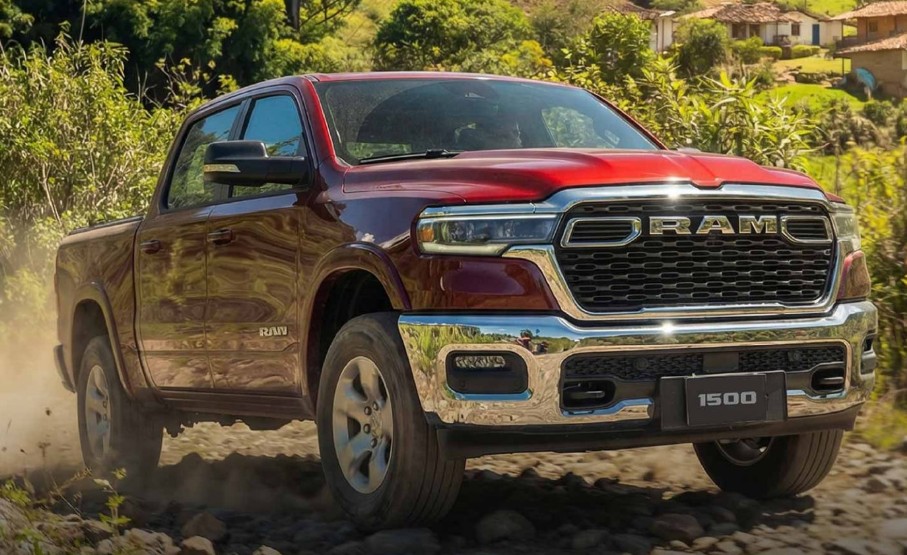
Comparing the Ram 1500 vs Tacoma might seem strange at first. One is a full-size pickup built to tow serious weight, swallow bulky cargo, and deliver near-luxury comfort. The other is a midsize truck designed around maneuverability, off-road adventure, efficiency, and everyday usability.
Yet plenty of buyers end up cross-shopping them.
Why? Because choosing a pickup isn't always about buying the biggest truck our budget allows. We need to think about what the truck will actually do Monday through Sunday. Are we towing a large travel trailer every month? Navigating cramped city parking garages? Heading down narrow forest trails? Carrying kids to school? Or perhaps doing all four?
For the current 2026 model year, that contrast is sharper than ever. The Ram 1500 offers up to 540 horsepower, 11,610 pounds of maximum towing capacity, and 2,360 pounds of maximum payload, depending on configuration. The 2026 Toyota Tacoma, meanwhile, offers an available i-FORCE MAX hybrid powertrain producing up to 326 horsepower and 465 lb-ft of torque, while properly equipped models can tow up to about 6,500 pounds.
So, which one belongs in our driveway?
Let's dig into the differences that actually matter.
Content in this publication
- Ram 1500 vs Tacoma at a Glance
- The Biggest Difference: Full-Size vs Midsize
- Ram 1500 vs Tacoma Engine Options
- Ram 1500 vs Tacoma Towing Capacity
- Payload and Bed Utility
- Ram 1500 vs Tacoma Fuel Economy
- Interior Space and Passenger Comfort
- Off-Road Performance: Tacoma's Home Turf
- Ram 1500 vs Tacoma Ride Quality
- Technology and Convenience
- Which Truck Is Easier to Daily Drive?
- Reliability and Long-Term Ownership
- Ram 1500 vs Tacoma for Work
- Ram 1500 vs Tacoma for Families
- Ram 1500 vs Tacoma for Camping and Overlanding
- Should We Buy a Ram 1500 or Toyota Tacoma?
- Which One Offers Better Value?
- Ram 1500 vs Tacoma: The Final Verdict
- Frequently Asked Questions
Ram 1500 vs Tacoma at a Glance
The easiest way to understand these trucks is to forget the badges for a moment.
Think of the Toyota Tacoma as a hiking boot. It's relatively compact, tough, adaptable, and built to venture into places where something larger becomes cumbersome.
The Ram 1500 is more like a heavy-duty work boot with a luxury insole. It takes up more room and requires more fuel and space, but when the work gets heavier, we quickly appreciate the extra muscle.
| Category | Ram 1500 | Toyota Tacoma |
|---|---|---|
| Truck class | Full-size light-duty | Midsize |
| Maximum available horsepower | 540 hp | 326 hp |
| Maximum available torque | 521 lb-ft | 465 lb-ft |
| Maximum towing capacity | 11,610 lb | Around 6,500 lb |
| Maximum Ram payload | Up to 2,360 lb | Lower than Ram overall |
| Transmission choices | 8-speed automatic | 8-speed automatic or available 6-speed manual |
| Best suited to | Towing, hauling, comfort | Off-roading, maneuverability, daily use |
| Cabin feel | Larger and more spacious | More compact |
| City friendliness | Fair | Better |
| Heavy trailer ability | Excellent | Moderate |
Ram's published maximum figures vary significantly by engine, cab, drivetrain, axle ratio, and equipment, so the maximum number shouldn't be treated as the capability of every truck on the dealer lot.
The Biggest Difference: Full-Size vs Midsize
This is the foundation of the entire comparison.
The Ram 1500 competes in the full-size light-duty segment. The Tacoma occupies the midsize category. Consequently, we're not simply comparing two different brands. We're comparing two different philosophies.
The Ram gives us more physical truck: more width, more cabin space, greater towing potential, higher available payload, and more powerful engine choices.
Tacoma answers with easier dimensions, a more trail-friendly footprint, and a personality built around adventure.
Why Truck Size Matters in Everyday Driving
Bigger sounds better on a specification sheet. In the supermarket parking lot, things become less straightforward.
A full-size Ram can feel substantial when we're threading through tight parking structures, older neighborhoods, or narrow trails. The Tacoma simply consumes less physical real estate.
For suburban roads and highways, the Ram's extra dimensions can become an advantage. Its larger cabin feels relaxed, passengers have more breathing room, and highway cruising suits the truck beautifully.
Tacoma makes its argument when space gets tight.
Which Size Should We Choose?
If we're repeatedly thinking, "Will the Ram fit there?" the Tacoma probably makes more sense.
If we're repeatedly thinking, "Will the Tacoma pull that?" the Ram probably makes more sense.
That simple distinction explains much of this battle.
Ram 1500 vs Tacoma Engine Options
Here's where the personalities separate dramatically.
Toyota has moved the modern Tacoma toward turbocharged four-cylinder power, including an available electrified i-FORCE MAX setup. Ram offers a broader collection of engines that ranges from a naturally aspirated V6 to twin-turbo inline-six Hurricane power and, for 2026, the returning HEMI V8 on selected configurations.
The 2026 Ram lineup offers a 3.6-liter Pentastar V6, a 3.0-liter Hurricane inline-six, a high-output Hurricane, and an available 5.7-liter HEMI V8. Depending on configuration, output stretches all the way to 540 horsepower and 521 lb-ft.
Tacoma tops out at 326 horsepower and 465 lb-ft with its available i-FORCE MAX hybrid system. Buyers can also choose between an eight-speed automatic transmission and, on certain configurations, a six-speed manual.
Ram 1500 Power: Built for Bigger Jobs
Ram's standard-output 3.0-liter Hurricane produces 420 horsepower and 469 lb-ft, while the high-output version reaches 540 horsepower and 521 lb-ft. The returning 5.7-liter HEMI V8 develops 395 horsepower and 410 lb-ft.
Those aren't merely bragging rights.
More power becomes useful when merging with a loaded trailer, climbing grades, carrying significant weight, or passing at highway speed.
The Ram feels like it has deeper lungs.
Tacoma Power: More Than the Numbers Suggest
Tacoma doesn't need 500 horsepower to accomplish its mission.
Its available 465 lb-ft of hybrid torque is substantial for a midsize truck, particularly where low-speed response matters.
That's useful on trails, steep inclines, and during normal acceleration. Toyota's approach is less about winning an outright horsepower contest and more about delivering useful muscle without turning the Tacoma into a full-size pickup.
Ram 1500 vs Tacoma Towing Capacity
This might be the quickest way to make our decision.
The 2026 Ram 1500 can tow as much as 11,610 pounds when properly equipped. Toyota lists maximum Tacoma towing capacity at up to approximately 6,500 pounds, depending on configuration.
That gap is enormous.
We're talking about roughly five thousand pounds of additional maximum trailer capability in the Ram's favor.
Choose the Ram If Towing Is a Priority
If we're regularly pulling a substantial travel trailer, enclosed equipment trailer, larger boat, or another heavy load, the Ram 1500 is the natural choice.
It isn't simply the maximum rating that matters.
A larger truck generally provides a longer, heavier platform, which can feel more settled when a substantial trailer is attached. Engine output, braking, cooling, wheelbase, hitch setup, payload availability, and trailer equipment all play into the real-world experience.
The Ram was designed around this kind of work.
When Tacoma's Towing Ability Is Enough
Not everybody needs five-digit towing capacity.
A Tacoma may comfortably fit buyers towing smaller campers, utility trailers, motorcycles, ATVs, or modest boats, provided the exact vehicle and trailer remain within their respective ratings.
And here's something worth remembering: unused towing capacity doesn't provide much value.
Buying an 11,000-pound-capable truck to pull a 2,500-pound trailer twice per year can be like buying a commercial refrigerator to store six cans of soda.
Useful? Sure.
Necessary? Maybe not.
Payload and Bed Utility
Payload isn't as glamorous as horsepower, yet it can become the limiting factor before towing capacity does.
Ram states that the 2026 Ram 1500 offers maximum payload capacity of up to 2,360 pounds when properly configured.
That makes the Ram particularly attractive for buyers carrying tools, building materials, equipment, camping gear, or passengers while simultaneously towing.
The Ram also offers a maximum bed cargo length of 76.3 inches, or roughly 6 feet 4 inches.
Tacoma's smaller footprint can make the bed easier to live with in some environments, although sheer capacity favors Ram.
One Important Payload Mistake to Avoid
Never assume the advertised maximum applies to every configuration.
Fancy trim? Four-wheel drive? Large wheels? Crew cab? Extra equipment?
Those items add weight, and that can reduce available payload.
You may be interested in reading Ram 1500 vs Sierra 1500: Which Full-Size Truck Wins?
We should always inspect the specific truck's payload label rather than buying based entirely on a website's maximum figure.
Ram 1500 vs Tacoma Fuel Economy
A midsize truck sounds like an automatic fuel-economy winner, but modern powertrains make the comparison more nuanced.
For 2026 Ram 1500 4x4 models, Ram publishes manufacturer estimates of 19/24 mpg city/highway for the 3.6-liter V6, 17/24 for the standard-output Hurricane, and 15/20 for the high-output Hurricane. The equivalent 4x2 Hurricane is listed at 18/25 mpg, while the V6 is listed at 20/25.
Real consumption will vary with configuration, tires, traffic, terrain, temperature, driving style, and towing.
Tacoma generally makes more sense when minimizing vehicle size and everyday operating demands is a priority, but we shouldn't decide from the word "midsize" alone. Comparing the specific engines and drivetrains we're considering is far more meaningful.
Towing Changes the Fuel-Economy Equation
Hook a trailer to either truck and fuel consumption rises.
Aerodynamic drag becomes especially important. Pulling a tall camper through the air can feel like towing a billboard against the wind.
If we tow frequently, the Ram's stronger powertrain may be worth the additional everyday appetite because it handles the workload with greater reserve.
If we rarely tow, Tacoma's smaller overall package becomes much easier to justify.
Interior Space and Passenger Comfort
This round belongs to Ram.
There is simply more room to spread out in a full-size pickup. A properly configured Ram 1500 can serve as both a work truck and a family road-trip machine without feeling like we're asking it to perform two incompatible jobs.
The Tacoma's cabin has improved enormously compared with older generations, but physics remains physics.
A midsize truck can't magically create the shoulder room and overall spaciousness of a full-size pickup.
Ram 1500 Feels More Like a Highway Lounge
Ram has spent years pushing pickup interiors toward SUV and luxury-car territory.
Higher trims lean heavily into comfort, screens, premium materials, and convenience technology. Ram says the 2026 1500 can offer more than 50 combined inches of available digital display area.
If we regularly travel with four adults, that extra space matters.
An hour-long test drive might not reveal it. An eight-hour highway trip certainly can.
Tacoma Is Easier to Position Around Town
The Tacoma trades cabin width for a more manageable exterior package.
That matters when pulling into tight parking spaces, squeezing through drive-through lanes, navigating urban garages, or maneuvering around trees on a trail.
We give up some room inside, but we gain freedom outside.
Off-Road Performance: Tacoma's Home Turf
Here's where Tacoma starts throwing punches well above its weight.
Toyota has built the Tacoma brand around rugged use for decades, and the latest generation doubles down on that character with dedicated off-road variants and technology.
A smaller footprint can be a genuine mechanical advantage off pavement.
Narrow trails don't care how luxurious our seats are.
Why Tacoma Works So Well on Trails
A midsize truck can be easier to place between rocks, trees, and trail edges. Its dimensions also reduce that nervous feeling when the path narrows and there's a tree trunk six inches from the passenger-side mirror.
Depending on trim, Tacoma can be configured specifically for serious recreational off-roading.
That makes it especially appealing for camping, overlanding, desert travel, mountain trails, and remote exploration.
Ram Isn't Helpless Off-Road
Far from it.
Ram offers serious off-road configurations, including the performance-oriented RHO. The 2026 Ram 1500 RHO uses the 540-hp high-output Hurricane and specialized hardware including Bilstein Black Hawk e2 shocks, a full-time active transfer case, a Dana 60 rear axle, and multiple drive modes.
That's serious machinery.
Yet width is width.
On broad desert trails, sand, open terrain, and high-speed dirt roads, the Ram can be spectacular. On a narrow wooded path, we may wish somebody had shrunk it in the wash.
Ram 1500 vs Tacoma Ride Quality
For normal road driving, the Ram generally has the advantage.
Its larger platform and comfort-oriented tuning make it particularly well suited to highway cruising. The truck feels planted and substantial rather than restless.
Tacoma's driving experience tends to feel more compact and purposeful.
We can think of it this way: Tacoma reminds us that we're driving an adventure-oriented pickup. Ram sometimes makes us forget we're driving a pickup at all.
That difference matters if our truck doubles as our primary family vehicle.
Technology and Convenience
Neither truck is stuck in the past.
Modern versions of both offer extensive driver assistance, infotainment, cameras, smartphone integration, and trim-specific convenience equipment.
The differences are less about whether technology exists and more about how each manufacturer uses it.
Ram focuses heavily on creating a premium full-size experience and supporting towing. Ram says the 2026 model offers more than 100 standard and available safety and security features, alongside an expanding collection of towing technology.
Toyota's Tacoma integrates technology into an adventure-first package, especially on specialty off-road trims.
Which Truck Is Easier to Daily Drive?
This is surprisingly close because "easy" can mean different things.
Tacoma is easier to maneuver.
Ram is easier to relax in.
There's our dilemma.
If the morning commute includes narrow streets, compact parking spaces, and dense traffic, we'd lean toward Tacoma.
If it involves 50 miles of interstate, we'd probably want the Ram.
Consider Where the Truck Sleeps
Before buying either truck, measure the garage.
Seriously.
A pickup that theoretically fits but leaves three inches around each mirror can transform parking into a nightly geometry exam.
This practical detail often pushes buyers toward the Tacoma even when they prefer the Ram's cabin.
Reliability and Long-Term Ownership
Toyota's Tacoma has an exceptionally strong reputation in the pickup market, particularly among buyers who value long ownership periods and robust resale demand.
But reputation alone shouldn't replace research into the specific generation, engine, transmission, recalls, service history, and configuration we're considering.
You may be interested in readingRam 1500 vs Sierra 1500: Which Full-Size Truck Wins?You may be interested in reading
Ram 1500 or Similar: Which Full-Size Truck Should We Choose?The current Tacoma is significantly different from older Tacomas. Likewise, today's Ram 1500 powertrain lineup differs substantially from trucks sold several years ago.
We should avoid assuming that a reputation earned by a 2012 model automatically predicts how a 2026 model will age.
Ram's 2026 Warranty Adds an Interesting Twist
Ram is promoting a 10-year/100,000-mile limited powertrain warranty on select 2026 trucks and vans, giving new-truck buyers another ownership consideration. Terms, eligibility, transferability, exclusions, and market availability should be checked before treating any warranty as part of the purchasing decision.
That doesn't automatically make one truck more reliable.
It does change the risk calculation for certain owners.
Ram 1500 vs Tacoma for Work
If we're buying primarily for contracting, construction, towing equipment, hauling materials, or another job where capability translates directly into income, Ram has a compelling argument.
Higher maximum payload and towing capability create more working headroom.
There is another advantage: space.
A crew working out of a larger truck may appreciate the additional cabin room and cargo capacity every single day.
Tacoma makes more sense for work that involves lighter payloads, rough terrain, crowded cities, narrow access roads, inspection duties, or remote sites where maneuverability matters more than maximum capacity.
Ram 1500 vs Tacoma for Families
The Ram 1500 gets our vote for family use when size isn't a problem.
The larger cabin is simply more comfortable when kids grow into teenagers, adults ride in the second row, or vacations involve hours of highway driving.
Tacoma can absolutely work as a family vehicle, especially in Double Cab form. But if we're consistently carrying four or five people, the Ram's extra dimensions stop feeling excessive and start feeling useful.
The trade-off arrives every time we park.
Nothing is free.
Ram 1500 vs Tacoma for Camping and Overlanding
This one depends on our definition of camping.
Are we towing a substantial travel trailer?
Ram.
Are we following a narrow trail toward a remote campsite with rooftop tents, recovery boards, and muddy tires?
Tacoma.
Both can be turned into impressive adventure rigs, but they arrive there from opposite directions.
Ram begins with space and capability.
Tacoma begins with maneuverability and trail-friendly proportions.
Should We Buy a Ram 1500 or Toyota Tacoma?
We can narrow the decision fairly quickly by looking at how the truck will actually be used.
- Choose the Ram 1500 if we regularly tow more than the Tacoma comfortably supports, need higher payload capacity, carry adult passengers often, prefer a large and comfortable cabin, spend substantial time on highways, or simply want full-size truck capability.
- Choose the Toyota Tacoma if we prioritize maneuverability, use narrow trails, spend a lot of time off pavement, want a midsize footprint, park in tighter spaces, or don't need the Ram's towing and hauling capacity.
- Test both before deciding because the size difference feels dramatically greater from the driver's seat than it appears in specification tables.
- Check the actual payload label of the exact vehicle before towing or hauling because options and configurations change the usable capacity.
- Buy for our normal workload, not our most imaginative scenario. A once-every-five-years possibility shouldn't necessarily dictate what we drive every day.
Which One Offers Better Value?
Value isn't the same as price.
Suppose Tacoma costs less to operate for our particular use, fits everywhere we go, carries everything we own, and tows the only trailer we'll ever use. In that scenario, paying for unused Ram capability doesn't create value.
Reverse the situation.
If we buy a Tacoma and discover a year later that our new camper exceeds its comfortable towing envelope, buying the smaller truck wasn't economical at all.
The best value is the truck that avoids unnecessary compromises.
Think Five Years Ahead
Truck needs have a habit of growing.
We buy a pickup and suddenly everybody remembers they have a couch that needs moving.
Camping gear multiplies.
Trailers get larger.
Families grow.
Projects become ambitious.
If we already expect our towing and hauling requirements to increase significantly, Ram's extra capacity provides breathing room.
But let's not confuse future-proofing with overbuying. Driving a huge truck for five years because we might purchase a large camper someday can become an expensive way to prepare for a trip that never happens.
Ram 1500 vs Tacoma: The Final Verdict
The Ram 1500 vs Tacoma comparison doesn't produce one universal winner because these trucks solve different problems.
If we want the more capable towing machine, the more spacious family truck, the more powerful engine lineup, and the more comfortable long-distance cruiser, the Ram 1500 wins. Its maximum 11,610-pound towing capacity and 2,360-pound payload ceiling put it in a different capability league from the Tacoma.
If we want a truck that's easier to maneuver, naturally suited to narrow trails, more conveniently sized for everyday use, and still capable of towing and hauling respectable loads, the Toyota Tacoma makes more sense.
Neither approach is wrong.
The mistake is choosing according to image rather than need.
The Ram can be like bringing a sledgehammer to drive a finishing nail if we never tow, rarely haul, and spend our life navigating packed parking lots.
The Tacoma can feel like arriving with a pocketknife when we suddenly need to pull a massive trailer across three states.
So instead of asking, "Which truck is better?" we should ask a more useful question:
Which truck makes fewer compromises for the way we actually live?
For heavy towing and maximum comfort, take the Ram.
For maneuverability and adventure, take the Tacoma.
And if our lifestyle sits somewhere between those extremes, drive both. Sometimes ten minutes behind the wheel settles an argument that ten hours of online research can't.
Frequently Asked Questions
1. Is a Ram 1500 better than a Toyota Tacoma?
The Ram 1500 is better if we need full-size pickup capability, particularly heavy towing, higher payload potential, strong engine choices, and a larger cabin. Tacoma is arguably the better fit for buyers who prefer a smaller truck, regularly drive off-road, navigate tight spaces, or simply don't need the Ram's extra capacity.
2. Can a Tacoma tow as much as a Ram 1500?
No. The difference is substantial. Toyota lists maximum 2026 Tacoma towing capacity at roughly 6,500 pounds, while the properly equipped 2026 Ram 1500 can tow up to 11,610 pounds. Exact limits depend on configuration, and buyers should always verify the rating of the individual vehicle.
3. Which is better off-road, Ram 1500 or Tacoma?
For narrow and technical trails, we'd generally favor the Tacoma because its midsize dimensions make it easier to position. Ram also offers highly capable off-road models, including the 540-hp RHO, and can be extremely capable in wide-open terrain.
4. Is the Ram 1500 more powerful than the Tacoma?
Yes, in maximum-output terms. The 2026 Ram 1500 offers as much as 540 horsepower and 521 lb-ft of torque from its high-output Hurricane engine. The 2026 Tacoma's available i-FORCE MAX hybrid produces up to 326 horsepower and 465 lb-ft.
5. Which truck is better for daily driving?
Tacoma is easier to maneuver and park, making it attractive in crowded urban areas. Ram 1500 offers greater cabin space and a more relaxed full-size feel, which can make it preferable for long commutes and highway travel. Our parking environment, passenger needs, and annual mileage should determine which advantage matters more.
You may be interested in readingRam 1500 vs Sierra 1500: Which Full-Size Truck Wins?You may be interested in reading
Ram 1500 or Similar: Which Full-Size Truck Should We Choose?You may be interested in reading
 BMW M5 Years: A Complete Guide to Every Generation
If you want to know other articles similar to Ram 1500 vs Tacoma: Which Truck Is Better? you can visit the category Models.
How to Identify Your Ford Fiesta Model
Toyota RAV4 Engine Oil Capacity: Complete Guide

Vauxhall Corsa Models: Complete Guide to Generations, Trims and Versions (1993–2026)
Kia Sportage Trim Levels: Complete 2027 Comparison
Toyota Corolla Cross vs RAV4: Which SUV Is Better?
Haval Jolion vs Omoda C5: Which SUV Is Better?
Leave a Reply
More content of your interest