
BMW M4 Weight: Curb Weight, Generations and Why It Matters

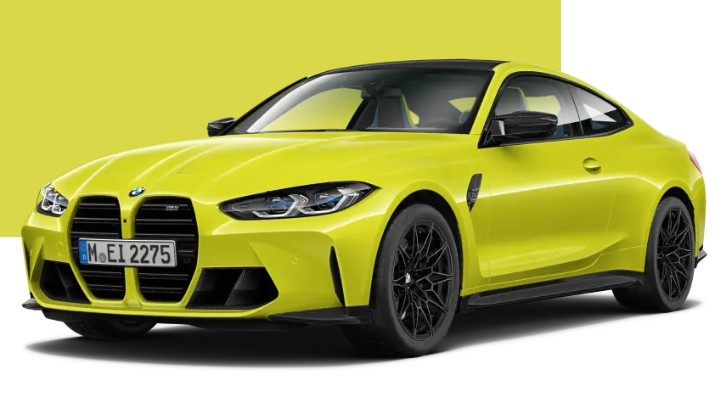
The BMW M4 weight is one of those specifications that looks simple until we start comparing different versions of the car. Ask how much a BMW M4 weighs and we could be talking about a relatively lean first-generation F82 coupe, a modern G82 Competition model with all-wheel drive, a convertible, or even the stripped-down M4 CSL.
Those cars wear the same M4 badge, but they do not sit on the scales equally.
As a quick reference, a modern BMW M4 Coupe weighs roughly 3,830 pounds (1,737 kg) in base form. The figure increases when we add an automatic transmission, M xDrive all-wheel drive, convertible hardware, or additional equipment. BMW's M4 CSL went in the opposite direction, cutting weight aggressively to achieve a DIN curb weight of about 1,625 kg (3,583 pounds).
So why should we care about a few hundred pounds when the M4 already has enormous power? Because weight influences almost everything a performance car does: acceleration, braking, steering response, tire wear, fuel consumption, and the way it changes direction.
Think of horsepower as muscle and weight as the backpack that muscle has to carry. More power certainly helps, but a lighter backpack makes every movement easier.
Content in this publication
- How Much Does a BMW M4 Weigh?
- What Does BMW M4 Curb Weight Mean?
- BMW M4 Weight in Pounds
- BMW M4 Weight in KG
- BMW M4 Weight by Generation
- BMW M4 Competition Weight
- BMW M4 xDrive Weight
- BMW M4 Convertible Weight
- BMW M4 CSL Weight
- BMW M4 CS Weight
- Why Is the New BMW M4 So Heavy?
- How BMW Reduces M4 Weight
- How Weight Affects BMW M4 Performance
- BMW M4 Weight Distribution
- Is the BMW M4 Too Heavy?
- BMW M4 Weight vs BMW M3
- BMW M4 Weight vs BMW M2
- BMW M4 Weight vs Porsche 911
- Can You Reduce the Weight of a BMW M4?
- Does BMW M4 Weight Affect Fuel Economy?
- Which BMW M4 Is the Lightest?
- Which BMW M4 Is the Heaviest?
- What Is the Best BMW M4 Weight for Daily Driving?
- Should BMW M4 Weight Influence Your Buying Decision?
- Final Thoughts on BMW M4 Weight
- FAQs About BMW M4 Weight
How Much Does a BMW M4 Weigh?
The short answer is that most BMW M4 models weigh somewhere between approximately 3,500 and 4,300 pounds, depending on generation and configuration.
For a current reference point, the standard modern M4 Coupe has a published base curb weight of approximately 3,830 pounds. The dramatically lighter M4 CSL weighs about 3,583 pounds, while the M4 Competition xDrive Convertible reaches approximately 4,306 pounds.
That gives us a surprisingly broad spread of more than 700 pounds within the extended M4 family.
A practical overview looks like this:
| BMW M4 Version | Approximate Weight |
|---|---|
| M4 Coupe | 3,830 lb / 1,737 kg |
| M4 CS | 3,902 lb / 1,770 kg |
| M4 CSL | 3,583 lb / 1,625 kg |
| M4 Competition xDrive Convertible | 4,306 lb / 1,953 kg |
| Earlier F82 M4 Coupe | Roughly 3,500–3,600 lb |
Exact numbers vary by market, model year, equipment, measurement standard, and optional features, so we should never treat a single M4 weight figure as universal.
What Does BMW M4 Curb Weight Mean?
Before comparing numbers, we need to understand the terminology.
Curb Weight Explained
Curb weight generally describes the weight of a vehicle in normal operating condition with its required fluids and standard equipment but without passengers or cargo.
Depending on the country and testing standard, fuel assumptions can differ. European specifications may also distinguish between DIN weight and EU weight, while American specifications commonly publish curb weight.
That is why we sometimes see two reputable websites quote slightly different BMW M4 weight numbers for what appears to be the same car.
They may not actually be measuring the same thing.
Curb Weight vs Gross Vehicle Weight
Curb weight should not be confused with gross vehicle weight.
Curb weight is essentially the car itself in ready-to-drive condition.
Gross vehicle weight includes the car plus occupants, luggage, and other payload up to the manufacturer's rated limit.
For performance discussions, curb weight is usually the more relevant measurement because it lets us compare one vehicle with another on reasonably equal terms.
BMW M4 Weight in Pounds
For readers in the United States, pounds are usually the most familiar measurement.
The base modern BMW M4 Coupe sits at about 3,830 pounds.
That might sound heavy compared with older sports cars, but today's M4 carries technology that performance coupes from two decades ago simply did not have.
We are talking about:
- sophisticated crash structures,
- adaptive suspension,
- large brakes,
- turbocharging hardware,
- advanced infotainment systems,
- electronic differentials,
- extensive sound insulation,
- powered luxury equipment,
- driver-assistance technology,
- and, on some versions, an all-wheel-drive system.
The modern M4 is essentially trying to be a sports car, luxury coupe, daily commuter, and track machine at the same time.
That versatility inevitably adds mass.
BMW M4 Weight in KG
Converting the common figures to kilograms gives us a useful international comparison.
A 3,830-pound M4 weighs approximately 1,737 kg.
The M4 CSL's official DIN curb weight is 1,625 kg, while the M4 Competition xDrive Convertible comes in at roughly 1,953 kg based on its 4,306-pound U.S. curb-weight figure.
That means the difference between a CSL and a heavily equipped convertible is more than 300 kg.
Imagine placing three average adults in the lighter car permanently. That gives us a rough visual representation of the difference.
BMW M4 Weight by Generation
The M4 has grown heavier over time, but the story is more complicated than simply saying newer equals worse.
F82 BMW M4 Weight
The first BMW M4 arrived for the 2015 model year after BMW separated the coupe version of the M3 into its own M4 nameplate.
The F82 M4 was notably lighter than today's G82.
Depending on specification and measurement method, an F82 coupe typically sits somewhere in the neighborhood of 3,500 to 3,600 pounds.
BMW used weight-saving materials extensively. The carbon-fiber-reinforced plastic roof became one of the most obvious visual examples, but lightweight engineering went deeper than the roof panel.
The F82 also benefited from being physically smaller and mechanically somewhat simpler than the current car.
Why the F82 Feels Light
Numbers only tell half the story.
The earlier M4 feels compact compared with the G82. Its dimensions, steering behavior, chassis tuning, and rear-wheel-drive layout create a sensation of lightness even when the scale says we are still driving a substantial luxury coupe.
That is why some enthusiasts prefer the F82 despite the newer car being faster.
Speed and sensation are not always the same thing.
G82 BMW M4 Weight
The current G82 generation is larger, more powerful, more rigid, and packed with additional equipment.
A base contemporary M4 Coupe weighs roughly 3,830 pounds.
On paper, that makes it significantly heavier than the original M4.
However, BMW compensated with more power, a wider track, enormous mechanical grip, sophisticated adaptive dampers, an active differential, and extensive chassis engineering.
The result is fascinating: the heavier car can often feel more planted and substantially faster even though there is more mass to control.
BMW M4 Competition Weight
The M4 Competition adds performance and, depending on configuration, some additional mass.
The Competition versions use BMW's turbocharged 3.0-liter inline-six paired with an eight-speed automatic transmission. Current rear-wheel-drive and xDrive Competition models sit above the basic manual M4 in both output and complexity.
We should therefore expect their weight to rise slightly.
Is that necessarily bad?
Not when the additional equipment produces substantially more usable performance.
The Competition model demonstrates why weight should never be judged in isolation. A car can gain pounds and simultaneously become quicker, more capable, and easier to drive rapidly.
BMW M4 xDrive Weight
Adding all-wheel drive inevitably introduces extra components.
An M xDrive system requires hardware such as:
- a transfer case,
- front driveshafts,
- additional differential components,
- extra axles,
- related electronics and controls.
Every component adds weight.
The M4 Competition xDrive therefore weighs more than its rear-wheel-drive counterpart.
Yet xDrive dramatically improves how effectively the car can deploy its power.
BMW currently quotes the M4 Competition xDrive Coupe at 523 horsepower, illustrating why extra traction matters in a car with this much output.
Instead of turning rear tires into smoke, the system helps convert more of that power into forward acceleration.
So we gain mass, but we also gain traction.
Does xDrive Make the M4 Feel Heavy?
Not as much as we might imagine.
BMW's M xDrive system is heavily rear-biased and designed around performance rather than simply bad-weather security.
On the road, the additional weight is partly disguised by explosive acceleration and immense grip.
Push harder on a circuit, though, and physics still keeps the receipts.
Extra mass eventually affects braking distances, tire temperatures, and direction changes.
BMW M4 Convertible Weight
This is where the scale really starts moving.
The M4 Competition xDrive Convertible has a curb weight of approximately 4,306 pounds according to BMW USA.
That is substantially heavier than the coupe.
Why?
Removing a fixed steel roof from a car sounds as though it should save weight. Unfortunately, the roof is an important structural element.
Once it disappears, engineers need to reinforce other areas of the chassis to maintain rigidity.
Then we add the folding roof mechanism itself.
Suddenly, our supposedly lighter open-top design becomes considerably heavier.
Where Does the Convertible's Extra Weight Come From?
The major contributors include structural reinforcement, roof motors, hinges, folding mechanisms, additional body hardware, and chassis changes designed to preserve rigidity.
The convertible also comes with xDrive in current M4 Competition specification in the U.S., adding another layer of mechanical complexity.
Still, driving roof-down with more than 500 horsepower under your right foot creates an experience numbers cannot fully capture.
Sometimes weight is a trade we willingly make.
BMW M4 CSL Weight
Now we reach the M4 that treats kilograms like enemies.
The BMW M4 CSL has an official DIN curb weight of 1,625 kg, or approximately 3,583 pounds. BMW also quotes a power-to-weight ratio of roughly 2.95 kg per horsepower.
That is extremely impressive for a modern front-engine BMW coupe.
How BMW Reduced M4 CSL Weight
BMW did not find one magical component and remove 100 kilograms. Instead, engineers attacked weight from dozens of directions.
The CSL uses lightweight components and removes equipment that would normally be expected in a road-going M4.
BMW fitted carbon-intensive components, lightweight bucket seats, carbon-ceramic brakes, and other specialized hardware while adopting a two-seat configuration.
It is the automotive equivalent of packing for a flight with only hand luggage. Anything that does not contribute directly to the mission gets questioned.
Why the CSL's Weight Matters So Much
Weight reduction affects multiple performance categories simultaneously.
A lighter car accelerates more easily.
Its brakes have less mass to slow.
Its tires have less inertia to control.
Its suspension has less body mass to manage through corners.
This creates a compounding benefit that simply adding horsepower cannot completely replicate.
BMW M4 CS Weight
The M4 CS sits between the regular Competition model and the extreme CSL.
A 2025 M4 CS has a listed curb weight of approximately 3,902 pounds.
That number may initially seem strange. Why does a performance-focused CS still weigh close to 3,900 pounds?
Because the CS retains greater everyday usability than the CSL while also incorporating xDrive.
It remains a four-seat road car rather than becoming a highly specialized two-seat machine.
That balance is precisely the point.
The CS attempts to deliver sharper responses without asking owners to sacrifice nearly everything that makes an M4 usable outside a racetrack.
Why Is the New BMW M4 So Heavy?
This question appears frequently whenever enthusiasts compare the G82 with previous M cars.
The easy answer is that modern cars keep getting bigger.
The better answer is that modern cars are expected to perform more jobs simultaneously.
Today's M4 must satisfy crash standards, emissions requirements, customer expectations, refinement targets, technology demands, and performance benchmarks that would have sounded absurd when earlier M3 generations were launched.
Safety Equipment Adds Mass
Modern vehicles contain extremely sophisticated structural systems.
High-strength steel, reinforced passenger cells, airbags, impact structures, sensors, cameras, and associated electronics all contribute weight.
We certainly want engineers to reduce mass, but very few owners would willingly trade modern crash protection just to save 150 pounds.
Luxury Adds Mass
Electric seats feel great until we place them on a scale.
So do premium audio systems, large infotainment displays, sound insulation, climate-control hardware, motors, wiring, and convenience electronics.
Luxury equipment adds up gram by gram until those grams become kilograms.
Performance Hardware Adds Mass Too
Ironically, faster cars often become heavier because the equipment required to control their performance also weighs more.
Larger brakes are heavier.
Wider wheels and tires are heavier.
Cooling systems become larger.
Transmissions must withstand more torque.
Drivetrain hardware becomes stronger.
Chassis reinforcement increases.
We add performance and then need more hardware to manage the performance we just added.
It becomes a mechanical snowball.
How BMW Reduces M4 Weight
BMW clearly understands that weight is an enemy of driving dynamics.
That is why the M4 uses lightweight materials strategically rather than simply constructing everything from traditional steel.
Carbon-Fiber Roof
One of the most recognizable M-car features is the carbon-fiber roof found on many coupe configurations.
BMW specifically notes that the carbon roof reduces overall weight while lowering the car's center of gravity.
The location of the weight savings matters almost as much as the amount.
Removing 10 pounds from the roof is more dynamically useful than removing 10 pounds near the floor because high-mounted mass has a stronger influence on body roll and the center of gravity.
Carbon Bucket Seats
Optional M Carbon bucket seats can reduce weight while providing much stronger lateral support.
They also change the character of the interior dramatically.
Climbing over their high side bolsters every morning may not be everyone's idea of luxury, but on a winding road they make perfect sense.
Carbon-Ceramic Brakes
Carbon-ceramic brakes can reduce unsprung and rotating mass compared with conventional heavy brake hardware.
BMW equips the M4 CSL with carbon-ceramic brakes as standard and explicitly highlights their weight-optimized design.
That type of weight reduction can be especially valuable because it affects components moving with the suspension and wheels.
How Weight Affects BMW M4 Performance
We can have endless arguments about whether 3,800 pounds is "too heavy," but the more useful question is how that weight affects the driving experience.
Acceleration
Newton never drove an M4, but his laws remain involved.
The more mass an engine has to accelerate, the more work it must perform.
However, traction matters too.
That is why a heavier M4 Competition xDrive can accelerate faster than a lighter rear-wheel-drive version. BMW lists the current M4 Competition xDrive Coupe at a remarkably quick 3.4-second 0–60 mph time, while the base M4 Coupe is listed at 4.1 seconds.
More weight, yet faster acceleration.
Physics has not been defeated; engineers have simply optimized another part of the equation.
Braking
Weight becomes far harder to hide under braking.
Every extra pound represents additional kinetic energy the braking system must dissipate.
This is one reason high-performance M4 variants receive enormous braking hardware.
A heavy, powerful car repeatedly slowing from track speeds generates astonishing amounts of heat.
Cornering
Weight influences how eagerly a car changes direction.
A lighter vehicle can feel delicate and immediate. A heavier vehicle tends to require more sophisticated suspension tuning and more tire to generate similar responsiveness.
BMW's chassis engineers have become extraordinarily good at hiding mass, but they cannot delete physics through software.
Tire Wear
More mass means greater loads on the tires.
Add aggressive alignment, more than 500 horsepower, and enthusiastic driving, and rear tires can disappear with alarming enthusiasm.
M4 ownership and inexpensive tires are not natural companions.
BMW M4 Weight Distribution
Raw curb weight tells us how much mass exists, but distribution tells us where that mass sits.
BMW has traditionally paid close attention to front-to-rear balance in its performance cars.
A well-balanced chassis distributes loads more predictably during acceleration, braking, and cornering.
That helps explain why an M4 can feel surprisingly composed despite being considerably heavier than lightweight sports cars.
Weight distribution is like carrying groceries.
Thirty pounds balanced between both hands feels much easier to control than the same 30 pounds hanging entirely from one side.
The total weight has not changed, but the way we manage it certainly has.
Is the BMW M4 Too Heavy?
For some enthusiasts, yes.
For others, absolutely not.
Everything depends on what we expect from the car.
If our definition of a perfect sports car is a minimalist 2,600-pound machine with hydraulic steering and almost no sound insulation, the M4 will seem enormous.
But that comparison misses the M4's broader mission.
This is a car capable of running brutally fast laps, carrying four people, commuting comfortably, surviving winter weather in xDrive form, swallowing luggage, and cruising quietly for hundreds of miles.
Very few lightweight sports cars can do all of those things.
Weight becomes the price of versatility.
BMW M4 Weight vs BMW M3
The modern M3 Sedan and M4 Coupe share an enormous amount mechanically, so their weight figures are much closer than many shoppers expect.
Choosing the M4 does not suddenly transform the platform into a featherweight sports car.
The major difference is body style and character.
The M3 gives us four doors and a more traditional sports-sedan profile.
The M4 provides the lower, wider visual drama of a coupe.
For most buyers, deciding between them should involve practicality and styling more than obsessing over a tiny curb-weight difference.
BMW M4 Weight vs BMW M2
The BMW M2 is smaller, but it is not dramatically lightweight by traditional sports-car standards either.
Modern safety requirements, powerful turbocharged engines, substantial cooling systems, and luxury equipment affect the entire BMW M family.
Still, the M2's shorter dimensions can make it feel more compact and playful.
The M4 counters with greater stability, refinement, interior space, and high-speed composure.
Would we rather have a terrier or a greyhound?
Both are fast. They simply express speed differently.
BMW M4 Weight vs Porsche 911
The Porsche 911 often highlights the philosophical difference between a dedicated sports car and a high-performance luxury coupe.
Many 911 configurations weigh less than equivalent M4 variants, and that lower mass contributes to the Porsche's famously responsive character.
The BMW fights back with significantly different practicality.
An M4 offers meaningful rear-seat usefulness, a generous trunk, and grand-touring comfort.
The Porsche is more specialized.
Again, weight tells us something important, but it does not tell us which car is objectively better.
Can You Reduce the Weight of a BMW M4?
Yes, although serious weight reduction becomes expensive surprisingly quickly.
Owners chasing lower mass can focus on several areas:
- lightweight forged wheels,
- carbon bucket seats,
- lighter exhaust components,
- carbon body panels,
- reduced interior trim,
- lighter batteries where appropriate,
- carbon-ceramic brake systems,
- removal of unnecessary track-day equipment from the cabin.
However, we should approach modifications intelligently.
Removing comfortable seats, insulation, and interior components from a daily-driven M4 might save dozens of pounds while making the car considerably worse during the other 99% of its life.
A better strategy is usually reducing unsprung and rotating mass first.
Why Lightweight Wheels Matter
A lighter wheel does more than reduce curb weight.
The suspension must move it vertically, the brakes must slow its rotation, and the engine must accelerate it.
Consequently, reducing wheel mass can improve several sensations at once.
That is why a quality lightweight wheel can sometimes make a car feel more responsive than its modest scale reduction would suggest.
Does BMW M4 Weight Affect Fuel Economy?
Absolutely.
All else being equal, moving more mass requires more energy.
City driving exposes the effect particularly clearly because the car repeatedly accelerates from low speeds.
Highway driving reduces the relative importance of weight because aerodynamic drag becomes the dominant enemy.
Of course, nobody buys an M4 because it is the obvious solution to saving fuel.
Still, weight remains part of the efficiency equation.
Which BMW M4 Is the Lightest?
Among the modern G82-generation road cars, the BMW M4 CSL is the obvious lightweight champion.
At an official DIN curb weight of 1,625 kg, BMW engineered it specifically around weight reduction and track performance.
The CSL is dramatically more focused than the regular M4.
It has two seats, specialized carbon components, aggressive chassis tuning, and far fewer concessions to everyday luxury.
For collectors and track enthusiasts, that purity is exactly the appeal.
For commuting through traffic every morning?
A standard M4 might actually be the smarter choice.
Which BMW M4 Is the Heaviest?
The M4 Competition xDrive Convertible sits at the heavy end of the mainstream M4 spectrum, with BMW USA listing a curb weight of 4,306 pounds.
Its weight comes from several directions at once:
all-wheel drive, structural reinforcement, roof hardware, luxury equipment, performance components, and modern safety technology.
Yet it still offers extraordinary performance.
That tells us something important about modern engineering: a car can weigh more than two tons and still accelerate and corner at speeds that would embarrass exotic cars from previous generations.
What Is the Best BMW M4 Weight for Daily Driving?
Probably not the lightest one.
That sounds counterintuitive, but hear us out.
The CSL is the weight champion because BMW deliberately removed some of the comfort and practicality that makes the standard car such a strong daily driver.
For normal roads, a regular M4 Coupe or Competition Coupe represents a better compromise.
We retain rear seats, comfort features, insulation, and everyday usability while still driving something extraordinarily capable.
The xDrive model makes even more sense for drivers living in wet or snowy climates, despite its additional weight.
Sometimes adding 100 pounds can make a car more useful 365 days a year.
Should BMW M4 Weight Influence Your Buying Decision?
Yes, but it should not dominate the decision.
When shopping for an M4, we should consider weight alongside:
- drivetrain,
- transmission,
- power output,
- suspension setup,
- intended use,
- climate,
- running costs,
- seating requirements,
- and driving personality.
Someone buying a weekend canyon car may value the lighter manual rear-wheel-drive M4.
A driver wanting maximum acceleration may prefer the heavier Competition xDrive.
A track-focused enthusiast might chase a CS or CSL.
Another buyer may happily accept the convertible's extra mass in exchange for open-air driving.
There is no universally correct M4 weight because there is no universally correct way to enjoy an M4.
Final Thoughts on BMW M4 Weight
The BMW M4 weight varies dramatically depending on which version we place on the scales. A standard contemporary M4 Coupe weighs around 3,830 pounds, the track-focused M4 CSL drops to approximately 3,583 pounds, and the M4 Competition xDrive Convertible reaches about 4,306 pounds.
Yes, the M4 has become heavier than its predecessors.
But focusing exclusively on that number ignores what the modern car can accomplish.
Today's M4 combines supercar-like acceleration, sophisticated chassis control, serious track capability, everyday comfort, advanced safety technology, and real practicality. BMW uses carbon fiber, lightweight brakes, carefully positioned materials, and clever engineering to keep that mass under control.
Would we love to see an M4 lose another 300 pounds without sacrificing anything?
Of course.
Every performance enthusiast would.
But until engineering discovers a way to make luxury, safety, structural rigidity, and all-wheel-drive hardware weigh nothing, every modern performance car will live somewhere between lightweight purity and real-world usability.
The M4 simply chooses to stand very close to the middle—and then gives us enough horsepower to make the scale seem considerably less important.
FAQs About BMW M4 Weight
1. How much does a BMW M4 weigh?
A modern BMW M4 Coupe weighs approximately 3,830 pounds (1,737 kg) in base form, although the exact figure varies according to transmission, drivetrain, equipment, body style, and model year.
2. How much does a BMW M4 Competition weigh?
The M4 Competition generally weighs more than the standard manual M4 because of its automatic transmission and, in xDrive form, additional all-wheel-drive hardware. Exact curb weight differs by market and model year, so the relevant specification sheet should always be checked for the individual vehicle.
3. How much does the BMW M4 CSL weigh?
BMW quotes a DIN curb weight of 1,625 kg, which is approximately 3,583 pounds, for the M4 CSL. Its extensive lightweight construction makes it one of the lightest G82-generation M4 variants.
4. Why does the BMW M4 Convertible weigh more than the Coupe?
The convertible requires additional structural reinforcement plus a folding roof mechanism, motors, hinges, and related hardware. The current M4 Competition xDrive Convertible weighs approximately 4,306 pounds according to BMW USA.
5. Does BMW M4 weight affect performance?
Yes. Weight influences acceleration, braking, cornering, tire wear, and fuel consumption. However, drivetrain technology can compensate in some areas. For example, the heavier M4 Competition xDrive uses its additional traction to achieve faster acceleration than the lighter rear-wheel-drive base M4.
If you want to know other articles similar to BMW M4 Weight: Curb Weight, Generations and Why It Matters you can visit the category Service and Parts.
Nissan Qashqai Fuel Tank Capacity: Complete Guide

Suzuki Swift Fuel Tank Capacity: Complete Guide
Mazda CX-5 Weight (2013–2026): Complete Guide in Pounds and KG

Kia Sportage Dashboard Symbols and Warning Lights

MINI Cooper Weight (2002–2027): Complete Weight Chart & Guide

Toyota RAV4 Engine Sizes: Complete Guide (1994–2026)
Leave a Reply
More content of your interest