
Kia Carnival Full Details: Specs, Features, Engines, Space, and Everything You Need to Know

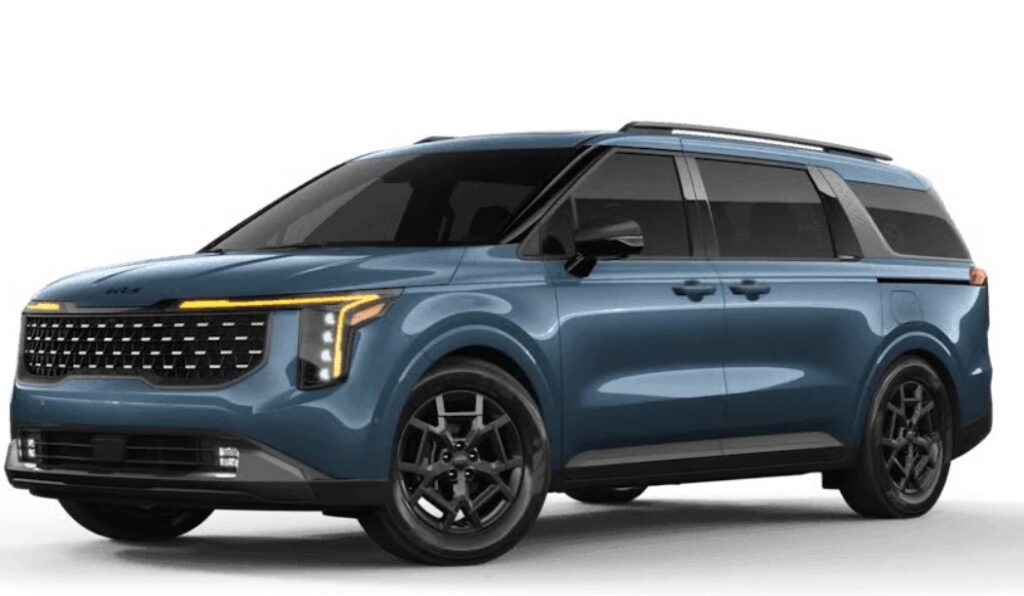
If you're searching for Kia Carnival full details, chances are you don't just want horsepower figures and a list of dimensions. You probably want to know what the Carnival is actually like to own, how much room it offers, which engine makes sense, whether the hybrid is worth considering, and whether this big family hauler can replace an SUV.
That's where the Carnival gets interesting.
Kia calls it an MPV—Multi-Purpose Vehicle—and that's a pretty accurate description. It combines the sliding doors and huge interior of a minivan with styling designed to resemble a large SUV. In other words, it tries to give us the practicality of a family shuttle without making us feel as though we're driving an airport transfer van.
And for the current generation, Kia has doubled down on that idea. Depending on market and model year, the Carnival can be offered with gasoline, diesel, or turbo-hybrid power, seating configurations ranging from luxurious seven-seat layouts to high-capacity versions, and an increasingly sophisticated collection of screens, cameras, safety technology, and comfort features.
Let's unpack the entire package.
Content in this publication
- Kia Carnival Full Details at a Glance
- What Type of Vehicle Is the Kia Carnival?
- Kia Carnival Exterior Design
- Kia Carnival Dimensions
- Kia Carnival Interior
- Kia Carnival Seating Capacity
- Kia Carnival Cargo Space
- Kia Carnival Engine Options
- Kia Carnival Hybrid Details
- Kia Carnival Transmission
- Kia Carnival Fuel Economy
- Kia Carnival Driving Experience
- Kia Carnival Technology
- Kia Carnival Safety Features
- Kia Carnival Family-Friendly Features
- Kia Carnival Towing Capacity
- Kia Carnival Trim Levels
- Kia Carnival Reliability
- Kia Carnival Maintenance
- Kia Carnival Pros and Cons
- Kia Carnival vs a Three-Row SUV
- Who Should Buy a Kia Carnival?
- Is the Kia Carnival Worth Buying?
- Which Kia Carnival Should We Choose?
- Final Thoughts: Kia Carnival Full Details Explained
- Frequently Asked Questions
Kia Carnival Full Details at a Glance
The modern Carnival is a large front-engine MPV built primarily around passenger comfort and interior flexibility. Although exact specifications vary significantly between countries, the current global Carnival is approximately 5.15 metres long, 1.995 metres wide, and rides on a substantial 3.09-metre wheelbase. Kia's Korean specifications list a length of 5,155 mm and wheelbase of 3,090 mm, which helps explain why the cabin feels enormous.
In markets such as the United States, the 2026 Carnival is available with a 3.5-litre V6 producing 287 hp and 260 lb-ft of torque. A turbo-hybrid version is also available, targeting buyers who want significantly better fuel economy without giving up the Carnival's basic practicality.
Broadly speaking, the Carnival offers:
- Three-row passenger accommodation
- Sliding rear doors
- Multiple seating arrangements
- Large cargo capacity
- Available gasoline, diesel, and hybrid power depending on market
- Extensive driver-assistance technology
- Large infotainment displays
- Available premium second-row seating
- SUV-inspired exterior styling
- Front-wheel-drive layouts in many markets
That combination is why the Carnival sits in an unusual sweet spot. It is less fashionable than a traditional SUV on paper, perhaps, but far more useful when people and luggage actually enter the equation.
What Type of Vehicle Is the Kia Carnival?
MPV Practicality With SUV Styling
Technically, the Carnival is an MPV or minivan-style vehicle rather than an SUV.
The distinction matters.
An SUV normally prioritizes higher ground clearance, available all-wheel drive, towing ability, and some degree of rough-road capability. The Carnival prioritizes interior volume, passenger access, low loading height, and road comfort.
Its sliding rear doors alone change the experience dramatically.
Try getting a toddler into a child seat in a narrow parking space using a conventional SUV door. Now imagine pressing a button and watching a huge sliding opening appear beside the seat.
That's the Carnival's party trick.
It may look SUV-like from across the parking lot, but underneath the styling lives a vehicle designed around families.
Is the Carnival a Minivan?
Essentially, yes.
Kia prefers the term MPV, partly because "minivan" does not exactly scream adventure and prestige. Yet from a functional perspective, the Carnival competes with vehicles such as the Toyota Sienna, Honda Odyssey, Chrysler Pacifica, and other large people movers.
We wouldn't get too hung up on the label. What matters is what it does.
And what it does very well is carry people.
Kia Carnival Exterior Design
The current Carnival uses a boxy, upright shape that intentionally borrows visual cues from SUVs.
The front end is broad, the bonnet appears more substantial than those of traditional minivans, and the roofline stays relatively flat to maximize passenger space. Newer versions also feature Kia's increasingly distinctive lighting signatures and more angular detailing.
From certain angles, it almost looks like a large crossover that just happens to have sliding doors.
Why the Boxy Shape Actually Helps
That square profile isn't merely styling theater.
A straighter roofline creates better third-row headroom. A wide body provides usable shoulder room. A long wheelbase opens up more legroom, while the nearly vertical rear section helps maximize cargo volume.
In family cars, boring geometry often creates brilliant usability.
Kia Carnival Dimensions
Dimensions differ slightly depending on trim, tyres, roof rails, and market specification, but Kia's global documentation lists the current Carnival at approximately:
| Measurement | Approximate Figure |
|---|---|
| Length | 5,155 mm |
| Width | 1,995 mm |
| Wheelbase | 3,090 mm |
| Height | About 1,740–1,785 mm |
| Seating | 7, 8, 9 or 11 depending on market |
| Tyres | Commonly 17, 18 or 19 inches depending on version |
Kia's documentation lists 17-, 18-, and 19-inch tyre configurations in some international markets.
These numbers tell us something important: this is not a small vehicle.
At more than five metres long, parking takes some awareness. Thankfully, higher trims can offset the Carnival's size with parking sensors, surround-view cameras, and other assistance systems.
Kia Carnival Interior
A Cabin Designed Around Passengers
If the exterior is designed to convince us the Carnival is cool, the interior is where Kia stops pretending.
This thing is built for families.
The cabin emphasizes horizontal space, broad storage areas, numerous cup holders, multiple charging points, wide rear access, and flexible seating.
The dashboard of newer models has also become dramatically more sophisticated, with available panoramic-style digital displays stretching across the driver's side of the cabin.
In U.S.-spec 2026 versions, Kia offers a 12.3-inch touchscreen on lower hybrid grades and dual 12.3-inch panoramic displays on higher trims.
Interior Quality
Recent Carnivals can feel surprisingly upscale.
No, we wouldn't confuse one with a Mercedes-Benz V-Class after five minutes of poking around the cabin. But higher Carnival trims can include leather seating, premium audio, digital rear-view mirrors, ambient-style technology, heated features, head-up displays, and luxury-focused second-row seating.
That's quite a leap from the old-school minivan formula.
Kia Carnival Seating Capacity
One of the most important Carnival details is also one of the most confusing because the seating configuration changes from market to market.
Depending on where the vehicle is sold, versions may accommodate seven, eight, nine, or even eleven occupants.
Kia's international documentation, for example, references seven-, eight-, and eleven-seat configurations.
Seven-Seat Carnival
Seven-seat versions may prioritize comfort.
Some markets offer luxurious second-row individual seats with relaxation functions. These are the chairs you want if someone else is driving.
Imagine business-class airline seating installed inside a family vehicle. That's roughly the concept.
Eight-Seat Carnival
For many families, eight seats provide the sweet spot.
You retain a usable middle position while preserving excellent overall passenger capacity. Depending on configuration, second-row seats can also provide different sliding or removal functions.
Nine- and Eleven-Seat Versions
High-capacity models are more market-specific and may target commercial transport, large families, or regions where MPVs are widely used as shuttle vehicles.
Always check the exact specification offered locally rather than assuming every Carnival configuration is available everywhere.
Kia Carnival Cargo Space
Cargo space is one of the Carnival's strongest arguments against large SUVs.
Kia's international documentation lists minimum luggage volume of roughly 627 litres behind the third row in seven- and eight-seat configurations under its VDA measurement methodology. Depending on seating configuration, maximum capacity can exceed 2,800 litres.
That is serious room.
Cargo Space With All Seats in Use
Even with passengers occupying all three rows, the Carnival retains a useful luggage area.
That's where it starts beating many seven-seat SUVs.
Some SUVs technically seat seven, but once that third row rises from the floor, the luggage compartment shrinks into something resembling a large grocery shelf.
The Carnival was designed around three-row use from the beginning.
Cargo Space With Seats Folded or Removed
Reconfigure the rear seating and the vehicle becomes almost van-like.
Large boxes, bicycles, luggage, baby gear, camping equipment, flat-pack furniture—the Carnival can swallow the sort of awkward cargo that turns an ordinary crossover into a three-dimensional puzzle.
Kia Carnival Engine Options
Engine availability depends heavily on country.
Across global markets, Carnival powertrains can include:
3.5-Litre V6 Gasoline Engine
In the United States, the 2026 Carnival gasoline model uses a 3.5-litre V6 producing 287 horsepower and 260 lb-ft of torque.
This engine suits the Carnival's personality.
It is smooth, naturally aspirated, and strong enough to move a fully loaded vehicle without feeling breathless.
You may be interested in reading Leapmotor C10 Insurance Group: Costs, Ratings and What UK Drivers Should Know
The downside?
Fuel consumption.
A large V6 pulling a large body through the air is never going to sip fuel like a compact hybrid.
Kia Carnival Diesel Engine
Diesel engines have historically been important to the Carnival in several international markets.
Their appeal is straightforward: strong low-end torque and potentially good highway fuel efficiency.
For buyers covering huge annual distances, towing, or carrying heavy passenger loads, diesel can make a lot of sense where it remains available.
However, diesel availability has become increasingly market-dependent, so buyers should check current local specifications.
Kia Carnival Hybrid Details
The Carnival Hybrid represents one of the most significant developments in the model's recent history.
Rather than using the large naturally aspirated V6, the hybrid combines a smaller turbocharged gasoline engine with electric assistance.
For the 2026 U.S. Carnival Hybrid, Kia advertises 271 lb-ft of torque and an estimated 32 mpg combined.
Why the Hybrid Matters
Large family vehicles often spend their lives doing exactly the kind of driving hybrids handle well:
school runs, traffic, suburban trips, errands, stop-start commuting, and low-speed urban driving.
That's where regenerative braking and electric assistance can reduce fuel usage substantially compared with a conventional large gasoline engine.
Is the Carnival Hybrid Slow?
Not necessarily.
The hybrid isn't trying to transform the Carnival into a sports car, but electric torque gives it useful low-speed response. The powertrain feels designed around efficiency and effortless daily driving rather than outright acceleration.
And that's exactly where a family MPV should focus.
Kia Carnival Transmission
The conventional gasoline Carnival commonly uses an eight-speed automatic transmission.
Its job is fairly simple: keep the V6 within a useful portion of its rev range while preserving smoothness.
The hybrid uses a different electrified drivetrain arrangement suited to its turbocharged gasoline-electric powertrain.
Neither version is designed to deliver sports-car drama.
That's a compliment.
In a vehicle full of sleeping children, drinks, phones, luggage, and perhaps an impatient grandparent, smooth beats theatrical every time.
Kia Carnival Fuel Economy
Fuel consumption varies considerably depending on engine, market, driving environment, wheel size, and vehicle load.
For context, Kia advertises the 2026 U.S. gasoline Carnival at up to an EPA-estimated 25 mpg highway, while the hybrid is rated around 32 mpg combined.
The real-world difference can become meaningful if we drive 15,000 or 20,000 miles per year.
Gasoline vs Hybrid Fuel Economy
The gasoline V6 may suit buyers who value simplicity, stronger traditional engine character, or lower initial cost.
The hybrid becomes increasingly attractive when:
- Most driving happens in cities
- Fuel is expensive
- Annual mileage is high
- The vehicle frequently encounters stop-start traffic
- You expect to keep it for several years
Highway-heavy drivers may see a smaller percentage advantage because conventional engines operate relatively efficiently at steady speeds.
Kia Carnival Driving Experience
Nobody buys a Carnival because they wake up craving apexes and steering feedback.
Yet it drives better than its size might suggest.
Ride Comfort
Comfort is central to the experience.
The long wheelbase and passenger-oriented suspension can give the Carnival a relaxed, settled ride, particularly on long highway journeys.
Larger wheels may slightly sharpen impacts over rough pavement, so buyers who prioritize pure comfort shouldn't automatically assume the biggest wheels are best.
Handling
The Carnival is stable and predictable rather than exciting.
Its relatively low passenger-floor architecture can make it feel more car-like than a tall body-on-frame SUV.
There is still body movement—physics hasn't retired—but the vehicle doesn't need to feel clumsy.
Steering
Steering is generally light enough for parking and urban use.
That's important because the Carnival's footprint becomes very obvious when entering tight underground car parks.
Kia Carnival Technology
Technology has become one of the Carnival's biggest selling points.
Depending on trim, features may include:
- Large touchscreen infotainment
- Digital instrument cluster
- Wireless Apple CarPlay
- Wireless Android Auto
- Multiple USB charging ports
- Wireless phone charging
- Navigation
- Kia connected services
- Head-up display
- Digital rear-view mirror
- Surround-view camera system
- Bose premium audio
- Rear passenger monitoring
- Passenger communication features
Kia's 2026 feature guide confirms wireless Apple CarPlay and wireless Android Auto availability, along with features such as Quiet Mode, which can mute rear speakers while allowing front occupants to continue listening to audio.
Passenger View Camera
This is one of those features that sounds gimmicky until we actually have children.
Available versions let the driver monitor rear occupants through an in-cabin camera rather than twisting around in the seat.
Higher U.S. trims also offer Passenger View and Passenger Talk functionality.
Kia Carnival Safety Features
Modern Carnivals can be packed with active safety technology.
Depending on trim and market, equipment may include:
- Forward Collision-Avoidance Assist
- Pedestrian detection
- Cyclist detection
- Junction assistance
- Blind-Spot Collision-Avoidance Assist
- Rear Cross-Traffic Collision-Avoidance Assist
- Lane-keeping technology
- Adaptive cruise control
- Parking sensors
- Surround-view monitoring
- Reverse parking collision avoidance
Kia documents Forward Collision-Avoidance Assist as being capable, when equipped, of detecting vehicles, powered two-wheelers, pedestrians, and cyclists and assisting with braking when a collision risk is identified.
Blind-spot technology can warn the driver about vehicles approaching from behind, while Rear Cross-Traffic Collision-Avoidance Assist can provide warnings and braking intervention in certain reversing situations.
Safety Systems Are Assistance, Not Autopilot
This deserves emphasis.
Driver-assistance systems can reduce risk, but they aren't substitutes for attention.
Cameras can be obscured. Radar has limitations. Weather can interfere with sensors.
Think of the technology as an extra pair of eyes—not a replacement brain.
Kia Carnival Family-Friendly Features
The Carnival's strongest features aren't always the ones that dominate brochures.
Parents may care more about sliding doors than horsepower.
Useful family features can include power sliding doors, rear sunshades, numerous cup holders, multiple charging ports, child-seat anchors, easily accessible rear seating, passenger cameras, and configurable climate controls.
Power Sliding Doors
Once you live with power sliding doors, ordinary rear doors can feel strangely primitive.
They make school drop-offs easier, reduce parking-lot door dings, and improve access when carrying bags or children.
Third-Row Access
Compared with many SUVs, accessing the Carnival's third row can be significantly easier thanks to its large side openings and purpose-built seating layout.
Kia Carnival Towing Capacity
Towing capacity varies by powertrain and market, so this is an area where buyers should never rely on one universal Carnival number.
For example, Kia's 2026 U.S. hybrid documentation lists towing limits that can differ depending on trailer braking equipment.
The broader lesson is simple: verify the owner's manual and certification information for your exact model, engine, trim, and destination market before towing.
The Carnival can tow modest recreational loads in suitable configurations, but if heavy towing is your priority, a body-on-frame SUV or pickup remains the more natural tool.
You may be interested in readingLeapmotor C10 Insurance Group: Costs, Ratings and What UK Drivers Should KnowYou may be interested in reading
Leapmotor C10 Reliability: Is It a Dependable SUV?Kia Carnival Trim Levels
Trim names differ by country.
In the United States, recent Carnival versions have included grades such as LXS, EX, SX, and SX Prestige, while other markets use completely different naming systems.
For the 2026 U.S. Carnival Hybrid, Kia lists:
LXS
The entry hybrid trim already includes eight-passenger seating and a 12.3-inch touchscreen.
EX
EX adds more convenience equipment, including features such as a smart power liftgate, roof rails, power front seats, driver's memory, passenger monitoring, and rear sunshades in the U.S. configuration.
SX
SX pushes further into technology territory with dual panoramic displays and available advanced viewing systems.
SX Prestige
This is the luxury-oriented version.
Features can include leather upholstery, premium Bose audio, a heated steering wheel, head-up display, digital rear-view mirror, and upscale appearance treatments.
Kia Carnival Reliability
The Carnival uses relatively mainstream Kia mechanical systems, but reliability depends greatly on powertrain, maintenance history, model year, and driving conditions.
When shopping used, we would pay particular attention to:
- Complete service history
- Transmission behaviour
- Electronic sliding-door operation
- Infotainment functionality
- Camera and sensor operation
- Suspension noises
- Battery condition
- Air-conditioning performance throughout the cabin
- Recalls or service campaigns
- Signs of commercial or shuttle use
A seven-seat vehicle used by one family can have had a very different life from an identical-looking example that spent three years carrying passengers commercially.
Kia Carnival Maintenance
Maintenance requirements vary by engine.
Typical items include engine oil and filter changes, brake inspections, tyre rotation, coolant checks, transmission inspection, cabin filters, air filters, and periodic replacement of wear components.
Hybrid versions add electrified components but still contain a gasoline engine that needs conventional maintenance.
Are Carnival Running Costs High?
Relative to compact cars? Yes.
Relative to large premium SUVs? Often no.
Tyres are large, there's more bodywork, brakes have a substantial vehicle to stop, and a V6 naturally uses more fuel.
Yet the Carnival can offer impressive practicality per dollar because buyers may avoid paying the premium attached to a similarly spacious luxury SUV.
Kia Carnival Pros and Cons
The Carnival makes the most sense when we evaluate it according to what it was designed to do.
| Pros | Cons |
|---|---|
| Excellent passenger space | Large exterior dimensions |
| Huge cargo flexibility | No serious off-road ability |
| Easy-access sliding doors | V6 fuel consumption can be substantial |
| Available hybrid efficiency | Some luxury features restricted to expensive trims |
| Strong technology offering | Market specifications vary considerably |
| Comfortable family-focused cabin | Styling still won't convince everyone who wants an SUV |
| Useful third row | Heavy towing isn't its specialty |
| Premium features available | Parking can require care |
Kia Carnival vs a Three-Row SUV
Here's the question many buyers eventually face.
Should we buy the Carnival or a three-row SUV?
Choose the Carnival If…
You regularly carry more than five people.
You use child seats.
You need genuine cargo room behind the third row.
You value sliding doors.
You take long family road trips.
You want maximum cabin efficiency.
Choose an SUV If…
You need all-wheel-drive capability unavailable on your local Carnival.
You regularly drive rough tracks.
You need substantial ground clearance.
You tow heavy trailers.
Or you simply prefer the SUV driving position and styling enough to accept reduced interior efficiency.
There is no universal winner.
But purely as a people-moving machine, the Carnival is brutally difficult for many SUVs to beat.
Who Should Buy a Kia Carnival?
The Carnival makes particular sense for:
- Families with three or more children
- Parents frequently using child seats
- Multi-generational households
- Road-trip enthusiasts
- Hotel and shuttle operators
- Buyers needing both passenger and cargo versatility
- People considering a three-row SUV primarily because they need space
- Drivers wanting a more efficient large family vehicle when the hybrid is available
It can also work surprisingly well for couples who rarely carry passengers but frequently transport bikes, camping equipment, or large amounts of gear.
Is the Kia Carnival Worth Buying?
For the right buyer, absolutely.
Its greatest strength isn't one dazzling specification.
It's the way everything works together.
The long wheelbase creates space. Sliding doors make that space accessible. Flexible seating turns passenger room into cargo room. Modern cameras help manage the vehicle's size. Hybrid technology can reduce one of the traditional weaknesses of large MPVs: fuel consumption.
The result feels like a Swiss Army knife on wheels.
Not glamorous in the traditional sports-car sense, perhaps.
But incredibly useful.
Which Kia Carnival Should We Choose?
If budget matters most, a well-equipped mid-range gasoline Carnival can offer excellent value.
If annual mileage is high or most driving happens around town, the hybrid deserves serious consideration.
If passengers regularly occupy the second row for long journeys, premium seating and higher trims become much easier to justify.
And if we're buying used?
Condition matters more than badges.
A meticulously maintained lower trim is a better purchase than a neglected flagship covered in shiny gadgets.
Final Thoughts: Kia Carnival Full Details Explained
When we look at the Kia Carnival full details, one theme appears repeatedly: space without unnecessary compromise.
The Carnival isn't trying to climb mountains. It isn't pretending to be a sports car. It isn't designed to tow enormous caravans through muddy fields.
Instead, it focuses relentlessly on something far more relevant to everyday families—moving people and their stuff comfortably.
Current versions add sophisticated infotainment, extensive safety technology, upscale interior options, and—in selected markets—a highly appealing hybrid powertrain.
The conventional V6 still makes sense for drivers who prefer straightforward gasoline performance, while diesel versions remain attractive in markets where they're sold. The hybrid, meanwhile, addresses fuel economy without throwing away the vehicle's core strengths.
Would we choose one instead of a three-row SUV?
If our lifestyle revolved around children, luggage, road trips, school runs, airports, grandparents, sports equipment, and crowded parking lots, we'd find the Carnival very difficult to ignore.
Sometimes practicality isn't boring.
Sometimes it's freedom.
Frequently Asked Questions
1. How many people can the Kia Carnival seat?
Depending on the market and configuration, the Carnival may be offered with seven, eight, nine, or even eleven seats. Seven- and eight-seat versions are particularly common in passenger-focused markets, while higher-capacity configurations may be offered elsewhere.
2. Is the Kia Carnival an SUV or minivan?
The Carnival is technically an MPV or minivan-style vehicle. Kia gives it SUV-inspired styling, but its sliding rear doors, low passenger floor, three-row layout, and emphasis on cabin space make it fundamentally a people mover.
3. Does the Kia Carnival come as a hybrid?
Yes. Current Carnival ranges in selected markets include a turbo-hybrid powertrain. In the U.S., Kia advertises the 2026 Carnival Hybrid with 271 lb-ft of torque and approximately 32 mpg combined.
4. How big is the Kia Carnival?
Current global specifications place the Carnival at roughly 5,155 mm long and 1,995 mm wide, with a 3,090 mm wheelbase. Exact height varies depending on configuration and equipment.
You may be interested in readingLeapmotor C10 Insurance Group: Costs, Ratings and What UK Drivers Should KnowYou may be interested in reading
Leapmotor C10 Reliability: Is It a Dependable SUV?You may be interested in reading
 BMW M2 Reliability: How Dependable Is BMW’s Small M Car?
5. Is the Kia Carnival good for large families?
Yes. In fact, that's arguably its greatest strength. Sliding doors, flexible three-row seating, substantial cargo capacity, family-focused technology, and available passenger monitoring make the Carnival particularly well suited to large families.
If you want to know other articles similar to Kia Carnival Full Details: Specs, Features, Engines, Space, and Everything You Need to Know you can visit the category Blog.
Volvo S90 Reliability: Problems, Costs & Best Years
Is Haval Jolion a Good Car? Honest Review, Reliability, Pros and Cons
How to Start Haval Jolion With Spare Key: Complete Guide
How to Calculate Per Diem on an Auto Loan

How to Calculate the Residual Value of a Car

Is the Honda Passport Selling Well? Sales Numbers Tell the Story
Leave a Reply
More content of your interest