
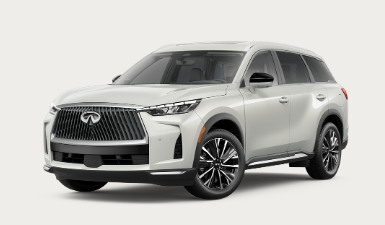
Infiniti QX60 vs Nissan Pathfinder: Luxury or Practicality?

The Infiniti QX60 vs Nissan Pathfinder comparison is more interesting than it first appears. Park them next to each other and we see two three-row SUVs with similar dimensions, family-friendly layouts, available all-wheel drive, and enough towing ability for a weekend escape. Dig deeper, though, and their personalities begin moving in different directions.
The Pathfinder is the practical adventurer. It focuses on passenger capacity, cargo flexibility, straightforward controls, and strong value. The QX60 takes the same basic family-SUV idea and dresses it for dinner: richer materials, quieter road manners, more elaborate technology, and a cabin designed to make the school run feel slightly less like the school run.
There is another important difference today. For the latest U.S.-market models available from their manufacturers, the 2027 Infiniti QX60 uses a 2.0-liter VC-Turbo four-cylinder producing 268 hp and 286 lb-ft of torque, while the 2026 Nissan Pathfinder retains a 3.5-liter V6 producing 284 hp and 259 lb-ft in most trims. Both use nine-speed automatic transmissions.
Because specifications vary by trim, drivetrain, market, and model year, we'll use those current U.S. models as our primary reference while explaining the broader differences that matter to buyers.
Content in this publication
- Infiniti QX60 vs Nissan Pathfinder at a Glance
- Are the Infiniti QX60 and Nissan Pathfinder Basically the Same SUV?
- Exterior Design: Sophistication Meets Ruggedness
- Infiniti QX60 vs Nissan Pathfinder Dimensions
- Interior Quality: This Is Where the QX60 Earns Its Badge
- Seating Capacity: Seven vs Eight Matters
- Cargo Space: Pathfinder Takes the Practical Approach
- Engine Comparison: Turbo Four vs Naturally Aspirated V6
- Which One Feels More Powerful?
- Ride Comfort and Refinement
- Fuel Economy
- Infiniti QX60 vs Nissan Pathfinder Towing Capacity
- All-Wheel Drive and Adventure Capability
- Technology and Infotainment
- Safety and Driver Assistance
- Warranty Coverage: Infiniti Adds Premium Peace of Mind
- Infiniti QX60 vs Nissan Pathfinder Price and Value
- Which Is Better for a Large Family?
- Which Is Better for Road Trips?
- Which Is Better for Daily Driving?
- Infiniti QX60 vs Nissan Pathfinder: Key Strengths
- Closing Thoughts: Two Similar-Sized SUVs With Different Priorities
- Frequently Asked Questions
Infiniti QX60 vs Nissan Pathfinder at a Glance
These SUVs may occupy neighboring branches of the same automotive family tree, but buying one over the other is less about choosing between twins and more about choosing how you want family transportation to feel.
| Category | Infiniti QX60 | Nissan Pathfinder |
|---|---|---|
| Current reference model | 2027 QX60 | 2026 Pathfinder |
| Engine | 2.0L VC-Turbo 4-cylinder | 3.5L V6 |
| Horsepower | 268 hp | 284 hp; 295 hp Rock Creek |
| Torque | 286 lb-ft | 259 lb-ft; 270 lb-ft Rock Creek |
| Transmission | 9-speed automatic | 9-speed automatic |
| Maximum seating | 7 | 8 |
| Cargo behind third row | 14.5 cu. ft. | 16.6 cu. ft. |
| Maximum cargo volume | About 75.4 cu. ft. | 80.5 cu. ft. |
| Maximum towing | Up to 6,000 lbs | Up to 6,000 lbs when properly equipped |
| Primary character | Premium comfort | Family practicality |
Current Infiniti specifications list up to seven seats in the QX60, while Nissan offers seating for as many as eight in the Pathfinder. Nissan also lists 16.6 cubic feet behind the third row and 80.5 cubic feet with the rear seats folded, compared with 14.5 cubic feet behind the third row and approximately 75.4 cubic feet maximum in the QX60.
Are the Infiniti QX60 and Nissan Pathfinder Basically the Same SUV?
Not really, although the resemblance is understandable.
They occupy almost exactly the same size category and share several engineering philosophies, including three-row layouts, transverse-engine configurations, nine-speed automatic transmissions, independent suspension designs, and available all-wheel-drive systems.
But calling the QX60 a Pathfinder wearing an expensive jacket misses what Infiniti has done with it.
The Pathfinder is configured primarily as a mainstream family SUV. Infiniti spends more of the QX60's budget on sound insulation, upholstery, interior detailing, comfort features, exterior presentation, and premium technology.
Think of two houses built on similarly sized lots. One prioritizes additional storage cabinets and a bigger utility room. The other spends more on hardwood flooring, lighting, furniture, and acoustic insulation. Their dimensions might overlap, but living in them doesn't necessarily feel the same.
Exterior Design: Sophistication Meets Ruggedness
The contrast starts before we open the doors.
Infiniti QX60 Styling
The QX60 leans toward elegance. Its bodywork is smoother, its visual details are more ornamental, and its overall stance feels lower and more road-focused.
For 2027, Infiniti presents the QX60 as a luxury three-row crossover, with available upscale exterior details and 20-inch wheels on higher trims. The SPORT trim adds darker accents and unique body treatments for a more aggressive appearance.
It looks appropriate pulling up outside a hotel or restaurant without shouting for attention.
Nissan Pathfinder Styling
The Pathfinder goes in the opposite direction. Its upright profile and chunkier details communicate utility first.
Rock Creek models push that theme further. Nissan gives the Rock Creek more ground clearance and a more powerful version of the V6, creating a noticeably more outdoors-oriented Pathfinder. The 2026 specifications list 7.7 inches of ground clearance for Rock Creek versus 7.1 inches for conventional Pathfinder models.
Which Design Ages Better?
That comes down to taste.
We would describe the QX60 as tailored and the Pathfinder as athletic. One resembles a well-cut blazer; the other looks ready to have camping gear thrown into the back.
Neither approach is inherently better. They're simply targeting different moods.
Infiniti QX60 vs Nissan Pathfinder Dimensions
Their footprints are remarkably close.
The current QX60 measures about 198 inches long and 78 inches wide. The Pathfinder measures approximately 197.7 inches long and 77.9 inches wide in conventional trims.
That similarity matters because moving from a Pathfinder to a QX60 does not mean moving into a dramatically larger vehicle.
Both are substantial midsize SUVs, yet neither reaches the bulk of a full-size truck-based SUV.
Parking and City Driving
Their similar dimensions mean parking difficulty is broadly comparable. Where the Infiniti can distinguish itself is through available camera technology and its more luxury-oriented driver environment.
Meanwhile, the Pathfinder's upright shape can make its boundaries relatively easy to judge.
For suburban driving, school parking lots, highway commuting, and supermarket duty, both remain manageable despite offering three rows.
Interior Quality: This Is Where the QX60 Earns Its Badge
Step inside and the family resemblance starts fading quickly.
Infiniti QX60 Interior
The QX60 places greater emphasis on touch, texture, atmosphere, and presentation.
Depending on trim, Infiniti offers features such as climate-controlled front seats, heated second-row seats, premium Klipsch audio, semi-aniline leather upholstery, massaging front seats, and a head-up display. The upscale AUTOGRAPH goes especially far, combining quilted semi-aniline leather in the first two rows with massaging front seats and a 20-speaker audio system.
The difference is not merely equipment. It's the way everything is arranged.
You feel that someone considered how the door panel should look at night, how stitching should run across the seats, and how the dashboard should appear when nobody is touching it.
Nissan Pathfinder Interior
The Pathfinder is less theatrical but enormously sensible.
Its interior emphasizes usable storage, family-friendly seating and easy access to the back. Nissan's EZ FLEX second-row system is specifically designed to improve third-row access and can allow the seat to tilt and slide even with a compatible child seat installed.
That may sound less glamorous than quilted leather, but parents carrying bags while guiding children into three rows might value it every single day.
Seating Capacity: Seven vs Eight Matters
This is one of the biggest practical differences.
The QX60 seats seven in its conventional configuration, while SPORT and AUTOGRAPH versions use second-row captain's chairs and seat six.
The Pathfinder can accommodate up to eight passengers with a second-row bench. Captain's chairs are available on certain trims, reducing capacity to seven.
For households routinely carrying six or seven people, that eighth Pathfinder seat could be more valuable than practically any luxury feature.
Second-Row Comfort
Interestingly, the Infiniti devotes more room to its second row.
Official figures list approximately 37.7 inches of second-row legroom in the QX60, compared with 35.5 inches in the Pathfinder. Both list about 28 inches of third-row legroom.
That helps explain their different missions.
The Nissan maximizes overall family utility. The Infiniti gives middle-row passengers a little more room to relax.
Third-Row Reality
Neither third row turns these SUVs into a limousine.
Adults can use the rear seats, particularly for shorter journeys, but teenagers and children will generally appreciate them more. With 28 inches of published third-row legroom in both, expectations should remain realistic.
For occasional extra passengers? Absolutely.
For carrying seven adults across several states? We'd want everyone to draw straws before assigning seats.
Cargo Space: Pathfinder Takes the Practical Approach
Families rarely travel with passengers alone.
There are backpacks, sports equipment, groceries, strollers, luggage, shopping bags, and that mysterious collection of objects children somehow accumulate during every journey.
You may be interested in reading Infiniti QX60 vs QX50: Which Luxury SUV Fits Your Life Better?
Here the Pathfinder has the advantage on paper.
Nissan publishes 16.6 cubic feet behind the third row and up to 80.5 cubic feet with the rear seats folded. Infiniti lists 14.5 cubic feet behind the QX60's third row, while previous/current-generation technical data places maximum cargo capacity around 75.4 cubic feet.
Cargo Flexibility Matters More Than the Numbers
Those numbers tell only part of the story.
The Pathfinder's family-first design, folding seat system, and under-floor cargo storage make it particularly easy to adapt between passengers and luggage.
The QX60 still offers plenty of useful cargo space. We'd hardly call 75-plus cubic feet cramped. But if maximizing every cubic inch is the goal, Nissan's packaging makes more sense.
Engine Comparison: Turbo Four vs Naturally Aspirated V6
This may be the most fascinating section of the modern Infiniti QX60 vs Nissan Pathfinder comparison because their engines are no longer variations of the same formula.
QX60 2.0L VC-Turbo
The 2027 QX60 uses Infiniti's 2.0-liter Variable Compression Turbo engine.
Output reaches:
- 268 horsepower
- 286 lb-ft of torque
- nine-speed automatic transmission
- front-wheel drive or available Intelligent All-Wheel Drive
- up to 24 mpg combined
- premium unleaded fuel recommended for peak performance
Infiniti's VC-Turbo system can alter its compression characteristics according to driving conditions, prioritizing performance or efficiency as required.
Pathfinder 3.5L V6
Nissan stays with a 3.5-liter naturally aspirated V6.
Most 2026 Pathfinder versions produce 284 horsepower and 259 lb-ft, while Rock Creek increases output to 295 horsepower and 270 lb-ft. A nine-speed automatic is standard.
The Pathfinder's V6 delivers its performance in a more traditional way. There is no variable-compression turbocharger involved—just a familiar six-cylinder engine pulling through nine gears.
Which One Feels More Powerful?
Numbers don't tell the entire story.
The Pathfinder has more peak horsepower in normal trims, but the QX60 produces more torque: 286 lb-ft versus 259 lb-ft.
That additional torque can help the Infiniti feel responsive during ordinary acceleration, where we spend far more time than we do exploring maximum horsepower at the top of the rev range.
The Nissan V6, however, offers the linear response and sound many drivers still associate with a traditional midsize SUV.
Transmission Behavior
Both vehicles use nine-speed automatic transmissions rather than continuously variable transmissions.
That's important.
Gear changes give acceleration a more conventional rhythm, especially when merging onto a freeway or towing. The transmission can step down several ratios when extra power is requested and settle into taller gears while cruising.
Driving Personality
The easiest way to explain the difference is this:
The Pathfinder feels like an SUV designed to perform family duties confidently.
The QX60 tries to perform the same duties without constantly reminding us that we're driving the family SUV.
Ride Comfort and Refinement
Here's where spec sheets become less useful.
Infiniti's premium positioning places greater emphasis on isolation. Cabin ambience, seat cushioning, road-noise suppression and suspension tuning all contribute to the feeling that the QX60 is the more sophisticated vehicle.
That's precisely what buyers are paying extra for.
The Pathfinder is comfortable, but its mission is wider. It has to handle commuting, road trips, muddy campsites, towing, school runs, and the occasional furniture-box expedition without pretending every journey is a luxury experience.
Fuel Economy
Despite using a turbocharged four-cylinder, the QX60 isn't dramatically removed from the Pathfinder in efficiency.
Infiniti currently quotes up to 24 mpg combined for the 2027 QX60. A 2027 QX60 PURE FWD specification lists 22 mpg city, 28 highway and 24 combined.
Nissan's 2026 specifications list many front-wheel-drive Pathfinder configurations at 21 mpg city, 27 highway and 23 combined, with figures varying for four-wheel-drive versions and Rock Creek.
The difference therefore exists, but nobody should buy either vehicle expecting compact-hybrid economy.
Infiniti QX60 vs Nissan Pathfinder Towing Capacity
Surprisingly, luxury doesn't sacrifice towing ability here.
The QX60 can tow up to 6,000 pounds when properly equipped. Infiniti also provides Tow Mode and trailer-sway-related technology on appropriately equipped vehicles.
The Pathfinder can also reach 6,000 pounds, although capacity depends more heavily on configuration. Nissan lists 3,500 pounds as standard for certain versions, with 6,000 pounds available through towing packages or standard on specific trims such as Rock Creek and Platinum.
For Boats and Campers
Six thousand pounds creates useful flexibility for smaller boats, utility trailers, and many compact travel trailers.
But remember: maximum tow rating is not the only number that matters. Payload, hitch weight, passenger weight and gross combined weight ratings must also be considered.
Never assume that having a 6,000-pound headline rating means we can automatically load a 6,000-pound trailer plus seven passengers and a week's worth of luggage.
All-Wheel Drive and Adventure Capability
Both SUVs offer traction-enhancing drivetrains, but Nissan leans harder into the adventure theme.
The Pathfinder offers Intelligent 4x4 and multiple terrain modes, while Rock Creek adds a more outdoors-oriented setup and 7.7 inches of ground clearance.
The QX60's available Intelligent All-Wheel Drive is more road-focused. Infiniti pairs it with multiple drive modes but packages the system primarily around confident all-weather driving rather than trail imagery.
For Snow and Bad Weather
Either can make sense.
Good tires remain enormously important, but available AWD or 4WD gives both vehicles additional flexibility when roads become slippery.
For Rough Trails
The Pathfinder—particularly Rock Creek—makes the stronger conceptual case for frequent dirt-road use.
The QX60 is better thought of as an all-weather luxury crossover that can handle occasional rough conditions rather than something we'd deliberately aim toward difficult terrain.
Technology and Infotainment
Modern SUVs increasingly compete like smartphones on wheels.
The QX60 emphasizes premium presentation with available high-end audio, surround-view camera systems, head-up display technology, connected features and driver-assistance systems.
For 2027, higher QX60 trims can include a 16-speaker Klipsch Premium system, while AUTOGRAPH models step up to a 20-speaker Klipsch Reference Premiere arrangement.
The Pathfinder covers the technologies most families actually use while placing less emphasis on luxury theater.
And that's an important distinction. More expensive does not automatically mean more useful.
If our priorities are navigation, smartphone integration, cameras and family convenience, the Pathfinder can cover the essentials. If audio quality, premium displays and polished presentation matter just as much, the QX60 begins making a stronger argument.
You may be interested in readingInfiniti QX60 vs QX50: Which Luxury SUV Fits Your Life Better?You may be interested in reading
Infiniti QX60 vs QX80: Which Luxury SUV Makes More Sense?Safety and Driver Assistance
Both vehicles offer extensive modern active-safety technology, although exact systems vary by trim.
The brands offer technologies involving automatic emergency braking, blind-spot monitoring, lane assistance, adaptive cruise-related functionality and camera systems.
Infiniti additionally positions available ProPILOT Assist and its more sophisticated monitoring technologies as part of the luxury experience, while Nissan offers its own suite of Nissan Safety Shield and ProPILOT-related systems depending on Pathfinder configuration.
The important buying lesson is simple: compare the exact trim, not just the model name.
A loaded Pathfinder may contain driver-assistance features absent from an entry-level luxury vehicle, while a high-trim QX60 can add systems and convenience features unavailable on lower Pathfinders.
This is one area where the luxury badge brings a measurable benefit.
For the 2027 QX60, Infiniti lists a basic warranty of 48 months/60,000 miles and a powertrain warranty of 72 months/70,000 miles, along with scheduled maintenance coverage for 36 months or 22,500 miles.
Nissan lists 36 months/36,000 miles of basic coverage and 60 months/60,000 miles for the Pathfinder powertrain.
For owners planning to keep the vehicle for several years, that additional coverage deserves to be included when calculating value.
Infiniti QX60 vs Nissan Pathfinder Price and Value
This is where the conversation becomes philosophical.
What exactly are we paying for?
The Pathfinder is fundamentally about maximizing SUV utility per dollar. We get three rows, an available eight-seat layout, generous cargo capacity, a V6 engine, available 6,000-pound towing and extensive family-oriented features without stepping into luxury-brand pricing.
The QX60 asks us to spend more for refinement.
The additional money buys things that are difficult to measure with cargo-volume charts: richer materials, more sophisticated cabin presentation, quieter road manners, available high-end seating, premium audio equipment and the atmosphere of a luxury vehicle.
Neither definition of value is wrong.
A toolbox and a Swiss watch can both represent excellent value. It depends entirely on why we're buying them.
Which Is Better for a Large Family?
For maximum family practicality, the Pathfinder makes a compelling case.
It can seat up to eight, carries more cargo, offers easy third-row access and doesn't make us quite as nervous when somebody enters with muddy shoes and a half-melted chocolate bar.
The QX60 works wonderfully for families too, particularly those who rarely need eight seats. Its more generous second-row legroom and luxury appointments can make longer journeys substantially more pleasant.
If six people travel frequently, a QX60 SPORT or AUTOGRAPH with captain's chairs can feel especially inviting.
Which Is Better for Road Trips?
Both are naturally suited to highway travel.
The Pathfinder's larger maximum cargo volume is useful when everyone brings luggage. Its V6 also provides familiar, predictable power delivery.
The QX60 answers with increased cabin refinement, available luxury seating and features designed to make several hours behind the wheel less tiring.
Imagine the same 500-mile journey.
The Pathfinder asks, "How much stuff are we bringing?"
The QX60 asks, "How comfortable would we like to be while bringing it?"
Which Is Better for Daily Driving?
For everyday suburban commuting, the QX60's premium environment is arguably where its extra expense becomes easiest to appreciate.
We interact with the seats, steering wheel, dashboard and audio system every day. Luxury features aren't only useful on vacations.
But everyday driving can also make Pathfinder's value proposition more persuasive. If most trips involve ten miles of traffic, grocery shopping and school pickups, spending thousands more for cabin refinement may simply not matter to every household.
Ownership Priorities Should Decide the Comparison
Before choosing, we'd focus on six questions:
- Do we regularly need eight seats?
- Is maximum cargo room important?
- Do we tow frequently?
- How much do interior materials and cabin quietness matter?
- Will we actually use premium comfort features?
- Would we rather spend the price difference on the vehicle or on everything we plan to do with it?
Those questions reveal far more than staring at horsepower figures for another hour.
Infiniti QX60 vs Nissan Pathfinder: Key Strengths
The Pathfinder's biggest strengths are seating flexibility, cargo capacity, straightforward V6 performance, towing capability and value. It is the more utilitarian interpretation of the three-row midsize SUV.
The QX60's biggest strengths are refinement, premium materials, stronger torque output from its turbocharged engine, second-row comfort, luxury technology and longer warranty coverage.
That difference is remarkably consistent throughout both vehicles.
Nissan concentrates on what the SUV can do.
Infiniti spends more attention on how we feel while it does it.
Closing Thoughts: Two Similar-Sized SUVs With Different Priorities
The Infiniti QX60 vs Nissan Pathfinder debate cannot be solved by saying that one is simply the expensive version of the other.
They're too different for that.
The Pathfinder makes the stronger case when passenger capacity, cargo volume, rugged versatility and price-conscious practicality dominate the shopping list. Its available eight-seat layout alone can decide the comparison for larger households.
The QX60 serves buyers who need three-row practicality but don't want practicality to define the entire experience. Its cabin feels more deliberate, its luxury equipment can be genuinely impressive, and its turbocharged powertrain now gives it a distinctly different personality from the Pathfinder's traditional V6.
So the choice becomes surprisingly simple.
If we want our SUV primarily to carry the family and everything that follows them, the Pathfinder's practical personality makes enormous sense.
If we want it to carry the family while making the journey feel more special, that's precisely where the QX60 earns its place.
Neither SUV changes the basic job.
They simply disagree about how luxurious that job needs to feel.
Frequently Asked Questions
Is the Infiniti QX60 the same as a Nissan Pathfinder?
No. They are closely related three-row midsize SUVs and have similar exterior dimensions, but their current powertrains, interiors, equipment strategies and positioning differ significantly. The current QX60 uses a 2.0-liter VC-Turbo four-cylinder, whereas the current Pathfinder uses a 3.5-liter V6.
Does the Infiniti QX60 or Nissan Pathfinder have more cargo space?
The Pathfinder has more published cargo volume. Nissan lists 16.6 cubic feet behind the third row and up to 80.5 cubic feet with the rear rows folded. The QX60 provides approximately 14.5 cubic feet behind its third row and around 75.4 cubic feet maximum.
Which seats more passengers, the QX60 or Pathfinder?
The Nissan Pathfinder can seat as many as eight people. The Infiniti QX60 accommodates up to seven in its standard configuration, while SPORT and AUTOGRAPH versions with captain's chairs seat six.
Can the Infiniti QX60 tow as much as the Nissan Pathfinder?
Both can reach a maximum towing capacity of approximately 6,000 pounds when properly equipped. Pathfinder capacity varies by configuration, with some versions rated at 3,500 pounds unless equipped with the necessary package.
You may be interested in readingInfiniti QX60 vs QX50: Which Luxury SUV Fits Your Life Better?You may be interested in reading
Infiniti QX60 vs QX80: Which Luxury SUV Makes More Sense?You may be interested in reading
Infiniti QX60 vs VW Atlas: Which Three-Row SUV Makes More Sense?Does the QX60 have a V6 engine like the Pathfinder?
Not on current U.S. models. The 2027 QX60 uses a turbocharged 2.0-liter variable-compression four-cylinder producing 268 hp and 286 lb-ft. The 2026 Pathfinder uses a naturally aspirated 3.5-liter V6 producing 284 hp and 259 lb-ft in most trims.
If you want to know other articles similar to Infiniti QX60 vs Nissan Pathfinder: Luxury or Practicality? you can visit the category Models.
NFINITI QX60 or Similar: Luxury SUVs Worth Comparing
Infiniti QX60 vs VW Atlas: Which Three-Row SUV Makes More Sense?
Infiniti QX60 vs QX80: Which Luxury SUV Makes More Sense?
Infiniti QX60 vs QX50: Which Luxury SUV Fits Your Life Better?
Infiniti QX60 vs Acura MDX: Which Luxury SUV Makes More Sense?
Mitsubishi Pajero Sport Models: Generations, Trims, Engines, and Differences Explained
Leave a Reply
More content of your interest