
Audi A4 Fuel Tank Capacity: Complete Guide by Generation

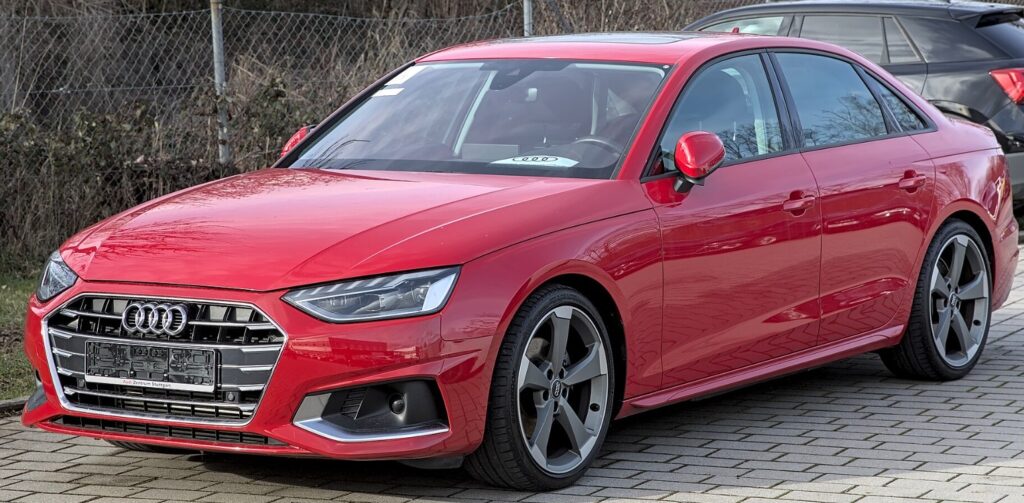
The Audi A4 fuel tank capacity is one of those specifications that seems as though it should have a simple answer. Search for it, though, and we quickly run into figures ranging from roughly 40 litres to 70 litres. So, which number is correct?
Potentially, several of them.
Audi has produced the A4 across multiple generations, body styles, engines, drivetrains, and markets. As the car evolved, so did the size of its fuel tank. Older A4 models often carried comparatively large tanks, while many newer versions use smaller tanks paired with more efficient engines.
For example, official Audi technical information lists a 54-litre fuel tank for numerous B9-generation versions, while some diesel configurations were offered with approximately 40 litres as standard and a larger tank depending on specification. A 2024 Audi A4 40 TFSI specification published by Audi also lists a 54-litre tank.
Earlier cars can be quite different. A technical specification for a B8 2.0 TDI lists a 65-litre tank, while Audi documentation for a 2007 A4 quattro lists 63 litres.
So rather than throwing one number at you and calling it a day, we're going to unpack the Audi A4 fuel tank properly.
Content in this publication
- What Is the Audi A4 Fuel Tank Capacity?
- Audi A4 B9 Fuel Tank Capacity
- Audi A4 B8 Fuel Tank Capacity
- Audi A4 B7 Fuel Tank Capacity
- Audi A4 B6 Fuel Tank Capacity
- Audi A4 B5 Fuel Tank Capacity
- Audi A4 Sedan vs Avant Fuel Tank Capacity
- Petrol vs Diesel Audi A4 Fuel Tank Capacity
- How to Calculate Audi A4 Driving Range
- Why the Amount We Refill Doesn't Match Tank Capacity
- How Much Does a Full Audi A4 Fuel Tank Weigh?
- Does a Larger Fuel Tank Reduce Fuel Economy?
- Audi A4 Fuel Gauge: How Accurate Is It?
- How to Confirm Your Exact Audi A4 Fuel Tank Size
- Can You Put More Fuel in Than the Stated Tank Capacity?
- How Fuel Tank Capacity Affects Road Trips
- What Audi A4 Owners Should Remember
- Conclusion: How Big Is an Audi A4 Fuel Tank?
- Frequently Asked Questions
What Is the Audi A4 Fuel Tank Capacity?
As a broad guide, the Audi A4 has used fuel tanks of approximately 40 to 70 litres, depending on generation and configuration.
For many drivers researching relatively modern A4 models, the number they'll encounter most frequently is around 54 litres, particularly on B9 petrol versions.
Older A4 generations tend to have larger tanks. Depending on model and drivetrain, B7 and B8 cars commonly sit somewhere around 60 to 70 litres.
Here's a useful general overview:
| Audi A4 generation | Approximate fuel tank range |
|---|---|
| B5 | Around 60–62 litres |
| B6 | Around 66–70 litres |
| B7 | Around 63–70 litres |
| B8 | Around 61–65 litres, with some variations |
| B9 | Around 40–58 litres depending on specification |
| Many later B9 petrol models | Around 54 litres |
These numbers should be treated as a generation guide rather than a vehicle-specific specification. Engine, quattro drivetrain, diesel equipment, market, model year, and optional tank configurations can change the figure.
Why Doesn't Every Audi A4 Have the Same Tank?
Because an Audi A4 isn't one fixed mechanical package.
Think of the A4 badge as the surname of a large family. Everyone is related, but they certainly don't all wear the same shoes.
Audi has sold the A4 with:
- Petrol and diesel engines
- Front-wheel drive and quattro
- Manual, automatic, Multitronic, Tiptronic, and S tronic transmissions
- Sedan and Avant bodies
- Different emissions equipment
- Mild-hybrid technology on later cars
- Market-specific configurations
Packaging underneath the vehicle therefore changes considerably.
A quattro system, for example, requires room for additional drivetrain components. Diesel versions may also need space for emissions hardware such as an AdBlue tank. Engineers have to fit all of these pieces together like an unusually complicated three-dimensional puzzle.
Audi A4 B9 Fuel Tank Capacity
The B9 A4 arrived for the 2016 model year in many markets and represents one of the biggest changes in fuel-tank philosophy.
Where previous A4 generations often relied on tanks north of 60 litres, many B9 models moved toward smaller capacities.
Official Audi documentation for various A4 versions lists 54 litres for numerous petrol models. The same technical material shows that certain diesel configurations could have a smaller approximate 40-litre tank, with larger arrangements depending on specification.
Audi's published specification for the 2024 A4 40 TFSI Advanced in Vietnam, for instance, lists its fuel tank at 54 litres.
Why shrink the tank?
Because modern engines travel farther on every litre.
Rather than carrying extra fuel—and extra weight—Audi could reduce the tank while still delivering practical driving range.
How Many Gallons Is a 54-Litre Audi A4 Tank?
A 54-litre fuel tank equals approximately:
- 14.3 US gallons
- 11.9 Imperial gallons
Those conversions matter because Audi specifications are usually discussed in litres outside the United States, while American owners often think in gallons.
Does Quattro Affect B9 Fuel Capacity?
It can.
The quattro system adds a driveshaft, rear differential, and associated components beneath the vehicle. Depending on the particular generation and engineering layout, that packaging can influence the shape or capacity of the fuel tank.
We shouldn't therefore assume that a front-wheel-drive A4 and an apparently similar quattro car automatically hold exactly the same amount.
Whenever accuracy matters, the specific model-year owner's manual or technical specification should win the argument.
Audi provides digital owner manuals for model-year 2008 and newer vehicles, searchable by model or VIN, making the VIN-specific manual one of the safest ways to confirm a particular car.
Audi A4 B8 Fuel Tank Capacity
The B8 generation generally carried a noticeably larger fuel tank than the later B9.
An Audi A4 B8 2.0 TDI technical specification from 2008 lists a 65-litre fuel tank.
Other B8 configurations can differ slightly, with approximately 61, 63, 64, or 65 litres appearing depending on engine, drivetrain, year, and market. Some early diesel configurations were larger still.
This larger tank suited the B8's character perfectly.
The car was designed as a serious motorway cruiser, particularly in diesel form. Combine an economical TDI engine with roughly 65 litres of diesel and suddenly a long interstate or European motorway journey becomes remarkably easy.
How Far Can a 65-Litre A4 Travel?
Suppose our A4 averages 6.0 L/100 km.
The theoretical calculation is:
65 ÷ 6.0 × 100 = approximately 1,083 km
That doesn't mean we should expect exactly 1,083 km from every tank.
Real-world consumption changes with speed, temperature, traffic, tyres, driving style, air conditioning, elevation, passenger load, and dozens of smaller factors.
Still, it shows why diesel A4s became popular among high-mileage drivers. Give one a large tank and an open motorway and it can seemingly swallow the horizon.
Audi A4 B7 Fuel Tank Capacity
Step back another generation and fuel tanks become larger again.
A 2007 Audi A4 technical specification lists the quattro fuel tank at 63 litres, equivalent to 16.6 US gallons.
Other B7 versions—particularly front-wheel-drive models in certain markets—were offered with capacities around 70 litres.
That difference highlights why searching simply for "Audi A4 tank size" can produce contradictory answers.
One website says 63 litres.
Another says 70.
Both can potentially be describing real A4s.
B7 Front-Wheel Drive vs Quattro
The distinction often comes down to packaging.
Quattro equipment occupies space beneath the car, requiring the tank to be shaped around the driveline. A front-wheel-drive car doesn't need exactly the same arrangement.
As a result, seemingly small differences in specification can produce surprisingly different tank capacities.
It's another reminder that the Audi badge on the boot tells us only part of the story.
Audi A4 B6 Fuel Tank Capacity
The B6 generation continued the older-school approach of pairing the A4 with a relatively generous fuel supply.
Many B6 configurations are associated with tanks in roughly the mid-to-upper 60-litre range, commonly around 66 to 70 litres depending on version.
That's substantially larger than the 54-litre tank found in many newer petrol A4s.
But bigger isn't automatically better.
A large tank lets us drive farther between fuel stops, yet carrying additional fuel also means carrying additional weight.
One litre of petrol weighs roughly three-quarters of a kilogram. Add 15 extra litres and we've effectively invited another small suitcase to ride beneath the back seat.
Audi A4 B5 Fuel Tank Capacity
The first-generation A4, known internally as the B5, generally used a tank around the low-60-litre mark, although precise capacity varies by engine and drivetrain.
The important point is the historical trend.
Early A4s depended more heavily on physical fuel volume to provide long cruising range. Newer cars increasingly achieve the same objective through improved efficiency.
It's rather like comparing an old traveller carrying a giant water bottle with a modern hiker carrying a smaller bottle but using every drop more carefully.
Audi A4 Sedan vs Avant Fuel Tank Capacity
Does buying an A4 Avant automatically give us a bigger fuel tank?
No.
While the estate body dramatically changes the cargo area, Audi doesn't simply throw a larger fuel tank underneath because there's more space behind the rear seats.
Tank capacity is dictated primarily by the platform, powertrain, drivetrain, emissions equipment, and underbody packaging.
Consequently, Sedan and Avant models within the same generation can sometimes share similar capacities.
Other configurations can differ.
Why Body Style Still Matters
Although the luggage compartment isn't where the main fuel tank lives, the body structure surrounding the rear axle can influence packaging.
Engineers have to consider:
- Crash protection
- Suspension travel
- Exhaust routing
- Rear differential placement
- Spare-wheel or repair-kit storage
- Emissions components
- Fuel-pump access
- Weight distribution
The final tank is therefore rarely a simple rectangular container.
It twists around other hardware like a piece of engineering origami.
Petrol vs Diesel Audi A4 Fuel Tank Capacity
Fuel type doesn't necessarily determine tank size, but it can influence it indirectly.
Modern diesel cars require more emissions-control equipment than older models. Certain diesel A4s use AdBlue, meaning Audi also has to find room for a separate AdBlue reservoir.
Official Audi B9 technical data, for example, lists some diesel configurations with approximately a 40-litre fuel tank and a 12-litre AdBlue tank, while other versions use larger fuel tanks.
Petrol versions don't require that same AdBlue storage arrangement.
Does Diesel Range Remain Better?
Often, yes.
A diesel A4 may have a smaller tank than an older model yet still offer impressive range because diesel engines tend to use less fuel during steady motorway driving.
Consider two hypothetical A4s:
A petrol car consuming 7.0 L/100 km with a 54-litre tank has a theoretical range of roughly 771 km.
A diesel consuming 5.0 L/100 km with the same tank could theoretically manage around 1,080 km.
Same tank. Dramatically different outcome.
That's why capacity alone doesn't tell us how often we'll see a petrol station.
How to Calculate Audi A4 Driving Range
We can estimate range with a remarkably simple equation:
Fuel tank capacity ÷ fuel consumption × 100
Suppose we have a 54-litre A4 averaging 6.5 L/100 km:
54 ÷ 6.5 × 100 = 831 km
That's the theoretical figure.
In everyday driving, we should expect somewhat less because we rarely consume every usable drop.
Estimated Range Examples
Here are some theoretical calculations for a 54-litre tank:
| Average consumption | Theoretical range |
| 5.0 L/100 km | 1,080 km |
| 5.5 L/100 km | 982 km |
| 6.0 L/100 km | 900 km |
| 6.5 L/100 km | 831 km |
| 7.0 L/100 km | 771 km |
| 8.0 L/100 km | 675 km |
| 9.0 L/100 km | 600 km |
| 10.0 L/100 km | 540 km |
Those numbers are mathematical estimates, not guaranteed vehicle ranges.
Headwinds alone can make a surprisingly large difference on a long motorway journey.
Why the Amount We Refill Doesn't Match Tank Capacity
Here's a common scenario.
The specification says our A4 has a 54-litre tank. The dashboard says the tank is nearly empty. We fill it up and the pump stops at 47 litres.
Where did the other seven litres go?
Nothing is necessarily wrong.
The fuel gauge reaching "empty" does not mean that every drop of fuel has disappeared.
The Fuel Reserve Explained
Manufacturers intentionally provide a reserve.
If the dashboard displayed empty at the precise moment the fuel pump swallowed its last drop, drivers would regularly find themselves stranded a few hundred metres short of a petrol station.
Instead, the warning system gives us breathing room.
The exact reserve varies with model, and we shouldn't treat it as a guaranteed emergency driving allowance.
When the low-fuel light appears, it's time to refuel—not time to begin an experiment.
Why Running an A4 Completely Dry Is a Bad Idea
Repeatedly driving until the tank is nearly empty offers virtually no benefit.
On a diesel, actually running out of fuel can be particularly inconvenient because air may enter the fuel system.
The fuel pump also relies on having fuel available for normal operation.
We therefore gain little from attempting to squeeze every theoretical kilometre out of the tank.
How Much Does a Full Audi A4 Fuel Tank Weigh?
Fuel isn't weightless.
Petrol generally weighs roughly 0.74–0.76 kg per litre, while diesel is denser at roughly 0.82–0.85 kg per litre.
Using approximate figures, 54 litres of petrol might weigh around 40 kg.
A 65-litre petrol tank could carry close to 49 kg of fuel.
That partly explains the industry's move toward smaller tanks.
Reducing fuel capacity can lower potential operating weight without necessarily reducing practical range if engine efficiency improves at the same time.
Does a Larger Fuel Tank Reduce Fuel Economy?
Not directly.
A 65-litre tank doesn't force the engine to burn more fuel than a 54-litre one.
What matters is how much fuel we're actually carrying.
Fill the bigger tank completely and we carry more weight. More mass theoretically requires slightly more energy to accelerate.
In everyday driving, though, the difference is modest compared with factors such as:
- Aggressive acceleration
- High motorway speeds
- Low tyre pressure
- Roof boxes
- Cold weather
- Short trips
- Heavy traffic
So there's little reason to deliberately avoid filling the tank purely to save fuel.
Audi A4 Fuel Gauge: How Accurate Is It?
Fuel gauges aren't laboratory measuring instruments.
The displayed level is derived from a sender inside the tank and interpreted by the car's electronics.
Tank shape further complicates the picture.
Because modern fuel tanks have irregular shapes, the first quarter of the gauge may not disappear at exactly the same rate as the final quarter.
We might drive 150 km before the needle visibly moves, then watch the second half drop much faster.
That doesn't necessarily mean the car suddenly became thirsty.
Why the Estimated Range Changes So Quickly
The A4's trip computer calculates remaining range from recent fuel consumption.
Cruise gently and the predicted range can rise.
Spend 20 minutes in stop-and-go traffic and it might tumble.
The system isn't predicting the future. It's essentially looking backward and saying, "If you keep driving like this, here's roughly what we've got left."
How to Confirm Your Exact Audi A4 Fuel Tank Size
If we need an exact answer for a specific car, guessing by generation isn't enough.
The best sources are the vehicle's documentation and VIN-specific information.
Audi's official online owner's manual system supports models from model year 2008 onward and allows owners to search using a VIN or model selection.
For maximum confidence, check:
- The vehicle owner's manual.
- Audi's VIN-specific digital documentation.
- Official technical specifications for the exact model year.
- The specification sheet supplied with the vehicle.
- An Audi dealer using the VIN.
This matters particularly when comparing imported vehicles.
An A4 originally sold in Germany may not have precisely the same specification as one delivered to Australia, North America, or another market.
Can You Put More Fuel in Than the Stated Tank Capacity?
Occasionally the amount shown on a pump can appear surprisingly close to—or even slightly above—the nominal tank capacity.
That doesn't automatically mean Audi published the wrong number.
"Fuel tank capacity" is normally an approximate nominal specification. The filler neck and expansion space complicate what the pump can physically deliver.
Temperature also affects fuel volume.
Still, a dramatic discrepancy deserves attention, particularly if pump accuracy is questionable.
Should We Top Off After the Pump Clicks?
Generally, no.
When the fuel nozzle automatically clicks off, we should stop filling rather than repeatedly forcing additional fuel into the system.
Modern vehicles incorporate evaporative-emissions components that aren't designed around the idea of filling every possible air space with liquid fuel.
Trying to squeeze another litre into the car isn't worth the trouble.
How Fuel Tank Capacity Affects Road Trips
This is where tank size becomes more than a trivia question.
A larger tank can be genuinely useful on long journeys.
Suppose two A4s both average 6.0 L/100 km.
A 54-litre tank theoretically provides about 900 km.
A 65-litre tank theoretically provides about 1,083 km.
That's an extra 183 km on paper.
For ordinary commuting, who cares?
For a long-distance road trip through sparsely populated areas, suddenly it matters.
Bigger Tank or Better Efficiency?
Given the choice, we'd prioritize efficiency.
A massive tank attached to a thirsty engine isn't particularly impressive.
Imagine a car with a 70-litre tank consuming 10 L/100 km. Its theoretical range is 700 km.
Now take a 54-litre A4 using 6 L/100 km. It can theoretically travel 900 km.
Smaller tank. Longer range.
Efficiency wins.
What Audi A4 Owners Should Remember
If there's one lesson worth carrying away, it's that Audi A4 fuel tank capacity cannot reliably be identified from the model name alone.
Generation matters.
Engine matters.
Drivetrain matters.
Model year matters.
Market can matter too.
Older B7 and B8 cars frequently carried fuel tanks in the 60-plus-litre range, while many B9 petrol cars use approximately 54 litres. Official Audi data confirms a 54-litre tank for multiple B9 specifications and for a published 2024 A4 40 TFSI configuration.
Meanwhile, documented older examples include a 65-litre B8 2.0 TDI and a 63-litre B7 quattro.
That evolution makes sense.
Audi didn't simply shrink the tank and hope nobody noticed. Engines became more efficient, vehicle architecture evolved, and packaging priorities changed.
Conclusion: How Big Is an Audi A4 Fuel Tank?
So, what is the Audi A4 fuel tank capacity?
For many modern B9 petrol A4s, around 54 litres is a useful answer.
For older A4 generations, expect something closer to roughly 60–70 litres, depending heavily on the exact version.
And some later diesel configurations may use smaller tanks because their efficient engines and emissions-system packaging change the equation.
The key is not to treat any single capacity as universal.
An Audi A4 has been around long enough to evolve dramatically. Comparing the tank of an early B5 with a modern B9 is a bit like comparing two smartphones separated by twenty years: the name may feel familiar, but nearly everything beneath the surface has changed.
Before ordering parts, calculating maximum range, or planning a long road trip, confirm the specification for your particular VIN.
That five-minute check beats discovering halfway across the country that the number you found online belonged to an entirely different A4.
Frequently Asked Questions
1. What is the fuel tank capacity of an Audi A4?
Audi A4 fuel tank capacity varies by generation and specification. Many modern B9 petrol models use approximately 54 litres, while older versions commonly have tanks in roughly the 60–70-litre range. Official Audi specifications should be checked for the exact model year and powertrain.
2. How many gallons does an Audi A4 hold?
A 54-litre Audi A4 tank is roughly 14.3 US gallons or 11.9 Imperial gallons. A 65-litre tank is approximately 17.2 US gallons.
3. How far can an Audi A4 travel on a full tank?
It depends mainly on fuel economy. An A4 using 6.0 L/100 km with a 54-litre tank has a theoretical range of about 900 km, while a 65-litre tank at the same consumption produces roughly 1,083 km. Actual range will normally differ because of driving conditions and reserve fuel.
4. Why does my Audi A4 take less fuel than its stated tank capacity?
The tank usually isn't completely empty when the low-fuel warning appears. Fuel remains as a reserve, which is why a vehicle with a nominal 54-litre tank may accept considerably less than 54 litres during a normal refill.
5. Does every Audi A4 have a 54-litre fuel tank?
No. The 54-litre figure applies to many newer A4 versions but isn't universal. Older A4 models often use larger tanks, while some modern diesel specifications may differ. Audi's VIN-specific owner documentation is the safest way to confirm an individual vehicle.
If you want to know other articles similar to Audi A4 Fuel Tank Capacity: Complete Guide by Generation you can visit the category Service and Parts.
Vauxhall Mokka Tyre Pressure Reset: Complete Guide
How to Reset the Tire Pressure System on Your Hyundai Tucson

Hyundai Kona Tire Pressure: Complete PSI Guide
Vauxhall Corsa Timing Belt Replacement Cost UK 2026
Mazda CX-5 Tire Size Chart: 2013–2026 Guide

How to Reset a Honda Civic: Complete Step-by-Step Guide
Leave a Reply
More content of your interest