
BYD Shark 6 Towing Capacity: Complete Towing Guide

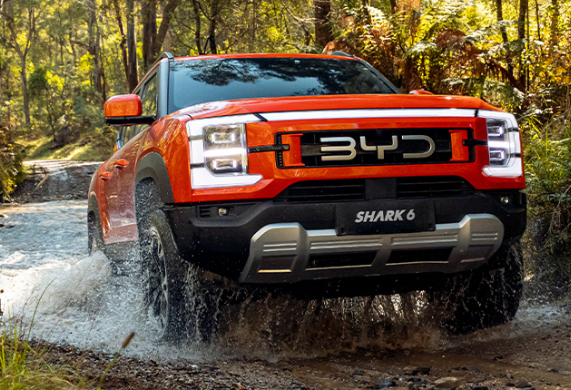
The BYD Shark 6 towing capacity has become one of the most interesting talking points in the Australian ute market. And there is a good reason for that. BYD's plug-in hybrid ute combines serious electric assistance, all-wheel drive, a petrol engine, a sizeable battery and ute practicality in one rather unusual package.
But there is now an important detail that buyers need to understand: not every BYD Shark 6 has the same towing capacity.
In the current Australian range, the BYD Shark 6 Dynamic Cab Chassis and Premium are rated to tow 2,500 kg braked, while the newer, more powerful Shark 6 Performance raises maximum braked towing capacity to 3,500 kg. All three variants have a 750 kg unbraked towing limit.
That changes the conversation considerably. The original Shark 6 was an appealing lifestyle ute that happened to tow reasonably well. The Performance version steps directly into the territory occupied by traditional heavy-duty towing utes.
Of course, a number printed on a specification sheet never tells the entire story. Gross vehicle mass, tow-ball download, kerb weight, passengers, accessories and trailer loading all matter.
So, rather than simply saying "it can tow 3.5 tonnes" and walking away, let's dig into what the numbers actually mean.
Content in this publication
- What Is the BYD Shark 6 Towing Capacity?
- BYD Shark 6 Towing Specifications Explained
- BYD Shark 6 Tow-Ball Weight
- BYD Shark 6 Payload and Kerb Weight
- What Is the BYD Shark 6 GCM?
- Can the BYD Shark 6 Tow a Caravan?
- Can the BYD Shark 6 Tow 3.5 Tonnes?
- BYD Shark 6 Engine and Hybrid System for Towing
- How Does Towing Affect BYD Shark 6 Fuel Consumption?
- Is the BYD Shark 6 Suitable for Long-Distance Towing?
- BYD Shark 6 Suspension and Towing
- Does the Shark 6 Have Trailer Stability Control?
- BYD Shark 6 Towing Capacity vs Traditional Utes
- What Can a 2,500 kg Shark 6 Tow?
- What Can a 3,500 kg Shark 6 Performance Tow?
- BYD Shark 6 Towing Safety Tips
- Should We Choose the Premium or Performance for Towing?
- Final Thoughts on BYD Shark 6 Towing Capacity
- Frequently Asked Questions
What Is the BYD Shark 6 Towing Capacity?
Here is the simplest answer for the current Australian range:
| BYD Shark 6 variant | Braked towing capacity | Unbraked towing capacity |
|---|---|---|
| Dynamic Cab Chassis | 2,500 kg | 750 kg |
| Premium Pickup | 2,500 kg | 750 kg |
| Performance Pickup | 3,500 kg | 750 kg |
BYD's current specification sheet confirms the distinction between the 1.5-litre Dynamic/Premium models and the 2.0-litre Performance.
That means buyers researching older articles online should pay close attention to the model being discussed. Earlier Shark 6 coverage often quotes a 2,500 kg towing capacity, which was correct for the original Australian Premium model and remains correct for the current Premium.
However, it is no longer the maximum capability available across the Shark 6 family.
The BYD Shark 6 Premium towing capacity is 2,500 kg with a braked trailer and 750 kg without trailer brakes. BYD also specifies a maximum tow-ball download of 250 kg for this version.
For many recreational users, 2.5 tonnes is plenty.
Think:
- Medium caravans
- Boat-and-trailer combinations
- Jet skis
- Horse floats within the relevant weight limits
- Box trailers
- Small machinery trailers
- Camping trailers
- Off-road camper trailers
Where things become more complicated is with large Australian caravans. Plenty of heavily equipped touring vans can move beyond the 2,500 kg limit surprisingly quickly.
That's where the Performance becomes much more interesting.
BYD Shark 6 Performance Towing Capacity
The BYD Shark 6 Performance can tow up to 3,500 kg braked, putting its headline capacity into the familiar 3.5-tonne ute category.
BYD pairs that increase with a new 2.0-litre turbocharged hybrid drivetrain producing 350 kW and 700 Nm, compared with 321 kW and 650 Nm in the 1.5-litre Dynamic and Premium models.
The Performance also receives a maximum tow-ball download rating of 350 kg.
So yes: if our sole question is whether there is now a Shark 6 capable of towing a 3,500 kg braked trailer according to its Australian specification, the answer is yes.
But that does not mean we can automatically hook up any 3.5-tonne caravan, fill the ute with five adults and throw hundreds of kilograms into the tray.
Weights interact.
And that's where things get interesting.
BYD Shark 6 Towing Specifications Explained
A towing figure looks wonderfully simple on a brochure.
Real towing is more like balancing a set of scales.
Before choosing a caravan or trailer, we should understand at least four figures:
- Braked towing capacity
- Tow-ball download
- Gross Vehicle Mass
- Gross Combined Mass
Ignoring any one of these can turn a theoretically legal combination into an overloaded one.
Braked vs Unbraked Towing Capacity
A braked trailer has its own braking system. Larger caravans, boats and equipment trailers normally fall into this category.
The Shark 6 limits are:
Dynamic/Premium: 2,500 kg braked
Performance: 3,500 kg braked
An unbraked trailer relies primarily on the tow vehicle's braking system.
The Shark 6 limit is:
750 kg unbraked across the range.
For serious towing, the braked number is therefore the figure most owners will care about.
BYD Shark 6 Tow-Ball Weight
Tow-ball download is one of those specifications that sounds dull until we realise how much it affects payload.
BYD lists maximum tow-ball download figures of:
250 kg — Dynamic Cab Chassis
250 kg — Premium
350 kg — Performance
Tow-ball download is the downward force placed on the vehicle through the tow hitch.
And crucially, that weight does not magically disappear.
It loads the tow vehicle.
Why Tow-Ball Download Matters
Imagine our Shark 6 is carrying:
- Two adults
- Two children
- Luggage
- Camping equipment
- A canopy or other accessories
- A fridge
- Recovery equipment
- 250-350 kg of tow-ball download
Suddenly, the ute's available vehicle weight capacity can shrink like ice on a summer driveway.
That's why maximum towing capacity should never be considered independently from payload.
BYD Shark 6 Payload and Kerb Weight
The current Australian specification sheet lists the following kerb weights:
| Variant | Kerb weight | GVM | GVM minus kerb weight* |
|---|---|---|---|
| Dynamic Cab Chassis | 2,600 kg | 3,500 kg | 900 kg |
| Premium | 2,710 kg | 3,500 kg | 790 kg |
| Performance | 2,775 kg | 3,500 kg | 725 kg |
*The final column is simply the mathematical difference between the published kerb weight and GVM, rather than a substitute for the manufacturer's loading instructions. Cab-chassis bodies and accessories in particular consume available capacity. BYD's current Australian specification sheet publishes the underlying kerb-weight and GVM figures.
The numbers reveal something important.
As the Shark becomes heavier and more powerful, its theoretical margin between kerb weight and GVM becomes smaller.
What Happens When We Add Tow-Ball Download?
Let's use the Premium as a simplified example.
Its published numbers are:
- Kerb weight: 2,710 kg
- GVM: 3,500 kg
- Difference: 790 kg
- Maximum tow-ball download: 250 kg
If we actually placed the full 250 kg permitted vertical load on the hitch, our remaining theoretical margin under GVM would fall from 790 kg to around 540 kg before passengers, aftermarket equipment and luggage are considered.
Now take the Performance:
- Kerb weight: 2,775 kg
- GVM: 3,500 kg
- Difference: 725 kg
- Maximum tow-ball download: 350 kg
Using the full 350 kg tow-ball allowance would leave roughly 375 kg of theoretical GVM headroom.
That is why "3,500 kg towing" should never be interpreted as "3,500 kg towing plus unlimited cargo."
Real-Life Loads Add Up Faster Than We Expect
Consider two adults at 85 kg each.
We're already at 170 kg.
Add:
- 40 kg fridge
- 30 kg recovery equipment
- 40 kg luggage
- 25 kg tools
- 30 kg accessories
- 350 kg tow-ball load
We've added 685 kg.
Suddenly that seemingly generous number doesn't look enormous.
The lesson isn't that the Shark cannot tow.
The lesson is that any ute towing close to its rated maximum needs proper weight calculations.
What Is the BYD Shark 6 GCM?
Gross Combined Mass, or GCM, sets another boundary around the vehicle-and-trailer combination.
BYD lists:
Dynamic Cab Chassis: 5,750 kg
Premium: 5,750 kg
Performance: 6,650 kg
The extra 900 kg of GCM available to the Performance corresponds with its significantly higher maximum towing capability.
This is a major specification to check when setting up a touring rig.
Why GCM Can Be More Important Than the Advertising
Suppose someone tells us:
"My ute can tow 3.5 tonnes."
Fine.
But how much does the ute itself weigh once loaded?
How much does the caravan actually weigh?
How much is sitting on each axle?
How much tow-ball load is being transferred to the vehicle?
That's where weighbridge measurements beat assumptions every time.
A brochure provides the boundaries.
A scale tells us where our actual setup sits within them.
Can the BYD Shark 6 Tow a Caravan?
Absolutely—provided the caravan and complete combination remain within the applicable limits.
For the 2,500 kg-rated Premium, we would generally be looking at lighter and medium-sized caravans rather than the heaviest full-size touring rigs.
The 3,500 kg-rated Performance dramatically expands the field and can accommodate substantially heavier caravans from a towing-capacity perspective.
But we should never choose a caravan based on its empty weight alone.
Caravan ATM Matters More Than Tare Weight
A caravan may look comfortably below the Shark's towing capacity when we examine its tare mass.
Then we add:
- Water
- Gas bottles
- Food
- Bedding
- Clothing
- Camping equipment
- Batteries
- Solar equipment
- Bikes
- Outdoor furniture
A caravan that looked light in the dealership can gain several hundred kilograms before the first holiday begins.
For towing decisions, the loaded weight is what matters.
Give Yourself Some Breathing Room
Running at the absolute maximum rating isn't compulsory simply because the vehicle allows it.
A lighter trailer generally gives us more flexibility for passengers, gear and changing travel conditions.
It can also make the entire combination less stressful.
When a crosswind appears on an exposed highway, extra weight margin feels far more valuable than it did while reading specifications at home.
Can the BYD Shark 6 Tow 3.5 Tonnes?
This question now needs a model-specific answer.
The Shark 6 Performance is rated for 3,500 kg braked towing.
The Shark 6 Premium and Dynamic Cab Chassis remain limited to 2,500 kg braked.
That distinction matters enormously when shopping used vehicles as well.
We shouldn't assume that a Shark 6 advertised privately has the newer 3.5-tonne rating simply because current BYD marketing mentions a 3,500 kg maximum.
Check the exact variant and compliance information.
BYD Shark 6 Engine and Hybrid System for Towing
The Shark 6 approaches towing rather differently from the traditional diesel dual-cab formula.
Instead of relying exclusively on a large diesel engine and conventional mechanical four-wheel-drive system, BYD uses its DMO Super Hybrid architecture.
In the Premium, the 1.5-litre turbo hybrid system produces combined outputs of 321 kW and 650 Nm.
The Performance steps up to a 2.0-litre turbo hybrid system producing 350 kW and 700 Nm.
Those are substantial numbers.
Electric Motors Change the Driving Character
Electric motors can provide strong torque response without waiting for a conventional combustion engine to build revs.
That can be particularly pleasant when:
- Pulling away with a trailer
- Joining fast traffic
- Climbing hills
- Manoeuvring at lower speeds
Numbers alone still don't tell us everything about sustained towing performance, thermal management or efficiency, but the hybrid system certainly gives the Shark a distinctive personality.
A diesel ute often feels like a work boot.
The Shark feels more like a hiking boot with an electric motor hidden in the sole.
How Does Towing Affect BYD Shark 6 Fuel Consumption?
Expect consumption to rise.
Significantly.
That's not a Shark-specific weakness; it's physics.
A large caravan creates aerodynamic drag roughly like towing a small wall behind the vehicle. Add another couple of tonnes and the drivetrain must work much harder.
BYD quotes low official combined-cycle consumption figures under specified test conditions, but those figures should not be treated as predictions for heavy caravan towing. BYD itself notes that range can vary with factors including load and driving conditions.
Battery Charge Also Matters
A plug-in hybrid is unusual because efficiency can change considerably depending on battery state and journey type.
Around town with regular charging, owners may exploit electric energy frequently.
During a long towing journey, however, sustained highway load creates a very different scenario.
We would therefore plan long caravan trips around realistic petrol consumption rather than assuming brochure-style plug-in-hybrid efficiency throughout the journey.
Is the BYD Shark 6 Suitable for Long-Distance Towing?
Potentially, yes.
It combines a petrol engine with battery assistance, so it does not depend exclusively on public charging infrastructure to continue travelling.
That's an important advantage for Australian touring.
We can refuel and keep moving even when fast chargers are sparse.
Still, anyone planning frequent long-distance towing should consider more than power.
Things We Would Check Before a Big Trip
We would pay particular attention to:
- Actual caravan weight
- Tow-ball download
- Vehicle GVM
- Combined mass
- Tyre pressures
- Trailer brakes
- Weight distribution
- Battery state
- Fuel stops
- Spare tyre condition
- Trailer tyre condition
BYD's Australian owner's handbook also states that the vehicle should not be used to tow during its first 2,000 km, as part of the recommended break-in procedure.
That little detail is exactly the sort of thing that gets missed when we focus only on the headline towing figure.
BYD Shark 6 Suspension and Towing
The Shark 6 uses double-wishbone suspension at both the front and rear, rather than the leaf-spring rear arrangement common among work-focused dual-cab utes.
This contributes to the Shark's comfort-oriented character.
But again, suspension design does not change the published loading limits.
Comfort Does Not Replace Weight Management
A ute might feel perfectly composed while technically overloaded.
That's dangerous because our backside is not a calibrated weighbridge.
Proper loading means verifying numbers, not waiting until the rear suspension looks unhappy.
Does the Shark 6 Have Trailer Stability Control?
Yes. BYD's current Australian specification sheet lists Trailer Stability Control across the Shark 6 range.
Electronic assistance can help detect and manage instability, although it should be viewed as a safety support system rather than permission to load a trailer poorly.
Correct tyre pressure, sensible speed and proper weight distribution remain fundamental.
BYD Shark 6 Towing Capacity vs Traditional Utes
This comparison changed dramatically with the arrival of the Performance.
Originally, the Shark 6 Premium's 2,500 kg rating placed it below the familiar 3,500 kg maximum claimed by many diesel dual-cab competitors.
For buyers towing 1,500-2,000 kg, that difference might have meant almost nothing.
For buyers with a 3,000 kg caravan, it meant everything.
The Performance Closes the Headline Gap
At 3,500 kg, the Shark 6 Performance now reaches the commonly advertised ceiling of numerous traditional towing utes.
That does not automatically mean every 3.5-tonne-rated ute has identical towing ability.
Different vehicles can have different:
- GVM figures
- GCM limits
- Payloads
- Axle ratings
- Tow-ball limits
- Suspension behaviour
- Fuel consumption
- Towbar requirements
The maximum trailer figure is only chapter one.
What Can a 2,500 kg Shark 6 Tow?
The Premium's 2.5-tonne capability still covers a broad range of recreational equipment.
We could realistically encounter compatible examples among:
- Pop-top caravans
- Compact full-height caravans
- Camper trailers
- Off-road campers
- Fishing boats
- Personal watercraft trailers
- Car trailers carrying lighter vehicles
- General-purpose work trailers
The important phrase is "depending on loaded weight."
Two caravans of almost identical dimensions can have surprisingly different ATMs.
Never estimate from size.
Check the plate and, ideally, weigh the actual loaded trailer.
What Can a 3,500 kg Shark 6 Performance Tow?
The 3.5-tonne Performance moves into much heavier territory.
Its rated capacity potentially accommodates:
- Large caravans
- Heavy boat combinations
- Enclosed car trailers
- Larger machinery trailers
- Heavier horse floats
Yet this is exactly where weight calculations become most important because tow-ball download may also approach several hundred kilograms.
A big towing number is useful.
A properly balanced towing setup is better.
BYD Shark 6 Towing Safety Tips
Before hitching up, we'd follow a straightforward routine:
- Confirm the exact Shark 6 variant.
- Check the trailer's loaded weight rather than relying solely on tare.
- Measure tow-ball download.
- Include passengers, accessories and cargo in vehicle loading calculations.
- Confirm GVM and GCM compliance.
- Check axle loads where relevant.
- Set vehicle and trailer tyre pressures correctly.
- Test trailer brakes before departure.
- Keep heavy trailer cargo low and appropriately positioned.
- Use a weighbridge when the combination is approaching its limits.
None of this is glamorous.
Neither is standing beside an overloaded caravan hundreds of kilometres from home.
Preparation wins.
The answer depends primarily on the trailer.
For trailers comfortably below 2,500 kg, the Premium already offers plenty of capability and the same fundamental DMO plug-in-hybrid concept.
If our intended trailer can exceed 2,500 kg, the Performance's 3,500 kg braked rating, higher 350 kg tow-ball limit and 6,650 kg GCM fundamentally change what is possible.
Buy based on what we actually plan to tow, not simply which specification sounds most impressive.
For Occasional Light Towing
The Premium may provide all the capacity we need.
For Large Caravans
The Performance deserves closer attention because its 3.5-tonne rating provides substantially more headroom.
For Maximum-Weight Towing
Run the complete calculation before buying either the ute or caravan.
Payload, ball load, GVM and GCM should all be part of the purchase decision.
Final Thoughts on BYD Shark 6 Towing Capacity
The BYD Shark 6 towing story is more interesting now than it was when the model first appeared in Australia.
The Dynamic Cab Chassis and Premium are rated to tow 2,500 kg braked, while the Shark 6 Performance increases that figure to 3,500 kg. Unbraked capacity is 750 kg across the current range.
That makes the Performance far more relevant to Australians towing heavier caravans, boats and equipment.
Yet maximum towing capacity should never become the only number we remember.
The Premium has a 3,500 kg GVM, 5,750 kg GCM and 250 kg maximum tow-ball download. The Performance retains the 3,500 kg GVM while increasing GCM to 6,650 kg and maximum tow-ball download to 350 kg.
Those figures tell the fuller story.
The Shark 6 combines enormous hybrid performance with an unusually comfortable, technology-heavy interpretation of the dual-cab ute. With the arrival of the 3.5-tonne Performance, it also has a much stronger answer for buyers asking that classic Australian question:
"But how much can it tow?"
Quite a lot—as long as we do the maths first.
Frequently Asked Questions
1. What is the BYD Shark 6 towing capacity?
The current BYD Shark 6 Premium and Dynamic Cab Chassis are rated for 2,500 kg braked towing, while the Shark 6 Performance is rated for 3,500 kg braked towing. All three have a 750 kg unbraked towing capacity in the current Australian specification.
2. Can a BYD Shark 6 tow a 3,500 kg caravan?
The Shark 6 Performance has a published maximum braked towing capacity of 3,500 kg. The Premium and Dynamic variants do not; they are limited to 2,500 kg. The complete combination must still comply with GVM, GCM, tow-ball and other applicable limits.
3. What is the BYD Shark 6 tow-ball weight limit?
BYD's current Australian specifications list a maximum tow-ball download of 250 kg for the Dynamic and Premium and 350 kg for the Performance.
4. Is the BYD Shark 6 good for towing a caravan?
Its specifications make it suitable for many caravans, but the correct model depends on caravan weight. The 2,500 kg Premium suits lighter combinations, while the 3,500 kg Performance expands the range of heavier vans it can legally accommodate from a maximum towing-rating perspective.
5. Can I tow with a brand-new BYD Shark 6 immediately?
BYD's Australian owner's handbook recommends not using the vehicle to tow during the first 2,000 km as part of the powertrain break-in procedure. Owners should follow the handbook supplied with their specific vehicle.
If you want to know other articles similar to BYD Shark 6 Towing Capacity: Complete Towing Guide you can visit the category Service and Parts.
Volvo S90 Engine Oil: Type, Capacity & Change Guide
Volvo S90 Boot Space: Size, Capacity and Practicality
SEO Title: Volvo S90 Oil Capacity: Complete Guide by Engine

Kia Sorento Oil Type: Complete Guide by Year & Engine
Kia Sorento Engine Capacity: Complete Guide by Year
Peugeot 308 Clutch Replacement Cost: Complete UK Guide for 2026
Leave a Reply
More content of your interest