
BYD Shark 6 Weight: Kerb Weight, Payload, GVM and What It Means

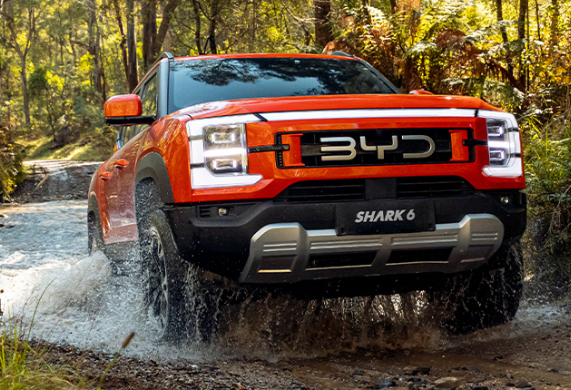
The BYD Shark 6 weight is one of the most important specifications to understand before buying this plug-in hybrid ute. Power figures and electric range may grab the headlines, but weight quietly influences almost everything else: payload, towing, braking, tyre wear, efficiency, handling and even how much gear we can realistically throw in the back before hitting a legal limit.
And the answer to “How much does a BYD Shark 6 weigh?” is no longer as simple as quoting one figure.
For the current Australian 2026 range, BYD lists three different variants. The SHARK 6 Dynamic Cab Chassis has a kerb weight of 2,600 kg, the Premium weighs 2,710 kg, and the Performance weighs 2,775 kg. All three have a published 3,500 kg gross vehicle mass (GVM).
That makes the Shark 6 a seriously substantial machine. It is not surprising when we consider what is hiding underneath: a combustion engine, electric motors, an AWD system, a sizeable Blade battery, a large dual-cab body and the structural hardware needed for ute duties.
So rather than simply throwing the kerb-weight number at you and moving on, let us unpack what those kilograms actually mean in the real world.
Content in this publication
- How Much Does the BYD Shark 6 Weigh?
- BYD Shark 6 Kerb Weight Explained
- BYD Shark 6 Performance Weight
- Why Is the BYD Shark 6 So Heavy?
- BYD Shark 6 Weight vs GVM
- What Counts Against the BYD Shark 6 Payload?
- BYD Shark 6 Weight and Towing Capacity
- Does the BYD Shark 6 Feel Heavy to Drive?
- How Weight Affects BYD Shark 6 Efficiency
- Does Carrying Extra Weight Reduce Electric Range?
- BYD Shark 6 Weight and Off-Road Driving
- BYD Shark 6 Weight Distribution
- Does the Shark 6 Weight Affect Everyday Use?
- What Should We Weigh Before a Long Trip?
- Is 2,710 kg Heavy for the BYD Shark 6 Premium?
- Which BYD Shark 6 Is Lightest?
- Which BYD Shark 6 Has the Highest Payload?
- BYD Shark 6 Weight: What Buyers Should Remember
- Conclusion: The BYD Shark 6 Is Heavy, but the Numbers Tell a Bigger Story
- Frequently Asked Questions About BYD Shark 6 Weight
How Much Does the BYD Shark 6 Weigh?
For the current Australian range, the weight figures look like this:
| BYD Shark 6 variant | Kerb weight | Approx. pounds | GVM | Payload allowance* | GCM |
|---|---|---|---|---|---|
| Dynamic Cab Chassis | 2,600 kg | 5,732 lb | 3,500 kg | 900 kg | 5,750 kg |
| Premium | 2,710 kg | 5,975 lb | 3,500 kg | 790 kg | 5,750 kg |
| Performance | 2,775 kg | 6,118 lb | 3,500 kg | 725 kg | 6,650 kg |
*Payload shown is the difference between the published GVM and kerb weight. Current specification databases likewise list 900 kg for the Dynamic, 790 kg for the Premium and 725 kg for the Performance.
These figures immediately tell us something interesting: the more equipment and performance hardware the Shark gains, the less nominal payload remains beneath the 3,500 kg GVM ceiling.
The Performance is the heavyweight champion at 2,775 kg, but that extra mass comes with a stronger towing specification and more powerful 2.0-litre hybrid drivetrain. BYD currently rates it for up to 3,500 kg braked towing, compared with 2,500 kg for the 1.5-litre Dynamic and Premium models.
BYD Shark 6 Kerb Weight Explained
Kerb weight is essentially the mass of the vehicle in road-ready form according to the manufacturer's applicable measurement standard, but without us loading it with passengers, luggage, tools and everything else we inevitably end up carrying.
That distinction matters.
If our Shark 6 Premium starts at around 2.71 tonnes before meaningful cargo is added, five adults, accessories, camping equipment and tow-ball load can consume its remaining capacity surprisingly quickly.
Think of GVM as a suitcase with a strict airline weight limit. The vehicle itself has already filled most of the suitcase. Everything we add afterwards has to fit into whatever capacity is left.
The BYD Shark 6 Premium kerb weight is 2,710 kg in current Australian specifications. BYD lists a GVM of 3,500 kg, giving a calculated difference of 790 kg between kerb weight and GVM.
For many buyers, this is the figure that matters most because the Premium represents the familiar pickup-bodied Shark 6 configuration.
A 790 kg theoretical payload sounds generous when we see it printed on a page. But it is important to remember that payload is not synonymous with “how much we can put in the tray.”
Passengers count. Accessories count. A canopy counts. An upgraded towbar counts. Recovery equipment counts. Cargo counts. And when towing, load imposed on the vehicle by the trailer coupling also matters.
In other words, a 790 kg payload can shrink like an ice cube on a hot driveway.
BYD Shark 6 Dynamic Cab Chassis Weight
The 2026 SHARK 6 Dynamic Cab Chassis weighs 2,600 kg, according to BYD Australia's specification sheet. It shares the same 3,500 kg GVM, leaving a nominal difference of 900 kg.
That makes it substantially lighter than the Premium before a tray or body is fitted.
There is an obvious catch: this is a cab-chassis vehicle. Once we install a tray, toolboxes, service body, canopy or other work equipment, those additions increase actual vehicle mass and eat into usable payload.
The 900 kg number therefore should not be interpreted as “900 kg available in the finished tray regardless of configuration.”
BYD itself warns that specifications can change depending on accessories and final vehicle configuration.
Why the Cab Chassis Starts Lighter
The difference makes sense structurally. The Dynamic Cab Chassis does not carry the complete factory pickup tub found behind the Premium and Performance cabins.
That gives commercial buyers freedom to build a setup around their work, but it also makes weighing the completed vehicle particularly important.
A tradie carrying drawer systems, tools, an alloy tray, auxiliary batteries and recovery equipment could transform a seemingly generous payload figure surprisingly quickly.
BYD Shark 6 Performance Weight
At the other end of the range sits the BYD Shark 6 Performance at 2,775 kg kerb weight.
That makes it approximately:
- 175 kg heavier than the Dynamic Cab Chassis
- 65 kg heavier than the Premium
- 725 kg below its 3,500 kg GVM before additional loading
The Performance receives a more powerful 2.0-litre turbocharged hybrid system producing a claimed combined 350 kW and 700 Nm, and BYD rates it for 3,500 kg braked towing.
We are therefore looking at a ute weighing almost 2.8 tonnes before we put ourselves inside it.
That sounds enormous—and it is—but there is context. A modern plug-in hybrid ute has to carry much more hardware than a conventional petrol or diesel vehicle.
Why Is the BYD Shark 6 So Heavy?
The simple answer is electrification.
A conventional ute normally carries an engine, transmission, fuel system and four-wheel-drive components. A plug-in hybrid adds another layer of equipment rather than replacing every component.
The Shark 6 uses BYD's DMO plug-in hybrid architecture, combining a turbocharged petrol engine with electric drive hardware and a 29.6 kWh Blade battery. BYD currently quotes combined outputs of 321 kW for the Dynamic and Premium and 350 kW for the Performance.
All of those systems have mass.
The Battery Is Part of the Story
Battery cells are dense. There is no magical way around that.
But simply saying “the battery makes it heavy” misses part of the engineering picture. The battery is incorporated into the vehicle architecture, while the Shark's hybrid drivetrain uses electric motors as fundamental parts of propulsion.
BYD says its integrated battery architecture is intended to contribute to vehicle rigidity while forming part of the DMO platform.
That is why comparing the Shark's mass with a simple combustion-powered ute does not tell the whole story. We are comparing different drivetrain philosophies.
Large Dimensions Add More Mass
The Shark 6 is not exactly hiding in the small-car parking section either.
The pickup-bodied versions measure approximately 5,457 mm long, 1,971 mm wide and 1,925 mm high, with a 3,260 mm wheelbase according to BYD's current Australian specification sheet.
This is a big vehicle carrying five seats, substantial suspension components, large wheels and tyres and a sizeable cargo area.
The scale is physical as well as numerical.
BYD Shark 6 Weight vs GVM
This is where the specification sheet becomes much more useful.
All three Australian Shark 6 variants currently list a GVM of 3,500 kg. GVM is the maximum permitted loaded vehicle mass specified for the vehicle.
Australian transport guidance describes GVM as the maximum loaded vehicle mass specified by the manufacturer or relevant authority.
So we cannot simply load the Shark until the suspension visually appears unhappy.
For the Premium, the calculation is straightforward:
3,500 kg GVM − 2,710 kg kerb weight = 790 kg
For the Performance:
3,500 kg − 2,775 kg = 725 kg
And for the Dynamic Cab Chassis in its published base configuration:
3,500 kg − 2,600 kg = 900 kg
Those numbers are far more revealing than kerb weight alone.
What Counts Against the BYD Shark 6 Payload?
This is where ute owners sometimes get caught.
Imagine we have a Shark 6 Premium. We begin with its nominal 790 kg difference between kerb weight and GVM.
Then we add four or five people.
Then a towbar.
Then perhaps a canopy.
Then a fridge.
Then recovery boards, tools, camping equipment, water, food and luggage.
Suddenly our impressive-looking payload number is considerably smaller.
The correct question is therefore not simply, “Can the tray carry this?”
It is: “What does the complete vehicle weigh in its actual loaded configuration?”
That is why a weighbridge can be far more informative than an accessories catalogue.
BYD Shark 6 Weight and Towing Capacity
Weight becomes even more significant when a trailer enters the picture.
The Dynamic and Premium are currently rated to tow 2,500 kg braked, while the Performance increases maximum braked towing capacity to 3,500 kg. Maximum tow-ball download is listed at 250 kg for Dynamic and Premium and 350 kg for Performance.
Those are headline figures.
But towing safely and legally involves more than matching the caravan's number with the brochure's towing-capacity number.
GCM Matters as Much as Maximum Towing Capacity
BYD lists a 5,750 kg gross combined mass for the Dynamic and Premium, while the Performance rises to 6,650 kg.
Gross combination limits exist because the ute and trailer cannot simply be considered as two completely independent weight allowances.
Australian guidance describes GCM as the total maximum loaded mass of the vehicle and the trailers it may tow, subject to the manufacturer's or relevant authority's specified limit.
Consider the Performance.
Its individual headline limits are 3,500 kg GVM and 3,500 kg braked towing. Adding those numbers gives 7,000 kg.
Yet the published GCM is 6,650 kg.
That alone tells us why we should never assume that maximum vehicle mass and maximum trailer rating can always be exploited simultaneously.
The same principle appears with the Premium: 3,500 kg GVM plus a 2,500 kg towing rating would total 6,000 kg, while its listed GCM is 5,750 kg.
Actual towing calculations also depend on trailer loading, coupling load, axle loads and local regulations, so anyone approaching the limits should work from measured weights rather than theoretical arithmetic alone.
Tow-Ball Download Is Easy to Forget
The Performance's maximum tow-ball download is listed at 350 kg.
That does not mean we can simply hitch a caravan with 350 kg pressing onto the back and forget about it. Weight applied through the tow hitch affects vehicle loading and rear axle load.
The Performance's maximum front axle load is listed at 1,700 kg and its maximum rear axle load at 1,900 kg. Premium and Dynamic specifications list their own axle limits as well.
A vehicle can therefore face an axle-loading problem even when a simple GVM calculation initially appears acceptable.
Does the BYD Shark 6 Feel Heavy to Drive?
Numbers tell us mass, but they do not completely describe behaviour.
A 2.7-tonne vehicle can feel cumbersome if the suspension, steering and powertrain are poorly calibrated. Equally, a heavy vehicle can disguise much of its bulk when engineers control body movement and distribute torque effectively.
The Shark's enormous combined power output certainly helps.
The Premium's claimed 321 kW drivetrain allows BYD to quote 0–100 km/h in 5.7 seconds, while the heavier 350 kW Performance is quoted at 5.5 seconds.
So acceleration is hardly the problem.
Physics, however, never goes on holiday.
Braking Still Has to Deal With Nearly Three Tonnes
A powerful drivetrain can make a heavy ute feel astonishingly quick, but every kilogram still needs to be slowed down.
That becomes particularly noticeable during repeated hard braking, emergency manoeuvres, steep descents and towing.
Regenerative braking can recover some energy under normal driving, but it does not magically remove the underlying momentum of a vehicle weighing well over 2.5 tonnes.
Imagine pushing a shopping trolley and then replacing the groceries with concrete blocks. Powerful electric motors can make the Shark leap forward with remarkable enthusiasm, but mass still introduces inertia when we ask it to stop or abruptly change direction.
How Weight Affects BYD Shark 6 Efficiency
The relationship between mass and efficiency is interesting in a plug-in hybrid.
Extra weight generally requires more energy to accelerate and climb hills. A heavier vehicle can therefore consume more electricity and fuel, particularly in stop-start driving, mountainous terrain or when heavily loaded.
Regenerative braking recovers part of the energy that would otherwise become heat, but the process is not perfectly efficient.
There is another variable too: aerodynamics.
At highway speed, aerodynamic resistance becomes increasingly important. The Shark is a tall, broad ute, not a slippery low-slung sedan. So although weight matters, it is not the only force shaping energy consumption.
BYD's published fuel and range figures should consequently be viewed as standardized comparison figures rather than guaranteed real-world outcomes. BYD itself notes that actual range can change with factors such as load, driving style and traffic conditions.
Does Carrying Extra Weight Reduce Electric Range?
Yes, particularly when the driving environment demands frequent acceleration or climbing.
Five adults plus luggage can represent several hundred kilograms. Add a loaded tub or trailer and the powertrain has considerably more work to do.
On a flat motorway at a steady speed, the difference may be less dramatic than expected because aerodynamic drag dominates much of the resistance.
Drive through hills, however, and gravity sends us the bill.
The practical lesson is simple: if we want to reproduce official range figures, filling the ute to its maximum weight and towing a caravan is not the way to do it.
BYD Shark 6 Weight and Off-Road Driving
Off-road, weight brings both advantages and disadvantages.
A heavy vehicle can feel planted and stable on certain surfaces. Electric torque also gives the Shark precise low-speed propulsion characteristics.
But soft sand and mud are less forgiving.
Nearly three tonnes creates substantial ground pressure, and once that mass begins sinking into a soft surface, recovering it can become considerably harder than extracting a lightweight 4WD.
Momentum also needs to be managed carefully on descents.
BYD equips the Shark 6 with terrain modes and electronic assistance, and lists 230 mm of unladen ground clearance for the current range.
Still, electronics cannot repeal gravity.
Tyre Pressure and Load Become Important
The heavier a vehicle is, the more important correct tyre load ratings and pressures become.
Pressure that works when lightly loaded may not necessarily be appropriate when carrying significant cargo or towing. Owners should follow the vehicle's tyre placard and relevant instructions rather than copying a generic internet pressure.
Tyres are the tiny patches of rubber responsible for translating nearly three tonnes of ute into acceleration, braking and cornering.
They deserve some respect.
BYD Shark 6 Weight Distribution
A plug-in hybrid ute has an interesting advantage when engineers position heavy components intelligently.
The battery can be mounted relatively low within the architecture instead of placing every major component high in the engine bay.
A lower concentration of heavy components can help control the centre of gravity compared with simply adding the same mass higher in the body.
It does not make the Shark lightweight, of course.
Instead, we might think of it as the difference between carrying a heavy suitcase close to our waist and balancing it above our head. The number on the scale has not changed, but how that mass behaves certainly has.
Does the Shark 6 Weight Affect Everyday Use?
For normal commuting, school runs and shopping, most drivers probably will not obsess over payload calculations every morning.
The bigger considerations are physical.
A heavy, wide ute asks more from parking spaces, tyres and brakes than a compact crossover. Its dimensions and turning circle matter around narrow streets and underground car parks.
Where weight becomes genuinely important is when we start using the Shark like a ute rather than an oversized passenger car.
Heavy accessories, work equipment, towing and touring setups transform weight from trivia into mathematics.
What Should We Weigh Before a Long Trip?
If we are building a touring or towing setup, the safest approach is to stop relying solely on brochure numbers once all the accessories have been installed.
We want to know what our particular vehicle weighs.
A Premium fitted with nothing but factory equipment is not the same proposition as one carrying a steel canopy, bull bar, recovery gear, five occupants, water and luggage.
Real scales settle arguments remarkably quickly.
We should also remember that remaining beneath GVM does not automatically prove that every other applicable rating has been satisfied. Axle limits, tyre ratings, trailer limits, towbar specifications and GCM can all matter.
Absolutely—it is a heavy ute.
But calling the Shark 6 “too heavy” based on the kerb figure alone would be overly simplistic.
Its mass comes with a sophisticated plug-in hybrid drivetrain, dual electric-motor propulsion, a sizeable traction battery, AWD capability, a full five-seat cabin and utility hardware.
The more useful question is whether the weight interferes with what we intend to do.
If our use revolves around commuting, recreational driving and moderate cargo, the Premium's mass may simply be part of the PHEV package.
If we intend to fit hundreds of kilograms of accessories and tow near the vehicle's limits, payload and GCM deserve much closer attention.
Which BYD Shark 6 Is Lightest?
The Dynamic Cab Chassis is the lightest current Australian Shark 6 at 2,600 kg in standard specification.
The Premium adds 110 kg, reaching 2,710 kg.
The Performance then adds another 65 kg and reaches 2,775 kg.
But “lightest” does not automatically mean “best for carrying the most gear” without qualification, because a cab-chassis requires us to add our chosen rear body or tray.
Once that equipment is fitted, the real-world difference can shrink.
Which BYD Shark 6 Has the Highest Payload?
On the basis of published kerb weight and GVM, the Dynamic Cab Chassis offers the largest initial allowance at roughly 900 kg, followed by the Premium at 790 kg and Performance at 725 kg.
Yet this is a perfect example of why specification sheets need interpretation.
The Dynamic's unfinished rear body means part of that apparent payload will normally be consumed when the owner fits a tray or other body.
The Performance sacrifices some payload because the vehicle itself weighs more, while rewarding us with additional power and significantly higher claimed towing capacity.
There is no free lunch in vehicle engineering. Add hardware somewhere and the scales usually notice.
BYD Shark 6 Weight: What Buyers Should Remember
If there is one idea worth taking away, it is this:
Do not confuse kerb weight, payload, GVM, towing capacity and GCM.
They are related, but they answer different questions.
Kerb weight tells us where the vehicle begins.
Payload tells us roughly how much additional mass can be introduced before reaching GVM.
GVM sets the maximum loaded vehicle mass.
Towing capacity limits the trailer.
GCM limits the overall combination according to the manufacturer's specification and applicable regulatory framework.
Once we understand those relationships, the BYD Shark 6 weight figures become much more useful than a lonely number buried at the bottom of a brochure.
Conclusion: The BYD Shark 6 Is Heavy, but the Numbers Tell a Bigger Story
The BYD Shark 6 weight ranges from 2,600 kg to 2,775 kg in the current Australian lineup, depending on configuration. The Premium weighs 2,710 kg, while the range-topping Performance climbs to 2,775 kg. All three variants carry a published 3,500 kg GVM.
Those are undeniably substantial numbers.
But a plug-in hybrid ute is almost two vehicles rolled into one: combustion engine, battery, electric propulsion and utility platform all sharing the same shell.
What matters most is how we intend to use that mass.
For everyday driving, the powerful hybrid drivetrain largely hides it. For towing, touring and commercial work, however, the scales suddenly become every bit as important as kilowatts and Newton-metres.
That is why checking the BYD Shark 6 kerb weight should only be the beginning. GVM, GCM, axle limits, payload, accessories and tow-ball load complete the picture.
And once we put those numbers together, we know not merely how heavy the Shark 6 is—we know how much useful work that weight still leaves us room to do.
Frequently Asked Questions About BYD Shark 6 Weight
1. What is the BYD Shark 6 weight?
The current Australian BYD Shark 6 range has published kerb weights of 2,600 kg for the Dynamic Cab Chassis, 2,710 kg for the Premium and 2,775 kg for the Performance. Specifications can vary between countries and configurations.
The Australian-spec BYD Shark 6 Premium has a kerb weight of 2,710 kg, or approximately 5,975 lb. Its GVM is 3,500 kg, giving a nominal 790 kg difference between kerb weight and maximum loaded vehicle mass.
3. What is the BYD Shark 6 payload capacity?
Current Australian data indicates approximately 900 kg for the Dynamic Cab Chassis, 790 kg for the Premium and 725 kg for the Performance when comparing their published kerb weights with their 3,500 kg GVM. Accessories, occupants and other loads reduce the remaining usable capacity.
4. What is the BYD Shark 6 GVM?
BYD lists a 3,500 kg gross vehicle mass for the Dynamic Cab Chassis, Premium and Performance models in its current Australian specification sheet.
5. Does the BYD Shark 6 weight affect towing?
Yes. Vehicle load, tow-ball download, axle loads and GCM all matter when towing. The Premium has a published 5,750 kg GCM and 2,500 kg braked towing rating, while the Performance increases those figures to 6,650 kg GCM and 3,500 kg braked towing.
If you want to know other articles similar to BYD Shark 6 Weight: Kerb Weight, Payload, GVM and What It Means you can visit the category Service and Parts.
Volvo S90 Engine Oil: Type, Capacity & Change Guide
Volvo S90 Boot Space: Size, Capacity and Practicality
SEO Title: Volvo S90 Oil Capacity: Complete Guide by Engine

Kia Sorento Oil Type: Complete Guide by Year & Engine
Kia Sorento Engine Capacity: Complete Guide by Year
Peugeot 308 Clutch Replacement Cost: Complete UK Guide for 2026
Leave a Reply
More content of your interest