
Toyota Sequoia vs Nissan Armada: Which Full-Size SUV Wins?

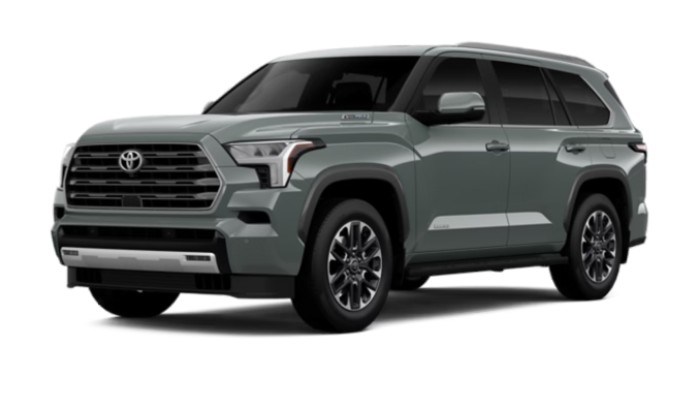
When we compare the Toyota Sequoia vs Nissan Armada, we are not choosing between two polite family crossovers designed primarily for school runs. These are genuine body-on-frame, three-row SUVs built to haul families, tow trailers, swallow luggage, and tackle roads that would make smaller SUVs reconsider their life choices.
The rivalry has also become considerably more interesting. Toyota transformed the Sequoia with its muscular i-FORCE MAX hybrid powertrain, while Nissan thoroughly reinvented the Armada around a twin-turbo V6, modern technology, improved off-road hardware, and a dramatically more upscale cabin.
For the 2026 model year, the Toyota produces 437 horsepower and 583 lb-ft of torque, can tow up to 9,500 pounds, and achieves up to an EPA-estimated 22 mpg combined. The regular Nissan Armada generates 425 horsepower and 516 lb-ft, with maximum towing rated at 8,500 pounds.
So Toyota wins on paper, right?
Not necessarily.
The Armada counters with a lower starting price, exceptional passenger space, strong technology, an available PRO-4X off-road model, adaptive air suspension on selected trims, and even a 460-horsepower NISMO version. The result is one of the closest full-size SUV battles we have seen in years.
Let's break it down.
Content in this publication
- Toyota Sequoia vs Nissan Armada at a Glance
- Powertrain Comparison: Hybrid Muscle vs Twin-Turbo Strength
- Which SUV Is Faster?
- Toyota Sequoia vs Nissan Armada Towing Capacity
- Fuel Economy: The Sequoia's Hybrid Advantage
- Interior Space and Passenger Comfort
- Which Has the Better Third Row?
- Interior Quality: Toyota Toughness or Nissan Luxury?
- Technology and Infotainment
- Toyota Sequoia vs Nissan Armada Off-Road
- Ride Quality and Highway Comfort
- Toyota Sequoia vs Nissan Armada Reliability
- Safety and Driver Assistance
- Trim Levels and Pricing
- Which SUV Is Better for Families?
- Which SUV Is Better for Towing?
- Which Is Better for Daily Driving?
- Sequoia vs Armada: Pros and Cons
- Toyota Sequoia vs Nissan Armada: Which Should We Buy?
- Final Verdict
- Frequently Asked Questions
- 1. Is the Toyota Sequoia better than the Nissan Armada?
- 2. Which can tow more, the Sequoia or Armada?
- 3. Is the Toyota Sequoia more fuel-efficient than the Nissan Armada?
- 4. Which is better off-road, Toyota Sequoia TRD Pro or Nissan Armada PRO-4X?
- 5. Which is cheaper, Toyota Sequoia or Nissan Armada?
Toyota Sequoia vs Nissan Armada at a Glance
Before diving into the details, here is the basic personality of each SUV.
| Category | Toyota Sequoia | Nissan Armada |
|---|---|---|
| Standard engine | 3.4L twin-turbo hybrid V6 | 3.5L twin-turbo V6 |
| Horsepower | 437 hp | 425 hp |
| Torque | 583 lb-ft | 516 lb-ft |
| Maximum towing | 9,500 lbs | 8,500 lbs |
| Seating | Up to 8 | Up to 8 |
| Construction | Body-on-frame | Body-on-frame |
| Fuel economy advantage | Yes | No |
| Dedicated off-road trim | TRD Pro | PRO-4X |
| Performance trim | No direct equivalent | NISMO |
| Starting MSRP | $65,725 | $58,840 |
Toyota lists the 2026 Sequoia from $65,725, while Nissan lists the Armada SV from $58,840, giving Nissan a meaningful entry-price advantage before options.
That price gap alone makes this comparison far more complicated than simply asking which SUV has the bigger numbers.
Powertrain Comparison: Hybrid Muscle vs Twin-Turbo Strength
Toyota Sequoia i-FORCE MAX
Every modern Sequoia revolves around Toyota's i-FORCE MAX powertrain.
It combines a twin-turbo V6 with an electric motor integrated into the drivetrain. The result is 437 horsepower and a stout 583 lb-ft of torque.
And that torque matters.
Press the accelerator and the Sequoia does not feel like a hybrid engineered primarily to stretch every gallon of fuel. Instead, the electric assistance behaves almost like another turbocharger. Torque arrives quickly, helping this large SUV move away from a stop with surprising urgency.
It feels more like a linebacker wearing running shoes than an eco-conscious family vehicle.
Why Toyota Uses Hybrid Power Here
The hybrid system serves several purposes simultaneously:
- It improves low-speed response.
- It increases torque.
- It supports towing performance.
- It reduces fuel consumption relative to many traditional full-size SUVs.
That last point is especially important because fuel costs can become painful when driving a vehicle this large.
Nissan Armada Twin-Turbo V6
The Armada follows a more conventional recipe but adds plenty of modern technology.
Its 3.5-liter twin-turbo V6 produces 425 horsepower and 516 lb-ft of torque, paired with a nine-speed automatic transmission.
That represents plenty of power for everyday driving, highway passing, carrying passengers, and pulling trailers.
The Armada also feels muscular in a way its naturally aspirated V8 predecessors did, although the character has changed. Instead of waiting for engine speed to build, the turbochargers provide a strong wave of torque.
The Armada NISMO Changes the Equation
There is one interesting exception.
For 2026, Nissan offers an Armada NISMO with a specially tuned version of the twin-turbo engine producing 460 horsepower. Nissan says its powertrain receives NISMO-specific tuning intended to strengthen performance through the middle and upper portions of the rev range.
That makes the NISMO the horsepower champion of this particular contest.
For most buyers, however, the normal 425-hp Armada is the more relevant comparison.
Which SUV Is Faster?
Neither manufacturer positions the standard Sequoia or Armada as a sports SUV, and neither vehicle is remotely small.
Still, the Sequoia's combination of electric torque and 583 lb-ft gives it impressive acceleration for such a substantial machine.
The Armada responds strongly as well, particularly once its turbochargers are working, while the 460-hp NISMO exists for buyers who want something more theatrical.
Our practical ranking is simple.
For immediate low-speed punch, we would favor the Sequoia.
For outright performance flavor, the Armada NISMO becomes the wildcard.
For ordinary family driving, both have more power than most owners will ever genuinely need.
Toyota Sequoia vs Nissan Armada Towing Capacity
This is one category where Toyota establishes a clear numerical advantage.
Sequoia Towing Capacity
Properly configured, the Toyota Sequoia can tow up to 9,500 pounds.
That puts it comfortably into serious towing territory.
A travel trailer, boat, pair of recreational vehicles, or moderately heavy equipment trailer fits naturally into the Sequoia's mission.
Its abundant torque also suits towing exceptionally well.
Armada Towing Capacity
The Nissan Armada can tow up to 8,500 pounds when properly equipped.
That is still substantial.
An 8,500-pound maximum is far beyond what the average SUV owner needs, and Nissan includes towing-focused equipment depending on configuration.
Towing Winner: Toyota Sequoia
If maximum trailer weight determines your purchase, the Toyota gets our vote.
A 1,000-pound advantage is significant enough that buyers regularly pulling heavy trailers should pay attention.
However, always compare the specific trim, drivetrain, passenger load, payload rating, tongue weight, and trailer configuration rather than relying exclusively on the headline maximum.
Fuel Economy: The Sequoia's Hybrid Advantage
Fuel economy may sound like an odd discussion when we are talking about enormous three-row SUVs.
Yet saving a few miles per gallon matters considerably over 15,000 or 20,000 miles of annual driving.
Toyota rates the 2026 Sequoia at up to an EPA-estimated 22 mpg combined, depending on configuration.
Certain versions are listed at an estimated 21 mpg city and 24 mpg highway, while heavier or more off-road-oriented configurations return lower figures.
The Armada cannot match those numbers.
According to Nissan's 2026 specifications, 2WD versions are estimated at 16 mpg city, 20 highway and 18 combined, while many 4WD models are rated at 16/19/17 mpg. The off-road-focused PRO-4X drops to an estimated 15/18/16 mpg.
Fuel Economy Winner: Toyota Sequoia
This one is straightforward.
If we drive frequently, especially around town, the Sequoia's hybrid technology can noticeably reduce fuel consumption.
Don't expect Prius numbers—this is still a massive SUV—but Toyota clearly wins the efficiency battle.
Interior Space and Passenger Comfort
Numbers tell only half the story when shopping for a three-row SUV.
The other half appears when seven people climb inside with backpacks, groceries, phones, water bottles, and enough luggage to recreate a small airport terminal.
The Nissan Armada is particularly impressive here.
Nissan lists 43.8 inches of front legroom, 39.2 inches in the second row, and 32.9 inches in the third row. Cargo volume behind the third row is listed at 20.4 cubic feet.
The generous third-row dimensions make the Armada appealing for families that genuinely use all three rows instead of treating the rearmost seats as an emergency bench.
Sequoia Interior Packaging
The Sequoia offers seating for as many as eight passengers and provides a broad, comfortable cabin.
Its biggest packaging compromise is related to the hybrid system and rear suspension layout. The cargo floor and third-row configuration are not as elegantly packaged as some competitors.
That does not make the Toyota impractical. Far from it.
You may be interested in reading Toyota Sequoia vs Honda Pilot: Which SUV Makes More Sense?
But if maximizing third-row and cargo usability is your priority, the Armada can feel like the more naturally spacious family machine.
Which Has the Better Third Row?
We would lean toward the Nissan Armada.
Adults can realistically spend time in its third row, and Nissan's latest interior architecture feels designed around actual three-row use.
The Sequoia remains perfectly capable for children and occasional adult passengers, but its packaging asks for a few more compromises.
Families with five children may therefore reach a different conclusion from couples who merely want an extra row available twice a year.
Context matters.
Interior Quality: Toyota Toughness or Nissan Luxury?
This is where the latest Armada makes its strongest impression.
Nissan has moved the cabin considerably upmarket.
Higher trims can include quilted leather seating, acoustic glass, a head-up display, massaging seats, sophisticated digital screens, and adaptive electronic air suspension. The Platinum Reserve sits especially close to luxury-SUV territory.
The Sequoia takes a slightly different approach.
Toyota combines chunky truck-inspired architecture with large displays and high-quality materials, especially in the Platinum, 1794 Edition, and Capstone.
The Capstone is the elegant choice.
The 1794 Edition leans toward western-inspired luxury.
The TRD Pro intentionally feels tougher and more adventurous.
Luxury Winner: Nissan Armada
This is subjective, but the latest Armada has arguably become the more polished luxury experience.
The Sequoia feels premium.
The Armada can feel almost like a luxury SUV wearing a Nissan badge.
Technology and Infotainment
Big SUVs need big screens, apparently, and neither manufacturer missed that memo.
The Sequoia offers Toyota's modern multimedia architecture, including an available 14-inch touchscreen with wireless Apple CarPlay and Android Auto compatibility.
It is large, responsive, and relatively straightforward.
Nissan answers with available 14.3-inch digital displays, Google built-in, wireless smartphone integration, multiple USB-C ports, available premium audio, and a sophisticated Around View Monitor system.
The Armada's available Invisible Hood View is especially clever off-road, using cameras to help drivers see terrain immediately in front of and beneath the vehicle.
Technology Winner: Nissan Armada
Toyota's interface is clean and easy.
Nissan simply throws more toys onto the table.
If digital technology matters heavily to us, the Armada holds a slight advantage.
Toyota Sequoia vs Nissan Armada Off-Road
This comparison becomes even more entertaining once pavement disappears.
Both vehicles use body-on-frame construction.
Both can be equipped with four-wheel drive.
Both have dedicated off-road variants.
But their personalities differ.
Toyota Sequoia TRD Pro
Toyota's TRD Pro badge carries genuine credibility.
The Sequoia TRD Pro is designed around serious trail capability, incorporating dedicated off-road suspension hardware, protection underneath the vehicle, aggressive tires, and Toyota's suite of terrain-management technology.
Toyota's decades-long association with vehicles such as the Land Cruiser, Tacoma, 4Runner, and Hilux also gives the company a particularly strong off-road reputation.
Who Should Buy the TRD Pro?
Choose it if your weekends regularly involve:
- Rocky trails
- Camping
- Snow
- Mud
- Remote roads
- Overlanding
- Rough boat ramps
This is not merely an appearance package.
Nissan Armada PRO-4X
Nissan has become much more serious about the Armada's off-road credentials.
The PRO-4X includes an electronic locking rear differential, black 20-inch wheels with all-terrain tires, and adaptive electronic air suspension, among other off-road-oriented features.
It also benefits from camera technology that can make placing such a large SUV on narrow trails significantly easier.
Off-Road Winner: Essentially a Tie
The Toyota has the deeper enthusiast reputation.
The Nissan has some extremely impressive hardware.
We would choose the Sequoia TRD Pro for traditional ruggedness and the Armada PRO-4X if we wanted off-road capability mixed with newer technology and adjustable suspension.
Ride Quality and Highway Comfort
Here's where the Armada quietly lands another punch.
Nissan uses an independent double-wishbone suspension architecture front and rear, and selected trims receive adaptive electronic air suspension.
That architecture helps it deliver a composed, sophisticated highway ride.
The Armada can shrink around the driver surprisingly well considering its dimensions.
Toyota's Sequoia remains comfortable, particularly on long interstate journeys, but its truck-related character is more apparent.
It feels sturdy.
The Nissan feels cushioned.
Road-Trip Winner: Nissan Armada
For interstate travel with six or seven passengers aboard, we give Nissan the advantage.
Its spacious cabin, comfortable suspension, and quieter luxury-focused trims create an excellent long-distance cruiser.
Toyota Sequoia vs Nissan Armada Reliability
Reliability is trickier than comparing horsepower.
Neither modern powertrain has decades of history behind it.
The Sequoia's current twin-turbo hybrid system is much more complicated than the naturally aspirated V8 used in older Sequoias, while the latest Armada has similarly moved from its previous V8 to a twin-turbo V6.
Toyota's broader reputation for long-term durability will naturally reassure some shoppers.
The Sequoia also receives substantial hybrid battery coverage. Toyota states that hybrid batteries on applicable vehicles are covered for 10 years or 150,000 miles, whichever comes first.
Still, we should resist claiming either 2026 SUV will unquestionably last longer. These particular configurations have not existed long enough for 10- or 15-year ownership data to settle the argument.
Potential Long-Term Ownership Winner: Sequoia
If resale value, brand reputation, and long-term ownership confidence dominate the decision, we would lean toward Toyota.
But we would not dismiss Nissan.
Modern Armada reliability should be judged on real-world data as the current generation ages.
Safety and Driver Assistance
Toyota equips the 2026 Sequoia with Toyota Safety Sense 2.5, including technologies such as pre-collision assistance with pedestrian detection and dynamic radar cruise control.
You may be interested in readingToyota Sequoia vs Honda Pilot: Which SUV Makes More Sense?You may be interested in reading
Toyota Sequoia vs Lexus GX: Which SUV Should We Buy?Nissan offers Safety Shield 360 along with ProPILOT Assist technology across the Armada lineup. More advanced ProPILOT functionality becomes available depending on trim and equipment.
Both vehicles therefore cover the mainstream active-safety essentials buyers expect from expensive family SUVs.
Driver-assistance systems should remain assistance systems, of course. A 5,000-plus-pound SUV still expects the person behind the steering wheel to pay attention.
Trim Levels and Pricing
2026 Toyota Sequoia Trims
Toyota offers six personalities:
- SR5
- Limited
- Platinum
- TRD Pro
- 1794 Edition
- Capstone
Official pricing begins at $65,725 for the SR5. Toyota lists the Limited from $71,495, Platinum from $81,735, TRD Pro from $82,465, 1794 Edition from $82,550, and Capstone from $86,135 before applicable fees and options.
Toyota has clearly spread the lineup across several missions.
The SR5 is the practical starting point.
Limited adds comfort.
Platinum moves upscale.
TRD Pro goes into the dirt.
1794 adds a distinctive luxury theme.
Capstone sits at the top.
2026 Nissan Armada Trims
The Armada lineup includes versions such as:
- SV
- SL
- Platinum
- PRO-4X
- NISMO
- Platinum Reserve
The 2026 SV begins at $58,840, SL at $63,530, Platinum at $70,490, PRO-4X at $74,300, NISMO at $79,530, and Platinum Reserve at $80,550 based on Nissan's published starting prices.
Value Winner: Nissan Armada
The Nissan starts thousands of dollars below the Toyota while offering an exceptionally strong standard engine.
That difference becomes difficult to ignore.
A shopper considering a base Sequoia could potentially step into a considerably better-equipped Armada for similar money.
Which SUV Is Better for Families?
For families, we would give the Armada a narrow win.
Why?
Its spacious rear seating, useful third row, comfortable highway manners, modern technology, and lower starting price make it easy to recommend.
The Sequoia is still an excellent family vehicle, especially if towing or fuel consumption matters.
But the Nissan feels slightly more optimized around transporting people.
Think of the Sequoia as an adventure truck that happens to seat eight.
The Armada increasingly feels like a luxury family lounge that happens to be built like a truck.
Which SUV Is Better for Towing?
Toyota Sequoia.
Its 9,500-pound maximum beats the Armada's 8,500-pound rating.
More importantly, the Toyota's 583 lb-ft of torque gives it the kind of low-speed muscle we want when pulling significant weight.
For frequent boat, camper, or trailer duty, Toyota gets our vote.
Which Is Better for Daily Driving?
The answer depends on the commute.
If fuel economy matters most, choose the Sequoia.
If comfort, passenger space, and luxury matter most, choose the Armada.
In dense urban environments, neither is exactly a compact hatchback. Parking garages may suddenly appear designed by people with a personal grudge against full-size SUV owners.
But the Armada's available camera systems make maneuvering easier than its dimensions suggest.
Sequoia vs Armada: Pros and Cons
Toyota Sequoia Pros
- Powerful 437-hp hybrid drivetrain
- Massive 583 lb-ft of torque
- Up to 9,500 pounds of towing capacity
- Better fuel economy
- Strong off-road TRD Pro variant
- Excellent brand reputation
- Broad range of luxury and rugged trims
Toyota Sequoia Cons
- Higher starting price
- Interior packaging could be better
- Third-row/cargo arrangement is not class-leading
- Hybrid complexity may concern traditional truck buyers
Nissan Armada Pros
- Lower starting price
- Powerful twin-turbo V6
- Spacious passenger compartment
- Excellent third-row usability
- Impressive technology
- Available adaptive air suspension
- Serious PRO-4X model
- 460-hp NISMO version
- Upscale Platinum Reserve trim
Nissan Armada Cons
- Worse fuel economy
- Maximum towing is lower
- New twin-turbo architecture has limited long-term history
- Upper trims can become expensive quickly
Toyota Sequoia vs Nissan Armada: Which Should We Buy?
After comparing these SUVs from almost every angle, there is no universal winner.
There are two different kinds of winners.
The Toyota Sequoia is the better choice if we prioritize towing, torque, fuel efficiency, ruggedness, and long-term ownership confidence.
The Nissan Armada is the better choice if we prioritize passenger comfort, interior space, technology, luxury, and value for money.
That distinction is important.
Toyota's strengths appear beneath the sheet metal. The hybrid drivetrain works hard, towing capacity is excellent, and the TRD Pro feels ready for serious adventure.
Nissan's strengths become immediately obvious from the driver's seat. The latest Armada feels spacious, polished, technically advanced, and surprisingly premium.
Our Overall Pick
For buyers who simply ask us which one we would choose for the broadest range of everyday uses, the Nissan Armada narrowly wins on value and family practicality.
Its substantially lower starting price makes that conclusion easier.
But if we tow regularly or expect to pile on huge annual mileage, we would spend the extra money on the Toyota Sequoia.
Sometimes the winner changes depending on what is attached to the trailer hitch.
Final Verdict
The Toyota Sequoia vs Nissan Armada battle has become far more competitive than it once was.
Toyota brings the technological hammer: a 437-horsepower hybrid system, 583 lb-ft of torque, impressive fuel efficiency for the segment, and up to 9,500 pounds of towing capacity.
Nissan responds with space, technology, luxury, lower pricing, excellent off-road equipment, and a twin-turbo powertrain that turns the Armada into something dramatically more modern than its predecessor.
For towing and efficiency, Sequoia wins.
For interior room and value, Armada wins.
For off-roading, TRD Pro and PRO-4X are remarkably close.
For performance enthusiasts, the 460-hp Armada NISMO offers something Toyota currently does not directly match.
Ultimately, we should not ask only which SUV is objectively better.
We should ask what kind of enormous SUV we actually need.
The Sequoia is the tougher workhorse with an efficient streak.
The Armada is the spacious luxury cruiser that recently discovered it enjoys lifting weights.
Either way, there is enough power, space, and capability here to make ordinary crossovers look rather small.
Frequently Asked Questions
1. Is the Toyota Sequoia better than the Nissan Armada?
The Toyota Sequoia is better for buyers who prioritize towing capacity, torque, fuel economy, and Toyota's established reputation for durable trucks and SUVs. The Nissan Armada is arguably better for buyers who want maximum passenger comfort, interior technology, luxury features, and a lower starting price.
2. Which can tow more, the Sequoia or Armada?
The Toyota Sequoia wins. Toyota rates the 2026 Sequoia for up to 9,500 pounds, while the Nissan Armada is rated for up to 8,500 pounds when properly configured.
3. Is the Toyota Sequoia more fuel-efficient than the Nissan Armada?
Yes. Toyota's hybrid powertrain gives the Sequoia a substantial efficiency advantage. Toyota quotes up to an EPA-estimated 22 mpg combined, while Nissan's published estimates generally range around 16–18 mpg combined, depending on Armada configuration.
4. Which is better off-road, Toyota Sequoia TRD Pro or Nissan Armada PRO-4X?
Both are highly capable. The Sequoia TRD Pro benefits from Toyota's extensive off-road experience and specialized TRD hardware. The Armada PRO-4X counters with an electronic locking rear differential, all-terrain tires, adaptive electronic air suspension, and sophisticated camera technology. Buyers focused on traditional ruggedness may favor Toyota, while those wanting technology and adjustable suspension may prefer Nissan.
You may be interested in readingToyota Sequoia vs Honda Pilot: Which SUV Makes More Sense?You may be interested in reading
Toyota Sequoia vs Lexus GX: Which SUV Should We Buy?You may be interested in reading
Toyota Sequoia vs Sienna: Which Toyota Fits Your Life Better?5. Which is cheaper, Toyota Sequoia or Nissan Armada?
The Nissan Armada is considerably cheaper at the entry level. The 2026 Armada SV starts at $58,840, compared with $65,725 for the 2026 Toyota Sequoia SR5, based on manufacturer-published starting MSRPs.
If you want to know other articles similar to Toyota Sequoia vs Nissan Armada: Which Full-Size SUV Wins? you can visit the category Models.
Haval Jolion vs Omoda C5: Which SUV Is Better?
Haval Jolion vs Chery Tiggo 4 Pro: Full Comparison
Haval Jolion vs H6: Which SUV Is Better in 2026?
Haval Jolion vs Toyota Corolla Cross: Which SUV Is Better?
Haval Jolion vs Jaecoo J5: Which SUV Is Better?
Volkswagen T-Cross vs Volkswagen T-Roc: Which Is Better?
Leave a Reply
More content of your interest