
Kia Rio vs Renault Clio: Which Small Hatchback Makes More Sense?

When we compare the Kia Rio vs Renault Clio, we are not just comparing two small hatchbacks. We are comparing two different attitudes toward everyday driving. The Kia Rio is the sensible friend who arrives on time, brings snacks, and never makes a fuss. The Renault Clio is the stylish one who knows the best café in town, dresses better than expected, and somehow makes a city commute feel a little more European.
Both cars live in the same broad small-car universe, but they do not speak with the same accent. The Rio has traditionally appealed to buyers who want value, reliability, simple ownership, and a practical cabin. The Clio, on the other hand, leans harder into design, refinement, technology, and fuel-efficient powertrains, especially in its newer hybrid versions.
There is also one important modern twist: in several markets, the Kia Rio has effectively become more of a used-car choice, while the Renault Clio continues as a current model in Europe and the UK. Kia has removed the Rio from some major new-car lineups, while Renault still promotes the Clio with petrol and full hybrid E-Tech options, including up to 391 litres of boot capacity and up to 65.7 mpg in current UK information.
So, which one should we choose? Let’s get into the real-world answer.
Content in this publication
- Kia Rio vs Renault Clio: Quick Overview
- Kia Rio vs Renault Clio: Design and Road Presence
- Kia Rio vs Renault Clio: Interior Quality
- Kia Rio vs Renault Clio: Space and Comfort
- Kia Rio vs Renault Clio: Engines and Performance
- Kia Rio vs Renault Clio: Fuel Economy
- Kia Rio vs Renault Clio: Driving Experience
- Kia Rio vs Renault Clio: Technology and Infotainment
- Kia Rio vs Renault Clio: Safety
- Kia Rio vs Renault Clio: Reliability and Ownership
- Kia Rio vs Renault Clio: Maintenance Costs
- Kia Rio vs Renault Clio: Value for Money
- Kia Rio vs Renault Clio: Used Car Buying Advice
- Kia Rio vs Renault Clio: Family Use
- Kia Rio vs Renault Clio: First Car Appeal
- Kia Rio vs Renault Clio: Long-Term Ownership
- Kia Rio vs Renault Clio: Pros and Cons
- Kia Rio vs Renault Clio: Which One Should We Buy?
- Kia Rio vs Renault Clio: Final Verdict
- FAQs About Kia Rio vs Renault Clio
Kia Rio vs Renault Clio: Quick Overview
At a glance, the Kia Rio is the more straightforward car. It is easy to understand, easy to drive, and usually easy to live with. It does not try to feel premium in the same way the Renault Clio does, but that is part of its charm. The Rio is like a good pair of sneakers: not dramatic, not flashy, but dependable when the day gets long.
The Renault Clio feels more polished, especially in later generations. It has a more expressive design, a more modern cabin, and stronger availability of hybrid technology. In newer form, the Clio also offers a wider tech package, including digital displays, connected infotainment, and a stronger list of driver assistance systems depending on trim. Renault says the latest Clio can offer up to 22 advanced driver assistance systems in the current UK range and up to 29 in the next-generation model preview.
The Basic Personality Difference
The Kia Rio is best for people who want:
- Simple ownership
- Good value on the used market
- Sensible running costs
- A practical small hatchback
- A car that does not feel complicated
The Renault Clio is best for people who want:
- More style
- Better cabin atmosphere
- Hybrid efficiency
- Stronger modern tech
- A more refined small-car experience
Neither car is “bad.” They simply serve different drivers.
Kia Rio vs Renault Clio: Design and Road Presence
Small cars can look anonymous. We have all seen hatchbacks that disappear into traffic like grey stones in a river. The Kia Rio and Renault Clio avoid that in different ways.
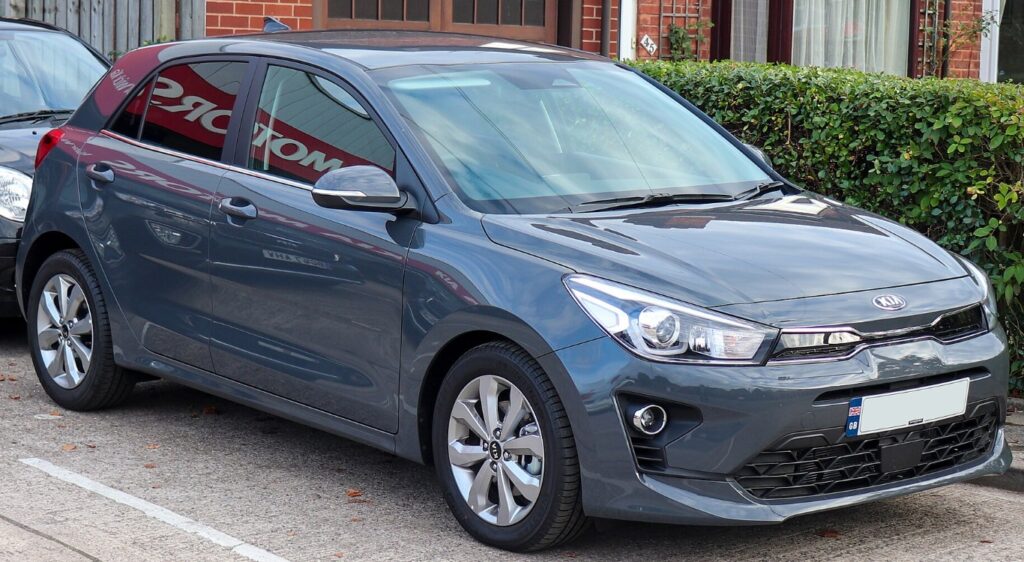
The Kia Rio has a clean, tidy shape. It is not loud, but it is balanced. Later versions look sharper than older ones, with a more confident front end and neat proportions. Still, the Rio plays it safe. It does not chase fashion. It wants to look modern enough without scaring off practical buyers.
The Renault Clio is more emotional. Renault has long understood that small cars do not need to look cheap. The Clio often feels like a miniaturized stylish European hatch rather than just an entry-level runabout. Its sculpted sides, distinctive lights, and more premium-looking nose give it a stronger showroom presence.
Which One Looks Better?
If we are judging pure style, the Renault Clio wins. It simply has more visual flair. It looks like someone spent extra time on the details.
But if we prefer a conservative car that does not shout, the Kia Rio still works beautifully. Some drivers do not want a hatchback that looks like it is wearing designer sunglasses. They just want something neat, friendly, and easy to park.
Kia Rio vs Renault Clio: Interior Quality
Inside, the difference becomes clearer. The Kia Rio cabin is functional, well laid out, and refreshingly simple. Buttons are usually where we expect them to be. Visibility is good. The seating position is easy to settle into. It feels like a car designed by people who know buyers do not want to fight the dashboard every morning.
The Renault Clio feels more sophisticated, especially in newer versions. The design is more stylish, the screen integration is more modern, and the materials tend to feel richer in the places we touch most often. Renault has pushed the Clio closer to the “small car with big-car mood” formula.
Cabin Practicality
The Rio’s strength is usability. It may not feel plush, but it is honest. We get enough storage for daily items, decent rear-seat access, and a dashboard that does not need a tutorial.
The Clio feels more upmarket, but depending on trim and generation, some controls may feel more tech-heavy. That is not necessarily a problem. For buyers who enjoy screens, digital displays, and a more designed interior, the Clio feels like the more exciting place to sit.
Interior Winner
The Renault Clio wins for style and perceived quality.
The Kia Rio wins for simplicity and no-nonsense usability.
Kia Rio vs Renault Clio: Space and Comfort
The small hatchback class is a game of millimetres. A few extra centimetres of legroom, a slightly wider cabin, or a deeper boot can change how useful the car feels.
The Kia Rio is compact but practical. Depending on market and year, later Kia Rio models are around 4.06 metres long, with boot figures commonly around 300 to 325 litres depending on version and measuring method. CarsGuide lists the 2023 Rio at roughly 4,065 to 4,070 mm long, while Automobile Dimension lists the 2021 Rio hatchback with 325 litres of boot space.
The Renault Clio is also compact, but current versions make clever use of space. Renault UK states that the Clio can offer up to 391 litres of boot space and up to 1,069 litres with the rear seats folded in the current range, though exact luggage capacity varies by powertrain and specification.
Rear Seat Comfort
Neither car is a limousine. Let’s be honest: if three adults are sitting across the back, nobody is writing a thank-you note afterward.
For children, teenagers, and shorter trips, both cars do the job. The Clio may feel more grown-up from the front seats, while the Rio often feels airy and easy to see out of. The Rio’s straightforward cabin shape can make it feel less claustrophobic, even when the numbers are close.
Boot Space Comparison
The Clio has the advantage if we are comparing newer models and maximum official boot claims. Its boot is one of the strongest points in the class. The Rio still offers useful cargo space, especially for grocery runs, gym bags, school backpacks, and weekend luggage.
Practical Space Verdict
For boot space, the Renault Clio has the edge.
For simple daily packaging, the Kia Rio remains very competitive.
Kia Rio vs Renault Clio: Engines and Performance
This is where the comparison depends heavily on year and market.
The Kia Rio has commonly been offered with small petrol engines, including naturally aspirated and turbocharged options in different regions. It was never designed to be a hot hatch. It is more about predictable performance, urban comfort, and low running costs.
The Renault Clio offers a broader modern powertrain story. Current UK information includes petrol and full hybrid E-Tech choices. Renault lists a full hybrid E-Tech 145 hp powertrain in the current Clio range, with combined fuel consumption of up to 65.7 mpg and CO₂ emissions from 98 g/km.
City Driving
In town, both cars feel at home. The Rio is light, easy, and friendly. Steering is simple, the car is compact, and parking does not feel like threading a sofa through a doorway.
The Clio, especially as a hybrid, can feel smoother in stop-start traffic. The electric assistance helps it move away quietly and efficiently, which is exactly what we want when crawling through city traffic.
Highway Driving
On faster roads, the Clio feels more mature in newer versions. It tends to feel more settled, better insulated, and more confident. The Rio can handle highway driving, of course, but it may feel more basic, especially with smaller engines or older automatic transmissions.
Performance Winner
For basic commuting, both are fine.
For stronger modern powertrain options, the Renault Clio wins.
Kia Rio vs Renault Clio: Fuel Economy
Fuel economy is a big reason people shop in this segment. A small car should sip fuel, not drink it like it has just crossed a desert.
You may be interested in reading Kia Rio vs Hyundai i10: Which Small Car Makes More Sense?
The Kia Rio can be economical, especially with smaller petrol engines and manual gearboxes. It is simple, light, and usually inexpensive to run. But because many Rio examples are now used cars in several markets, real-world economy depends on age, engine, maintenance, tyre condition, and driving style.
The Renault Clio has a major advantage with its hybrid options. Renault’s current UK Clio full hybrid E-Tech 145 hp is listed at up to 65.7 mpg combined, while the TCe petrol version is listed by Renault UK press material at up to 54.3 mpg, depending on specification and WLTP testing.
Which Is Cheaper to Fuel?
If we compare an older petrol Kia Rio with a newer Renault Clio hybrid, the Clio will likely be more efficient, especially in city driving.
If we compare used petrol vs used petrol, the gap narrows. In that case, purchase price, insurance, servicing, and condition may matter more than fuel economy alone.
Kia Rio vs Renault Clio: Driving Experience
The Kia Rio is easy to drive, but not especially exciting. That is not an insult. Many buyers do not want drama from a small hatchback. They want the car to start, steer, brake, and behave. The Rio does that well.
The Renault Clio feels a bit more polished. It has a more European driving flavour, with a better sense of composure in later models. It is not a sports car, but it can feel more agile, more settled, and more enjoyable on a winding road.
Steering and Handling
The Rio’s steering is light and practical. It is good for city driving, parking, and tight spaces.
The Clio’s steering often feels more connected. It gives the car a more playful character, like a small dog that still thinks it is a wolf.
Ride Comfort
The Clio tends to feel more refined over distance. The Rio is comfortable enough, but some versions can feel firmer or noisier on rough roads.
Driving Verdict
The Kia Rio is easier to like for simple driving.
The Renault Clio is easier to enjoy.
Kia Rio vs Renault Clio: Technology and Infotainment
Technology is another area where age matters. A newer Clio will naturally feel more advanced than an older Rio.
The Kia Rio offers the basics well in later models: touchscreen infotainment, smartphone connectivity on many trims, reversing camera availability, and straightforward controls. It is not overloaded, which many drivers will appreciate.
The Renault Clio goes further in newer versions. Renault highlights features such as digital driver displays, up to 9.3-inch multimedia screens in some current trims, wireless smartphone replication, connected navigation, and advanced driver assistance depending on version.
Which Has Better Tech?
The Clio wins if we are comparing newer cars. It feels more modern and offers more features.
But the Rio has a hidden advantage: simplicity. Not everyone wants a car that feels like a smartphone on wheels. Sometimes a few physical buttons and a clean screen are exactly what we need.
Kia Rio vs Renault Clio: Safety
Safety depends on generation, year, trim, and market. This is important because a base model in one country may not have the same safety equipment as a higher-trim model somewhere else.
The Renault Clio has traditionally performed strongly in safety, and newer versions include a wide range of driver assistance systems. Renault currently promotes the Clio with advanced assistance features such as emergency braking and adaptive cruise control on selected trims.
The Kia Rio also offered important safety features in later models, but availability varied. Some examples may include lane keeping assistance, autonomous emergency braking, reversing camera, and stability control depending on market and trim.
Used-Car Safety Tip
When shopping used, do not assume every Rio or Clio has the same safety kit. We should check the exact vehicle, not just the model name.
Look for:
- Autonomous emergency braking
- Lane keeping assistance
- Blind-spot monitoring
- Multiple airbags
- Stability control
- Reversing camera
- Parking sensors
- Full service and accident history
Safety Verdict
For newer cars, the Renault Clio has the stronger modern safety story.
For used cars, the winner depends on the exact trim and equipment.
Kia Rio vs Renault Clio: Reliability and Ownership
The Kia Rio has a strong reputation for sensible ownership. It is not a complicated car, and that often helps reliability. Fewer complex systems can mean fewer expensive surprises. Kia’s brand image has also been built around long warranties in many markets, which helped the Rio appeal to value-focused buyers.
The Renault Clio has improved significantly over generations. Modern Clios feel better built than older stereotypes may suggest. Still, because the Clio can include more complex hybrid systems, digital features, and advanced driver assistance, buyers should pay close attention to servicing and warranty coverage.
Which Is More Reliable?
For simple used-car ownership, the Kia Rio may feel safer, especially with a clean service history.
For newer-car ownership, the Renault Clio can be a very strong choice, especially if bought with warranty protection and proper servicing.
Ownership Reality
A well-maintained Clio is better than a neglected Rio.
A well-maintained Rio is better than a flashy Clio with hidden problems.
Condition is king.
Kia Rio vs Renault Clio: Maintenance Costs
The Kia Rio is usually affordable to maintain. Parts are generally reasonable, servicing is straightforward, and independent garages can usually handle routine work without drama.
The Renault Clio can also be affordable, but hybrid versions may require more specialist knowledge. That does not mean they are unreliable. It simply means buyers should respect the technology. A hybrid car is like a good espresso machine: brilliant when cared for, annoying when ignored.
Common Ownership Costs to Consider
Before buying either car, we should budget for:
- Oil and filter changes
- Brake pads and discs
- Tyres
- Battery replacement
- Suspension wear
- Air conditioning service
- Transmission servicing where applicable
- Hybrid system checks for Clio E-Tech models
Maintenance Verdict
The Kia Rio is likely cheaper and simpler for used-car maintenance.
The Renault Clio may cost more in some versions but offers stronger modern efficiency and tech.
Kia Rio vs Renault Clio: Value for Money
This may be the most important part of the whole comparison.
The Kia Rio shines as a used-car value choice. Because it is not as fashionable as some rivals, we may find good examples at attractive prices. It is practical, easy to drive, and sensible. For a first car, commuter car, or low-stress family runabout, it makes a lot of sense.
The Renault Clio offers stronger desirability. It looks better, feels more modern, and has more advanced powertrain options. That usually means it may cost more, especially in newer hybrid form. But it also gives us more car for the heart, not just the spreadsheet.
You may be interested in readingKia Rio vs Hyundai i10: Which Small Car Makes More Sense?You may be interested in reading
Kia Rio or Similar UK: The Smart Buyer’s Guide to Small Cars That Still Make SenseBest Value Depends on Buyer Type
Choose the Kia Rio if we want:
- Lower purchase price
- Simpler ownership
- Good basic practicality
- A dependable used hatchback
Choose the Renault Clio if we want:
- Better design
- Newer technology
- Hybrid efficiency
- More premium small-car feel
Kia Rio vs Renault Clio: Used Car Buying Advice
Since the Rio is no longer a current new-car option in various markets, many buyers will compare a used Kia Rio against a used or nearly new Renault Clio.
That changes the game.
A used Rio can be excellent value, but we need to inspect carefully. The same applies to the Clio. Small hatchbacks often live hard lives: city traffic, short trips, kerbed wheels, cheap tyres, missed services, and parking scars. They may look cute, but some have been through the daily battlefield.
What to Check on a Used Kia Rio
Before buying a Kia Rio, check:
- Full service history
- Engine oil condition
- Clutch feel on manual versions
- Smooth automatic shifts where applicable
- Suspension knocks
- Brake wear
- Air conditioning performance
- Infotainment and camera function
- Tyre condition and alignment
- Signs of accident repair
What to Check on a Used Renault Clio
Before buying a Renault Clio, check:
- Service history
- Hybrid system health if applicable
- Dashboard warning lights
- Infotainment screen performance
- Electrical features
- Gearbox smoothness
- Suspension noise
- Brake condition
- Tyre wear
- Software updates where relevant
Kia Rio vs Renault Clio: Family Use
Can these cars work for a small family? Yes, with realistic expectations.
The Kia Rio is good for school runs, errands, and local family use. It is easy to park, easy to clean, and not too precious. Parents may appreciate that.
The Renault Clio feels more mature and may offer better boot space in newer versions, which helps with pushchairs, shopping, and weekend bags. It also has a more comfortable cabin for longer drives.
Child Seats and Daily Life
Both cars can handle child seats, but rear-seat space is not huge. If we regularly carry rear-facing child seats, we should test the exact setup before buying. A car can look spacious on paper and still make the front passenger sit with their knees in the glovebox.
Family Verdict
For budget family use, the Rio is a strong choice.
For a more polished small family car, the Clio is better.
Kia Rio vs Renault Clio: First Car Appeal
Both cars are excellent first-car candidates, but again, for different reasons.
The Kia Rio is calm and predictable. It is not intimidating. It feels like a car that helps new drivers build confidence.
The Renault Clio has more personality. It may appeal more to younger drivers who want something stylish but still practical.
Insurance and Running Costs
Insurance depends on engine, trim, age, driver profile, location, and claims history. Generally, smaller petrol versions of both cars should be reasonable to insure, while newer, more powerful, or hybrid versions may cost more.
For first-time buyers, the best version is usually not the flashiest one. A modest engine, good tyres, clean history, and affordable insurance matter more than big wheels or sporty trim.
Kia Rio vs Renault Clio: Long-Term Ownership
If we plan to keep the car for many years, the Kia Rio has a strong argument. It is simple, durable, and practical. As long as parts remain available and the car is maintained, it can be a faithful companion.
The Renault Clio is better if we want a car that feels current for longer. Its design, tech, and hybrid efficiency may age better in markets where fuel economy and emissions matter more each year.
Resale Value
The Clio may hold stronger appeal because it is a more popular and stylish nameplate in many European markets. The Rio may depreciate more gently if bought used at the right price, because much of the depreciation has already happened.
Long-Term Verdict
Buy the Rio if we want simple long-term value.
Buy the Clio if we want modern features and stronger future-facing efficiency.
Kia Rio vs Renault Clio: Pros and Cons
Kia Rio Pros
- Simple and easy to drive
- Good used-car value
- Practical cabin
- Sensible running costs
- Straightforward maintenance
- Good choice for first-time buyers
- Less complicated than many newer rivals
Kia Rio Cons
- Less stylish than the Clio
- Fewer modern powertrain options
- No longer widely available new in several markets
- Cabin can feel basic
- Less refined on longer drives
Renault Clio Pros
- More stylish exterior
- Better interior atmosphere
- Available hybrid efficiency
- Stronger modern technology
- Good boot space in newer versions
- More refined driving experience
- Stronger current model presence
Renault Clio Cons
- Can cost more to buy
- Hybrid versions may be more complex
- Tech-heavy cabin may not suit everyone
- Used examples need careful inspection
- Some trims offer better value than others
Kia Rio vs Renault Clio: Which One Should We Buy?
The best choice depends on what we value most.
If we want the smartest used-car purchase, the Kia Rio deserves serious attention. It is practical, honest, and usually cheaper to buy. It does not try to impress everyone, and that is exactly why it works. The Rio is the car equivalent of a reliable backpack: not glamorous, but always useful.
If we want the better all-round modern small hatchback, the Renault Clio wins. It looks better, feels better inside, offers stronger fuel-efficient technology, and has a more refined driving experience. It is the car we choose when we want our daily commute to feel less like a chore and more like a small ritual.
Our Simple Recommendation
Buy the Kia Rio if budget, simplicity, and used-car dependability matter most.
Buy the Renault Clio if style, technology, hybrid economy, and modern refinement matter more.
Kia Rio vs Renault Clio: Final Verdict
The Kia Rio vs Renault Clio comparison is not a fight where one car knocks the other out in the first round. It is more like choosing between a practical watch and a stylish smartwatch. Both tell the time. One is simpler. The other does more.
The Kia Rio is the better choice for buyers who want a dependable, affordable, easy-going hatchback. It is especially appealing as a used car, where value becomes its strongest weapon.
The Renault Clio is the better car overall if we judge design, cabin feel, technology, fuel economy, and modern appeal. Its hybrid options make it especially attractive for city drivers who want efficiency without plugging in.
So, our final answer is this: the Renault Clio is the stronger modern hatchback, but the Kia Rio may be the smarter budget buy. If the Clio is the polished café espresso, the Rio is the reliable home coffee maker. One has more flair. The other gets the job done every morning.
FAQs About Kia Rio vs Renault Clio
1. Is the Kia Rio better than the Renault Clio?
The Kia Rio is better if we want a simple, affordable, used small car with easy ownership. The Renault Clio is better if we want stronger design, better technology, more refinement, and hybrid efficiency.
2. Is the Renault Clio more fuel-efficient than the Kia Rio?
In newer hybrid form, yes, the Renault Clio is likely more fuel-efficient than most petrol Kia Rio models. Renault lists the current Clio full hybrid E-Tech 145 hp at up to 65.7 mpg combined in UK information.
3. Is the Kia Rio still available new?
In several markets, the Kia Rio is no longer widely available as a new car. Reports show it was discontinued from the European market, and Kia’s newer small-car strategy has shifted toward other models in various regions.
4. Which car has more boot space, Kia Rio or Renault Clio?
Newer Renault Clio versions generally offer more boot space. Renault UK lists up to 391 litres in the current Clio range, while later Kia Rio hatchback figures are commonly around 300 to 325 litres depending on model and market.
You may be interested in readingKia Rio vs Hyundai i10: Which Small Car Makes More Sense?You may be interested in reading
Kia Rio or Similar UK: The Smart Buyer’s Guide to Small Cars That Still Make SenseYou may be interested in reading
Kia Rio vs Hyundai i20: Which Small Hatchback Makes More Sense?5. Which is better for first-time drivers, Kia Rio or Renault Clio?
Both can work well. The Kia Rio is simpler and often cheaper as a used car, making it great for first-time drivers on a budget. The Renault Clio feels more stylish and modern, but may cost more depending on trim, engine, and insurance.
If you want to know other articles similar to Kia Rio vs Renault Clio: Which Small Hatchback Makes More Sense? you can visit the category Models.
Kia Rio vs Toyota Yaris: Which Small Car Makes More Sense?
Kia Rio vs Hyundai i20: Which Small Hatchback Makes More Sense?
Kia Rio or Similar UK: The Smart Buyer’s Guide to Small Cars That Still Make Sense
Kia Rio vs Hyundai i10: Which Small Car Makes More Sense?
Kia Rio vs VW Polo: Which Small Hatchback Makes More Sense?
Kia Rio vs Skoda Fabia: Which Small Hatchback Makes More Sense?
Leave a Reply
More content of your interest