
BYD Shark 6 2025 vs 2026: What Actually Changed?

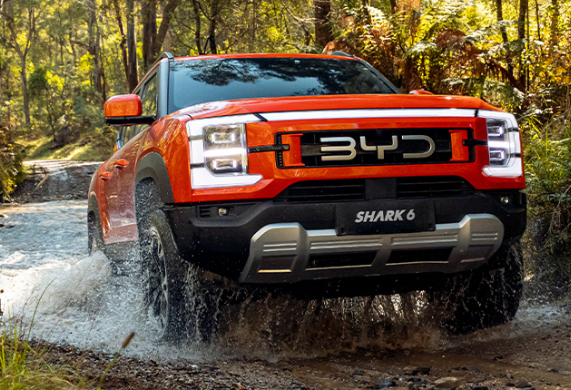
The BYD Shark 6 2025 vs 2026 comparison is more interesting than a typical model-year update. This is not simply a story of a new grille, different wheels, and a few extra USB ports. Instead, BYD has transformed the Shark 6 from a one-version experiment into a proper ute family.
In Australia, the 2025 Shark 6 arrived essentially as a single Premium dual-cab model, priced at $57,900 before on-road costs. It combined a 1.5-litre turbocharged petrol engine with two electric motors, a 29.58kWh Blade battery, 321kW of combined power, 650Nm of torque, and a 2500kg braked towing capacity.
For 2026, BYD has widened the net considerably. The Premium remains, but it now sits between a work-oriented Dynamic Cab Chassis and a substantially upgraded Performance model. The Performance gets a 2.0-litre turbo engine, 350kW, 700Nm, 3500kg braked towing and a new Crawl mode designed to improve low-speed off-road ability.
So, is the 2026 Shark 6 genuinely better than the 2025 model? Well, that depends on which 2026 version we're talking about. If we compare Premium with Premium, the changes are surprisingly modest. If we compare the old Shark 6 with the new Performance, the difference is much more substantial.
Let's untangle it properly.
Content in this publication
- BYD Shark 6 2025 vs 2026: Quick Comparison
- What Was the 2025 BYD Shark 6?
- What Changed for the 2026 BYD Shark 6?
- 2026 BYD Shark 6 Dynamic Cab Chassis
- 2026 BYD Shark 6 Premium
- 2026 BYD Shark 6 Performance
- 2025 vs 2026 Shark 6 Towing Capacity
- 2025 vs 2026 Off-Road Capability
- BYD Shark 6 2025 vs 2026 Fuel Economy
- Electric Range: 2025 vs 2026
- Battery and Charging Differences
- Dimensions: Has the 2026 Shark 6 Grown?
- Payload and Weight Differences
- Interior and Technology Changes
- Exterior Design: Can We Tell Them Apart?
- BYD Shark 6 2025 vs 2026 Price
- Is a 2025 Shark 6 Still Worth Considering?
- When Does the 2026 Performance Make More Sense?
- 2025 Premium vs 2026 Premium: Is Upgrading Worth It?
- Which BYD Shark 6 Fits Which Type of Owner?
- What Should We Check Before Buying Either Model Year?
- Closing Thoughts: The 2026 Shark 6 Is About Choice, Not Just a Facelift
- FAQs About BYD Shark 6 2025 vs 2026
- 1. What is the main difference between the 2025 and 2026 BYD Shark 6?
- 2. Does the 2026 BYD Shark 6 tow 3500kg?
- 3. Is the 2026 Shark 6 Premium more powerful than the 2025 Premium?
- 4. Does the 2026 BYD Shark 6 have a bigger battery?
- 5. Is the 2026 Shark 6 Performance better off-road than the 2025 model?
BYD Shark 6 2025 vs 2026: Quick Comparison
Here is the simplest way to understand the Australian-market changes.
| Specification | 2025 Shark 6 Premium | 2026 Premium | 2026 Performance |
|---|---|---|---|
| Engine | 1.5L turbo petrol | 1.5L turbo petrol | 2.0L turbo petrol |
| Drivetrain | AWD PHEV | AWD PHEV | AWD PHEV |
| Combined power | 321kW | 321kW | 350kW |
| Combined torque | 650Nm | 650Nm | 700Nm |
| 0-100km/h | 5.7 sec | 5.7 sec | 5.5 sec |
| Battery | 29.58kWh | 29.6kWh | 29.6kWh |
| Braked towing | 2500kg | 2500kg | 3500kg |
| Kerb weight | 2710kg | 2710kg | 2775kg |
| Fuel tank | 60L | 60L | 60L |
| Wheel size | 18-inch | 18-inch | 18-inch |
| Price before on-roads | $57,900 | $57,900 | $62,900 |
The 2026 official specification sheet confirms the Premium retains the familiar 321kW/650Nm drivetrain, while the Performance moves to 350kW/700Nm and a 3500kg tow rating.
That immediately tells us something important: a 2026 badge does not automatically mean more power or towing capacity. Those headline upgrades belong primarily to the Performance.
What Was the 2025 BYD Shark 6?
The original Shark 6 landed with a remarkably straightforward range strategy: one ute, one high-specification Premium grade.
When Australian orders opened, the Shark 6 Premium was listed at $57,900 before on-road costs. Rather than creating half a dozen grades, BYD packed the original model with equipment and let the unusual plug-in hybrid drivetrain do most of the talking.
It was an unusual approach in a ute segment accustomed to sprawling ranges involving workhorses, mid-spec family models, luxury variants and performance flagships.
The Shark essentially walked into the room wearing its best clothes from day one.
That simplicity is one reason a used or remaining-stock 2025 Shark 6 is relatively easy to understand. If someone says they have a MY25 Shark 6 in Australia, they are overwhelmingly talking about the Premium dual-cab.
2025 Shark 6 Powertrain
Underneath, the 2025 model combines a 1.5-litre turbocharged petrol engine with a front and rear electric motor.
The official figures include:
- 135kW and 260Nm from the petrol engine
- 170kW and 310Nm front electric motor
- 150kW and 340Nm rear electric motor
- 321kW maximum combined power
- 650Nm maximum combined torque
- AWD
- 5.7-second claimed 0-100km/h time
BYD's 2025 specification sheet confirms those figures.
Those numbers remain impressive even by 2026 ute standards. The Shark does not feel like a conventional diesel dual-cab that gradually builds momentum; electrically assisted torque gives it much more immediate responses.
Battery and Electric Driving
The 2025 Shark carries a 29.58kWh BYD Blade battery and supports up to 7kW AC charging and 55kW DC charging. BYD quoted 100km of electric driving under its specified NEDC methodology and an 800km combined-range figure.
Those figures require context, though.
Plug-in hybrid consumption depends enormously on how frequently we charge. If the battery has plenty of energy available, short commutes can be completed with relatively little petrol use. Once the battery reaches its lower operating state of charge, the petrol engine naturally has to contribute more.
That's why treating a PHEV's headline fuel figure exactly like a diesel ute's consumption number can be misleading.
The Charging Habit Matters More Than the Brochure Number
If we plug the Shark in regularly, its large battery is a major part of the ownership equation.
If we never plug it in, we're carrying a large battery around without extracting its biggest everyday advantage.
Simple, but easy to overlook.
What Changed for the 2026 BYD Shark 6?
The biggest 2026 development is not that BYD reinvented the existing Premium. It is that the range expanded from one main configuration into three distinct personalities.
BYD's current Australian lineup consists of:
- Dynamic Cab Chassis
- Premium Pickup
- Performance Pickup
The Dynamic starts at $55,900 before on-road costs, the Premium is $57,900, and the Performance is $62,900.
That makes the 2026 range much easier to tailor to a particular job.
2026 BYD Shark 6 Dynamic Cab Chassis
The Dynamic is arguably the most strategically important addition even though it is not the glamorous one.
A Shark Designed More for Work
Instead of the integrated pickup tub, the Dynamic uses a cab-chassis configuration that allows an appropriate tray or body to be installed.
Mechanically, it retains the familiar:
- 1.5-litre turbo hybrid engine
- Dual electric motors
- AWD layout
- 321kW combined output
- 650Nm combined torque
- 2500kg braked towing capacity
BYD lists a 12.8-inch touchscreen for the Dynamic rather than the 15.6-inch display used by the Premium and Performance.
Its kerb weight is listed at 2600kg in standard cab-chassis form, although the final working weight naturally changes once a tray, body and accessories are added.
Why the Dynamic Matters
The original Shark 6 was more family-adventure ute than stripped-back work truck.
Dynamic changes that equation.
Fleet operators, businesses and owners who want specialised trays now have a factory Shark variant built around that use case rather than modifying a Premium pickup.
It broadens the Shark's audience considerably.
Here comes the part many buyers misunderstand.
Move from a 2025 Premium into a 2026 Premium and you do not suddenly receive the Performance model's 2.0-litre engine.
The 2026 Premium still has:
- 1.5-litre turbo engine
- 321kW combined power
- 650Nm
- 5.7-second 0-100km/h claim
- 29.6kWh Blade battery
- 60-litre fuel tank
- 2500kg braked towing
- 2710kg kerb weight
- 18-inch wheels
- 230mm unladen ground clearance
Those figures line up extremely closely with the original 2025 specification.
Think of the 2026 Premium as the continuation of the original Shark formula rather than Shark 6 Version 2.0.
2026 BYD Shark 6 Performance
This is where 2026 becomes significantly more interesting.
A Larger 2.0-Litre Turbo Engine
The Performance replaces the Premium's 1.5-litre petrol engine with a 2.0-litre turbocharged petrol engine.
The petrol engine itself is rated at 180kW and 380Nm, according to BYD's current specifications. The front electric motor output also rises, while the rear motor remains part of the dual-motor arrangement.
Combined system output becomes:
350kW and 700Nm.
That's an increase of 29kW and 50Nm over the 2025/2026 Premium.
Acceleration Improves, but Only Slightly
You might expect another 29kW to turn the Performance into a dramatically faster machine.
Not quite.
The claimed 0-100km/h time improves from 5.7 seconds to 5.5 seconds.
So the additional output is less about creating a drag-strip ute and more about giving BYD additional capability under heavier loads.
And that leads us to the biggest upgrade.
2025 vs 2026 Shark 6 Towing Capacity
If towing is central to the decision, this could be the most important section of the entire comparison.
You may be interested in reading Test Drive Review: The Fiat 500 Abarth 0-60 Acceleration
2025 Shark 6: 2500kg
The 2025 Premium carries a maximum 2500kg braked towing capacity and 750kg unbraked rating.
For lighter boats, trailers and caravans, that can be plenty.
But 2500kg left the original Shark below the 3500kg benchmark commonly offered by mainstream dual-cab rivals.
Buying a newer Premium doesn't solve that particular limitation.
The official MY26 specification still lists the Premium at 2500kg braked towing.
That's an important detail when searching used listings because "2026 Shark" alone tells us very little.
2026 Performance: 3500kg
The Performance raises the limit to 3500kg braked.
It also gets a 350kg maximum towball download figure compared with 250kg for the Dynamic and Premium.
For anyone towing something between 2500kg and 3500kg, the Performance isn't simply a nicer trim. It belongs to a different capability bracket.
2025 vs 2026 Off-Road Capability
The Shark 6 uses BYD's DMO architecture and an electrically driven AWD system rather than following the exact mechanical recipe of a traditional diesel 4WD ute.
That creates strengths and compromises.
The Original Shark Relied Heavily on Electronics
The 2025 model offered terrain modes including Mud, Sand, Snow and Mountain, alongside hill-descent and electronic stability systems.
However, independent testing highlighted limitations in difficult low-speed, slippery climbs, where its electronically managed drivetrain could struggle compared with traditional systems equipped with low-range gearing or locking differentials.
2026 Performance Adds Crawl Mode
BYD responded with a new Crawl mode on the Performance.
According to launch information, Crawl mode operates at very low speeds and is intended to improve progress across rocks, steep climbs, deep ruts and soft surfaces by more effectively coordinating the petrol engine and electric drivetrain.
It does not magically turn the Shark into a traditional ute with low-range gearing and locking differentials.
But it directly addresses a weakness identified in the earlier vehicle.
Software Could Narrow the Gap Further
BYD Australia also announced plans during 2026 to roll its new off-road mode more broadly across the Shark 6 range. Because software equipment can depend on production timing and over-the-air updates, buyers should check the actual software installed in a specific vehicle rather than assuming every MY26 Shark has identical functionality.
BYD Shark 6 2025 vs 2026 Fuel Economy
This is where we need to resist comparing numbers blindly.
The 2025 Premium was quoted at 2.0L/100km with sufficient battery state of charge and 7.9L/100km once battery charge was below the specified threshold.
The 2026 specification lists:
- Dynamic: 2.0L/100km under the stated NEDC sufficient-charge test
- Premium: 2.0L/100km under the stated NEDC sufficient-charge test
- Performance: 1.3L/100km under WLTP sufficient-charge testing
BYD also lists 10.5L/100km for the Performance in the low-state-of-charge WLTP measurement.
Don't Read 1.3 vs 2.0 as a Direct Victory
Why?
Because the official figures are presented using different test cycles.
The Premium figures use NEDC in the current specification sheet, whereas the Performance values are labelled WLTP. That makes a simplistic "1.3 is 35% better than 2.0" conclusion inappropriate.
Real consumption will depend heavily on:
- charging frequency,
- trip length,
- towing,
- payload,
- temperature,
- speed,
- terrain,
- and how often the petrol engine is required.
For a PHEV ute, the wall socket can influence fuel consumption almost as much as the accelerator pedal.
Electric Range: 2025 vs 2026
The 2025 Premium carries a claimed 100km electric range under NEDC within BYD's stated test conditions.
The 2026 Dynamic and Premium remain at 100km NEDC, while the Performance is listed at 80km WLTP in BYD's current detailed specification sheet.
Again, different test protocols mean we shouldn't treat 100km versus 80km as a clean 20-percent reduction.
What we can say confidently is that the Performance continues to use a roughly 29.6kWh Blade battery but prioritises additional power and towing capability.
Battery and Charging Differences
There is remarkably little drama here.
Both generations use BYD's Blade battery technology, with the original officially stated at 29.58kWh and the latest sheet rounding capacity to 29.6kWh.
Charging remains:
AC Charging
Up to 7kW Type 2.
DC Charging
Up to 55kW CCS2.
Vehicle-to-Load
V2L remains available, allowing the vehicle's high-voltage battery to power compatible external equipment.
So anyone waiting for MY26 solely because they expected radically faster charging will not find that leap here.
Dimensions: Has the 2026 Shark 6 Grown?
For the regular pickups, no meaningful dimensional transformation has occurred.
The Premium measures:
- 5457mm long
- 1971mm wide
- 1925mm high
- 3260mm wheelbase
- 230mm unladen ground clearance
Those measurements carry from the 2025 Premium into the MY26 pickup range.
The Dynamic cab-chassis is slightly different at 5413mm before allowing for the fitted tray configuration.
In other words, don't expect the MY26 Premium to occupy a different parking space. It is essentially the same large ute footprint.
Payload and Weight Differences
Weight deserves more attention than it usually receives because a ute can have spectacular towing numbers while still running into GVM or combined-mass constraints.
The 2025 and 2026 Premium are both listed at approximately 2710kg kerb weight with a 3500kg GVM, producing a nominal difference of 790kg before considering the exact vehicle configuration and fitted accessories.
The Performance weighs 2775kg while retaining a 3500kg GVM, so its additional hardware consumes some theoretical payload headroom even though towing capability rises substantially.
That's the paradox: the stronger tow vehicle is also the heavier ute.
Towing Capacity Is Only One Number in the Equation
When towing near maximum capacity, we also need to consider:
- passengers,
- luggage,
- towball download,
- accessories,
- tray contents,
- GVM,
- gross combined mass,
- and axle limits.
The badge on the tailgate doesn't repeal physics.
Interior and Technology Changes
The Shark's cabin remains one of its most distinctive traits.
The 2025 Premium specification included a 15.6-inch touchscreen, 10.25-inch instrument display, head-up display, heated and ventilated front seats, wireless smartphone integration, wireless charging and a Dynaudio audio system.
The 2026 Premium preserves the same general high-tech atmosphere.
2026 Performance Gets Google Automotive Services
The current MY26 specification sheet lists Google Automotive Services with Google Maps for the Performance, while BYD's own specification document still distinguishes equipment between variants.
BYD also announced during 2026 that additional Google integration was planned for selected Shark 6 grades.
You may be interested in readingTest Drive Review: The Fiat 500 Abarth 0-60 AccelerationYou may be interested in reading
 Customizing Your Ride: A Comprehensive Guide to the Fiat 500 Body Kit
This is an area where software updates can blur traditional model-year boundaries.
A late-production vehicle may not behave exactly like an early-production example carrying the same badge.
Audio Specification Has Also Shifted
Interestingly, the 2025 official brochure describes a 12-speaker Dynaudio system, while the current 2026 specification lists an 11-speaker Dynaudio system.
It's a tiny detail, but it reinforces a broader lesson: newer does not necessarily mean every individual specification increases.
Exterior Design: Can We Tell Them Apart?
This isn't a dramatic facelift.
The familiar blocky nose, squared body, large BYD branding and muscular dual-cab proportions continue into 2026.
Even the Performance is surprisingly subtle from the outside.
BYD has concentrated more heavily on what sits underneath rather than dressing the Performance like a cartoonishly aggressive sports ute.
That's probably a wise choice. The Shark already has enough visual presence to make a compact hatchback beside it look like a lunchbox.
BYD Shark 6 2025 vs 2026 Price
Here is another surprise.
The 2025 Premium launched at $57,900 before on-road costs, and the 2026 Premium remains listed at $57,900.
The broader 2026 structure is:
- Dynamic Cab Chassis: $55,900 before on-road costs
- Premium: $57,900 before on-road costs
- Performance: $62,900 before on-road costs
That makes the Performance's extra mechanical capability a $5000 step above Premium at list price.
Of course, dealer pricing, promotions, demonstrators and remaining MY25 stock can completely reshape the real-world equation.
Is a 2025 Shark 6 Still Worth Considering?
Absolutely—provided its specifications match what we actually need.
Mechanically, the 2025 Premium remains remarkably close to the 2026 Premium.
It still gives us:
321kW, 650Nm, fast acceleration, a sizeable plug-in battery, AWD, a luxurious cabin, V2L and plenty of standard equipment.
If a dealer or used-car seller discounts a MY25 substantially below an equivalent 2026 Premium, the older badge alone shouldn't scare us away.
Where the 2025 Model Makes the Most Sense
A 2025 Premium becomes especially interesting when:
- we don't need to tow more than 2500kg,
- we're comfortable with its off-road limitations,
- we want the established Premium equipment level,
- and the purchase price is meaningfully below a newer vehicle.
In that situation, we're not giving up 29kW because the regular MY26 Premium doesn't receive it either.
When Does the 2026 Performance Make More Sense?
The Performance is easier to justify when the extra capability is actually useful.
Its strongest arguments are:
- 3500kg braked towing,
- 350kW,
- 700Nm,
- 2.0-litre turbo engine,
- Crawl mode,
- upgraded braking/suspension-related changes,
- and the additional technology associated with the flagship specification.
If we're towing a heavy caravan, for example, the difference between 2500kg and 3500kg isn't an abstract specification-sheet victory.
It can determine whether the trailer can legally be towed by the vehicle at all.
This is probably the most important question for existing owners.
If we already own a 2025 Premium and are considering swapping it for a 2026 Premium simply because it is newer, the mechanical incentive is limited.
Core drivetrain output remains 321kW/650Nm. Towing remains 2500kg. Acceleration remains 5.7 seconds. Dimensions and battery architecture are fundamentally familiar.
The much more significant jump is:
2025 Premium → 2026 Performance
rather than:
2025 Premium → 2026 Premium.
That distinction can save someone thousands of dollars and a great deal of confusion.
Which BYD Shark 6 Fits Which Type of Owner?
We find one at a strong price and want the original high-specification Shark experience without needing 3.5-tonne towing.
Choose a 2026 Dynamic When
We need a cab-chassis platform for work, trays or specialised commercial equipment.
We want the established Shark recipe in a current-model vehicle and 2500kg towing is sufficient.
Choose a 2026 Performance When
Heavy towing and improved low-speed off-road performance matter enough to justify the extra purchase price and weight.
There isn't one universally superior answer because BYD has deliberately made the 2026 range more specialised.
What Should We Check Before Buying Either Model Year?
Model-year comparisons are useful, but build date and actual specification matter more than we'd sometimes like to admit.
Before signing anything, we would verify:
- Exact model grade and model year
- Build and compliance dates
- 2500kg or 3500kg towing rating
- Current software version and available OTA updates
- Installed infotainment functions
- Payload after accessories
- Towball and combined-mass limits
- Whether a cab-chassis price includes a tray
- Charging cable and V2L equipment supplied
- Current dealer or manufacturer promotions
This matters particularly with the Shark because software functions have evolved during its relatively short life.
Closing Thoughts: The 2026 Shark 6 Is About Choice, Not Just a Facelift
The easiest way to summarise BYD Shark 6 2025 vs 2026 is this: the 2025 vehicle introduced the idea, while the 2026 lineup expands what we can do with it.
The original Shark 6 Premium already had the important ingredients—321kW, 650Nm, dual-motor AWD, a large Blade battery, quick acceleration and an unusually polished interior for a ute.
The 2026 Premium doesn't throw that recipe in the bin. It largely carries it forward.
Instead, BYD has stretched the Shark in two directions. The Dynamic moves toward commercial work with its cab-chassis body, while the Performance moves toward higher towing capability and stronger low-speed off-road performance with its 2.0-litre hybrid system, 350kW output and 3500kg tow rating.
That makes the decision pleasantly straightforward once we stop focusing solely on the year printed in the advertisement.
A discounted MY25 Premium can still be a compelling proposition. A MY26 Premium is not mechanically transformed simply because the calendar changed. And the Performance is the one to examine closely if the shortcomings of the original Shark—particularly towing—were what kept us away.
Sometimes a model-year update is fresh paint.
This time, BYD simply built a bigger toolbox.
FAQs About BYD Shark 6 2025 vs 2026
1. What is the main difference between the 2025 and 2026 BYD Shark 6?
The biggest difference is the expanded 2026 range. The 2025 Australian lineup centred on the Premium with a 1.5-litre PHEV system producing 321kW and 650Nm. For 2026, BYD added the Dynamic Cab Chassis and Performance. The Performance uses a 2.0-litre turbo hybrid system producing 350kW and 700Nm.
2. Does the 2026 BYD Shark 6 tow 3500kg?
Only the 2026 Shark 6 Performance is rated to tow up to 3500kg braked in the current Australian specification. The 2026 Dynamic and Premium remain rated at 2500kg braked.
No. Both are rated at 321kW and 650Nm, with a claimed 0-100km/h time of 5.7 seconds. The more powerful 350kW/700Nm drivetrain belongs to the 2026 Performance.
4. Does the 2026 BYD Shark 6 have a bigger battery?
Not meaningfully. The 2025 specification lists a 29.58kWh Blade battery, while the 2026 specification rounds battery capacity to 29.6kWh across the range. Charging remains up to 7kW AC and 55kW DC.
5. Is the 2026 Shark 6 Performance better off-road than the 2025 model?
It introduces an important improvement called Crawl mode, designed to improve low-speed traction on steep, rocky, rutted or slippery surfaces. However, the Shark continues to rely on its electronically managed AWD architecture rather than adopting traditional low-range gearing and locking differentials
You may be interested in readingTest Drive Review: The Fiat 500 Abarth 0-60 AccelerationYou may be interested in reading
Customizing Your Ride: A Comprehensive Guide to the Fiat 500 Body KitYou may be interested in reading
 A Trip Down Memory Lane: The 1977 Fiat 124 Spider
If you want to know other articles similar to BYD Shark 6 2025 vs 2026: What Actually Changed? you can visit the category Models.
BMW i7 vs Porsche Taycan: Luxury EVs With Very Different Personalities
BMW i7 vs 7 Series: Which BMW Flagship Makes More Sense?
BMW i7 vs Mercedes EQS: The Ultimate Luxury EV Comparison
BMW i7 vs M760e: Electric Luxury or Plug-In Hybrid Power?
NFINITI QX60 or Similar: Luxury SUVs Worth Comparing
Infiniti QX60 vs VW Atlas: Which Three-Row SUV Makes More Sense?
Leave a Reply
More content of your interest