

BYD Shark 6 Average Per Litre: How Far Does It Really Go on One Litre?

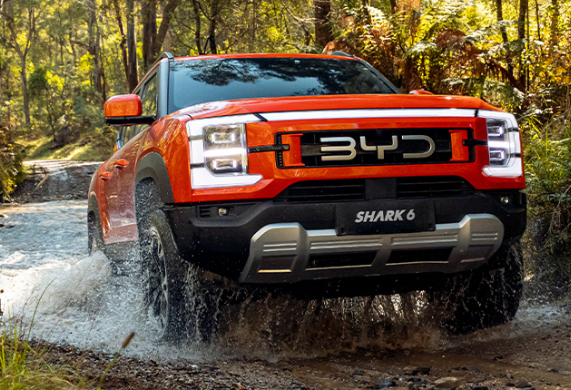
If you are searching for the BYD Shark 6 average per litre, there is one important detail we need to clear up immediately: this is a plug-in hybrid ute, so its fuel economy cannot be interpreted exactly like that of a conventional petrol or diesel pickup.
For the Australian-spec 2026 BYD Shark 6 Dynamic and Premium, BYD lists 2.0 L/100 km when battery state of charge is above 25%, while consumption rises to 7.9 L/100 km below 25% state of charge. Those figures convert to approximately 50 km/L and 12.7 km/L, respectively. The newer Shark 6 Performance has different figures: 1.3 L/100 km with sufficient battery charge and 10.5 L/100 km below 25%, equivalent to roughly 76.9 km/L and 9.5 km/L.
Sounds extraordinary, right?
Well, yes—but there is a catch.
The spectacular 50 km/L-style figure isn't telling us that the Shark 6's petrol engine magically sips fuel like a tiny city hatchback. Electricity is doing a substantial portion of the work. Once we understand that distinction, the Shark's numbers become much easier to interpret.
Let's break down the BYD Shark 6 fuel economy, convert everything into kilometres per litre, examine real-world results, and work out what owners might realistically expect.
Content in this publication
- BYD Shark 6 Average Per Litre: Quick Answer
- What Does "Average Per Litre" Actually Mean?
- Why the BYD Shark 6 Can Claim 50 km Per Litre
- BYD Shark 6 Average Per Litre With a Charged Battery
- BYD Shark 6 Average Per Litre With a Low Battery
- What About the BYD Shark 6 Performance?
- BYD Shark 6 Real-World Fuel Economy
- Why Some Shark 6 Owners May See 2 L/100 km and Others 10+
- Can the BYD Shark 6 Really Do 800 km?
- How Far Can One Litre Take a BYD Shark 6?
- Does the Shark 6 Save Fuel in City Driving?
- Highway Fuel Consumption Is a Different Story
- What Happens When Towing?
- How Driving Style Changes the Shark 6 Average Per Litre
- Should You Charge the BYD Shark 6 Every Day?
- Fuel Economy Versus Energy Economy
- BYD Shark 6 Compared With a Conventional Ute
- Is 12.7 km/L Good for a Ute?
- Why Real-World Reports Vary So Much
- How to Measure Your Own BYD Shark 6 Average Per Litre
- So, What Is the Real BYD Shark 6 Average Per Litre?
- Conclusion: Understanding the BYD Shark 6 Fuel Economy Properly
- Frequently Asked Questions
BYD Shark 6 Average Per Litre: Quick Answer
For buyers who simply want the numbers, here is the easiest way to understand them.
| Driving condition | Fuel consumption | Approx. km per litre |
|---|---|---|
| Shark 6 Dynamic/Premium, SOC above 25% | 2.0 L/100 km | 50 km/L |
| Shark 6 Dynamic/Premium, SOC below 25% | 7.9 L/100 km | 12.7 km/L |
| Shark 6 Performance, SOC above 25% | 1.3 L/100 km | 76.9 km/L |
| Shark 6 Performance, SOC below 25% | 10.5 L/100 km | 9.5 km/L |
| Independent 2025 Premium road test | 6.3 L/100 km | 15.9 km/L |
BYD's current Australian specification sheet also lists a 60-litre fuel tank and a 29.6 kWh Blade Battery. The Dynamic and Premium have a stated 100 km electric range under NEDC testing, while the Performance uses different WLTP figures.
The key takeaway is simple: how frequently we charge the Shark 6 can completely transform its petrol consumption.
What Does "Average Per Litre" Actually Mean?
Australians normally see fuel economy written as litres per 100 kilometres, or L/100 km.
However, many drivers prefer kilometres per litre because it answers a more intuitive question:
How far can the vehicle travel using one litre of petrol?
To convert L/100 km into km/L, we divide 100 by the consumption figure.
For example:
100 ÷ 7.9 = approximately 12.7 km/L.
Therefore, a Shark 6 consuming 7.9 L/100 km effectively travels about 12.7 kilometres for every litre of petrol.
Why km/L Can Be Easier to Understand
Think of fuel like money in your wallet.
L/100 km tells us how much money we spend travelling a certain distance.
Km/L tells us how much distance we receive from each unit we spend.
Both describe exactly the same relationship from opposite directions.
BYD Shark 6 Fuel Consumption Conversion
For the standard 1.5-litre versions:
- 2.0 L/100 km = 50 km/L
- 5.0 L/100 km = 20 km/L
- 6.3 L/100 km = 15.9 km/L
- 7.9 L/100 km = 12.7 km/L
- 10.0 L/100 km = 10 km/L
- 12.0 L/100 km = 8.3 km/L
These conversions become useful when examining owner reports because one person's driving pattern can look dramatically different from another's.
Why the BYD Shark 6 Can Claim 50 km Per Litre
Here is where things become interesting.
The Shark 6 Dynamic and Premium aren't simply petrol utes fitted with a small battery. They use BYD's Dual Mode Off-road—or DMO—plug-in hybrid architecture.
The Australian Premium combines a 1.5-litre turbocharged petrol engine, front and rear electric motors, all-wheel drive and a 29.6 kWh battery. Total system output is listed at 321 kW and 650 Nm.
That large battery means many kilometres can be driven using electricity rather than petrol.
So when the official test produces 2.0 L/100 km, the calculation includes a substantial amount of electrically assisted travel.
The Important PHEV Catch
Calling 2.0 L/100 km "50 km per litre" is mathematically correct.
But treating it as pure petrol efficiency is misleading.
Imagine travelling 100 km while petrol supplies only a fraction of the energy and your home's electrical outlet supplies much of the rest.
We might burn two litres of fuel, but electricity hasn't disappeared from the equation.
It is like saying dinner cost only $10 because somebody else paid half the bill.
Electricity Is Part of the Energy Equation
This is why anyone comparing the Shark 6 with a diesel Hilux, Ranger or D-Max should look beyond the headline petrol figure.
A PHEV requires us to consider:
- petrol consumption;
- electricity consumption;
- charging frequency;
- journey length;
- battery state of charge;
- towing and payload;
- highway versus urban driving.
Ignore those variables and the numbers can become more confusing than helpful.
BYD Shark 6 Average Per Litre With a Charged Battery
Let's start with the scenario that best suits the Shark 6.
Suppose we charge overnight and our normal daily driving is considerably shorter than the available electric range.
BYD lists the Dynamic and Premium at 2.0 L/100 km with SOC above 25%, equivalent to:
Approximately 50 km Per Litre
On paper, that is spectacular for a large dual-cab ute weighing well over two tonnes.
BYD also quotes an 800 km combined range for the Dynamic and Premium under its applicable test methodology.
Yet daily use could be even more interesting.
If someone's commute is 30 or 40 km and the battery is recharged every night, that person may complete substantial stretches without using much petrol at all.
Another owner who never plugs the vehicle in could experience something entirely different.
And that brings us to arguably the most important number in this article.
BYD Shark 6 Average Per Litre With a Low Battery
Once the state of charge drops below 25%, BYD lists fuel consumption of 7.9 L/100 km for the Dynamic and Premium.
Converted into kilometres per litre:
7.9 L/100 km Equals About 12.7 km/L
This figure is much more relevant to someone tackling a long road trip without stopping to recharge.
At this point, the petrol engine must do substantially more work.
The Shark hasn't suddenly become inefficient. Rather, the enormous electrical helping hand it enjoyed earlier in the journey has diminished.
Think of the battery as a strong cyclist pushing us up a hill. When that cyclist steps away, we notice how heavy the bike really is.
What About the BYD Shark 6 Performance?
The expanded Australian Shark 6 range introduces another complication for anyone Googling fuel consumption because the figures now vary by model.
The Shark 6 Performance uses a 2.0-litre turbo hybrid engine, with BYD quoting 350 kW, 700 Nm and a 3500 kg maximum braked towing capacity. Its official specification sheet lists 1.3 L/100 km with SOC above 25% and 10.5 L/100 km below 25%, using WLTP figures.
Performance Model in Kilometres Per Litre
That works out to:
1.3 L/100 km = approximately 76.9 km/L
and
10.5 L/100 km = approximately 9.5 km/L
Again, don't read 76.9 km/L as the efficiency of the petrol engine alone. It reflects plug-in hybrid operation with substantial electrical assistance.
Why the Low-Battery Number Matters
For buyers considering the Performance specifically for heavy towing or lengthy highway journeys, the 10.5 L/100 km low-SOC number may be more relevant than the 1.3 L/100 km headline figure.
That's because long-distance towing can quickly move a PHEV away from the ideal short-trip, regularly charged environment in which its fuel advantage is greatest.
BYD Shark 6 Real-World Fuel Economy
Laboratory figures give us a standardised comparison.
Real roads give us potholes, headwinds, hills, air conditioning, trailers, traffic lights and occasionally a right foot with ambitions of its own.
One CarExpert test of a 2025 Shark 6 Premium recorded 6.3 L/100 km, while the official figures listed for that vehicle were 2.0 L/100 km above 25% SOC and 7.9 L/100 km below it.
6.3 L/100 km Equals Around 15.9 km/L
That is still an impressive result for a large 321 kW dual-cab ute.
However, the reviewer noted that battery charge was low for much of the primarily highway driving.
This perfectly illustrates why there isn't one universal answer to "How many kilometres per litre does a BYD Shark 6 get?"
The correct answer is closer to:
It depends heavily on how much electricity you put into it.
Why Some Shark 6 Owners May See 2 L/100 km and Others 10+
Two owners could buy identical vehicles and report dramatically different economy without either person being wrong.
Owner A: The Daily Commuter
Imagine we drive:
- 45 km each weekday;
- mostly urban and suburban roads;
- charge at home every night;
- rarely tow;
- take only occasional long trips.
Our petrol engine may remain inactive or lightly used for significant portions of our driving.
Fuel consumption could therefore remain extremely low.
Owner B: The Highway Traveller
Now imagine:
- 300 km journeys are normal;
- charging away from home is infrequent;
- cruising speed remains high;
- the ute carries equipment;
- the battery spends much of the trip near its lower operating range.
Our fuel figure could move much closer to the low-SOC consumption figure.
Owner C: The Towing Driver
Add a caravan, boat or heavy trailer and physics arrives with an invoice.
More mass means more energy is required for acceleration. Aerodynamic drag from a large caravan can also dramatically increase highway energy demand.
Even the cleverest hybrid technology cannot negotiate with the laws of physics.
Can the BYD Shark 6 Really Do 800 km?
BYD quotes 800 km combined range for the 2026 Dynamic and Premium variants under the applicable official testing conditions. The Performance is listed at 640 km WLTP.
These numbers combine the vehicle's petrol and electrical energy resources.
They should therefore not be interpreted as:
60 litres × fuel economy = total range.
The battery contributes too.
BYD Shark 6 Fuel Tank Capacity
All variants in BYD's current Australian specification sheet have a 60-litre fuel tank.
If we performed a purely mathematical calculation using 7.9 L/100 km:
60 ÷ 7.9 × 100 = approximately 759 km.
But that isn't a prediction that every Shark will travel exactly 759 km after its battery reaches a low state of charge. Hybrid operation, reserve fuel, road conditions and many other factors influence actual distance.
Think of it as a rough mathematical reference rather than a guaranteed range.
How Far Can One Litre Take a BYD Shark 6?
For the Dynamic and Premium, we can summarise the answer this way.
With Regular Charging: Up to About 50 km/L on the Official Test
That corresponds to the 2.0 L/100 km figure.
But electricity is contributing significantly.
With a Low Battery: About 12.7 km/L Officially
That corresponds to 7.9 L/100 km.
For long highway travel, this is often a more useful number to keep in mind.
In One Independent Road Test: About 15.9 km/L
CarExpert's 6.3 L/100 km result converts to about 15.9 km/L.
None of these figures contradict one another. They simply describe different energy and driving conditions.
Does the Shark 6 Save Fuel in City Driving?
This is where plug-in hybrids can shine.
Internal-combustion vehicles are generally disadvantaged in stop-start traffic because engines repeatedly accelerate a heavy vehicle and waste energy through conventional braking.
The Shark 6 can use its electric motors and regenerative braking system instead.
When we slow down, some kinetic energy can be recovered rather than simply transformed into heat through the brakes.
Short Trips Are the Sweet Spot
Suppose our typical round trip is 50 km and we recharge overnight.
A substantial proportion—or potentially all—of that driving can take place using stored electricity, depending on temperature, traffic, terrain and driving behaviour.
Do the same trip in a traditional diesel ute and every kilometre depends on liquid fuel.
That is why PHEV ownership can be extraordinarily economical for one household and surprisingly ordinary for another.
Highway Fuel Consumption Is a Different Story
At constant highway speed, regenerative braking provides fewer opportunities because we aren't slowing down frequently.
Aerodynamic drag also grows considerably as speed increases.
Once the battery's easily usable charge has been reduced, petrol consumption becomes more noticeable.
A CarExpert test recorded 6.3 L/100 km under primarily highway conditions with a relatively low battery, although any single test should be treated as an example rather than a universal result.
The Petrol Engine Matters More on Long Trips
This is the point at which people moving from conventional utes should adjust their expectations.
The Shark 6 may begin a long trip behaving almost like an EV.
Later, it behaves increasingly like a hybrid carrying a large battery.
That's why measuring only the first 100 km can tell a very different story from measuring a 700 km journey.
What Happens When Towing?
BYD currently lists a maximum braked towing capacity of 2500 kg for the Dynamic and Premium and 3500 kg for the Performance.
Fuel economy while towing isn't represented by one universal official number because trailers vary enormously.
A narrow utility trailer is nothing like a tall dual-axle caravan punching a hole through the air at 100 km/h.
Expect Lower Kilometres Per Litre
Towing can increase:
- aerodynamic resistance;
- total vehicle mass;
- engine load;
- electric motor demand;
- battery consumption.
Therefore, someone expecting the headline "50 km/L" while towing long distances is using the wrong benchmark.
Once electrical assistance is depleted, consumption can rise substantially.
Towing Economy Is About the Whole Journey
When judging the Shark 6 as a tow vehicle, track both:
petrol in litres and electricity in kWh.
Otherwise, comparing it with a diesel ute becomes an apples-versus-electric-oranges exercise.
How Driving Style Changes the Shark 6 Average Per Litre
The Shark 6 packs serious performance.
The Dynamic and Premium offer 321 kW, while the Performance reaches 350 kW.
And power is tempting.
Push the accelerator hard at every opportunity and energy consumption will rise, regardless of whether that energy comes from petrol or electricity.
For Better Fuel Economy
A few habits make a meaningful difference:
- accelerate progressively rather than aggressively;
- maintain steady highway speeds;
- anticipate traffic to maximise regenerative braking;
- keep tyres correctly inflated;
- avoid unnecessary weight;
- charge regularly;
- use EV energy where it makes the most sense;
- remove unnecessary aerodynamic accessories when possible.
None of these tricks is revolutionary.
Efficiency is usually won through dozens of boring little decisions rather than one spectacular hack.
Should You Charge the BYD Shark 6 Every Day?
If convenient home charging is available and we use the vehicle daily, frequent charging is generally how we extract the biggest advantage from its plug-in architecture.
A PHEV with an empty battery is like carrying an umbrella through a rainstorm without opening it.
Technically, we still have the equipment. We simply aren't using its principal advantage.
Home Charging Changes the Economics
Suppose two people each travel 15,000 km per year.
One charges almost every evening.
The other treats the Shark 6 like a regular petrol ute.
Their annual petrol consumption could differ substantially.
But the first driver will obviously purchase more electricity, so total running cost should include the household electricity bill rather than looking exclusively at petrol.
Fuel Economy Versus Energy Economy
This distinction deserves its own section because many PHEV comparisons miss it.
A petrol-only vehicle has a straightforward energy source:
petrol.
A Shark 6 can draw energy from:
petrol + grid electricity + regenerative braking.
So asking only about litres per 100 km gives us an incomplete picture.
The Best Measurement for Owners
Instead, keep records for several thousand kilometres and track:
- kilometres travelled;
- litres purchased;
- electricity charged;
- charging cost;
- petrol cost.
Then calculate total energy cost per 100 km.
That number tells us much more about whether the Shark 6 is actually saving money in our personal driving pattern.
BYD Shark 6 Compared With a Conventional Ute
A conventional diesel ute can often deliver relatively predictable economy.
Fill it up, drive it, calculate consumption.
The Shark 6 is more dynamic.
Its numbers can look astonishing on Monday after charging overnight and far more conventional during Saturday's 500 km caravan trip.
Neither result tells the whole story.
Where the Shark 6 Has an Efficiency Advantage
It makes particularly strong sense when we:
- have home charging;
- make frequent short or medium trips;
- spend time in urban traffic;
- can recharge between longer journeys;
- want high performance without using petrol continuously.
Where Its Headline Number Becomes Less Representative
The official low fuel figure becomes less representative when we:
- rarely charge;
- travel hundreds of kilometres continuously;
- tow regularly;
- carry heavy loads;
- drive at sustained high speeds.
That's not a flaw unique to BYD. It is fundamentally how plug-in hybrid fuel-consumption testing and usage work.
Is 12.7 km/L Good for a Ute?
Viewed in isolation, 12.7 km/L from 7.9 L/100 km is a respectable theoretical benchmark for a large, powerful all-wheel-drive dual-cab.
Remember what we are moving.
The Australian Premium has a kerb weight around 2710 kg, while the current specification sheet lists substantial system output and dual electric motors.
This isn't a lightweight economy car wearing a pickup costume.
It's a big machine with serious performance.
That context makes the low-SOC consumption figure arguably more interesting than the eye-catching 2.0 L/100 km number.
Why Real-World Reports Vary So Much
Search owner groups and reviews and we may see dramatically different numbers.
That doesn't automatically mean one driver is exaggerating.
One early pre-production off-road CarExpert drive reported around 12 L/100 km, but the reviewer explicitly noted that almost all of the driving was off-road and the petrol engine was operating for a large portion of the test.
Another later road test returned 6.3 L/100 km.
Those convert to roughly:
- 12 L/100 km = 8.3 km/L
- 6.3 L/100 km = 15.9 km/L
Huge difference.
Different conditions, different result.
Never Judge a PHEV From One Consumption Screenshot
A dashboard reading covering 40 km doesn't tell us much without knowing:
- starting battery percentage;
- ending battery percentage;
- electricity used;
- road type;
- average speed;
- towing load;
- elevation;
- temperature.
Context is everything.
How to Measure Your Own BYD Shark 6 Average Per Litre
If we already own a Shark 6, the easiest method is to track several full refuelling cycles.
Reset a trip meter and record how many litres we purchase.
Then divide kilometres travelled by litres consumed.
However, for a PHEV, we should also record electricity.
Example
Suppose we travel 1,000 km and use 40 litres of petrol.
1,000 ÷ 40 = 25 km/L.
That looks fantastic.
But if we also charged the battery five times, electricity contributed substantially to those 1,000 km.
So 25 km/L is still a valid petrol-consumption measurement—it simply isn't the complete energy-efficiency story.
Use a Longer Measurement Period
A month is better than a weekend.
Three months is better than a week.
The longer the period, the more our measurement includes normal commuting, weekend trips, traffic, highway travel and charging habits.
That is the number worth trusting.
So, What Is the Real BYD Shark 6 Average Per Litre?
There isn't a single figure that accurately describes every use case.
For the current Australian Dynamic and Premium models, the clearest summary is:
Official charged-battery figure: 2.0 L/100 km, or 50 km/L.
Official below-25% SOC figure: 7.9 L/100 km, or approximately 12.7 km/L.
For the Performance:
Official charged-battery figure: 1.3 L/100 km, or approximately 76.9 km/L.
Official low-SOC figure: 10.5 L/100 km, or around 9.5 km/L.
And at least one independent Premium road test recorded 6.3 L/100 km, equivalent to about 15.9 km/L.
The broad lesson?
Charge frequently and the Shark 6 can use remarkably little petrol. Drive hundreds of kilometres without charging and its fuel consumption becomes far more conventional.
Conclusion: Understanding the BYD Shark 6 Fuel Economy Properly
The BYD Shark 6 average per litre looks impressive, but the most useful answer isn't simply "50 km/L."
The Shark 6 is a plug-in hybrid, meaning petrol is only one part of its energy story.
With a healthy battery charge, the Dynamic and Premium's official 2.0 L/100 km figure mathematically equals 50 km per litre. Once battery SOC falls below 25%, the official figure becomes 7.9 L/100 km, or roughly 12.7 km/L.
That difference tells us almost everything we need to know.
If we charge regularly, drive moderate daily distances and use the electric capability intelligently, the petrol savings can be substantial.
If we buy one, never plug it in and spend our weekends hauling a caravan across the country, the headline 2.0 L/100 km figure shouldn't be our expectation.
The Shark 6 is therefore less like a conventional ute with one fixed appetite and more like a machine with two personalities. Feed it electricity regularly and petrol consumption can shrink dramatically. Let the battery run low on long journeys and the petrol engine starts picking up far more of the tab.
For prospective owners, that isn't something to fear. It is simply something worth understanding before comparing numbers.
Frequently Asked Questions
1. How many kilometres per litre does a BYD Shark 6 get?
The Australian Shark 6 Dynamic and Premium are officially rated at 2.0 L/100 km with battery SOC above 25%, equivalent to 50 km/L. Below 25% SOC, 7.9 L/100 km equals approximately 12.7 km/L.
2. Is the BYD Shark 6 really capable of 50 km per litre?
Mathematically, yes: 2.0 L/100 km converts to 50 km/L. However, that official plug-in hybrid result includes substantial energy supplied by the battery. It should not be interpreted as the petrol engine independently achieving 50 km/L.
3. What is the BYD Shark 6 fuel consumption with a flat or low battery?
BYD lists 7.9 L/100 km below 25% battery state of charge for the Dynamic and Premium, equivalent to roughly 12.7 km/L. The Performance is listed at 10.5 L/100 km, or approximately 9.5 km/L, under its applicable test standard.
4. How big is the BYD Shark 6 fuel tank?
The current Australian specification sheet lists a 60-litre fuel tank across the Shark 6 range.
5. Does charging the BYD Shark 6 improve petrol economy?
Yes. Regular charging allows a larger share of shorter journeys to be powered by stored electricity, reducing petrol use. Drivers who rarely recharge and routinely undertake long trips should expect consumption closer to the vehicle's low-SOC figures than its headline plug-in figure.
If you want to know other articles similar to BYD Shark 6 Average Per Litre: How Far Does It Really Go on One Litre? you can visit the category Driving.
Can Nissan Rogue Pull a Boat? Complete Towing Guide
Can Nissan Rogue Be Flat Towed? Complete Towing Guide
Are Nissan Rogue Good on Gas? MPG, Fuel Economy, and Real-World Costs
Can Nissan Rogue Drive in Snow? Complete Winter Driving Guide

Kia Sorento Diesel Fuel Consumption: MPG, Efficiency and Real-World Range
Haval Jolion Hybrid Fuel Consumption: How Efficient Is It Really?
Leave a Reply
More content of your interest