

BYD Shark 6 Long Range Fuel Tank: Is the 120L Upgrade Worth It?

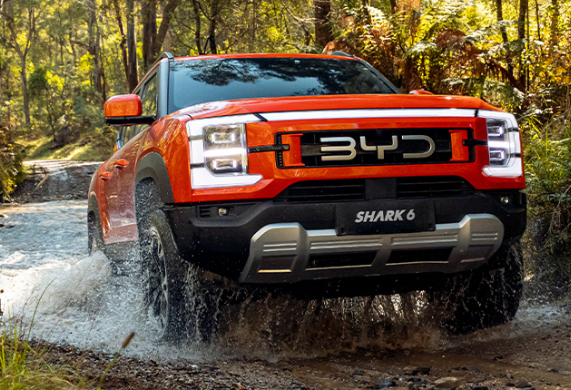
The BYD Shark 6 long range fuel tank question has become increasingly interesting for one simple reason: the Shark 6 is already a vehicle designed to travel far, but its standard petrol tank is relatively modest for a large touring ute.
From the factory, Australian-market BYD Shark 6 models use a 60-litre fuel tank. The 2025 Shark 6 Premium combines that petrol capacity with a 29.58 kWh Blade Battery and an officially quoted combined range of approximately 800 km, including up to 100 km of electric driving under the relevant test cycle.
That sounds pretty healthy.
But what happens when we point the nose toward Australia's interior, hook up a camper trailer, load the tray and start travelling through places where petrol stations become tiny dots separated by hundreds of kilometres?
Suddenly, 60 litres doesn't feel enormous.
That's where the 120-litre BYD Shark 6 replacement long-range fuel tank enters the picture. Instead of carrying extra jerry cans or planning every trip around petrol stations, the upgrade essentially doubles the ute's petrol capacity.
And that could completely change the Shark 6 as a touring vehicle.
Let's look at how it works, how far we could realistically travel and whether installing one actually makes sense.
Content in this publication
- How Big Is the Standard BYD Shark 6 Fuel Tank?
- Why Does the Shark 6 Only Need a 60L Tank?
- Is There a BYD Shark 6 Long Range Fuel Tank?
- How Far Can a BYD Shark 6 Travel With the Standard Tank?
- How Far Could the Shark 6 Travel With a 120L Tank?
- How the Plug-In Hybrid System Changes Long-Distance Touring
- BYD Shark 6 Premium Range With a 120L Tank
- What About the 2026 BYD Shark 6 Performance?
- Will a Long Range Tank Reduce Payload?
- Does the 120L Tank Affect Ground Clearance?
- Replacement Tank vs Auxiliary Fuel Tank
- Could We Just Carry Jerry Cans Instead?
- Does a Bigger Tank Increase Fuel Consumption?
- How Much Would It Cost to Fill a 120L Shark 6 Tank?
- Is a Long Range Tank Useful If We Can Charge the Shark 6?
- Who Should Consider a BYD Shark 6 Long Range Tank?
- What Should We Check Before Buying?
- Can the Shark 6 Really Become a 1,400km Touring Ute?
- Why Range Anxiety Is Different in a Plug-In Hybrid Ute
- Does the 120L Long Range Tank Make the Shark 6 a Better Tourer?
- BYD Shark 6 Long Range Fuel Tank: Final Thoughts
- Frequently Asked Questions
How Big Is the Standard BYD Shark 6 Fuel Tank?
The Australian BYD Shark 6 comes from the factory with a 60-litre petrol tank.
This applies to the current Shark 6 range, including the Dynamic Cab Chassis, Premium and Performance according to BYD's 2026 specification sheet.
That gives us the following starting point:
| Specification | Standard Shark 6 |
|---|---|
| Fuel tank capacity | 60 L |
| Battery capacity | 29.6 kWh approximately |
| Drivetrain | Plug-in hybrid AWD |
| Premium/Dynamic electric range | 100 km NEDC |
| Premium/Dynamic combined range | 800 km |
| Standard long-range replacement option | 120 L aftermarket |
The important thing to understand is that the Shark doesn't depend purely on petrol.
It's a plug-in hybrid.
Therefore, talking about its driving range is slightly different from discussing something such as a diesel Hilux or Ranger.
We essentially have two energy tanks: petrol in one corner and electricity in the other.
Why Does the Shark 6 Only Need a 60L Tank?
At first glance, 60 litres seems surprisingly small for a ute measuring more than 5.4 metres long.
There is logic behind it.
The Shark 6's drivetrain was designed around BYD's DMO plug-in hybrid architecture. The petrol engine works alongside powerful electric motors rather than behaving like a conventional engine doing all the heavy lifting.
The Premium produces a combined 321 kW and 650 Nm, while its 29.58 kWh Blade Battery allows significant portions of normal commuting to be completed using electricity.
For someone who charges every evening and drives 30-60 km per day, petrol could almost become a supporting actor rather than the star of the film.
Touring is different.
City Driving and Remote Touring Are Two Different Worlds
Around town, we can plug the Shark in regularly.
Crossing remote Australia? Not so much.
There may be:
- hundreds of kilometres between reliable fuel stops,
- limited public charging infrastructure,
- increased consumption from towing,
- higher consumption on sand and dirt,
- roof racks and accessories creating additional aerodynamic drag,
- greater vehicle weight from camping equipment.
That's where extra petrol capacity becomes attractive.
The factory setup makes enormous sense as an everyday plug-in hybrid.
A BYD Shark 6 long range tank makes more sense when we want to transform it into a serious touring machine.
Is There a BYD Shark 6 Long Range Fuel Tank?
Yes.
Brown Davis offers a 120-litre replacement long-range fuel tank designed for the BYD Shark 6.
It replaces the vehicle's standard fuel tank rather than functioning as a separate auxiliary tank. Brown Davis specifies that its unit retains the original filler point and standard fuel-supply method, occupies the standard tank location and requires no vehicle modifications according to its installation information.
That's important.
We're not talking about throwing a universal fuel cell into the tray and hoping everything works.
This is a vehicle-specific solution.
Standard Tank vs 120L Long Range Tank
Here's where things get interesting.
| Feature | Factory Tank | Long Range Tank |
|---|---|---|
| Capacity | 60 L | 120 L |
| Capacity increase | — | 60 L |
| Percentage increase | — | 100% |
| Tank type | Factory | Replacement |
| Original filler retained | Yes | Yes |
| Fuel supply system | Factory | Factory system retained |
| Location | Factory position | Replaces factory tank |
| Approx. quoted installation time | — | 3 hours |
The Brown Davis unit therefore provides twice the petrol capacity of the standard Australian tank.
That's not a marginal upgrade.
It's like replacing a normal water bottle with a backpack hydration bladder before walking into the desert.
How Far Can a BYD Shark 6 Travel With the Standard Tank?
BYD quotes an 800 km combined driving range for the Dynamic and Premium Shark 6 variants in Australia.
Brown Davis breaks the factory figure down as approximately:
- 700 km petrol range
- 100 km electric range
- 800 km combined
Those figures are based on BYD-quoted specifications rather than an independent long-distance test, so we should treat them as reference numbers rather than promises.
Our actual range will depend heavily on how and where we drive.
Understanding the 7.9L/100km Figure
The Australian Shark 6 Premium has an official fuel-consumption figure of 7.9 L/100 km when battery state of charge is below 25% under its applicable test cycle.
Pure mathematics would suggest:
60 ÷ 7.9 × 100 = roughly 759 km
That calculation isn't an official real-world range estimate. It simply demonstrates how tank size and consumption interact.
And nobody should plan a remote trip assuming they'll use every last drop of petrol.
We need a safety margin.
Wind, terrain, temperature and towing can quickly turn spreadsheet mathematics into roadside reality.
How Far Could the Shark 6 Travel With a 120L Tank?
This is the big question.
Brown Davis estimates approximately 1,400 km of petrol range using its 120-litre replacement tank, versus approximately 700 km of petrol range from the original 60-litre tank.
Add electric driving at the beginning of the trip and theoretical total travel distance becomes even greater.
That's serious touring territory.
Potential Range Comparison
Using the supplier's quoted range comparison:
| Setup | Approx. Petrol Range |
|---|---|
| Standard 60 L tank | 700 km |
| 120 L long-range tank | 1,400 km |
| Increase | ~700 km |
We should emphasise the word approximate.
Doubling fuel capacity does not guarantee exactly double the distance under every condition.
Carrying another 60 litres of fuel adds weight. Touring accessories add weight. Towing dramatically changes aerodynamic resistance.
But as a simple range-extending tool, doubling fuel capacity is difficult to argue with.
The Real Advantage Isn't Always Maximum Range
Here's something we think matters more than chasing a gigantic kilometre figure.
Imagine fuel stations positioned every 300 km.
With the standard tank, we're thinking:
"Should we stop here just in case?"
With 120 litres aboard, we gain flexibility.
Maybe we skip an expensive remote station.
Maybe we explore an additional track.
Maybe we stay another night at camp.
Maybe we don't have to reorganise the entire trip because one fuel stop is unexpectedly closed.
Range creates options.
And when travelling remotely, options are valuable.
How the Plug-In Hybrid System Changes Long-Distance Touring
A conventional ute carries diesel or petrol.
That's essentially its entire energy reserve.
The Shark 6 carries both petrol and stored electricity.
That makes the long-range tank particularly interesting.
We could leave home or camp with:
- a fully charged Blade Battery,
- 120 litres of petrol,
- regenerative braking available during the trip.
The battery handles certain driving demands while the petrol engine supports the hybrid system as required.
It's less like having one enormous reservoir and more like carrying two different energy sources that work together.
For the Shark 6 Premium, the potential touring improvement is straightforward.
The factory configuration combines a 60 L tank with an electric range quoted at 100 km NEDC and an official combined range of 800 km.
Replacing the petrol tank with a 120 L unit doubles fuel storage.
If driving conditions remain broadly similar, the number of kilometres between petrol stops can potentially increase dramatically.
But conditions rarely remain identical.
What Could Reduce Range?
Real-world consumption could rise because of:
- towing a caravan,
- carrying maximum payload,
- large all-terrain tyres,
- low tyre pressures,
- suspension modifications,
- bull bars,
- roof tents,
- canopies,
- headwinds,
- sand driving,
- high-speed motorway travel,
- steep terrain.
Think of official fuel consumption as calm water.
Touring introduces waves.
What About the 2026 BYD Shark 6 Performance?
This deserves special attention because the Shark 6 lineup has expanded.
The Australian 2026 Shark 6 Performance receives a 2.0-litre turbocharged petrol engine, combined output of 350 kW and 700 Nm, 3,500 kg braked towing capacity and a 60 L factory fuel tank. BYD lists approximately 640 km combined WLTP range for the Performance version.
Its quoted low-battery fuel consumption is 10.5 L/100 km WLTP, higher than the 7.9 L/100 km figure quoted for the 1.5-litre Dynamic and Premium variants under NEDC methodology. These test cycles are different, so they shouldn't be treated as perfectly direct comparisons.
The extra capacity of a long-range tank could therefore be even more appealing to Performance owners planning to use the vehicle's greater towing capability.
Check Compatibility Before Installation
There's an important detail here.
Some Australian sellers of the 120 L replacement tank specifically ask customers to advise whether their Shark 6 has the newer 2.0-litre high-performance engine.
So we shouldn't assume every version uses an identical installation process simply because the headline tank capacity is the same.
Verify the exact:
- model year,
- variant,
- engine,
- market specification,
- tank part number
before purchasing.
That's far cheaper than discovering a compatibility problem with a 40 kg steel tank sitting on the workshop floor.
Will a Long Range Tank Reduce Payload?
This is an often-overlooked point.
Fuel weighs something.
An extra 60 litres of petrol can represent roughly 40-45 kg of additional liquid mass, depending on fuel density.
The replacement tank itself also has its own mass, although we're removing the original tank during installation, so the relevant payload impact isn't simply the total weight of the replacement tank.
Still, when fully fuelled, a long-range setup means the vehicle is carrying significantly more fuel weight than before.
That matters when calculating:
- passengers,
- camping equipment,
- canopy weight,
- tow-ball download,
- accessories,
- recovery equipment,
- tools,
- GVM.
More range isn't free.
We're effectively exchanging a little payload capacity for additional energy storage.
For many remote travellers, that's a trade worth making.
For someone constantly operating close to GVM, it deserves careful calculation.
Does the 120L Tank Affect Ground Clearance?
Brown Davis specifically discusses ground clearance in its BYD Shark 6 installation material and designs the tank with a tapered leading section intended to reduce frontal impact and help preserve ramp-over clearance.
This is particularly important on a ute.
A poorly designed long-range tank hanging several centimetres lower than the chassis could turn into a giant metal shovel when cresting rocky terrain.
That's why we prefer a dedicated vehicle-specific replacement rather than improvising.
Tank Construction
Brown Davis says its Shark 6 tank uses aluminium-coated steel and incorporates:
- internal baffling,
- reinforced mounting brackets,
- an underguard,
- factory-style fuel pump sender mounting,
- connection to the original filler,
- fuel-line retaining points.
Internal baffling is particularly useful.
Without it, 120 litres of fuel could move around like bathwater every time we turn or brake.
Baffles help control that movement.
Replacement Tank vs Auxiliary Fuel Tank
These two terms often get mixed together.
Replacement Tank
A replacement tank removes the original tank and installs a larger one in its place.
Advantages include:
- one filler system,
- no fuel-transfer procedure,
- minimal complexity,
- factory-style operation,
- no tray space sacrificed.
The available Shark 6 120 L option works this way.
Auxiliary Tank
An auxiliary tank adds a second separate fuel reservoir.
Depending on the vehicle, fuel may need to be pumped from the auxiliary tank into the main tank.
That can provide substantial capacity, but adds:
- additional plumbing,
- extra weight,
- another tank,
- additional controls,
- potentially more complicated installation.
For the Shark 6, the 120 L replacement approach is beautifully simple: bigger tank, same basic role.
Could We Just Carry Jerry Cans Instead?
Absolutely.
And for occasional touring, this might make more financial sense.
Three 20-litre jerry cans provide the same additional 60 litres that separates the factory 60 L tank from the 120 L replacement.
But there's a catch.
Actually, several.
Jerry cans require storage space.
They must be properly secured.
They add clutter.
They may produce fumes depending on storage arrangements.
And we have to manually pour fuel into the vehicle.
A long-range tank effectively hides those extra 60 litres underneath the ute.
Long Range Tank vs Jerry Cans
| Factor | 120L Tank | Jerry Cans |
|---|---|---|
| Extra capacity | Integrated | Flexible |
| Tray space | Preserved | Consumed |
| Refuelling | Normal filler | Manual |
| Initial cost | Higher | Lower |
| Can be removed easily | No | Yes |
| Convenience | Excellent | Moderate |
| Occasional touring | Possibly excessive | Sensible |
| Regular remote touring | Excellent fit | Less convenient |
There's no universally correct answer.
If we cross remote regions twice a year, permanent range makes sense.
If we need additional fuel once every three years, jerry cans may be perfectly adequate.
Does a Bigger Tank Increase Fuel Consumption?
Technically, yes — but probably not in the dramatic way some people imagine.
The engine has to move additional mass when the 120 L tank is full.
Therefore, consumption could rise slightly compared with carrying only 60 litres.
But remember something important.
Fuel disappears as we drive.
The vehicle becomes progressively lighter throughout the journey.
A long-range tank doesn't force us to carry 120 litres every day either.
Around town, we can simply fill it partially.
That's one overlooked advantage.
A 120 L tank gives us capacity, not an obligation.
How Much Would It Cost to Fill a 120L Shark 6 Tank?
The equation couldn't be simpler:
Fuel price × 120 = full-tank cost
If petrol were $2.00 per litre, for example:
120 × $2.00 = $240
The standard 60-litre tank under the same hypothetical price would cost:
60 × $2.00 = $120
A bigger tank doesn't inherently make petrol more expensive.
We simply purchase more of it at once.
There can even be a strategic benefit during touring.
If fuel is significantly cheaper in a major town, extra tank capacity gives us the ability to buy more there and potentially avoid purchasing as much from expensive remote locations.
Is a Long Range Tank Useful If We Can Charge the Shark 6?
Yes — because charging and refuelling solve different problems.
If our trip takes us through cities and developed regional areas, charging can reduce petrol use dramatically.
Remote touring is another story.
A petrol station can transfer hundreds of kilometres of driving energy into the ute in minutes.
Even where chargers exist, charging availability may depend on:
- charger location,
- charging speed,
- queues,
- reliability,
- caravan access,
- local power infrastructure.
Having both a large petrol reserve and plug-in capability gives us redundancy.
And redundancy is exactly what we want when travelling far from major towns.
Who Should Consider a BYD Shark 6 Long Range Tank?
The upgrade makes the strongest case for owners who frequently travel outside metropolitan areas.
We would seriously consider it for:
- long-distance touring,
- outback travel,
- remote work,
- caravan towing,
- extended camping,
- overlanding,
- rural property use,
- trips where petrol availability is uncertain.
The convenience compounds over time.
If every major journey eliminates two or three unnecessary fuel stops, the upgrade gradually becomes something we appreciate without even thinking about it.
Who Probably Doesn't Need One?
Not everyone does.
If our Shark spends 95% of its life:
- commuting,
- charging at home,
- driving around cities,
- travelling between major towns,
the standard 60 L tank already offers substantial flexibility when combined with the battery.
Installing a 120 L tank purely because "bigger is better" doesn't automatically make sense.
This isn't a horsepower modification.
It's a problem-solving modification.
If range isn't a problem, there's nothing to solve.
What Should We Check Before Buying?
Before ordering any BYD Shark 6 long range tank, we'd confirm several things.
- Exact model compatibility
Verify year, engine and Shark 6 variant. - Professional installation requirements
Fuel systems aren't the ideal place for DIY experimentation. - Warranty implications
Ask both the tank supplier and vehicle manufacturer how the modification may affect relevant warranty coverage. - GVM and payload
Calculate the weight of the additional fuel as part of the vehicle's operating load. - Insurance
Tell the insurer about significant vehicle modifications where required. - Local regulations
Make sure installation complies with applicable vehicle and fuel-system regulations. - Touring requirements
Decide whether 120 litres actually solves a problem in the type of travel we do.
A little homework before installation can prevent expensive headaches afterwards.
Can the Shark 6 Really Become a 1,400km Touring Ute?
Potentially, yes — under favourable conditions.
Brown Davis's own comparison estimates 1,400 km of petrol range from its 120 L tank, based on figures attributed to BYD.
But we wouldn't plan a remote route by typing "1,400 km" into a calculator and assuming the number is guaranteed.
Real range may be substantially lower while towing or driving difficult terrain.
Suppose our fully loaded Shark starts consuming 12 L/100 km.
120 litres would theoretically represent around:
1,000 km
At 15 L/100 km:
800 km
Even those less flattering numbers reveal why the bigger tank is appealing.
The point isn't achieving a magical laboratory figure.
The point is dramatically increasing our buffer.
Why Range Anxiety Is Different in a Plug-In Hybrid Ute
EV range anxiety gets plenty of attention.
Remote-area fuel anxiety existed decades before electric cars showed up.
Anyone who has watched a fuel gauge sink while the next petrol station remains hundreds of kilometres away understands the feeling.
The Shark 6 presents an interesting solution.
Electricity can handle everyday driving.
Petrol can handle extended travel.
A long-range tank stretches that second safety net even further.
It's like carrying a bigger parachute without giving up the first one.
Does the 120L Long Range Tank Make the Shark 6 a Better Tourer?
For the right owner, definitely.
The standard Shark 6 already blends several interesting qualities:
- plug-in hybrid efficiency,
- strong combined performance,
- AWD,
- respectable ground clearance,
- V2L power capability,
- ute practicality,
- useful electric-only range.
The 60 L tank isn't necessarily a weakness in everyday use.
It's simply designed around the broader hybrid system.
But remote touring changes priorities.
Once petrol availability becomes uncertain, carrying twice as much fuel becomes less about convenience and more about independence.
Our Practical View
We wouldn't install a 120 L tank on a Shark used primarily as a suburban commuter.
We would seriously consider one on a Shark being transformed into a touring build.
Add a canopy, fridge, recovery equipment, all-terrain tyres and camping gear, and the character of the vehicle changes.
At that point, fuel autonomy belongs on the upgrade list beside suspension and underbody protection.
BYD Shark 6 Long Range Fuel Tank: Final Thoughts
The factory 60-litre BYD Shark 6 fuel tank works surprisingly well because it isn't working alone. The Blade Battery and plug-in hybrid drivetrain contribute significantly to the ute's overall range, helping the Premium and Dynamic achieve an officially quoted combined figure of around 800 km under BYD's stated testing methodology.
But for remote touring, we can now go much further.
A vehicle-specific 120 L replacement long-range tank effectively doubles petrol storage while retaining the standard filler and fuel-supply arrangement. Brown Davis estimates that this can increase the petrol component of the Shark's touring range from approximately 700 km to around 1,400 km under its comparison assumptions.
Will every Shark travel 1,400 km between petrol stops?
No.
Towing, speed, payload, terrain and weather will see to that.
But that isn't really the point.
The beauty of the upgrade is freedom.
Freedom to drive past a fuel station.
Freedom to explore a side road.
Freedom to tow farther between stops.
And perhaps most importantly, freedom from staring nervously at the fuel gauge while wondering whether the tiny petrol-pump icon on the map still represents an operating service station.
For daily driving, 60 litres should be plenty for most Shark 6 owners.
For serious touring, though?
A 120-litre tank transforms the equation.
Frequently Asked Questions
1. What is the standard BYD Shark 6 fuel tank capacity?
Australian Shark 6 models use a 60-litre petrol tank. The plug-in hybrid drivetrain also includes a roughly 29.6 kWh Blade Battery, so total driving range combines petrol and electric energy rather than depending exclusively on the fuel tank.
2. Can you get a 120L fuel tank for the BYD Shark 6?
Yes. Brown Davis produces a 120-litre replacement long-range fuel tank for the Shark 6. It replaces the standard tank, retains the original filler point and uses the standard fuel-supply arrangement according to the manufacturer.
3. How far can a Shark 6 travel with a 120L tank?
Brown Davis estimates approximately 1,400 km of petrol range, compared with around 700 km using the original 60 L tank. Real-world range may be considerably different depending on towing, payload, speed, weather and terrain.
4. Does a 120L tank affect BYD Shark 6 payload?
Yes, indirectly. Carrying an additional 60 litres of petrol adds roughly 40-45 kg of fuel mass. Owners should include additional fuel and modification weight when calculating payload and GVM, particularly when towing or carrying heavy accessories.
5. Is the BYD Shark 6 long range tank worth installing?
It makes the strongest case for owners regularly undertaking remote touring, towing or rural travel where fuel stops are widely spaced. Owners who predominantly commute and charge at home will probably find the standard 60 L tank more than adequate.
If you want to know other articles similar to BYD Shark 6 Long Range Fuel Tank: Is the 120L Upgrade Worth It? you can visit the category Driving.
Can Nissan Rogue Pull a Boat? Complete Towing Guide
Can Nissan Rogue Be Flat Towed? Complete Towing Guide
Are Nissan Rogue Good on Gas? MPG, Fuel Economy, and Real-World Costs
Can Nissan Rogue Drive in Snow? Complete Winter Driving Guide

Kia Sorento Diesel Fuel Consumption: MPG, Efficiency and Real-World Range
Haval Jolion Hybrid Fuel Consumption: How Efficient Is It Really?
Leave a Reply
More content of your interest