
How Much Can a Mazda BT-50 Tow? Complete Towing Guide

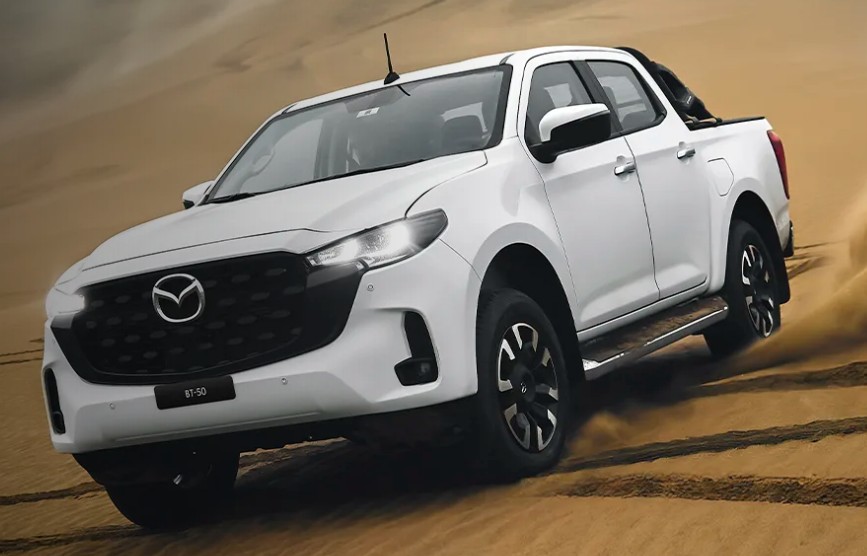
The Mazda BT-50 can tow up to 3,500 kg—or 3.5 tonnes—with a braked trailer, depending on the engine, drivetrain, body style, model year, and market. Certain lower-powered variants may have a reduced maximum, including a 3,000 kg braked limit on some configurations. Mazda also lists a maximum tow-ball download of up to 350 kg when the vehicle and towing equipment are correctly specified.
That headline figure sounds wonderfully simple. Hitch up a 3.5-tonne caravan, load the family, fill the tray, and head toward the horizon—right?
Not quite.
A maximum towing rating is only the opening line of the story. The real amount a Mazda BT-50 can safely and legally tow depends on several connected weight limits. Passengers, luggage, accessories, fuel, tow-ball weight and anything carried in the tray can all reduce the margin available.
Think of the BT-50’s towing capacity as the size of a suitcase. The label may say it holds 23 kg, but whether the zipper closes depends entirely on what we place inside.
In this guide, we will explain the BT-50’s braked and unbraked towing limits, payload considerations, tow-ball weight, gross combination mass and the practical difference between theoretical capacity and real-world towing ability.
Content in this publication
- Mazda BT-50 Towing Capacity at a Glance
- What Does a 3,500 kg Towing Capacity Mean?
- Do All Mazda BT-50 Models Tow 3,500 kg?
- How Much Can a Mazda BT-50 Tow in Pounds?
- What Is Tow-Ball Download?
- What Is the Mazda BT-50 Payload Capacity?
- Understanding the Main Towing Weight Terms
- Can a Mazda BT-50 Tow 3.5 Tonnes and Carry a Full Payload?
- Can a Mazda BT-50 Tow a Caravan?
- Can a Mazda BT-50 Tow a Boat?
- Can a Mazda BT-50 Tow a Horse Float?
- Can a Mazda BT-50 Tow Another Car?
- How the BT-50 Feels When Towing
- BT-50 Towing Safety Technology
- Choosing the Right Tow Bar and Brake Controller
- How to Calculate Your Real BT-50 Towing Capacity
- Tips for Towing Safely With a Mazda BT-50
- Does Four-Wheel Drive Improve Towing Capacity?
- Manual vs Automatic BT-50 for Towing
- Does Towing Affect Fuel Economy?
- Is the Mazda BT-50 a Good Tow Vehicle?
- Common Mazda BT-50 Towing Mistakes
- Final Verdict: How Much Can a Mazda BT-50 Tow?
- Frequently Asked Questions
Mazda BT-50 Towing Capacity at a Glance
For most current Mazda BT-50 models equipped for heavy-duty towing, the important headline numbers are:
| Towing specification | Typical maximum |
|---|---|
| Maximum braked towing capacity | Up to 3,500 kg |
| Maximum unbraked towing capacity | Usually up to 750 kg |
| Maximum tow-ball download | Up to 350 kg |
| Reduced braked capacity on some variants | 3,000 kg |
| Recommended trailer brakes | Required for heavier trailers under local regulations |
Mazda Australia currently promotes the BT-50 as capable of towing up to 3.5 tonnes, while its official towing equipment is rated for as much as 3,500 kg with a 350 kg tow-ball download.
However, those figures are maximum ratings—not a promise that every BT-50 can tow 3,500 kg while simultaneously carrying its maximum payload.
What Does a 3,500 kg Towing Capacity Mean?
A 3,500 kg braked towing capacity means the BT-50 may tow a trailer with an aggregate trailer mass of up to 3,500 kg, provided that:
- The trailer has a suitable braking system.
- The exact BT-50 variant is rated for 3,500 kg.
- The tow bar and coupling are appropriately rated.
- The tow-ball download remains within its limit.
- The vehicle stays below its gross vehicle mass.
- The combined vehicle and trailer weight stays below the permitted gross combination mass.
- Tyres, suspension and brakes are in serviceable condition.
- The load is distributed correctly.
- Local towing laws are followed.
The phrase “up to” carries a lot of weight here—literally. It means 3,500 kg is the ceiling under approved conditions, not necessarily the ideal everyday target.
Braked Towing Explained
A braked trailer uses its own braking system to help slow the combined rig. Depending on its design and local regulations, the trailer may use electric, hydraulic, override or electronically controlled brakes.
Mazda offers heavy-duty tow-pack configurations that may include an electric brake controller and trailer breakaway wiring. These components help the BT-50 and trailer behave like a coordinated pair rather than two heavy objects arguing over who should stop first.
For large caravans, horse floats, machinery trailers and heavy boats, trailer brakes are essential. The ute’s brakes alone are not intended to control several tonnes of additional moving mass.
Unbraked Towing Explained
An unbraked trailer has no independent service braking system. Because the tow vehicle must perform all the stopping work, its permitted weight is much lower.
Many BT-50 variants are commonly limited to 750 kg for an unbraked trailer, although the owner’s manual and compliance information for the exact vehicle should always take priority.
Small garden trailers, lightweight box trailers and compact recreational trailers may fit within this range. A full-sized caravan, large boat or loaded car transporter certainly will not.
Do All Mazda BT-50 Models Tow 3,500 kg?
No. We should never assume every BT-50 has the same rating simply because the badge on the tailgate looks familiar.
The official Australian BT-50 brochure lists 3,000 kg braked towing capacity for at least one configuration, while numerous other variants are rated to 3,500 kg.
The exact limit may vary according to:
- Engine
- Transmission
- Two-wheel-drive or four-wheel-drive layout
- Standard-height or high-rider suspension
- Single Cab, Freestyle Cab or Dual Cab body
- Pickup or cab-chassis configuration
- Model year
- Country-specific certification
- Factory or aftermarket towing equipment
Before purchasing a trailer, we should check the owner’s manual, vehicle identification plate, towing section of the specification sheet and tow-bar rating.
The 3.0-Litre Diesel BT-50
The current 3.0-litre turbo-diesel is the most obvious option for drivers planning frequent or heavy towing. Mazda lists outputs of up to 140 kW and 450 Nm, with maximum torque available from low engine speeds, which helps the vehicle move a heavy trailer without requiring constant high-revving drama.
Torque does not increase the legal towing rating by itself, but it strongly influences how relaxed the vehicle feels when:
- Pulling away from a stop
- Climbing long hills
- Merging into traffic
- Maintaining speed against a headwind
- Manoeuvring a trailer at low speed
- Travelling on loose or uneven surfaces
A towing vehicle should feel like a calm workhorse, not a sprinter gasping through the final metres of a race.
The Smaller-Engine BT-50
Some markets and model years offer the BT-50 with a smaller diesel engine. These versions may be efficient and perfectly suitable for everyday work, lighter trailers and moderate recreational towing.
Nevertheless, buyers should confirm the specific rating because some lower-output BT-50 configurations may carry a reduced 3,000 kg braked towing limit rather than the full 3,500 kg figure.
For a trailer weighing 1,500–2,000 kg, that difference might not matter. For a large caravan approaching 3,000 kg once loaded, it becomes extremely important.
How Much Can a Mazda BT-50 Tow in Pounds?
For readers using imperial measurements:
- 3,500 kg equals approximately 7,716 lb.
- 3,000 kg equals approximately 6,614 lb.
- 750 kg equals approximately 1,653 lb.
- 350 kg of tow-ball download equals approximately 772 lb.
That places a properly specified 3.5-tonne BT-50 within the mainstream one-tonne pickup class for towing capability in markets such as Australia and New Zealand.
The BT-50 is not currently sold as a new vehicle in the United States, so American buyers researching imported or overseas specifications should avoid assuming that local U.S. towing standards, equipment rules or trailer-brake requirements are identical.
What Is Tow-Ball Download?
Tow-ball download—also called tongue weight or hitch weight—is the downward force the trailer applies to the BT-50’s tow ball.
Mazda’s genuine towing setup can support a maximum download of up to 350 kg on appropriately rated models.
That does not mean every trailer should place exactly 350 kg on the ball. It means the download must not exceed the lower rating of the:
- Vehicle
- Tow bar
- Tow ball
- Coupling
- Trailer
- Any load-distribution equipment
A stable trailer generally needs positive weight on the hitch. Too little can encourage sway; too much can overload the ute’s rear axle, lighten the steering and consume a large portion of the available payload.
Tow-Ball Weight Counts as Payload
This is one of the most commonly misunderstood parts of towing.
Suppose our BT-50 has 900 kg of available payload and the loaded caravan places 300 kg on the tow ball. We do not still have 900 kg available inside the ute. The ball load has already used 300 kg, leaving approximately 600 kg for:
- Driver and passengers
- Luggage
- Tools
- Canopy
- Bull bar
- Roof rack
- Fridge
- Auxiliary battery
- Drawer system
- Recovery equipment
- Anything carried in the tray
Suddenly, a big-looking payload can shrink like an ice cube on a summer bonnet.
What Is the Mazda BT-50 Payload Capacity?
Payload varies substantially between BT-50 configurations. Mazda has previously cited examples ranging from 887 kg for a 4x4 Dual Cab Thunder automatic to 1,236 kg for a 4x2 Single Cab-Chassis XS automatic.
Those examples illustrate why a single payload figure cannot represent the entire range.
A work-focused Single Cab may carry more because it has a lighter body and fewer luxury features. A heavily equipped Dual Cab may have a lower payload because more of its permitted vehicle mass is already occupied by the ute itself.
How Accessories Reduce Payload
Every permanently or temporarily fitted item adds weight. Common touring accessories can include:
- Steel bull bar
- Winch
- Driving lights
- Underbody protection
- Side steps
- Canopy
- Drawer system
- Long-range fuel tank
- Auxiliary battery
- Roof platform
- Awning
- Refrigerator
- Water tank
- Recovery boards
- Spare wheel carrier
- Tow bar
A few accessories may look harmless individually, but together they can weigh several hundred kilograms. Add four adults, camping equipment and 300 kg of tow-ball download, and a seemingly capable ute may approach its vehicle limit surprisingly quickly.
Mazda provides an online payload and towing calculator for the current BT-50 range, reinforcing the need to calculate the entire setup rather than relying solely on the headline towing number.
Understanding the Main Towing Weight Terms
Towing terminology can feel like alphabet soup served in an engineer’s workshop. Once we separate the terms, however, the calculation becomes much easier.
Tare Mass
Tare mass is the weight of the vehicle in a specified unladen condition. The exact definition can differ slightly by jurisdiction, especially regarding fuel and fluids.
It does not normally represent a fully equipped touring ute carrying people, accessories and cargo.
Kerb Weight
Kerb weight generally refers to the vehicle ready to drive with operating fluids and fuel, but without passengers or cargo. Again, definitions can vary by country or manufacturer.
Gross Vehicle Mass
Gross vehicle mass, or GVM, is the maximum permitted operating weight of the BT-50 itself.
It includes:
- The vehicle
- Occupants
- Cargo
- Accessories
- Tow-ball download
Crossing the GVM limit is not made acceptable simply because the trailer remains below 3,500 kg.
Aggregate Trailer Mass
Aggregate trailer mass, or ATM, is the maximum loaded weight of the trailer when it is standing independently with its full load supported by its wheels and jockey wheel.
This is the number normally compared with the vehicle’s maximum braked towing capacity.
Gross Trailer Mass
Gross trailer mass, or GTM, is the weight supported by the trailer’s wheels while it is connected to the tow vehicle.
Because part of the trailer’s weight is resting on the tow ball, GTM is usually lower than ATM.
In simplified form:
GTM = ATM minus tow-ball download
Gross Combination Mass
Gross combination mass, or GCM, is the maximum permitted operating weight of the BT-50 and trailer together.
This is where the advertised 3,500 kg towing capacity can become misleading. In some combinations, towing a trailer at the full 3,500 kg limit may leave less capacity for passengers, accessories and cargo in the ute.
Can a Mazda BT-50 Tow 3.5 Tonnes and Carry a Full Payload?
Usually, we should not assume it can.
The vehicle must satisfy several limits at the same time:
- Maximum braked towing capacity
- Maximum tow-ball download
- Gross vehicle mass
- Gross combination mass
- Front axle limit
- Rear axle limit
- Tow-bar and coupling ratings
- Trailer ATM and GTM ratings
A combination can be below the towing limit yet still exceed GVM or rear-axle capacity.
For example, imagine a hypothetical BT-50 and trailer setup:
- Loaded ute before hitching: 2,850 kg
- Tow-ball download: 300 kg
- Loaded vehicle after hitching: 3,150 kg
- Trailer ATM: 3,500 kg
- Trailer weight carried on its wheels: 3,200 kg
The combination weight would be based on the loaded ute plus the trailer load supported by its wheels. Whether that setup is legal depends on the exact GVM, GCM and axle ratings of that particular BT-50.
The lesson is simple: we cannot confirm compliance with a towing-capacity figure alone.
Can a Mazda BT-50 Tow a Caravan?
Yes. A properly specified BT-50 can tow many caravans, from compact touring models to large dual-axle vans.
Mazda describes the BT-50 as a suitable towing platform for caravan travel and highlights its 3.0-litre engine’s 140 kW and 450 Nm outputs.
However, caravan buyers should use the van’s loaded ATM, not its empty or tare weight.
A caravan advertised with a tare mass of 2,600 kg may weigh much more after adding:
- Water
- Gas cylinders
- Food
- Clothing
- Bedding
- Batteries
- Solar equipment
- Outdoor furniture
- Bikes
- Generator
- Tools
- Personal belongings
A family can add hundreds of kilograms without noticing. The caravan does not gain weight with a dramatic warning bell; it does so quietly, one camping chair at a time.
Comfortable Caravan Weight Range
Although the legal maximum may be 3,500 kg, many owners prefer a lighter caravan to create additional safety and payload margin.
A caravan with a loaded ATM between approximately 2,000 and 3,000 kg may offer a more relaxed match for many BT-50 touring setups, provided all vehicle and trailer limits are respected.
That is not a universal recommendation. A heavily accessorised ute may have less available margin than a standard vehicle, while an experienced operator with a carefully weighed combination may manage a heavier trailer responsibly.
Can a Mazda BT-50 Tow a Boat?
Yes. The BT-50 can tow many recreational boats, including substantial offshore fishing rigs, as long as the combined weight of the boat, motor, trailer, fuel and equipment remains within the relevant limit.
Do not calculate boat-trailer weight using the hull specification alone. We must include:
- Trailer
- Outboard or inboard engine
- Fuel
- Batteries
- Anchors
- Safety equipment
- Fishing gear
- Water
- Coolers
- Electronics
- Spare wheel
- Personal equipment
Mazda has demonstrated the current BT-50 towing a personal-watercraft trailer weighing far less than its maximum capacity, illustrating how lightly loaded recreational trailers leave a broad operating margin.
Launching on a slippery or steep ramp also makes four-wheel drive particularly valuable, even when the trailer’s road weight is moderate.
Can a Mazda BT-50 Tow a Horse Float?
It can, provided the fully loaded float remains below the vehicle’s limits.
Horse-float weights vary dramatically. A two-horse float might appear manageable when empty, but two large horses, feed, water, tack and equipment can push the total upward quickly.
Live loads also behave differently from fixed cargo. Horses move, shift weight and react to braking or cornering. Smooth acceleration, progressive braking and careful route selection become even more important.
We should weigh the loaded float and confirm that:
- ATM is below the BT-50’s braked capacity.
- Tow-ball weight is appropriate.
- Trailer brakes operate correctly.
- Tyres are rated and properly inflated.
- The vehicle remains within GVM, GCM and axle limits.
- The float is suitable for the number and size of horses carried.
Can a Mazda BT-50 Tow Another Car?
Yes, in many cases. A car trailer carrying a compact or midsize vehicle may remain within the BT-50’s 3,500 kg maximum.
The calculation must include:
- Empty trailer weight
- Transported vehicle weight
- Fuel in the transported vehicle
- Spare wheels
- Tools
- Tie-down equipment
- Winch
- Any additional cargo
A 900 kg trailer carrying a 1,800 kg vehicle already totals 2,700 kg before tools or accessories. A heavy SUV or another pickup could push the combination beyond the BT-50’s capacity.
How the BT-50 Feels When Towing
A towing specification tells us what the vehicle is permitted to pull. It does not fully describe what the driving experience feels like.
The 3.0-litre turbo-diesel’s low-speed torque helps the BT-50 pull away confidently and maintain momentum on rolling roads. Its automatic transmission can reduce driver workload, particularly in stop-start traffic or during low-speed manoeuvring.
Nevertheless, a heavy trailer changes the personality of any ute.
Expect:
- Longer stopping distances
- Slower acceleration
- Greater fuel consumption
- Wider turns
- More sensitivity to crosswinds
- Extra transmission and engine heat
- Reduced rear suspension travel
- Increased tyre load
- More effort on steep climbs
- Greater care when overtaking
A 3.5-tonne trailer does not simply follow the vehicle like a loyal shadow. It behaves more like a second vehicle attached by a hinge.
BT-50 Towing Safety Technology
Current BT-50 models include safety features intended to improve stability and awareness. Mazda highlights Trailer Sway Control, which can adjust braking and engine torque when it detects side-to-side trailer movement.
This can be helpful, but electronic assistance cannot correct every loading or driving mistake.
Trailer sway may be encouraged by:
- Insufficient tow-ball weight
- Excessive speed
- Poor cargo distribution
- Sudden steering movements
- Strong crosswinds
- Passing large trucks
- Incorrect tyre pressures
- Worn suspension
- Incompatible trailer geometry
- Overloading
Technology is the safety net, not the trapeze artist. Correct setup still matters most.
Choosing the Right Tow Bar and Brake Controller
The tow bar must be rated for the intended trailer and compatible with the BT-50.
Mazda’s genuine tow packs can be rated to 3,500 kg with a 350 kg maximum download and may include the tow bar, wiring harness and tow ball. Heavy-duty packages can add an electric brake controller and breakaway harness.
When selecting equipment, check:
- Tow-bar maximum capacity
- Maximum tow-ball download
- Coupling size and rating
- Safety-chain attachment points
- Electrical connector
- Trailer-light operation
- Brake-controller compatibility
- Breakaway-system requirements
- Local certification rules
The lowest-rated component determines the practical maximum. A 3,500 kg-rated ute connected to a 2,500 kg-rated tow bar is a 2,500 kg towing setup.
How to Calculate Your Real BT-50 Towing Capacity
We can approach the calculation in a practical sequence.
Step 1: Identify the Exact Vehicle
Record the:
- Model year
- Engine
- Transmission
- Drivetrain
- Cab style
- Trim
- Pickup or cab-chassis body
Step 2: Find the Official Limits
Locate the vehicle’s:
- Maximum braked towing capacity
- Maximum unbraked towing capacity
- Maximum tow-ball download
- GVM
- GCM
- Front axle limit
- Rear axle limit
Step 3: Weigh the Loaded BT-50
Load the ute exactly as it will travel, including passengers, fuel, accessories, luggage and equipment.
Step 4: Weigh the Loaded Trailer
Include everything carried during the trip. Do not rely exclusively on the manufacturer’s empty weight.
Step 5: Measure Tow-Ball Download
Use suitable scales or a professional weighing service.
Step 6: Check Each Limit Separately
Confirm that no individual rating is exceeded.
A public weighbridge or mobile caravan-weighing service can provide much more certainty than estimates scribbled on the back of a fuel receipt.
Tips for Towing Safely With a Mazda BT-50
Before a long towing trip, we should:
- Inspect the tow bar, coupling and safety chains.
- Test trailer lights and brakes.
- Set the brake controller correctly.
- Check wheel-nut torque.
- Adjust tyre pressures according to the manual and tyre load.
- Secure all cargo.
- Confirm mirrors provide a clear rearward view.
- Distribute weight evenly.
- Avoid placing excessive mass behind the trailer axle.
- Allow additional braking distance.
- Reduce speed in wind and rain.
- Use lower gears on long descents.
- Stop periodically to inspect tyres, hubs and the coupling.
- Never exceed the lowest applicable rating.
Mazda’s BT-50 owner guidance also warns drivers to become accustomed to the additional weight and length. One official owner’s manual states that speeds should not exceed 80 km/h when towing a laden weight greater than 3,000 kg, though instructions can differ by model and market.
The exact owner’s manual for the vehicle should therefore guide speed, tyre-pressure and operating decisions.
Does Four-Wheel Drive Improve Towing Capacity?
Four-wheel drive does not automatically increase the certified towing rating, but it can improve traction in situations such as:
- Gravel roads
- Wet grass
- Mud
- Sand
- Steep boat ramps
- Loose campsites
- Slippery inclines
A 4x2 BT-50 may tow perfectly well on sealed roads, especially when the trailer is moderate in weight. A 4x4 version becomes more valuable when the journey leaves the bitumen or involves challenging launch ramps and campsites.
Remember that four-wheel drive helps us move. It does not shorten braking distances on dry pavement or excuse poor trailer loading.
Manual vs Automatic BT-50 for Towing
Both transmissions can be suitable, subject to the official rating of the exact model.
An automatic offers:
- Easier low-speed manoeuvring
- Less clutch wear
- Smoother hill starts
- Reduced driver workload
- Convenient gear selection in traffic
A manual offers:
- Direct control over gear choice
- Familiar engine-braking behaviour
- Simpler operation for drivers who prefer manual engagement
For frequent towing, many drivers favour the automatic because it reduces fatigue. However, transmission temperature, maintenance and correct gear selection remain important.
Does Towing Affect Fuel Economy?
Yes—often significantly.
Fuel use can rise because the engine must overcome:
- Additional mass
- Greater aerodynamic drag
- Increased rolling resistance
- Steeper throttle demands
- More frequent gear changes
- Headwinds
- Hills
- Roof-mounted accessories
A tall caravan can affect fuel consumption more than a low, streamlined trailer of similar weight. At highway speeds, pushing a large flat-fronted caravan through the air can feel like towing a garden shed through a storm.
Slowing down slightly often improves consumption, stability and stopping margin at the same time.
Is the Mazda BT-50 a Good Tow Vehicle?
Yes, particularly in 3.0-litre form.
Its strengths include:
- Up to 3,500 kg braked towing capacity
- Up to 350 kg tow-ball download
- Strong low-speed diesel torque
- Available four-wheel drive
- Trailer Sway Control
- Genuine towing packages
- Multiple cab and body configurations
- Competitive payload choices
Its main limitation is not unique to Mazda: towing at the maximum can restrict the payload available in the vehicle. Buyers building a heavily accessorised touring ute must calculate GVM, GCM and axle loads carefully.
The BT-50 is capable, but capability rewards preparation. Treat the limits as a complete system rather than a marketing headline, and it can be a confident partner for caravans, boats, horse floats and work trailers.
Common Mazda BT-50 Towing Mistakes
The most frequent errors include:
Using the Trailer’s Empty Weight
A trailer may gain several hundred kilograms once loaded. Always calculate using its actual travelling weight.
Ignoring Tow-Ball Download
Tow-ball weight is carried by the vehicle and consumes payload.
Forgetting Accessories
Bull bars, canopies, drawers and long-range tanks do not become weightless simply because they are bolted to the ute.
Assuming Every BT-50 Is Rated to 3,500 kg
Some variants may be limited to 3,000 kg or another market-specific figure.
Checking Only GCM
A combination may sit below GCM while exceeding the rear-axle limit, GVM or trailer ATM.
Treating Safety Technology as a Cure
Trailer Sway Control can assist, but it cannot make an overloaded or badly balanced trailer safe.
Final Verdict: How Much Can a Mazda BT-50 Tow?
A Mazda BT-50 can tow up to 3,500 kg with a braked trailer when the specific model, tow bar and operating conditions support that rating. Some variants may be limited to 3,000 kg, while unbraked trailers are commonly restricted to around 750 kg. The maximum permitted tow-ball download can reach 350 kg.
But the smartest answer is not simply “3.5 tonnes.”
The real towing capacity is the lowest limit produced by the vehicle’s tow rating, payload, GVM, GCM, axle ratings, tow-bar rating, trailer rating and actual loaded weights.
For lighter trailers, the BT-50 offers ample breathing room. For large caravans approaching 3.5 tonnes, accurate weighing becomes essential. We should calculate every passenger, accessory and kilogram of tow-ball load before setting out.
Do that homework, and the BT-50 becomes what a good towing ute should be: strong, predictable and reassuringly uneventful.
Frequently Asked Questions
1. How much can a Mazda BT-50 tow with trailer brakes?
Most appropriately specified current Mazda BT-50 models can tow up to 3,500 kg with a braked trailer. Some variants may have a lower 3,000 kg limit, so the exact vehicle specification must be checked.
2. How much can a Mazda BT-50 tow without trailer brakes?
The unbraked towing limit is commonly up to 750 kg, although the owner’s manual and compliance information for the exact model should always be consulted.
3. Can a Mazda BT-50 tow a 3,500 kg caravan?
A 3,500 kg-rated BT-50 may legally tow a caravan with a loaded ATM of 3,500 kg, but only when the ute also remains within its GVM, GCM, tow-ball and axle limits. A full 3.5-tonne caravan can substantially reduce the payload available for passengers and cargo.
4. What is the maximum tow-ball weight of a Mazda BT-50?
Mazda’s genuine towing equipment supports a maximum tow-ball download of up to 350 kg on suitable BT-50 models. The vehicle, tow bar, coupling and trailer ratings must all be respected.
5. Which Mazda BT-50 is best for towing?
For frequent heavy towing, the 3.0-litre turbo-diesel 4x4 automatic is generally the most appealing configuration because it offers up to 140 kW, 450 Nm and a 3,500 kg braked rating on applicable variants. The final choice should also consider payload, cab style, accessories and expected trailer weight.
If you want to know other articles similar to How Much Can a Mazda BT-50 Tow? Complete Towing Guide you can visit the category Service and Parts.
How to Reset the Tire Pressure System on Your Hyundai Tucson
Hyundai Kona Tire Pressure: Complete PSI Guide
Vauxhall Corsa Timing Belt Replacement Cost UK 2026
Mazda CX-5 Tire Size Chart: 2013–2026 Guide
How to Reset a Honda Civic: Complete Step-by-Step Guide
Best Engine Oil for Hyundai Tucson: Complete Guide
Leave a Reply
More content of your interest