
Hyundai Santa Fe Years: Complete Model Year and Generation Guide

The Hyundai Santa Fe years tell a surprisingly interesting story. What began as a practical, slightly unconventional SUV around the turn of the millennium has gradually transformed into one of Hyundai’s most important family vehicles. Today’s Santa Fe barely resembles the rounded original. Put a 2001 model beside a current one and they look like distant relatives who happen to share the same surname.
Hyundai introduced the first Santa Fe in 2000, with North American sales beginning for the 2001 model year. Since then, the vehicle has passed through five generations, moving from a relatively simple crossover into a sophisticated midsize SUV with advanced driver assistance, hybrid technology, three-row seating, and a dramatically more rugged design.
For shoppers researching used models, however, knowing that history isn't just trivia. Different Hyundai Santa Fe model years can feel remarkably different behind the wheel. Engines changed. Dimensions grew. Technology improved. Names were shuffled around. Hybrid power arrived. Even the Santa Fe's role within Hyundai's SUV family changed.
So, which Santa Fe years belong together? When did each generation begin? Which years represent major redesigns, and when did Hyundai simply make smaller improvements?
We’ll break it all down.
Content in this publication
- Hyundai Santa Fe Years at a Glance
- First-Generation Hyundai Santa Fe Years: 2001–2006
- Second-Generation Hyundai Santa Fe Years: 2007–2012
- Third-Generation Hyundai Santa Fe Years: 2013–2018
- Fourth-Generation Hyundai Santa Fe Years: 2019–2023
- 2021 Hyundai Santa Fe: A Major Mid-Cycle Turning Point
- 2022–2023 Hyundai Santa Fe Years
- Fifth-Generation Hyundai Santa Fe Years: 2024–Present
- 2024 Santa Fe Powertrains
- 2025 Hyundai Santa Fe: Building on the Redesign
- 2026 Hyundai Santa Fe: An Important Mechanical Change
- 2027 Hyundai Santa Fe: The Timeline Continues
- Which Hyundai Santa Fe Years Belong to Each Generation?
- Which Hyundai Santa Fe Years Represent the Biggest Changes?
- What Are the Best Hyundai Santa Fe Years?
- Which Hyundai Santa Fe Years Should You Avoid?
- Older vs Newer Hyundai Santa Fe Years
- How Long Has the Hyundai Santa Fe Been Made?
- How to Choose Between Different Hyundai Santa Fe Years
- Hyundai Santa Fe Years and the SUV's Evolution
- Conclusion: Understanding Hyundai Santa Fe Years Makes Buying Easier
- Frequently Asked Questions About Hyundai Santa Fe Years
Hyundai Santa Fe Years at a Glance
For North American shoppers, the easiest way to understand the Santa Fe timeline is to divide the SUV into five primary model-year groups. Cars.com likewise groups the U.S. Santa Fe into 2001–2006, 2007–2012, 2013–2018, 2019–2023, and 2024–2026 generations, while Hyundai's historical material uses production and international-launch dates that sometimes begin slightly earlier.
- First generation: 2001–2006 model years
- Second generation: 2007–2012 model years
- Third generation: 2013–2018 model years
- Fourth generation: 2019–2023 model years
- Fifth generation: 2024 onward
- Latest development: Hyundai has already published U.S. pricing documentation for the 2027 Santa Fe as of July 2026.
That looks simple enough, right? Mostly. The complication is that Hyundai launched some generations internationally before their corresponding North American model years. There were also short-wheelbase, long-wheelbase, Santa Fe Sport, Santa Fe XL, gasoline, hybrid, and plug-in-hybrid variations depending on market.
Let's untangle that timeline.
First-Generation Hyundai Santa Fe Years: 2001–2006
Where the Santa Fe Story Began
The first-generation Santa Fe entered production in 2000 and reached buyers in the United States as a 2001 model. It was Hyundai's first SUV and arrived during an era when crossover-style vehicles were rapidly becoming more attractive to families who wanted SUV practicality without traditional truck manners.
Its styling certainly wasn't shy.
Curved bodywork, chunky proportions, oversized lighting elements, and an unusually shaped profile gave the original Santa Fe plenty of character. Nobody was going to confuse it with a generic sedan wearing taller shoes.
More importantly, demand proved strong. Hyundai says U.S. demand became high enough that production had to be increased not long after the vehicle arrived.
What Defined the 2001–2006 Santa Fe?
Compared with modern Santa Fe models, the original SUV was relatively straightforward. Yet that simplicity is part of its charm today. We're talking about a vehicle created before giant touchscreens, app-connected cabins, digital instrument panels, and sprawling suites of electronic driving aids became normal.
Hyundai gradually improved the first generation rather than leaving it untouched. The company notes that a 2003 update brought a more powerful engine option and a computer-controlled four-wheel-drive system in response to demand for stronger performance.
Why These Early Years Still Matter
The first-generation Santa Fe established the formula that Hyundai would repeatedly refine: useful passenger space, SUV practicality, approachable pricing, and enough equipment to make shoppers question whether they really needed to spend more on an established Japanese or American rival.
Today, these are obviously old vehicles. A 2001 Santa Fe has accumulated roughly a quarter-century of possible wear by 2026. At that age, service history and physical condition matter far more than whether one particular model year has a slightly better reputation than another.
Second-Generation Hyundai Santa Fe Years: 2007–2012
The Santa Fe Grows Up
The second generation represented a major maturity leap. Hyundai introduced the second-generation vehicle internationally in 2006, and the redesigned Santa Fe arrived as a 2007 model in North America. Hyundai characterizes this generation as offering more power, increased space, and improved safety technology.
This was the point where the Santa Fe started shedding some of the eccentric personality of the original.
Its exterior became smoother and more conventional. The cabin felt more polished. The vehicle increasingly looked like something designed to compete directly with mainstream family crossovers rather than merely offer a budget alternative.
Why 2007 Was Such an Important Santa Fe Year
A complete redesign is fundamentally different from a normal annual refresh.
When we move from a 2006 Santa Fe to a 2007, we're stepping from one generation into another. That means shoppers comparing the two aren't simply deciding between cars separated by twelve months. They're choosing between two distinct stages of Santa Fe development.
That's why generation boundaries matter so much when shopping used.
2008–2012: Refining the Formula
Hyundai kept evolving the second-generation vehicle throughout its run. As is typical with long production cycles, later examples benefited from updates in styling, equipment, powertrain offerings, and technology.
By the time the 2012 model year arrived, the Santa Fe was no longer the newcomer trying to earn a place at the table. It was preparing to enter a much more ambitious third generation.
Third-Generation Hyundai Santa Fe Years: 2013–2018
The 2013 Redesign Changed the Family
The third generation arrived globally in 2012 and became the 2013-generation Santa Fe in North America. This period is slightly confusing because Hyundai used different bodies and names across its markets.
In North America, the shorter version was marketed as the Santa Fe Sport, while a longer model carried the Santa Fe name in the United States. Canada also used the Santa Fe XL name for the longer version. Internationally, naming and seating configurations differed.
If you've ever searched used listings and wondered why a 2016 Santa Fe Sport and a 2016 Santa Fe look like related but different vehicles, that's the reason.
Santa Fe Sport vs Santa Fe
This generation effectively allowed Hyundai to stretch the Santa Fe name across more than one family-SUV need.
The Santa Fe Sport targeted buyers who wanted a more manageable crossover footprint, while the longer version concentrated more heavily on passenger capacity.
It was a clever strategy, but it can make today's used-car search confusing.
Check the Badge, Not Just the Year
Suppose two advertisements both say “2017 Hyundai Santa Fe.”
Are they necessarily describing equivalent vehicles?
Not always.
Whenever we're researching these middle-generation Santa Fe years, checking the exact model designation, engine, seating arrangement, and market specification is essential. The year alone doesn't tell the whole story.
2013–2018: A More Modern Santa Fe Era
The third generation moved the Santa Fe noticeably closer to the contemporary SUV formula. Styling became sharper, cabins more sophisticated, and technology more central to the ownership experience.
This is also the generation where the Santa Fe begins to feel considerably more modern to many present-day used-car shoppers. Early models are still more than a decade old, of course, so inspection and maintenance history remain critical.
Fourth-Generation Hyundai Santa Fe Years: 2019–2023
2019 Brings Another Complete Redesign
For the U.S. market, Hyundai designated the 2019 Santa Fe as an all-new model. Hyundai's 2019 model-year documentation specifically described it as all new, while contemporary company material identified it as the fourth generation.
This generation also simplified some of the naming confusion left by its predecessor.
The new Santa Fe occupied a clear place in Hyundai's increasingly broad SUV range, while Hyundai was preparing another larger three-row vehicle under a separate name. Hyundai confirmed during the fourth-generation Santa Fe reveal that a separate three-row, eight-passenger SUV was under development.
That vehicle strategy eventually allowed the Santa Fe to carve out its own identity rather than trying to be everything for everyone.
What Changed for 2019?
Hyundai's U.S. launch information highlighted a substantially more technology-rich vehicle. The 2019 Santa Fe offered modern connectivity including Android Auto and Apple CarPlay, alongside a broader range of comfort and driver-assistance features than its predecessors.
Design also became bolder.
The slim upper lighting arrangement and larger grille gave the fourth-generation Santa Fe a recognizable face. Once again, comparing a 2018 and 2019 model illustrates why we should think in generations rather than simply consecutive calendar years.
2021 Hyundai Santa Fe: A Major Mid-Cycle Turning Point
Not every meaningful Santa Fe year marks a totally new generation.
The 2021 model is a perfect example.
You may be interested in reading Nissan Frontier Generation Years: Complete Guide From 1998 to 2026
Hyundai substantially updated the fourth-generation Santa Fe for 2021, including revised styling, interior improvements, and significant powertrain changes. The company's U.S. material documented a standard 2.5-liter engine paired with an eight-speed automatic and expanded powertrain choices.
Hybrid technology also became an increasingly important piece of the Santa Fe story during the fourth generation. Broadly, the generation was the first Santa Fe era to introduce hybrid and plug-in-hybrid powertrains.
Why Mid-Cycle Refresh Years Can Be Attractive
Imagine generations as chapters in a book. A redesign starts a new chapter; a mid-cycle refresh rewrites several important pages without changing the entire story.
That's why buyers shouldn't automatically assume that every year within one generation is essentially identical.
A refreshed vehicle may have different engines, transmissions, exterior details, infotainment technology, trim structures, or safety equipment from the early version of the same generation.
2022–2023 Hyundai Santa Fe Years
By 2022 and 2023, the fourth-generation Santa Fe was approaching the mature end of its cycle.
From a used-car buyer's perspective, late-generation vehicles can be interesting because the underlying design has already spent several years on the road. But “newer within the generation” should never be translated automatically into “guaranteed better.”
Mileage, accident history, servicing, drivetrain, recalls, climate, previous use, and individual vehicle condition can easily matter more than a one- or two-year difference.
Then, in 2024, Hyundai effectively flipped the table over and started again.
Fifth-Generation Hyundai Santa Fe Years: 2024–Present
The 2024 Santa Fe Reinvented the SUV
Few Santa Fe redesigns have been as visually dramatic as the fifth generation.
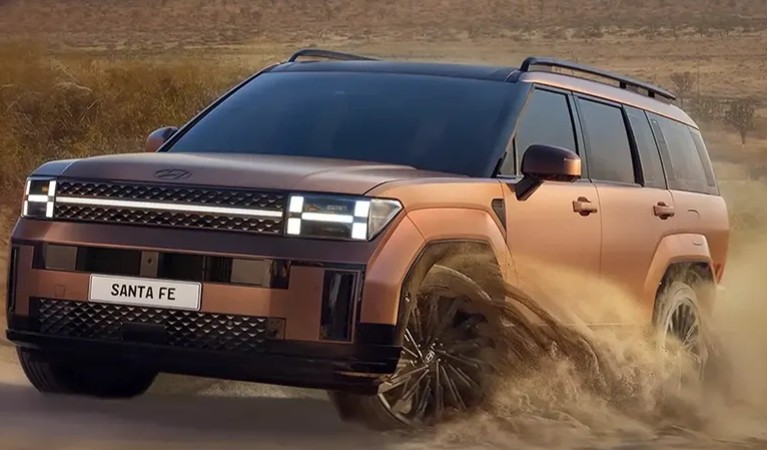
Hyundai globally unveiled the radically transformed model in August 2023, while the redesigned vehicle launched in North America as the 2024 Santa Fe. Hyundai's U.S. materials describe the 2024 model as all new.
Gone was the flowing crossover shape of previous generations.
In came a squared-off profile, a broad rear opening, distinctive H-shaped lighting details, and a much more adventure-oriented personality. The result looks almost like Hyundai took the previous Santa Fe, placed it inside a geometric mold, and sharpened every edge.
Three Rows Become Central Again
One of the most important practical changes was the return of standard three-row seating for the U.S.-market fifth-generation Santa Fe. Hyundai's materials highlight standard third-row seating and the ability to fold both the second and third rows to create a large, flat cargo-oriented interior.
This gave the Santa Fe a different mission.
It still sits below Hyundai's larger Palisade, but it can accommodate families that occasionally need additional seats without necessarily wanting the footprint of Hyundai's biggest SUV.
2024 Santa Fe Powertrains
In the U.S., Hyundai launched the redesigned 2024 model with a turbocharged 2.5-liter gasoline engine using an eight-speed dual-clutch transmission, while the hybrid paired a turbocharged 1.6-liter engine with a six-speed automatic.
That detail becomes particularly relevant when we jump ahead two model years.
Why?
Because Hyundai changed the gasoline model's transmission strategy.
2025 Hyundai Santa Fe: Building on the Redesign
The 2025 Santa Fe remained part of the fifth-generation family rather than undergoing another major redesign.
This is an important distinction when comparing 2024 and 2025 models. Visually and conceptually, they belong to the same chapter.
The fifth-generation Santa Fe also earned major industry recognition: Hyundai announced that it was named the 2025 North American Utility Vehicle of the Year, emphasizing features such as standard three-row seating and its panoramic curved display.
For buyers, however, awards are only one input. The more useful exercise is comparing exact equipment, drivetrain, warranty status, mileage, and price.
2026 Hyundai Santa Fe: An Important Mechanical Change
The 8-Speed Automatic Replaces the DCT
The 2026 Santa Fe is particularly noteworthy for shoppers comparing recent gasoline models.
Hyundai's official 2026 documentation shows the 2.5-liter turbocharged Santa Fe paired with an eight-speed conventional automatic transmission. This replaced the eight-speed dual-clutch transmission used by the 2.5T fifth-generation model at launch.
The hybrid continues with its 1.6-liter turbocharged hybrid setup and six-speed automatic in U.S. specifications.
That makes 2026 more than a year where Hyundai merely changed paint colors or moved features between trims.
For shoppers choosing between a 2024, 2025, and 2026 gasoline Santa Fe, transmission type belongs on the comparison sheet.
2027 Hyundai Santa Fe: The Timeline Continues
Here's where searches for “Hyundai Santa Fe years” can become outdated surprisingly quickly.
As of July 20, 2026, Hyundai Motor America's official media pricing document already lists the 2027 Santa Fe. The document shows 2.5-liter turbo gasoline versions with an eight-speed automatic and hybrid versions with the 1.6-liter turbo hybrid powertrain and six-speed automatic.
So, although 2026 is the current calendar year, the Santa Fe model-year story has already moved into 2027.
The fifth generation therefore continues beyond the familiar 2024–2026 grouping found on some automotive databases.
Which Hyundai Santa Fe Years Belong to Each Generation?
The cleanest North American chronology is straightforward: 2001–2006 represents the first generation, 2007–2012 the second, 2013–2018 the third, 2019–2023 the fourth, and 2024 onward the fifth. Cars.com uses essentially these generation boundaries through its currently listed 2026 models, while Hyundai has since published 2027 U.S. Santa Fe documentation.
International readers should remember that production introductions don't always match U.S. model-year labels perfectly. Hyundai's own historical timeline places the first generation at 2000–2006 and the second at 2006–2012, reflecting international launch timing.
That difference isn't contradictory. It's simply the usual gap between global debut dates, production schedules, regional sales launches, and formal model-year naming.
Which Hyundai Santa Fe Years Represent the Biggest Changes?
2001: The Beginning
The 2001 model matters because it introduced the Santa Fe to U.S. shoppers after production began in 2000. It established Hyundai in the SUV segment and created a nameplate that would survive through decades of market change.
2007: Second-Generation Redesign
This was the transition toward a more spacious, polished, and mature Santa Fe. Hyundai's historical account emphasizes increased power, additional room, and improved safety for the second generation.
2013: Third Generation and Expanded Santa Fe Family
The third generation brought the Santa Fe Sport and longer-wheelbase Santa Fe arrangement in North America, creating one of the most important naming splits in the model's history.
2019: Fourth Generation
Hyundai completely redesigned the Santa Fe again for 2019, adding a more modern interior, sharper styling, and extensive technology. Hyundai explicitly described the 2019 U.S. model as all new.
2021: Major Fourth-Generation Update
Although not a new generation, 2021 deserves attention because Hyundai substantially revised the fourth-generation Santa Fe and its powertrain lineup.
2024: Radical Fifth-Generation Redesign
The boxier 2024 Santa Fe represented perhaps the biggest visual transformation in the SUV's history. It also made three-row seating standard on U.S. models and placed much greater emphasis on flexible passenger and cargo space.
2026: Gasoline Transmission Change
The switch from the gasoline 2.5T model's DCT to a conventional eight-speed automatic makes 2026 mechanically noteworthy within the fifth-generation run.
What Are the Best Hyundai Santa Fe Years?
This is where we should resist giving an oversimplified answer.
There's no universal “best year” because different shoppers value different things.
You may be interested in readingNissan Frontier Generation Years: Complete Guide From 1998 to 2026You may be interested in reading
 Volvo XC90 Models: Complete Guide to Trims, Engines, and Generations
Someone spending a modest amount on an older used SUV may prefer a well-maintained late second- or third-generation example. Someone wanting a more contemporary cabin could gravitate toward the 2019–2023 generation. A family wanting the dramatic new design and standard third row will naturally focus on 2024-and-newer vehicles.
And if we're choosing among recent non-hybrid fifth-generation models, the conventional eight-speed automatic fitted to the 2026 gasoline version creates another meaningful dividing line.
The strongest used Santa Fe isn't automatically the year that tops somebody's online ranking. It's the vehicle where model year, maintenance history, mileage, specification, recall status, price, and condition all make sense together.
Which Hyundai Santa Fe Years Should You Avoid?
We wouldn't condemn an entire production year purely because of its badge.
Automotive reliability is messier than that.
Two Santa Fe vehicles built in the same year can reach the used market in dramatically different condition. One might have enjoyed scheduled maintenance, gentle highway mileage, dry indoor parking, and one careful owner. Another could have missed services, suffered accident repairs, spent years in severe conditions, and changed hands repeatedly.
Which one would we rather own?
Exactly.
When evaluating any Santa Fe year, verify the VIN for outstanding recalls, inspect maintenance records, research the exact engine and transmission fitted to that vehicle, and arrange an independent pre-purchase inspection when possible.
Older vs Newer Hyundai Santa Fe Years
Why Buy an Older Santa Fe?
Older examples can offer a lot of physical vehicle for the money. Depreciation has already done much of its work, and buyers unconcerned with the latest infotainment or driver-assistance systems may find an older vehicle perfectly adequate.
The catch is age.
Rubber components deteriorate. Suspension parts wear. Air-conditioning systems age. Electronics can fail. Rust depends heavily on geography. Service history gradually becomes more important than the original brochure specification.
Why Buy a Newer Santa Fe?
Newer Santa Fe generations offer a much more advanced experience.
The fourth and fifth generations increasingly emphasize connectivity, active safety technology, convenience features, sophisticated cabin design, and electrified powertrains. The fifth generation takes the transformation even further with standard U.S. three-row seating and a radically redesigned body.
Of course, newer also means more expensive.
That's why the sweet spot isn't necessarily the newest Santa Fe we can afford. It's the newest one whose added benefits actually matter to us.
How Long Has the Hyundai Santa Fe Been Made?
Hyundai has produced the Santa Fe continuously since 2000, and it has been sold in North America beginning with the 2001 model year.
That gives the nameplate more than a quarter-century of history by 2026.
Few things demonstrate Hyundai's evolution better.
The earliest Santa Fe was created when Hyundai was still working aggressively to reshape its reputation in major export markets. The newest version competes in a completely different environment, where buyers expect big digital displays, advanced safety technology, refined interiors, electrified options, and increasingly premium design.
The badge stayed.
Almost everything surrounding it changed.
How to Choose Between Different Hyundai Santa Fe Years
Start with the generation rather than obsessing over an individual year.
A shopper deciding between 2017 and 2018 models is making a relatively narrow comparison within one generation. Someone comparing 2018 with 2019 is crossing a complete redesign boundary. Similarly, comparing 2023 with 2024 means comparing the outgoing fourth generation with the radically different fifth generation.
Next, narrow the search according to drivetrain, seating capacity, equipment, mileage, and budget.
Finally, evaluate the actual vehicle.
That's where online research ends and smart used-car shopping begins.
A Model Year Is a Starting Point, Not a Verdict
Think of the model year like the cover of a book.
It tells us which edition we're holding, but not what happened to that particular copy after it left the store.
A pristine, documented, carefully serviced older Santa Fe can easily be a more sensible purchase than a newer example with questionable history.
Hyundai Santa Fe Years and the SUV's Evolution
Looking across every generation makes Hyundai's progress particularly obvious.
The first Santa Fe was practical and unusual. The second became more polished. The third broadened the family with multiple body configurations. The fourth embraced a more premium and technology-focused direction. The fifth threw away much of the previous design language and emerged as a boxy, three-row family SUV with an entirely new personality.
Hyundai itself celebrated the Santa Fe's first twenty years by describing its progression from the first 2000-era vehicle through four generations of increasing sophistication. Since that retrospective, the fifth generation has extended the transformation even further.
That's what makes researching Hyundai Santa Fe years more interesting than simply finding a manufacturing date.
We're watching an entire brand evolve through a single vehicle.
Conclusion: Understanding Hyundai Santa Fe Years Makes Buying Easier
The Hyundai Santa Fe has evolved through five major generations since its debut, with North American model years broadly dividing into 2001–2006, 2007–2012, 2013–2018, 2019–2023, and 2024 onward.
Each transition brought something meaningful.
The 2007 model marked a more mature second generation. The 2013 generation expanded the Santa Fe family. The 2019 redesign pushed technology and refinement forward. The substantially updated 2021 model changed the fourth-generation formula again. Then the boxy 2024 Santa Fe completely redefined the vehicle's appearance and returned three-row versatility to the center of its identity.
Even within the newest generation, the story continues. The 2026 gasoline model switched to a conventional eight-speed automatic, and Hyundai has already released official U.S. information for the 2027 Santa Fe.
So, which Santa Fe year should we buy?
Don't chase a year number alone. Choose the generation that fits our needs, identify the drivetrain and equipment we want, investigate the specific vehicle's history, and compare its condition with its asking price.
The Santa Fe has spent more than two decades changing its clothes, technology, engines, dimensions, and personality. Understanding those changes gives us something far more useful than a simplistic best-year list: it gives us the ability to recognize which Hyundai Santa Fe years actually make sense for us.
Frequently Asked Questions About Hyundai Santa Fe Years
1. What years has the Hyundai Santa Fe been made?
Hyundai began producing the Santa Fe in 2000, with the SUV arriving for the 2001 model year in the United States. Production continues today, and Hyundai has already published U.S. documentation for the 2027 model year.
2. How many generations of Hyundai Santa Fe are there?
There are five generations. For North American model years, they can broadly be grouped as 2001–2006, 2007–2012, 2013–2018, 2019–2023, and 2024 onward.
3. What year did the Hyundai Santa Fe change body style?
The biggest North American redesign years are 2007, 2013, 2019, and 2024 because each marks the start of a new generation. The 2024 redesign is especially dramatic because Hyundai replaced the previous flowing crossover styling with a much boxier fifth-generation shape.
You may be interested in readingNissan Frontier Generation Years: Complete Guide From 1998 to 2026You may be interested in reading
Volvo XC90 Models: Complete Guide to Trims, Engines, and GenerationsYou may be interested in reading
 Alfa Romeo MiTo Models: Complete Guide to Trims, Engines and Versions
4. What is the difference between a 2023 and 2024 Santa Fe?
They belong to different generations. The 2023 model is part of the fourth generation, while the 2024 Santa Fe introduced the fifth generation with completely different exterior styling, a redesigned interior, and standard third-row seating in the U.S. market.
5. Is the 2026 Hyundai Santa Fe different from the 2024 model?
Both belong to the fifth generation, but there is an important drivetrain difference for U.S. gasoline models. The redesigned 2024 2.5T used an eight-speed dual-clutch transmission, while official 2026 specifications show a conventional eight-speed automatic transmission. The hybrid continues to use a six-speed automatic.
If you want to know other articles similar to Hyundai Santa Fe Years: Complete Model Year and Generation Guide you can visit the category Models.
Volkswagen T-Cross vs Volkswagen T-Roc: Which Is Better?
Hyundai Tucson Weight: Complete Guide to Curb, Gross, and Payload Specs

Honda Passport vs Toyota 4Runner: Which SUV Is Better?
Honda Passport vs Ford Bronco: Which SUV Is Better?
Honda Passport vs Ford Explorer: Which SUV Is Better?
Honda Passport or Pilot: Which SUV Is Better?
Leave a Reply
More content of your interest