
Mazda CX-5 Fuel Tank Capacity: Complete Guide

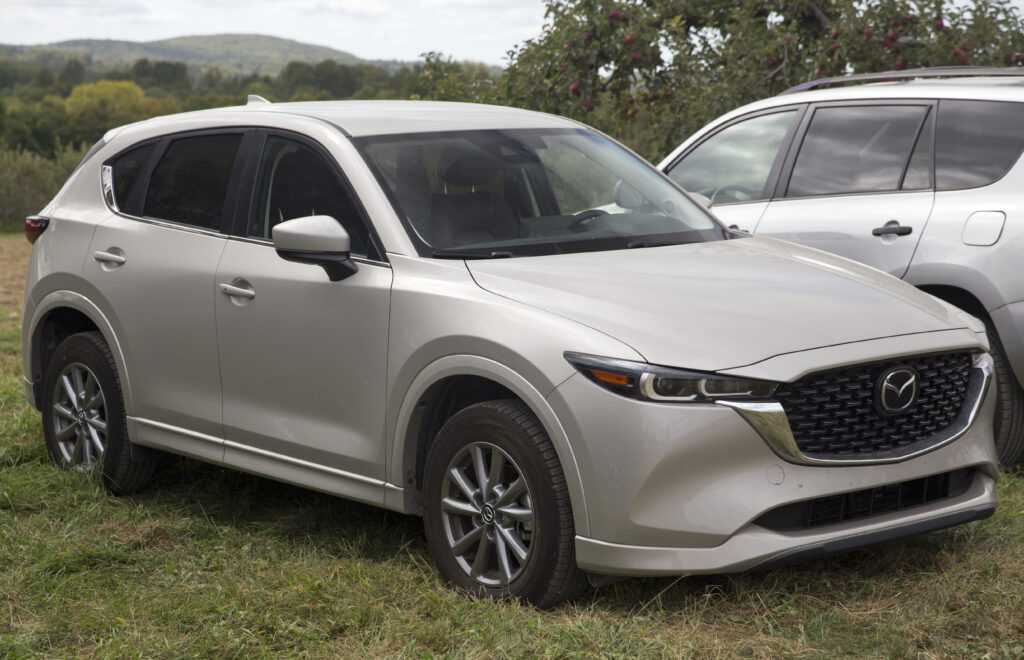
The Mazda CX-5 fuel tank capacity is typically between 56 and 58 litres (14.8–15.3 US gallons), depending on the model year, drivetrain, and country where the vehicle is sold.
For most recent Mazda CX-5 models sold in the United States, including the 2025 and 2026 AWD versions, the fuel tank holds 58 litres or 15.3 US gallons.
However, some front-wheel-drive versions sold internationally have a slightly smaller 56-litre fuel tank.
Knowing the exact fuel tank capacity is useful when planning long journeys, calculating fuel costs, comparing fuel efficiency, and understanding how far your SUV can travel before refuelling.
In this guide, we'll explore Mazda CX-5 fuel tank sizes from 2013 to 2026, including petrol, diesel, turbocharged, FWD, and AWD models.
Content in this publication
- Mazda CX-5 Fuel Tank Capacity at a Glance
- Mazda CX-5 Fuel Tank Capacity by Year
- 2026 Mazda CX-5 Fuel Tank Capacity
- 2025 Mazda CX-5 Fuel Tank Capacity
- 2022–2024 Mazda CX-5 Fuel Tank Capacity
- 2017–2021 Mazda CX-5 Fuel Tank Capacity
- 2013–2016 Mazda CX-5 Fuel Tank Capacity
- Mazda CX-5 FWD vs AWD Fuel Tank Capacity
- Mazda CX-5 Fuel Capacity in the UK and Australia
- Mazda CX-5 Petrol vs Diesel Fuel Tank Capacity
- How Far Can a Mazda CX-5 Go on a Full Tank?
- 2026 Mazda CX-5 Driving Range
- 2025 Mazda CX-5 Driving Range
- Mazda CX-5 Range in Kilometres
- Real-World Mazda CX-5 Fuel Range
- How Much Does It Cost to Fill a Mazda CX-5?
- Why Doesn't My Mazda CX-5 Take 58 Litres?
- Mazda CX-5 Fuel Warning Light Explained
- How Accurate Is the Mazda CX-5 Fuel Gauge?
- What Fuel Does the Mazda CX-5 Use?
- How to Improve Mazda CX-5 Fuel Efficiency
- Is the Mazda CX-5 Fuel Tank Big Enough?
- Mazda CX-5 Fuel Tank Capacity: Buying Tips
- Frequently Asked Questions
- Conclusion: Mazda CX-5 Fuel Tank Capacity
Mazda CX-5 Fuel Tank Capacity at a Glance
Here are the most important specifications.
| Specification | Fuel Tank Capacity |
|---|---|
| Mazda CX-5 FWD | 56 litres |
| Mazda CX-5 AWD | 58 litres |
| US Mazda CX-5 2025 | 58 litres |
| US Mazda CX-5 2026 AWD | 58 litres |
| 56-litre tank in US gallons | 14.8 gallons |
| 58-litre tank in US gallons | 15.3 gallons |
| 56-litre tank in UK gallons | 12.3 gallons |
| 58-litre tank in UK gallons | 12.8 gallons |
These figures represent the manufacturer's approximate tank capacities, not the amount of fuel required at every visit to a petrol station.
For instance, a vehicle with a 58-litre fuel tank might only require 45 litres to fill because several litres remain inside.
Mazda CX-5 Fuel Tank Capacity by Year
Although Mazda has redesigned and updated the CX-5 several times, its fuel tank capacity has remained relatively consistent.
The main differences generally relate to drivetrain configuration and market specifications rather than simply the vehicle's age.
Mazda CX-5 Fuel Tank Size: 2013–2026
| Model Year | FWD Capacity | AWD Capacity |
|---|---|---|
| 2013 | 56 L (14.8 US gal) | 58 L (15.3 US gal) |
| 2014 | 56 L (14.8 US gal) | 58 L (15.3 US gal) |
| 2015 | 56 L (14.8 US gal) | 58 L (15.3 US gal) |
| 2016 | 56 L (14.8 US gal) | 58 L (15.3 US gal) |
| 2017 | 56 L (14.8 US gal) | 58 L (15.3 US gal) |
| 2018 | 56 L (14.8 US gal) | 58 L (15.3 US gal) |
| 2019 | 56 L (14.8 US gal) | 58 L (15.3 US gal) |
| 2020 | 56 L (14.8 US gal) | 58 L (15.3 US gal) |
| 2021 | 56 L (14.8 US gal) | 58 L (15.3 US gal) |
| 2022 | Market-dependent | 58 L (15.3 US gal) |
| 2023 | Market-dependent | 58 L (15.3 US gal) |
| 2024 | Market-dependent | 58 L (15.3 US gal) |
| 2025 | Market-dependent | 58 L (15.3 US gal) |
| 2026 | 56 L (14.8 US gal) | 58 L (15.3 US gal) |
Important: This table summarises the commonly documented FWD and AWD capacities. Not every drivetrain was available in every country or model year. For example, the US-market CX-5 adopted standard AWD for the 2022 model year, while FWD versions continued to exist in some international markets.
Always check the owner's manual for your specific vehicle.
2026 Mazda CX-5 Fuel Tank Capacity
The redesigned 2026 Mazda CX-5 maintains a familiar fuel tank arrangement.
According to Mazda's 2026 specifications:
- Front-wheel-drive versions: 56 litres (14.8 US gallons).
- All-wheel-drive versions: 58 litres (15.3 US gallons).
The US-market 2026 CX-5 comes with AWD, giving it a 15.3-gallon fuel tank.
This is particularly interesting because the third-generation CX-5 introduces significant changes to its body design, dimensions, interior, and technology.
Despite these updates, its AWD fuel capacity remains the same as the previous generation.
Does the 2026 CX-5 Have a Bigger Gas Tank?
No. The 2026 AWD CX-5 does not have a larger fuel tank than the US-market 2025 version.
Both have a capacity of approximately 58 litres.
However, fuel consumption can change because of differences in vehicle weight, engine calibration, aerodynamics, and driving conditions.
Consequently, identical tank capacities do not necessarily produce identical driving ranges.
2025 Mazda CX-5 Fuel Tank Capacity
The 2025 Mazda CX-5 has a fuel tank capacity of 15.3 US gallons (58 litres) in the United States and Canada.
This applies to the standard AWD configuration, including both naturally aspirated and turbocharged petrol engines.
The 2025 range includes versions such as the 2.5 S, Carbon Edition, Premium Plus, Carbon Turbo, and Turbo Signature.
Although these versions offer different equipment and engine performance, their North American fuel tank capacities are the same.
In contrast, Mazda's 2025 specifications list a 56-litre capacity for the Mexican market.
Does the Turbo CX-5 Have a Different Tank?
For the 2025 US-market model, no.
The naturally aspirated 2.5-litre petrol engine and the 2.5-litre turbocharged engine share the same 58-litre fuel tank.
The difference is how quickly they consume the fuel.
A turbocharged CX-5 can use more petrol, especially during aggressive acceleration or city driving.
Therefore, a turbocharged version may require more frequent refuelling even though the tank itself is not smaller.
2022–2024 Mazda CX-5 Fuel Tank Capacity
For the 2022, 2023, and 2024 model years, the US-market Mazda CX-5 generally features a 58-litre fuel tank.
During this period, AWD became standard across the American CX-5 range.
This simplified the specifications for US buyers because they no longer needed to compare the capacity of two different drivetrain configurations.
International versions can differ, particularly in markets where FWD models continued to be offered.
The important distinction is that the CX-5's tank capacity depends on its actual market and configuration, not just the badge on the tailgate.
2017–2021 Mazda CX-5 Fuel Tank Capacity
The second-generation Mazda CX-5 arrived for the 2017 model year and introduced a more refined design.
It also offered improved cabin materials, enhanced safety technology, and additional engine options throughout its production life.
For these model years, the commonly specified capacities were:
- FWD: 56 litres.
- AWD: 58 litres.
The difference between the two configurations is only two litres, equivalent to approximately 0.5 US gallons.
While that might seem insignificant, it can provide several additional miles of driving range.
Nevertheless, drivetrain efficiency often has a greater impact on driving distance than the small capacity difference.
2013–2016 Mazda CX-5 Fuel Tank Capacity
The first-generation Mazda CX-5 introduced the model's combination of SUV practicality and Mazda's SKYACTIV engineering.
Its original fuel tank capacities were also approximately:
- 56 litres for two-wheel-drive models.
- 58 litres for all-wheel-drive models.
These figures applied to many petrol and diesel configurations, although exact specifications varied by country.
The first generation was offered with several engines, including the 2.0-litre petrol, 2.5-litre petrol, and 2.2-litre diesel in selected markets.
Despite substantial differences in engine performance and fuel consumption, the tank capacity generally followed the drivetrain configuration.
Mazda CX-5 FWD vs AWD Fuel Tank Capacity
One of the most common questions about the Mazda CX-5 is whether all-wheel drive affects fuel tank capacity.
In many CX-5 configurations, it does.
| Drivetrain | Litres | US Gallons | UK Gallons |
|---|---|---|---|
| Front-wheel drive | 56 | 14.8 | 12.3 |
| All-wheel drive | 58 | 15.3 | 12.8 |
| Difference | 2 | 0.5 | 0.4 |
Why Does AWD Have a Larger Fuel Tank?
Vehicle packaging, drivetrain components, and engineering decisions influence fuel tank design.
Mazda has used different fuel tank specifications for FWD and AWD versions across several CX-5 generations.
The AWD version commonly carries an additional two litres.
However, the larger fuel tank does not automatically make the AWD version more economical or guarantee a longer driving range.
Because AWD systems add mechanical components and weight, fuel efficiency can differ from comparable FWD models.
The final result depends on engine type, transmission, driving conditions, and vehicle specifications.
Mazda CX-5 Fuel Capacity in the UK and Australia
Fuel tank capacities can appear confusing when comparing American, British, and Australian websites.
Part of the confusion comes from different measurement systems.
The United States uses US gallons, while the United Kingdom traditionally uses imperial gallons.
Australia primarily publishes fuel tank capacity in litres.
For a 58-litre Mazda CX-5 fuel tank:
| Measurement | Capacity |
|---|---|
| Litres | 58 L |
| US gallons | 15.3 |
| Imperial gallons | 12.8 |
A 15.3-US-gallon fuel tank and a 12.8-imperial-gallon fuel tank are essentially the same physical size.
Mazda CX-5 Fuel Tank Size in Australia
Many Australian Mazda CX-5 models have the following capacities:
- 2.0-litre petrol FWD: 56 litres.
- 2.5-litre petrol FWD: 56 litres.
- 2.5-litre petrol AWD: 58 litres.
- 2.5-litre turbo petrol AWD: 58 litres.
Availability depends on model year and trim.
Australian drivers should use the litres figure rather than comparing gallon measurements from American websites.
Mazda CX-5 Fuel Tank Size in the UK
Many UK-market Mazda CX-5 configurations also use 56-litre FWD and 58-litre AWD capacities.
However, UK models have featured different petrol and diesel engines over the years.
For that reason, it's worth checking the official specification for the exact model rather than assuming every British CX-5 has the same tank.
Mazda CX-5 Petrol vs Diesel Fuel Tank Capacity
Does the diesel Mazda CX-5 have a bigger fuel tank than the petrol version?
Not necessarily.
For many generations, the fuel tank capacity is determined mainly by the drivetrain rather than whether the vehicle runs on petrol or diesel.
For example, a 2.2-litre diesel AWD CX-5 can have a 58-litre tank, while a petrol AWD version of the same generation may also have a 58-litre tank.
The major difference is fuel consumption.
Diesel engines have often delivered better fuel economy on long-distance journeys, allowing them to travel farther on a similar quantity of fuel.
However, fuel economy varies considerably across diesel generations, emissions systems, transmissions, and driving conditions.
We should also remember that diesel and petrol engines require different fuel types. Never fill a diesel CX-5 with petrol or a petrol CX-5 with diesel.
How Far Can a Mazda CX-5 Go on a Full Tank?
The driving range of a Mazda CX-5 depends on two main factors:
- The amount of usable fuel available.
- The vehicle's actual fuel consumption.
A larger fuel tank can increase potential range, but an efficient engine can make an even bigger difference.
To estimate driving distance in miles, we can use this simple formula:
Driving range = Fuel tank capacity (US gallons) × Fuel economy (MPG)
For example, a Mazda CX-5 with a 15.3-gallon fuel tank averaging 26 MPG has a theoretical full-tank driving range of:
15.3 × 26 = 397.8 miles
That means approximately 398 miles under the assumed conditions.
This calculation is not a promise that the vehicle will travel 398 miles before running out of fuel.
Actual driving range will vary, and drivers should refuel before the tank is empty.
2026 Mazda CX-5 Driving Range
The US-market 2026 Mazda CX-5 2.5 S AWD has an EPA-estimated fuel economy of approximately:
- City: 24 MPG.
- Highway: 30 MPG.
- Combined: 26 MPG.
Using its 15.3-US-gallon fuel tank, we can calculate the following theoretical distances.
| Driving Conditions | Fuel Economy | Theoretical Range |
|---|---|---|
| City | 24 MPG | 367 miles |
| Highway | 30 MPG | 459 miles |
| Combined | 26 MPG | 398 miles |
These figures are mathematical full-tank estimates based on EPA fuel economy ratings.
They're useful for comparison, but real journeys may return different results.
Driving at higher speeds, using the air conditioning, carrying passengers, and travelling through mountainous areas can reduce range.
2025 Mazda CX-5 Driving Range
The 2025 Mazda CX-5 has several different EPA fuel economy ratings depending on the engine and equipment.
For example, certain naturally aspirated versions are rated at approximately 25 MPG combined, while more efficient configurations can achieve around 28 MPG combined.
Turbocharged versions are generally rated around 24 MPG combined.
We can estimate their full-tank distances using the same 15.3-gallon tank.
| 2025 CX-5 Configuration | Combined MPG | Estimated Full-Tank Range |
|---|---|---|
| 2.5L standard AWD | 25 | 383 miles |
| 2.5L efficient AWD configuration | 28 | 428 miles |
| 2.5L Turbo AWD | 24 | 367 miles |
These examples show why checking fuel economy matters as much as checking fuel tank capacity.
Two CX-5 models can have identical gas tanks yet differ in theoretical driving range by approximately 60 miles.
Mazda CX-5 Range in Kilometres
For drivers in the UK, Australia, Canada, and other countries using the metric system, fuel consumption is often measured in litres per 100 kilometres.
The calculation is:
Driving range (km) = Fuel tank capacity (L) ÷ Consumption (L/100 km) × 100
Here are illustrative calculations for 56-litre and 58-litre tanks.
| Fuel Consumption | 56-Litre Tank | 58-Litre Tank |
|---|---|---|
| 6.0 L/100 km | 933 km | 967 km |
| 7.0 L/100 km | 800 km | 829 km |
| 8.0 L/100 km | 700 km | 725 km |
| 9.0 L/100 km | 622 km | 644 km |
| 10.0 L/100 km | 560 km | 580 km |
These are examples of how consumption affects range, not official fuel economy ratings for every Mazda CX-5.
In everyday driving, leaving a fuel reserve reduces the practical distance between refuelling stops.
Real-World Mazda CX-5 Fuel Range
Manufacturer fuel economy figures are measured under standardised conditions.
Real-world driving is more unpredictable.
A Mazda CX-5 can consume noticeably more fuel during stop-and-go traffic than on a steady highway journey.
Similarly, an aggressive driving style can produce a lower range than gentle acceleration and consistent speeds.
For many petrol-powered CX-5 owners, a practical refuelling interval of roughly 300–400 miles may be reasonable, although some drivers will experience shorter or longer intervals.
There is no single guaranteed range for every CX-5.
City Driving
City driving often involves:
- Frequent acceleration and braking.
- Traffic lights and congestion.
- Idling and low-speed operation.
- Short journeys with a cold engine.
These factors can increase fuel consumption.
A turbocharged CX-5 may be particularly sensitive to frequent heavy acceleration.
Highway Driving
Long highway journeys can be more efficient when we maintain steady speeds and avoid unnecessary braking.
However, very high speeds can increase aerodynamic resistance and fuel consumption.
A vehicle travelling consistently at moderate highway speeds may achieve a longer range than one travelling considerably faster.
Mountain Driving
Steep gradients increase engine load, often requiring more fuel.
Although descending hills may reduce immediate consumption, it doesn't always compensate for the additional fuel required during climbs.
Drivers travelling through mountainous regions should therefore plan fuel stops conservatively.
How Much Does It Cost to Fill a Mazda CX-5?
The cost of filling a Mazda CX-5 depends on local petrol prices and the quantity required.
We can calculate it using:
Fuel cost = Gallons required × Price per gallon
For illustration, assume petrol costs $3.50 per US gallon.
| Fuel Tank Size | Hypothetical Price | Cost From Empty |
|---|---|---|
| 14.8 US gallons | $3.50/gallon | $51.80 |
| 15.3 US gallons | $3.50/gallon | $53.55 |
These are hypothetical examples, not current petrol price quotations.
In practice, the total amount paid is usually lower because we normally refuel before the tank is completely empty.
For drivers buying fuel by the litre, we can apply the same calculation.
If petrol costs 1.70 currency units per litre, filling a 58-litre tank from empty would theoretically cost 98.60 currency units.
This makes it easy to adjust the calculation to local fuel prices.
Why Doesn't My Mazda CX-5 Take 58 Litres?
Some drivers become concerned when their Mazda CX-5 takes only 40 or 45 litres despite having a 58-litre fuel tank.
In most cases, this is completely normal.
The stated tank capacity is the approximate total capacity, not the amount the car must accept every time it is refuelled.
Consider a CX-5 with a 58-litre tank.
If approximately 13 litres remain inside, the vehicle would need about 45 litres to reach full capacity.
Other factors can affect refuelling measurements, including:
- Fuel remaining when the warning light comes on.
- Fuel gauge estimation.
- Vehicle angle at the petrol station.
- Automatic pump shut-off behaviour.
- Normal variation in filling conditions.
We should never attempt to force additional petrol into the tank after the pump has automatically shut off.
Repeated topping off can create problems with the vehicle's fuel vapour control system.
Mazda CX-5 Fuel Warning Light Explained
The Mazda CX-5 has a low-fuel warning system designed to alert the driver when refuelling is needed.
However, the warning light does not mean the tank is already completely empty.
Some fuel generally remains when the warning appears.
The exact quantity varies depending on model year, driving conditions, and the vehicle's fuel level calculation.
How Many Miles Are Left When the Fuel Light Comes On?
There isn't one reliable number for every Mazda CX-5.
Remaining distance depends on current fuel consumption and the fuel level when the warning activates.
For example, the same remaining quantity of fuel can provide very different distances in heavy city traffic and on an open highway.
The safest approach is to refuel promptly rather than treating the remaining range display as a guarantee.
Is It Bad to Drive With Very Little Fuel?
Frequently driving with an almost empty tank is not a good habit.
It increases the risk of running out of fuel, particularly in remote areas or unexpected traffic.
Running out of fuel can also cause engine stalling and create an unsafe situation on busy roads.
Mazda recommends keeping the tank above approximately one-quarter full in several CX-5 owner manuals.
For a 58-litre tank, one quarter represents roughly 14.5 litres, although the fuel gauge should not be treated as a precision measuring instrument.
How Accurate Is the Mazda CX-5 Fuel Gauge?
The Mazda CX-5 fuel gauge estimates the amount of fuel remaining.
Like other vehicles, it doesn't necessarily move at a perfectly uniform rate.
You might notice the gauge remaining close to full for a while before gradually dropping.
This doesn't mean the tank is changing capacity.
Fuel movement, sensor characteristics, and the vehicle's position can influence readings.
For example, parking on a steep hill may temporarily affect the indicated fuel level.
Similarly, the distance-to-empty display can change when your recent driving conditions become more or less fuel-efficient.
The important point is that the gauge and range display are estimates, not exact measurements of every remaining litre.
What Fuel Does the Mazda CX-5 Use?
Fuel requirements depend on engine configuration and market.
For many US-market Mazda CX-5 petrol engines, regular unleaded petrol rated at 87 AKI or higher is acceptable.
Certain turbocharged engines can deliver additional performance when premium petrol is used, although regular fuel remains permitted where specified by Mazda.
Fuel octane labels differ internationally.
For example, 87 AKI in the United States is not the same measurement as 87 RON in countries that use the Research Octane Number system.
Therefore, drivers in the UK, Australia, and other markets should follow the RON requirement listed for their specific vehicle.
The correct fuel grade is more important than selecting an unnecessarily expensive petrol option.
How to Improve Mazda CX-5 Fuel Efficiency
Increasing driving range does not require installing a larger fuel tank.
We can often make meaningful improvements through driving habits and regular maintenance.
1. Maintain Correct Tyre Pressure
Underinflated tyres increase rolling resistance and can contribute to higher fuel consumption.
Check tyre pressures regularly, especially before long journeys.
Use the tyre pressure specifications displayed on the vehicle's tyre information label.
2. Accelerate Smoothly
Frequent aggressive acceleration uses more fuel.
Gentle acceleration and anticipating traffic conditions can reduce unnecessary fuel consumption.
This is particularly beneficial in busy urban environments.
3. Avoid Carrying Unnecessary Weight
Additional cargo increases vehicle weight.
While the effect may be relatively small during a short journey, reducing unnecessary loads can help improve efficiency over time.
4. Reduce Aerodynamic Drag
Roof racks, roof boxes, and other external accessories can increase aerodynamic resistance.
Removing unused accessories may improve highway fuel economy.
This can be especially noticeable during long journeys at higher speeds.
5. Keep Up With Maintenance
A well-maintained engine is more likely to operate efficiently.
Follow the recommended service schedule and address mechanical issues promptly.
Worn spark plugs, faulty sensors, or other engine problems may negatively affect fuel consumption.
6. Plan Efficient Routes
Avoiding heavy congestion and unnecessary detours can reduce total fuel usage.
A slightly longer route with consistent traffic flow may sometimes be more economical than a shorter route involving repeated stops.
However, driving distance, traffic conditions, and journey time should all be considered.
Is the Mazda CX-5 Fuel Tank Big Enough?
For most drivers, the Mazda CX-5's 56–58-litre fuel tank provides a practical balance between capacity, vehicle packaging, and everyday usability.
It is generally sufficient for commuting, family trips, and many longer highway journeys without requiring unusually frequent fuel stops.
However, whether the tank feels large enough depends on personal driving habits.
Someone travelling mainly on motorways may experience longer intervals between refuelling stops than a driver dealing with daily urban congestion.
The turbocharged CX-5 can also require more frequent stops due to its higher fuel consumption.
For buyers considering a used Mazda CX-5, we recommend examining the vehicle's fuel economy ratings as well as its tank size.
A smaller tank paired with an efficient engine can sometimes deliver more driving distance than a larger tank paired with a less efficient powertrain.
Mazda CX-5 Fuel Tank Capacity: Buying Tips
When comparing different Mazda CX-5 versions, remember that fuel tank capacity is only one part of the ownership experience.
A sensible comparison should consider engine performance, fuel consumption, maintenance costs, equipment, and expected annual mileage.
For example, a naturally aspirated petrol version may provide a better balance of running costs for someone who prioritises fuel efficiency.
A turbocharged version may appeal more to drivers seeking stronger acceleration.
Diesel versions, where available, can offer attractive long-distance economy, although their suitability depends on mileage patterns, emissions equipment, and local regulations.
Before purchasing, check these details:
- The exact model year.
- Whether the vehicle is FWD or AWD.
- Engine displacement and fuel type.
- Official combined fuel consumption.
- Local fuel prices.
- The manufacturer's fuel tank specification.
This helps avoid comparing vehicles based solely on their advertised tank capacity.
Frequently Asked Questions
1. How Many Litres Is the Mazda CX-5 Fuel Tank?
The Mazda CX-5 typically has a fuel tank capacity of 56 litres for FWD versions and 58 litres for AWD versions. The 2025 and 2026 US-market AWD models have a 58-litre tank. Always verify the specification for your model year and country.
2. How Many Gallons Does a Mazda CX-5 Hold?
A Mazda CX-5 with a 58-litre fuel tank holds approximately 15.3 US gallons or 12.8 imperial gallons. Models with a 56-litre tank hold approximately 14.8 US gallons or 12.3 imperial gallons.
3. How Far Can a Mazda CX-5 Travel on a Full Tank?
Driving range depends on engine type and fuel consumption. For example, a 2026 US-market Mazda CX-5 averaging 26 MPG has a theoretical full-tank range of approximately 398 miles. Actual range varies, and drivers should refuel before the tank is empty.
4. Does the Mazda CX-5 Turbo Have a Bigger Tank?
No. The 2025 US-market Mazda CX-5 Turbo uses the same 58-litre fuel tank as its naturally aspirated AWD counterparts. However, the turbocharged engine generally consumes more petrol, which can reduce driving range.
5. Is the 2026 Mazda CX-5 Fuel Tank Bigger Than the 2025 Model?
No. The US-market 2025 and 2026 Mazda CX-5 AWD models both have a 58-litre (15.3-US-gallon) fuel tank. The redesigned 2026 model retains this capacity even though its overall dimensions and vehicle design have changed.
Conclusion: Mazda CX-5 Fuel Tank Capacity
The Mazda CX-5 fuel tank capacity ranges from approximately 56 to 58 litres, depending on drivetrain, model year, and market.
For drivers in the United States, the most useful figure is 15.3 US gallons (58 litres), which applies to recent AWD models, including the 2025 and redesigned 2026 Mazda CX-5.
Meanwhile, many FWD configurations sold internationally use a 56-litre tank.
Although the difference is relatively small, understanding the correct capacity helps us estimate driving range, calculate refuelling costs, and plan longer journeys.
Ultimately, the distance a Mazda CX-5 can travel on a full tank depends more on real-world fuel consumption than on tank size alone. By maintaining the vehicle properly, driving efficiently, and monitoring fuel levels, we can make the most of every litre.
If you want to know other articles similar to Mazda CX-5 Fuel Tank Capacity: Complete Guide you can visit the category Driving.
Toyota RAV4 Miles Per Gallon: Complete MPG and Fuel Economy Guide
Toyota Prius MPG UK: Official and Real Fuel Economy

Mazda CX-5 Real-World MPG: What Drivers Actually Get
Mazda CX-5 0-60: Acceleration Times by Year and Engine
MG HS Fuel Consumption: Complete MPG Guide

Can Nissan Rogue Pull a Boat? Complete Towing Guide
Leave a Reply
More content of your interest