

Toyota Sequoia Hybrid MPG: How Fuel-Efficient Is This Full-Size SUV?

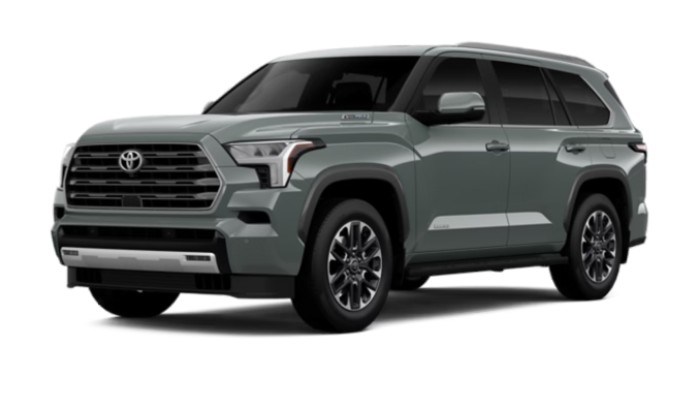
The words “hybrid SUV” usually make us picture something quiet, light, and extremely economical. Then the Toyota Sequoia rolls into view looking like it could tow a small house.
That contrast explains why Toyota Sequoia hybrid MPG is such an interesting topic.
The modern Sequoia uses Toyota's i-FORCE MAX twin-turbo V6 hybrid powertrain, but this isn't a hybrid designed primarily to chase Prius-like fuel-economy numbers. Toyota engineered the system to combine efficiency with serious horsepower, torque, towing capability, and the durability expected from a large body-on-frame SUV.
For the 2026 Toyota Sequoia, Toyota quotes fuel economy of up to an EPA-estimated 22 MPG combined. The most efficient SR5 and Limited 4x2 configurations are rated at 21 MPG city, 24 MPG highway, and 22 MPG combined.
Twenty-two MPG may not sound spectacular beside a compact hybrid crossover returning 35 or 40 MPG. But that's missing the point.
The Sequoia is a huge three-row SUV with up to eight seats, substantial towing capability, and 437 horsepower with 583 lb-ft of torque. Toyota says properly equipped versions can tow roughly 9,500 pounds or more, depending on configuration.
So, is the Toyota Sequoia hybrid actually economical? How much fuel does it use in the real world? Does 4WD hurt MPG? And does buying the hybrid save enough gas to matter?
Let's dig into it.
Content in this publication
- What Is the Toyota Sequoia Hybrid MPG?
- Why Isn't the Toyota Sequoia Hybrid Getting 30 or 40 MPG?
- How the Toyota Sequoia Hybrid System Works
- Toyota Sequoia Hybrid City MPG
- Toyota Sequoia Hybrid Highway MPG
- Toyota Sequoia Hybrid Combined MPG
- Toyota Sequoia 2WD vs 4WD MPG
- Toyota Sequoia TRD Pro MPG Expectations
- Does Towing Reduce Toyota Sequoia Hybrid MPG?
- How Far Can a Toyota Sequoia Hybrid Travel on One Tank?
- How Much Fuel Does a Toyota Sequoia Use per 1,000 Miles?
- How Much Can Driving Style Change Sequoia MPG?
- Tire Pressure and Toyota Sequoia Hybrid MPG
- Do Roof Racks Hurt Sequoia MPG?
- Does Air Conditioning Reduce Hybrid MPG?
- Why Winter Can Lower Toyota Sequoia Hybrid MPG
- Is 22 MPG Actually Good for a Full-Size SUV?
- Toyota Sequoia Hybrid MPG vs Smaller Hybrid SUVs
- Can You Get Better Than EPA MPG in a Sequoia?
- How to Improve Toyota Sequoia Hybrid MPG
- Is the Toyota Sequoia Hybrid Worth It for Fuel Savings?
- Toyota Sequoia Hybrid MPG for Daily Commuting
- Toyota Sequoia Hybrid MPG for Road Trips
- Does the Toyota Sequoia Hybrid Need to Be Plugged In?
- What Toyota Sequoia MPG Should You Realistically Expect?
- The Bigger Picture: Why the Sequoia Hybrid Makes Sense
- Conclusion: Is Toyota Sequoia Hybrid MPG Good Enough?
- Frequently Asked Questions
What Is the Toyota Sequoia Hybrid MPG?
Let's begin with the number most shoppers actually want.
Toyota lists the 2026 Sequoia at up to 22 MPG combined, with certain rear-wheel-drive SR5 and Limited models rated at 21 MPG city and 24 MPG highway.
That's our benchmark.
And yes, every current-generation Sequoia uses the i-FORCE MAX hybrid system. You don't pick between a traditional gasoline engine and an economy-focused hybrid in the way you might with a Toyota RAV4 or Highlander.
The hybrid powertrain is the standard recipe.
2026 Toyota Sequoia MPG at a Glance
For the most efficient configurations, think roughly:
- City: up to 21 MPG
- Highway: up to 24 MPG
- Combined: up to 22 MPG
- Fuel tank: roughly 22.5 gallons
- Power: 437 hp
- Torque: 583 lb-ft
- Maximum towing capability: approximately 9,500 pounds, depending on configuration
Toyota's own comparison data lists the Sequoia with a 22.5-gallon fuel tank and 21/24/22 MPG city/highway/combined figures for the efficient configuration used in its comparison.
Those numbers immediately tell us what kind of hybrid we're dealing with.
This is not a hypermiling machine wearing an SUV costume.
It's a powerful full-size SUV using electrification to make a thirsty type of vehicle noticeably less thirsty.
Why Isn't the Toyota Sequoia Hybrid Getting 30 or 40 MPG?
This question comes up constantly.
We hear “Toyota hybrid,” remember what the Prius can achieve, and subconsciously expect a giant Sequoia to perform the same magic.
Physics has other plans.
The Sequoia is large, heavy, tall, and designed to carry people, cargo, and trailers. At highway speed, it pushes a substantial wall of air. Around town, its powertrain has to accelerate far more mass than something like a Corolla Hybrid.
A hybrid system can recover energy that would otherwise disappear through braking, assist the gasoline engine during acceleration, and improve powertrain efficiency.
It cannot repeal the laws of physics.
The Sequoia Hybrid Has a Different Mission
Toyota's i-FORCE MAX system emphasizes performance as well as fuel economy.
The powertrain develops 437 horsepower and 583 lb-ft of torque, figures that would have sounded like sports-car territory not so long ago.
That electric motor isn't sitting there merely trying to squeeze another mile from every gallon.
It's also contributing immediate torque.
Imagine having an electric teammate standing next to the gasoline engine. When the Sequoia needs to move its considerable weight, accelerate onto the freeway, climb a grade, or pull a trailer, the electric portion of the system can join the effort.
The result is a hybrid with muscles.
How the Toyota Sequoia Hybrid System Works
The Sequoia's i-FORCE MAX combines a twin-turbocharged V6 gasoline engine with an electric motor integrated into the driveline.
Toyota describes the i-FORCE MAX architecture as placing the electric motor between the engine and transmission. The philosophy is somewhat different from Toyota hybrids developed primarily for maximum economy.
In practical terms, the system can use electric assistance when useful, recover energy during deceleration, and coordinate gasoline and electric power according to driving conditions.
Why the Electric Motor Helps a Large SUV
Large vehicles use a surprising amount of energy simply getting moving.
That's where hybridization makes sense.
A gasoline engine isn't always operating in its sweetest efficiency zone during low-speed acceleration. Adding an electric motor lets the vehicle use instant electric torque to support the combustion engine.
Once we're cruising steadily, particularly at highway speeds, the gasoline engine becomes more involved.
That's partly why the Sequoia's difference between city and highway MPG isn't dramatic.
Regenerative Braking Matters Too
Conventional brakes turn kinetic energy into heat.
Hybrids can reclaim some of that energy through regenerative braking and send it back toward the battery.
Drive down a hill, slow for traffic, or approach a red light, and some energy that would otherwise vanish can be reused later.
It's essentially automotive recycling.
Not every joule comes back, of course. But in a large vehicle repeatedly slowing and accelerating through urban traffic, recovering even part of that energy can make a meaningful difference.
Toyota Sequoia Hybrid City MPG
The 2026 Sequoia can achieve up to an EPA-estimated 21 MPG in the city in its more efficient 4x2 configuration.
That's where the hybrid hardware gets frequent opportunities to work.
City driving includes braking, coasting, low-speed movement, and repeated acceleration. Regenerative braking can recover energy, while electrical assistance can help reduce how much work the gasoline engine performs during certain conditions.
Yet we shouldn't confuse this with the behavior of a smaller Toyota hybrid.
Why Short Trips Can Still Hurt MPG
If your commute is three miles from home to work, don't assume you'll automatically see the EPA city figure.
Cold engines operate differently from fully warmed-up engines. Climate-control use, short trips, traffic, aggressive acceleration, and temperature can all affect fuel consumption.
A giant SUV crawling between intersections also has plenty of mass to move every time the light turns green.
Drivers who accelerate smoothly generally give the hybrid system a better opportunity to operate efficiently.
Drivers who treat every green light like the starting grid at Daytona shouldn't be surprised when MPG sinks.
Toyota Sequoia Hybrid Highway MPG
Highway efficiency reaches up to an EPA-estimated 24 MPG on certain 2026 rear-wheel-drive Sequoia models.
For a full-size three-row SUV capable of serious towing, that number is respectable.
But highway MPG is extremely sensitive to speed.
Why Speed Makes Such a Difference
Air resistance increases rapidly as speed rises.
At 50 mph, the Sequoia is already moving a large frontal area through the air.
At 70 mph, it's working considerably harder.
At 80 mph with a roof box strapped on top, the SUV is basically arguing with the atmosphere.
That's why two owners driving the same Sequoia over a similar highway route might report noticeably different fuel economy.
The driver cruising gently may approach the official highway figure.
The driver maintaining high speeds into a headwind may wonder where several MPG disappeared.
Toyota Sequoia Hybrid Combined MPG
For buyers trying to estimate everyday ownership costs, combined MPG is usually the most useful figure.
The efficient versions of the 2026 Sequoia reach an EPA-estimated 22 MPG combined.
Combined MPG represents a standardized mixture of urban and highway driving rather than a promise that your trip computer will permanently display 22.0.
Think of it as a laboratory reference point.
Your driveway isn't a laboratory.
Your weather, commute, tires, traffic, passengers, terrain, cargo, and driving habits all join the equation.
Toyota Sequoia 2WD vs 4WD MPG
If fuel economy is one of your priorities, drivetrain configuration deserves attention.
Toyota's official figures show that the most efficient 4x2 Sequoia configurations reach 21 city/24 highway/22 combined MPG, while certain four-wheel-drive versions carry lower EPA estimates.
Why?
Four-wheel-drive hardware adds components and usually additional weight. Mechanical losses can also increase slightly.
The difference isn't enormous, but over tens of thousands of miles it can become measurable.
Should You Choose 2WD Just for Better MPG?
Only if it fits how you actually use the vehicle.
If you live somewhere with mild weather, spend nearly all your time on pavement, and don't need the additional capability, rear-wheel drive can make sense.
But sacrificing capability you genuinely need just to gain a modest fuel-economy advantage can be false economy.
The best drivetrain isn't the one with the highest number on an EPA label.
It's the one suited to your life.
Toyota Sequoia TRD Pro MPG Expectations
The TRD Pro is aimed at buyers who want serious off-road hardware and appearance.
Naturally, that isn't the perfect recipe for maximizing MPG.
Off-road-oriented tires, four-wheel-drive hardware, different suspension components, and increased rolling resistance can all work against fuel economy.
The same basic principle applies to any vehicle: optimizing it for capability usually nudges efficiency in the opposite direction.
It's like choosing hiking boots over running shoes. Both get us down the trail, but they're optimized for different jobs.
Can a TRD Pro Still Be Efficiently Driven?
Absolutely.
Driving style matters regardless of trim.
Smooth throttle inputs, steady speeds, correct tire pressures, sensible highway velocity, and avoiding unnecessary roof-mounted accessories can all help.
Just don't purchase the most trail-focused Sequoia expecting it to be the MPG champion of the lineup.
Does Towing Reduce Toyota Sequoia Hybrid MPG?
Yes—sometimes dramatically.
Toyota advertises substantial towing capability for the Sequoia, with current 2026 models offering a maximum figure above 9,500 pounds when properly configured.
That's impressive.
But towing fuel economy is a different universe from unloaded EPA testing.
Trailer Aerodynamics Can Matter More Than Weight
A heavy but aerodynamic trailer may sometimes create less highway fuel-economy damage than a lighter trailer shaped like a giant brick.
At speed, aerodynamic drag becomes the villain.
Tow a tall travel trailer into a strong headwind and the powertrain must continually overcome enormous air resistance.
That's when MPG can tumble.
The Hybrid Still Has an Advantage
The hybrid system can provide electric torque during acceleration and help with power delivery under load.
What it cannot do is eliminate the energy required to pull thousands of pounds.
So when estimating a towing trip, don't calculate fuel stops using the Sequoia's unloaded 22-MPG combined rating.
Leave yourself margin.
Plenty of it.
How Far Can a Toyota Sequoia Hybrid Travel on One Tank?
Toyota lists a fuel tank of around 22.5 gallons in its current comparison specifications.
If we combine that capacity with an EPA-estimated 22 MPG, a simple theoretical calculation gives us about:
22.5 × 22 = 495 miles
That doesn't mean we should expect exactly 495 miles between every fill-up.
The vehicle won't normally use every drop of fuel in the tank before indicating empty, and real-world MPG varies.
Still, the calculation gives us useful context.
A highway-oriented road trip could theoretically produce a substantial cruising range.
Real Range Depends on the Drive
Imagine two Sequoias.
One carries two adults along a flat highway at moderate speed on a calm day.
The other has six passengers, luggage, a roof carrier, four-wheel drive, mountainous terrain, and strong headwinds.
Same vehicle family.
Very different fuel range.
That's why calculating fuel stops from your own historical MPG is much more reliable than blindly multiplying the EPA number by tank capacity.
How Much Fuel Does a Toyota Sequoia Use per 1,000 Miles?
Here's an easier way to understand the MPG figure.
At 22 MPG:
1,000 miles ÷ 22 MPG = roughly 45.5 gallons.
At 18 MPG:
1,000 miles ÷ 18 MPG = roughly 55.6 gallons.
That seemingly small four-MPG difference means about 10 additional gallons every 1,000 miles.
Over 15,000 miles per year?
Now we're talking about roughly 150 extra gallons.
Small MPG changes aren't so small after all.
How Much Can Driving Style Change Sequoia MPG?
Quite a bit.
A vehicle this large rewards smoothness.
Flooring the accelerator isn't free. The energy required to accelerate a heavy SUV has to come from somewhere, and ultimately much of it comes from gasoline.
Then slamming on the brakes throws much of that energy away again, even though regenerative braking can recover part of it.
Drive Like There's an Egg Under the Accelerator
We don't mean crawling everywhere.
We mean looking ahead.
If traffic 300 yards ahead is stopping, easing off early lets the vehicle coast and decelerate progressively.
Accelerating gently after the light changes avoids unnecessary bursts of fuel consumption.
The goal isn't to drive painfully slowly.
It's to drive deliberately.
Tire Pressure and Toyota Sequoia Hybrid MPG
Tires are easy to ignore until they're flat.
But underinflated tires increase rolling resistance, meaning the powertrain must work harder to keep the SUV moving.
With a vehicle as heavy as the Sequoia, maintaining the correct pressure is particularly worthwhile.
Use the pressure specified for your vehicle on the tire-information placard rather than blindly inflating to the maximum pressure written on the tire sidewall.
Off-Road Tires Can Affect Efficiency
Aggressive all-terrain tires look fantastic and can improve capability.
They may also weigh more and create greater rolling resistance.
That's a perfectly fair trade if you regularly leave the pavement.
If the wildest terrain your Sequoia encounters is the grocery-store parking lot, however, it's worth considering whether you really need extremely aggressive rubber.
Do Roof Racks Hurt Sequoia MPG?
Potentially, yes.
Aerodynamic accessories matter most at speed.
Roof baskets, cargo boxes, awnings, kayaks, bikes, and oversized accessories can disturb airflow around the vehicle.
The Sequoia already has a large frontal area.
Adding more drag is like opening a tiny parachute over the roof.
If you use accessories occasionally, removing them when they're unnecessary may help highway MPG.
Does Air Conditioning Reduce Hybrid MPG?
Climate control consumes energy.
The effect varies according to temperature, humidity, trip length, and operating conditions.
You don't need to suffer through summer without air conditioning for the sake of one decimal point on the MPG display.
Comfort matters.
But extreme climate-control loads can influence fuel use, particularly on shorter journeys.
Why Winter Can Lower Toyota Sequoia Hybrid MPG
Drivers in cold climates may notice lower winter numbers.
Cold engines take time to warm.
Cold batteries behave differently.
Winter gasoline formulations, snow, slush, heater use, and lower tire pressures can all work against efficiency.
Then there's the aerodynamic masterpiece known as driving through a snowstorm.
If your summer average is higher than your winter average, it doesn't automatically mean something is wrong with the Sequoia.
Seasonal variation is normal.
Is 22 MPG Actually Good for a Full-Size SUV?
Context is everything.
Twenty-two MPG would be disappointing in a small sedan.
In a powerful, body-on-frame, three-row SUV with a 437-hp hybrid system and serious towing credentials, it's much more compelling.
Toyota itself positions the 2026 Sequoia at up to 22 combined MPG while retaining 437 horsepower and 583 lb-ft of torque.
That's the achievement.
Efficiency without turning the Sequoia into something it isn't.
Think Improvement, Not Transformation
The hybrid system doesn't transform the Sequoia into a lightweight crossover.
Instead, it makes a large, capable SUV more efficient while simultaneously delivering huge torque.
That's an important distinction.
If your primary goal is maximum MPG, Toyota sells many other hybrids better suited to the mission.
If your goal is carrying a big family, towing substantial loads, and still using less fuel than we'd historically expect from a giant SUV, the Sequoia becomes far more interesting.
Toyota Sequoia Hybrid MPG vs Smaller Hybrid SUVs
This isn't really a fair fight.
Compact and midsize hybrid crossovers typically weigh less, present less frontal area, use smaller engines, and aren't expected to tow enormous trailers.
Naturally, they can return much higher MPG.
The Sequoia buyer is solving a different problem.
We're comparing a moving apartment to a backpack.
Both carry things.
That's about where the similarity ends.
Who Should Prioritize the Sequoia Instead?
The Sequoia makes sense for shoppers who genuinely need substantial interior space, strong towing capability, a rugged truck-based platform, or a combination of those qualities.
If you're transporting one person and a laptop 98% of the time, buying a Sequoia for fuel economy alone would be peculiar.
But if you actually use its capacity, comparing its MPG with a compact hybrid isn't particularly meaningful.
Can You Get Better Than EPA MPG in a Sequoia?
Possibly.
EPA estimates are standardized testing figures, not hard limits.
Favorable terrain, mild weather, moderate cruising speeds, careful acceleration, low traffic, proper tire pressures, and a lightly loaded vehicle can create circumstances where a driver beats the official number.
Toyota also explicitly notes that actual mileage varies according to factors including vehicle condition and how and where the vehicle is driven.
The reverse is equally true.
Urban congestion, winter conditions, fast highway travel, towing, hills, roof accessories, and aggressive driving can pull MPG significantly below the rating.
Don't Chase the Dashboard Number Too Hard
There's a strange thing that happens when we start watching MPG constantly.
Suddenly every hill feels personal.
Use the display as feedback, not a scoreboard.
If your long-term average seems reasonable for your conditions, enjoy the SUV.
That's what you bought it for.
How to Improve Toyota Sequoia Hybrid MPG
We don't need strange fuel additives or magical devices.
The fundamentals matter most.
Keep tires correctly inflated. Accelerate progressively. Avoid unnecessary idling. Remove unused aerodynamic accessories. Maintain reasonable highway speeds. Keep up with scheduled maintenance. Anticipate traffic rather than accelerating hard only to brake moments later.
None of those changes is exciting.
That's exactly why they work.
Efficiency is usually built from boring little habits repeated thousands of times.
Highway Speed May Be Your Biggest Lever
If most of your mileage comes from freeway driving, reducing cruising speed slightly can have a surprisingly meaningful effect.
You don't need to crawl.
But the aerodynamic difference between relaxed cruising and sustained very-high-speed travel becomes significant in something shaped like the Sequoia.
Sometimes the simplest fuel-saving modification is your right foot.
Is the Toyota Sequoia Hybrid Worth It for Fuel Savings?
We wouldn't buy a Sequoia solely because it's a hybrid.
The bigger argument is the overall package.
The i-FORCE MAX powertrain gives us excellent torque, strong acceleration, substantial towing capability, and respectable economy for a vehicle this large.
Toyota's current specification combines 437 hp, 583 lb-ft of torque, roughly 9,500 pounds of maximum towing capability, and up to 22 MPG combined.
Viewed together, those numbers make more sense than MPG viewed alone.
The Hybrid System Is About Capability Plus Efficiency
That's the key takeaway.
Some hybrids exist mainly to sip fuel.
The Sequoia hybrid exists to do hard work without drinking quite as much of it.
That distinction changes how we should judge the vehicle.
Toyota Sequoia Hybrid MPG for Daily Commuting
Can you commute in one?
Of course.
The real question is whether it makes sense for your commute.
If you need three rows after work, regularly tow on weekends, transport a large family, or simply want one vehicle capable of handling almost everything, the Sequoia can make a compelling all-purpose machine.
If your commute consists of one person traveling through dense city traffic with no need for towing or cargo space, a smaller hybrid will obviously consume less fuel.
Buying the right-sized vehicle remains one of the easiest ways to reduce fuel consumption.
Toyota Sequoia Hybrid MPG for Road Trips
This may be where the Sequoia shines brightest.
Its combination of passenger space, highway comfort, substantial range, cargo capacity, and reasonable highway MPG makes it well suited to long journeys.
With the most efficient configuration rated at 24 MPG highway, fuel stops can be reasonably spaced under favorable conditions.
And unlike squeezing a family into a tiny economy car, everyone can bring more than one pair of socks.
That's worth something too.
Does the Toyota Sequoia Hybrid Need to Be Plugged In?
No.
The Sequoia uses a conventional hybrid system rather than a plug-in hybrid setup.
Drivers don't need to connect it to a charger every evening.
The vehicle manages its hybrid battery through the powertrain and regenerative braking system as you drive.
That makes ownership straightforward for people who want some benefits of electrification without changing their fueling routine.
Is That Better Than a Plug-In Hybrid?
Neither concept is universally better.
A plug-in hybrid can offer significant electric-only driving when regularly charged.
A conventional hybrid is simpler for people who cannot charge at home or don't want to think about plugging in.
For a vehicle built around long trips, towing, and heavy-duty capability, Toyota has clearly prioritized a different balance.
What Toyota Sequoia MPG Should You Realistically Expect?
The safest starting point is the EPA label for your specific drivetrain and trim.
For the efficient 2026 4x2 models, that means as much as 21 MPG city, 24 MPG highway, and 22 MPG combined.
From there, adjust expectations based on your lifestyle.
Lots of highway cruising at sensible speeds? You may do well.
Stop-and-go traffic plus short journeys? Expect variation.
TRD equipment and aggressive tires? Probably lower.
Towing a travel trailer across Wyoming into a headwind?
Forget the brochure number and start looking for the next gas station.
The Bigger Picture: Why the Sequoia Hybrid Makes Sense
The modern Sequoia represents an interesting stage in hybrid development.
Electrification is no longer reserved for tiny cars trying to set fuel-economy records.
Manufacturers can also use electric motors to improve the way large, powerful vehicles deliver torque while reducing fuel consumption compared with what we'd traditionally expect from such machines.
That's where the Sequoia sits.
It doesn't whisper, “Look how little fuel I use.”
It says, “Look how much SUV you can move with this amount of fuel.”
And that's a very different proposition.
Conclusion: Is Toyota Sequoia Hybrid MPG Good Enough?
The Toyota Sequoia hybrid MPG reaches up to an EPA-estimated 22 MPG combined for the 2026 model, while the most efficient 4x2 SR5 and Limited configurations are rated at 21 MPG city and 24 MPG highway.
Those numbers won't impress a Prius owner.
They might impress someone who remembers how thirsty large V8-powered SUVs traditionally were.
The Sequoia's hybrid system isn't trying to turn a full-size SUV into an economy car. It's using electrification to balance efficiency with 437 horsepower, 583 lb-ft of torque, three-row utility, and serious towing capability.
And judged on those terms, the formula makes sense.
If maximum MPG dominates your purchasing decision, choose something smaller.
If you need a large SUV and want to reduce the fuel penalty without giving up power and capability, the Sequoia hybrid becomes considerably more persuasive.
Sometimes fuel efficiency isn't about using the least gasoline possible.
It's about getting more work from every gallon.
Frequently Asked Questions
1. What MPG does the Toyota Sequoia hybrid get?
The 2026 Toyota Sequoia offers up to an EPA-estimated 22 MPG combined. Certain 4x2 SR5 and Limited versions are rated at 21 MPG city and 24 MPG highway. Actual fuel economy varies with drivetrain, trim, weather, speed, terrain, load, and driving style.
2. Is the Toyota Sequoia hybrid good on gas?
It's reasonably fuel-efficient for a large, powerful, body-on-frame SUV, but it isn't economical compared with smaller hybrids. The important context is that the Sequoia combines up to 22 MPG combined with 437 horsepower, 583 lb-ft of torque, and substantial towing capability.
3. Does the Toyota Sequoia hybrid get better MPG on the highway?
Yes. The most efficient 2026 configurations are rated at up to 24 MPG highway, compared with 21 MPG city and 22 MPG combined. Highway results can still fall significantly when driving quickly, towing, climbing mountains, or using drag-producing roof accessories.
4. Does the Toyota Sequoia hybrid need to be plugged in?
No. The Sequoia's i-FORCE MAX system is a conventional hybrid rather than a plug-in hybrid. It does not require routine external charging. Its electric motor and hybrid battery work together with the gasoline engine during normal driving.
5. How many miles can a Toyota Sequoia hybrid travel on a tank?
Toyota lists a roughly 22.5-gallon fuel tank in current Sequoia comparison specifications. At 22 MPG, that mathematically represents approximately 495 miles of theoretical range, although real usable range will normally differ because of driving conditions, fuel reserve, load, terrain, weather, and individual MPG.
If you want to know other articles similar to Toyota Sequoia Hybrid MPG: How Fuel-Efficient Is This Full-Size SUV? you can visit the category Driving.
Can Nissan Rogue Pull a Boat? Complete Towing Guide
Can Nissan Rogue Be Flat Towed? Complete Towing Guide
Are Nissan Rogue Good on Gas? MPG, Fuel Economy, and Real-World Costs
Can Nissan Rogue Drive in Snow? Complete Winter Driving Guide

Kia Sorento Diesel Fuel Consumption: MPG, Efficiency and Real-World Range
Haval Jolion Hybrid Fuel Consumption: How Efficient Is It Really?
Leave a Reply
More content of your interest