
Volvo S90 vs BMW 5 Series: Which Luxury Sedan Wins?

Choosing between the Volvo S90 vs BMW 5 Series is not as simple as comparing horsepower, technology, or purchase prices. Both luxury sedans offer premium interiors, advanced safety systems, comfortable seating, and refined driving experiences. However, they approach luxury from noticeably different perspectives.
The Volvo S90 emphasizes Scandinavian design, relaxation, passenger comfort, and understated elegance. The BMW 5 Series combines executive-level luxury with responsive handling, sophisticated technology, and a broader selection of powertrains.
So, which luxury sedan should we choose?
In this comprehensive comparison, we'll examine the Volvo S90 and BMW 5 Series across the categories that matter most: design, performance, fuel efficiency, interior quality, passenger space, reliability, maintenance costs, and long-term value.
We'll primarily compare the 2025 Volvo S90 with the current-generation BMW 5 Series, including the 2026 model. Specifications refer mainly to US-market versions unless otherwise stated.
One important distinction: Volvo has discontinued new S90 sales in the United States and United Kingdom. However, an updated S90 was introduced for China and selected international markets in 2025. Consequently, availability and specifications depend on where we live.
Content in this publication
- Volvo S90 vs BMW 5 Series: Quick Comparison
- 1. Exterior Design: Scandinavian Elegance vs German Sportiness
- 2. Volvo S90 vs BMW 5 Series Dimensions
- 3. Interior Quality and Luxury Materials
- 4. Volvo S90 vs BMW 5 Series Engine Options
- 5. Acceleration and Performance Comparison
- 6. Driving Experience: Which Is More Enjoyable?
- 7. Ride Comfort and Suspension Quality
- 8. Volvo S90 vs BMW 5 Series Fuel Economy
- 9. Volvo S90 vs BMW 5 Series Boot Space
- 10. Rear Seat Space and Passenger Comfort
- 11. Technology and Infotainment Systems
- 12. Volvo S90 vs BMW 5 Series Safety
- 13. Volvo S90 vs BMW 5 Series Reliability
- 14. Maintenance and Repair Costs
- 15. Insurance Costs and Ownership Expenses
- 16. Volvo S90 vs BMW 5 Series Price Comparison
- 17. Depreciation and Resale Value
- 18. Volvo S90 vs BMW 5 Series for Long-Distance Driving
- 19. Which Is Better for City Driving?
- 20. Volvo S90 vs BMW 5 Series: Pros and Cons
- 21. Which Luxury Sedan Should You Buy?
- 22. Volvo S90 vs BMW 5 Series: Our Final Comparison
- Frequently Asked Questions
- Conclusion: Volvo S90 or BMW 5 Series?
Volvo S90 vs BMW 5 Series: Quick Comparison
Before exploring the details, let's compare their main characteristics.
| Feature | Volvo S90 | BMW 5 Series |
|---|---|---|
| Brand origin | Sweden | Germany |
| Vehicle category | Executive luxury sedan | Executive luxury sedan |
| Design philosophy | Scandinavian minimalism | Modern sporting luxury |
| Seating capacity | 5 passengers | 5 passengers |
| Entry petrol engine | 2.0L turbocharged four-cylinder | 2.0L turbocharged four-cylinder |
| Representative US horsepower | 295 hp (S90 B6) | 255 hp (530i) |
| Powerful hybrid option | 455 hp (S90 T8) | 483 hp (550e xDrive) |
| Transmission | 8-speed automatic | 8-speed automatic |
| Drivetrain | AWD on recent US versions | RWD or AWD, depending on version |
| Boot capacity | Approximately 382 litres | Approximately 518 litres |
| Main strength | Comfort and refinement | Technology and driving dynamics |
| Current US availability | Used and certified pre-owned | New and used |
Specifications reflect representative recent US-market models. Engine choices, equipment, cargo measurements, and availability differ across countries and model years.
At first glance, the BMW has the advantage in technology, luggage capacity, and powertrain variety. Meanwhile, the Volvo makes an excellent impression with its comfortable seating, elegant styling, and relaxed driving character.
Design is one of the most noticeable differences between these luxury sedans.
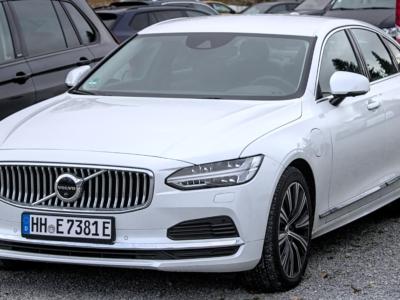
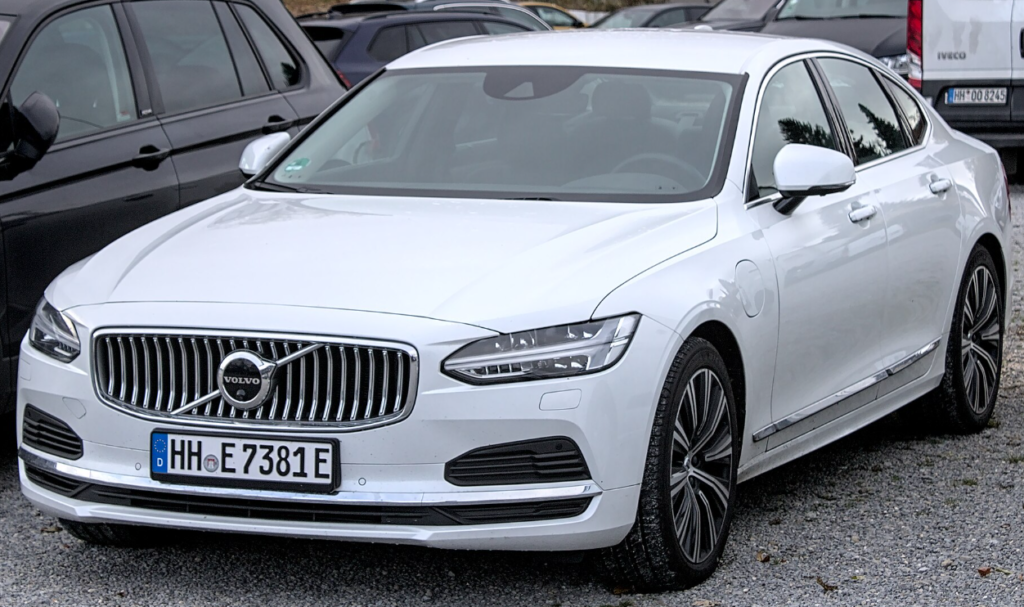
Volvo S90 Exterior Design
The Volvo S90 follows a clean and sophisticated Scandinavian design philosophy.
Rather than relying on aggressive styling, Volvo emphasizes balanced proportions, simple surfaces, and recognizable details.
Some of its defining exterior characteristics include:
- Thor's Hammer LED headlight styling.
- A distinctive front grille with Volvo branding.
- Long, elegant body proportions.
- Smooth side panels with restrained detailing.
- Sophisticated alloy wheel designs.
- A premium appearance without excessive decoration.
The S90 looks particularly attractive in understated exterior colors, where its proportions and subtle design elements become more noticeable.
We think this approach works exceptionally well for buyers who prefer a luxury sedan that looks elegant without attracting unnecessary attention.
BMW 5 Series Exterior Design
The BMW 5 Series takes a more assertive approach.
Its exterior design features a prominent kidney grille, sculpted surfaces, distinctive lighting, and a muscular stance.
Depending on the specification, the BMW can look either sophisticated or noticeably sporty.
The M Sport package adds more aggressive styling elements, creating a stronger visual connection with BMW's performance-oriented models.
Compared with the Volvo, the 5 Series generally communicates a more dynamic personality.
Our design verdict: The Volvo S90 is appealing for its timeless elegance, while the BMW 5 Series is better suited to drivers who prefer a bold, modern appearance.
2. Volvo S90 vs BMW 5 Series Dimensions
Both vehicles are substantial luxury sedans designed to provide generous passenger accommodation.
For reference, here are the approximate exterior dimensions of the recent US-market Volvo S90 and current BMW 5 Series.
| Dimension | Volvo S90 | BMW 5 Series |
|---|---|---|
| Length | 5,090 mm | 5,060 mm |
| Width, excluding mirrors | 1,890 mm | 1,900 mm |
| Height | Approximately 1,450 mm | 1,514 mm |
| Wheelbase | 3,061 mm | 2,995 mm |
| Seating capacity | 5 | 5 |
These measurements highlight an interesting difference.
Although the Volvo has a longer wheelbase, the BMW has a taller body and a slightly wider overall profile.
A longer wheelbase can benefit passenger accommodation and ride characteristics, but it doesn't automatically guarantee more interior space.
Seat construction, floor design, dashboard positioning, and cabin packaging also matter.
Which Luxury Sedan Feels Bigger?
The Volvo S90 often creates a particularly spacious impression because of its long cabin and minimalist interior design.
The BMW 5 Series also provides generous accommodation, although its driver-oriented cockpit gives the front seating area a different atmosphere.
For families and business passengers, both vehicles provide enough space for most everyday journeys.
3. Interior Quality and Luxury Materials
Interior quality is a major reason to consider either vehicle.
Fortunately, both manufacturers deliver premium cabins, although their design priorities differ.
Volvo S90 Interior
Inside the Volvo S90, we find an environment designed around simplicity and comfort.
Depending on the model and equipment level, the cabin can include:
- Nappa leather upholstery.
- Natural wood interior trim.
- Soft-touch dashboard materials.
- Orrefors crystal gear selector.
- Heated and ventilated seats.
- Multi-zone climate control.
- Premium Harman Kardon or Bowers & Wilkins audio.
The interior feels welcoming rather than overly complicated.
Volvo's attention to seating ergonomics is particularly valuable during long journeys.
The understated design also contributes to a calm atmosphere, especially when combined with lighter interior colors.
BMW 5 Series Interior
The BMW approaches luxury with a stronger focus on digital technology.
Its cabin incorporates a large curved display, modern ambient lighting, premium upholstery options, and a driver-focused dashboard.
Depending on the specification, buyers can also obtain sophisticated seat adjustments, upgraded audio systems, and additional luxury features.
The overall impression is highly contemporary.
However, drivers who prefer physical buttons may need some time to adjust to the touchscreen-based controls.
Interior verdict: We prefer the Volvo for traditional luxury and relaxation, while the BMW wins for its modern digital cockpit.
4. Volvo S90 vs BMW 5 Series Engine Options
Engine selection plays a significant role in determining which sedan is the better purchase.
Both vehicles offer electrified powertrains, although BMW provides a broader selection in several markets.
Volvo S90 Engine Options
The recent US-market Volvo S90 was available with two main powertrain configurations.
Volvo S90 B6 Mild Hybrid
This model combines a turbocharged 2.0-litre four-cylinder petrol engine with a 48-volt mild-hybrid system.
Its main specifications include:
- Engine: 2.0-litre four-cylinder.
- Maximum output: 295 horsepower.
- Transmission: Eight-speed automatic.
- Drivetrain: All-wheel drive.
- Electrification: Mild hybrid.
The B6 provides strong everyday acceleration and smooth power delivery.
Because it's a mild hybrid, we don't need to plug it into an external charger.
Volvo S90 T8 Plug-In Hybrid
The T8 combines a turbocharged petrol engine with an electric motor.
Recent US-market models deliver approximately 455 horsepower.
The combination provides substantial acceleration while allowing electric-only driving when the battery has sufficient charge.
The T8 is especially interesting for drivers who want a comfortable executive sedan with impressive performance and the ability to complete shorter journeys using electricity.
BMW 5 Series Engine Options
The current BMW 5 Series offers several powertrain choices.
BMW 530i
The 530i uses a turbocharged 2.0-litre four-cylinder engine producing approximately 255 horsepower in US specification.
It offers a good balance between performance and fuel consumption.
BMW 540i xDrive
The 540i xDrive features a turbocharged 3.0-litre inline-six engine producing approximately 375 horsepower.
Its smooth six-cylinder engine gives it a more powerful and refined character.
BMW 550e xDrive
The plug-in hybrid BMW 550e xDrive combines a six-cylinder petrol engine with an electric motor to produce approximately 483 horsepower.
This makes it particularly appealing to drivers who want strong acceleration alongside plug-in hybrid functionality.
BMW also offers the fully electric i5 as part of its broader executive sedan range.
Which Engine Is Better?
For relaxed everyday driving, the Volvo S90 B6 delivers more than enough performance.
For buyers who enjoy stronger acceleration and traditional six-cylinder refinement, the BMW 540i xDrive becomes particularly attractive.
When comparing plug-in hybrids, both the S90 T8 and BMW 550e offer impressive power.
However, BMW's broader engine selection gives it an advantage for buyers with specific performance preferences.
5. Acceleration and Performance Comparison
Performance involves more than horsepower.
Transmission response, vehicle weight, traction, and suspension design all influence how a car feels on the road.
The Volvo S90 is designed to deliver effortless acceleration without sacrificing comfort.
Its mild-hybrid powertrain provides strong mid-range performance, while the T8 plug-in hybrid delivers considerably quicker acceleration.
The BMW 5 Series is also quick, particularly in its six-cylinder and plug-in hybrid versions.
For example, the current US-market BMW 540i xDrive has a manufacturer-quoted 0–60 mph time of approximately 4.4 seconds.
The BMW 550e xDrive is even quicker, with a quoted time of approximately 4.1 seconds.
These figures demonstrate that a modern executive sedan can deliver serious performance while maintaining excellent comfort.
Nevertheless, acceleration figures alone shouldn't determine our choice.
For most buyers, the difference in steering response, suspension behavior, and overall driving character will be more noticeable during daily use.
6. Driving Experience: Which Is More Enjoyable?
The driving experience is arguably the biggest distinction between the Volvo S90 and BMW 5 Series.
Volvo S90 Driving Experience
The S90 prioritizes stability, comfort, and predictable handling.
Its steering feels reassuring, while the suspension is generally tuned to support smooth motorway cruising.
The vehicle feels particularly comfortable during relaxed journeys.
At higher speeds, the S90 delivers the composed character expected from a premium executive sedan.
However, drivers looking for especially sharp handling may find its personality less engaging than that of the BMW.
You may be interested in reading Test Drive Review: The Fiat 500 Abarth 0-60 Acceleration
BMW 5 Series Driving Experience
The BMW 5 Series traditionally emphasizes a balance between comfort and driver involvement.
Its steering, suspension tuning, and powertrain response create a more driver-focused experience.
The available rear-wheel-drive layout on certain versions also distinguishes it from the AWD-only recent US-market Volvo S90.
That said, the latest 5 Series is more comfort-oriented than some earlier generations.
Its increased size and sophisticated suspension mean that it feels like a refined executive car rather than a lightweight sports sedan.
Our Driving Verdict
If we regularly enjoy winding roads and responsive handling, the BMW is the more appealing choice.
If our priorities involve relaxed commuting, quiet motorway cruising, and minimal driving stress, the Volvo deserves serious consideration.
7. Ride Comfort and Suspension Quality
Both sedans deliver a comfortable ride, but their suspension characteristics vary.
The Volvo S90 generally emphasizes smoothness and passenger relaxation.
Depending on the version, its available suspension technologies can help improve body control and comfort.
The BMW 5 Series offers a more variable experience.
Models equipped with larger wheels and sportier suspension settings may feel firmer on uneven roads.
Meanwhile, versions with comfort-oriented suspension configurations can deliver excellent ride quality.
We should also remember that tyre selection influences comfort significantly.
A luxury sedan fitted with large wheels and low-profile tyres may transmit more road imperfections into the cabin.
For buyers who frequently travel on poorly maintained roads, choosing the right wheel and suspension combination can be as important as selecting the car itself.
Comfort verdict: The Volvo has a particularly relaxed character, but a carefully specified BMW 5 Series can be equally comfortable for long-distance travel.
8. Volvo S90 vs BMW 5 Series Fuel Economy
Fuel consumption is an important consideration, especially for buyers covering substantial annual mileage.
The results depend heavily on the engine and whether the vehicle is a conventional petrol model, mild hybrid, or plug-in hybrid.
Petrol and Mild-Hybrid Fuel Economy
Recent US-market Volvo S90 B6 models have an EPA combined fuel economy rating of approximately 26 mpg.
The current BMW 530i has a manufacturer-listed combined figure of approximately 31 mpg in US specification.
| Model | Approximate combined fuel economy |
|---|---|
| Volvo S90 B6 AWD | 26 US mpg |
| BMW 530i | 31 US mpg |
| BMW 530i xDrive | 30 US mpg |
| BMW 540i xDrive | 28 US mpg |
Figures vary by model year and configuration.
Based on these ratings, the BMW 530i offers an efficiency advantage over the Volvo S90 B6.
However, real-world results depend on traffic, weather, driving style, and maintenance.
Plug-In Hybrid Efficiency
Plug-in hybrids require a different approach.
Both the Volvo S90 T8 and BMW 550e can operate using electricity for some journeys.
Their fuel savings depend largely on charging frequency.
If we charge regularly and complete short daily trips, a plug-in hybrid can significantly reduce petrol consumption.
If we rarely charge, we may carry the extra weight of a battery and electric motor without taking full advantage of the technology.
For this reason, choosing between conventional and plug-in hybrid versions requires considering our actual driving habits.
9. Volvo S90 vs BMW 5 Series Boot Space
Boot capacity is another area where these sedans differ.
The recent US-market Volvo S90 offers approximately 13.5 cubic feet of luggage capacity, equivalent to around 382 litres.
The current BMW 5 Series has approximately 18.3 cubic feet, equivalent to around 518 litres.
| Boot specification | Volvo S90 | BMW 5 Series |
|---|---|---|
| Approximate capacity | 382 litres | 518 litres |
| Cargo capacity in cubic feet | 13.5 | 18.3 |
| Best suited to | Everyday luggage | Larger luggage requirements |
Measurement methods and capacities can differ between regional specifications.
Is the Volvo S90 Boot Big Enough?
For everyday shopping, briefcases, smaller suitcases, and normal family duties, the Volvo's boot is generally practical.
However, the BMW provides additional luggage space that can make a difference when traveling with several passengers.
The shape of the boot opening and the availability of folding rear seats should also be considered.
Some Volvo configurations have rear-seat equipment that can affect cargo flexibility.
Boot space winner: BMW 5 Series.
10. Rear Seat Space and Passenger Comfort
Executive sedans are often used for transporting passengers, making rear-seat comfort particularly important.
The Volvo S90 benefits from its long wheelbase and spacious cabin layout.
Passengers can enjoy generous legroom, supportive seating, and an airy atmosphere.
Certain equipment packages provide additional rear-seat comfort features, reinforcing the Volvo's executive-luxury positioning.
The BMW 5 Series also offers generous rear accommodation.
Its taller body and modern cabin design make it practical for everyday family use and professional transportation.
Which Is Better for Long Journeys?
For passengers who value a relaxed environment, the Volvo is particularly appealing.
Its seating comfort and understated interior make extended journeys pleasant.
The BMW is also excellent for motorway travel, and its additional luggage capacity can benefit families carrying more equipment.
We would choose the Volvo for its relaxing rear-seat atmosphere, while the BMW offers a compelling combination of comfort and everyday practicality.
11. Technology and Infotainment Systems
Modern luxury sedans depend heavily on infotainment technology, digital displays, and connectivity.
Both manufacturers offer sophisticated systems, although their approaches differ.
Volvo S90 Infotainment
Recent S90 models feature Google-based infotainment with useful integrated services.
Available functions include:
- Google Maps navigation.
- Google Assistant.
- Google Play applications.
- Smartphone connectivity.
- Digital instrument displays.
- Voice controls.
- Premium audio options.
The system focuses on convenience and straightforward functionality.
However, the vertical touchscreen design of earlier versions can feel less modern than the latest BMW interface.
The updated S90 introduced for selected international markets includes a newer interface and an 11.2-inch central display.
BMW 5 Series Infotainment
The BMW uses its Curved Display system, combining a 12.3-inch digital instrument display with a 14.9-inch central control screen.
Its infotainment environment offers extensive personalization and connected features.
Depending on the model, features may include:
- Wireless smartphone integration.
- Connected navigation services.
- Voice assistant functionality.
- Digital vehicle settings.
- Over-the-air software updates.
- Advanced parking assistance.
The BMW's interface offers an impressive visual presentation.
However, touchscreen-heavy controls may require more attention than conventional physical buttons.
Technology verdict: The BMW 5 Series wins for its modern display layout and extensive digital functionality.
12. Volvo S90 vs BMW 5 Series Safety
Safety is a major consideration for luxury sedan buyers.
Volvo has built much of its reputation around occupant protection and accident prevention.
The S90 offers a comprehensive collection of safety and driver-assistance technologies, depending on its model year.
These can include collision avoidance assistance, blind-spot monitoring, lane support, adaptive cruise control, and parking assistance.
The BMW 5 Series also includes advanced safety technologies.
Depending on specification and market, features can include forward collision warning, automatic emergency braking, lane assistance, adaptive cruise control, and sophisticated parking systems.
Is the Volvo S90 Safer Than the BMW 5 Series?
We shouldn't automatically assume that the Volvo is safer simply because of the brand's reputation.
Both manufacturers invest heavily in modern crash protection and driver-assistance technology.
Safety equipment, crash-test results, and testing standards vary by model year and country.
For an accurate comparison, we recommend checking independent crash-test ratings for the exact vehicles being considered.
We should also examine standard equipment rather than assuming that every advertised driver-assistance feature is included.
Safety verdict: Both vehicles are strong contenders, and neither should be declared the universal winner without comparing equivalent model-year crash tests.
13. Volvo S90 vs BMW 5 Series Reliability
Reliability is one of the most important factors when purchasing a luxury sedan, particularly a used example.
Both vehicles combine advanced electronics, turbocharged engines, and sophisticated mechanical systems.
While these technologies improve performance and convenience, they can also increase repair complexity.
Volvo S90 Reliability
The Volvo S90 has an established ownership history.
Potential concerns on some model years include:
- Infotainment system malfunctions.
- Electrical warning messages.
- Twelve-volt battery problems.
- Sensor-related issues.
- Air-conditioning faults.
- Suspension wear on higher-mileage examples.
Not every vehicle experiences these problems, and maintenance history makes a significant difference.
In the 2025 What Car? reliability survey, the combined Volvo S90/V90 group covering specified earlier model years received a 76.7% rating, with electrical issues being a notable concern.
That result suggests we should inspect the electrical systems particularly carefully when purchasing a used S90.
BMW 5 Series Reliability
The BMW 5 Series has a long history, but reliability varies considerably across generations and engines.
Potential issues to investigate include:
- Electronic system faults.
- Cooling system leaks.
- Suspension component wear.
- Infotainment problems.
- Hybrid system faults where applicable.
- Expensive repairs involving specialized components.
Previous-generation petrol BMW 5 Series models performed strongly in some owner surveys.
For example, the 2017–2023 petrol 5 Series achieved a 96.7% reliability rating in a What Car? survey.
However, this figure shouldn't be treated as a direct reliability prediction for the current-generation BMW.
You may be interested in readingTest Drive Review: The Fiat 500 Abarth 0-60 AccelerationYou may be interested in reading
 Customizing Your Ride: A Comprehensive Guide to the Fiat 500 Body Kit
Which Is More Reliable?
We cannot confidently declare either model universally more reliable.
Results depend on the engine, production year, maintenance history, and how the car has been used.
A well-maintained BMW may be a better ownership proposition than a neglected Volvo, and vice versa.
For used examples, a comprehensive service history and independent pre-purchase inspection are essential.
14. Maintenance and Repair Costs
Luxury vehicles generally cost more to maintain than mainstream family cars.
The Volvo S90 and BMW 5 Series are no exceptions.
Volvo S90 Maintenance Costs
Regular Volvo maintenance includes engine oil changes, filters, brake servicing, tyre replacement, and manufacturer-recommended inspections.
Plug-in hybrid models may require additional specialist knowledge.
Parts availability can also affect repair costs, especially in markets where the S90 has been discontinued.
Fortunately, independent Volvo specialists may provide alternatives to dealership servicing for vehicles outside their warranty period.
BMW 5 Series Maintenance Costs
BMW servicing also involves premium-priced components and manufacturer-specific maintenance requirements.
Larger performance tyres, sophisticated suspension components, and complex powertrains can increase expenses.
The 540i and 550e may involve different maintenance requirements compared with the four-cylinder 530i.
As with the Volvo, a reputable independent specialist can be valuable once the manufacturer's warranty expires.
Which Is Cheaper to Maintain?
It's difficult to establish a universal winner without comparing the same age, mileage, and usage.
Maintenance expenses depend on local labour costs, parts prices, engine choice, and service intervals.
Before purchasing either model, we recommend obtaining quotes for scheduled servicing, replacement tyres, brakes, and common repairs.
15. Insurance Costs and Ownership Expenses
Insurance can represent a substantial part of luxury sedan ownership.
Premiums depend on multiple factors, including:
- Driver age and experience.
- Geographic location.
- Vehicle value.
- Engine performance.
- Repair costs.
- Annual mileage.
- Claims history.
- Selected coverage and deductible.
A high-performance BMW variant may cost more to insure than a lower-powered alternative, but this isn't guaranteed.
Likewise, the Volvo's safety equipment does not automatically mean lower insurance premiums.
The best approach is to request quotes for the exact vehicles before making a purchase.
We should also consider registration fees, taxes, financing costs, depreciation, fuel, and routine servicing.
A lower purchase price doesn't always translate into lower total ownership costs.
16. Volvo S90 vs BMW 5 Series Price Comparison
Purchase prices vary widely depending on model year, market, engine, and optional equipment.
To establish a useful reference, consider the original US starting prices for selected versions.
| Model | Approximate starting US MSRP |
|---|---|
| 2025 Volvo S90 B6 Plus | $58,300 |
| 2025 Volvo S90 T8 Plus | $65,650 |
| 2026 BMW 5 Series 530i | $60,500 |
These are model-year reference prices before applicable destination charges, taxes, and options, not current transaction prices.
The Volvo offered competitive luxury equipment in its later US model years.
However, because the S90 is no longer sold new in the US, buyers primarily need to compare used Volvo prices against new or used BMW alternatives.
Is the Volvo S90 Better Value?
It certainly can be.
A used S90 may provide luxurious seating, premium materials, and powerful hybrid technology at an attractive price relative to its original MSRP.
However, a lower purchase price should be weighed against service history, warranty coverage, repair costs, and future depreciation.
Is the BMW 5 Series Worth the Extra Money?
For drivers who prioritize technology, engine variety, and handling, the BMW can justify a higher price.
Its broader availability in major markets is also an important advantage.
Nevertheless, buyers who primarily want comfort and premium materials may find that a well-equipped used Volvo satisfies their needs for less money.
17. Depreciation and Resale Value
Depreciation affects how much money we recover when selling our vehicle.
Both luxury sedans can experience significant depreciation, especially during their early years.
The actual rate depends on mileage, engine type, market demand, age, and condition.
Volvo S90 Resale Value
The S90's more limited presence in certain markets may affect resale demand.
Buyers interested in used examples should examine how quickly similar vehicles sell locally.
A well-maintained example with attractive equipment and complete documentation may be easier to sell than one with an incomplete history.
BMW 5 Series Resale Value
The BMW 5 Series benefits from a widely recognized nameplate and a long-established market presence.
However, depreciation still varies considerably between engines and trim levels.
Expensive options do not necessarily retain their full value when the vehicle is resold.
Which Holds Its Value Better?
The answer depends on the specific model, purchase price, and local market.
We recommend comparing real used-car listings rather than relying only on brand reputation.
A heavily depreciated Volvo may represent excellent value to a second-hand buyer, even if its original owner experienced a substantial loss.
18. Volvo S90 vs BMW 5 Series for Long-Distance Driving
Both sedans are designed to cover long distances comfortably.
The Volvo excels at creating a calm environment for drivers and passengers.
Its supportive seats, refined cabin, and smooth cruising character make it attractive for regular motorway journeys.
The BMW also performs exceptionally well on highways.
Its comfortable seating, refined engines, and advanced assistance systems make extended trips manageable.
The BMW's greater luggage capacity may be useful for family holidays or business travel.
Which Would We Choose for Highway Driving?
If passenger comfort and relaxation were our priorities, we'd lean toward the Volvo S90.
If we wanted a combination of comfort, performance, and luggage practicality, we'd choose the BMW 5 Series.
Both are excellent long-distance vehicles when fitted with appropriate tyres and maintained properly.
19. Which Is Better for City Driving?
Large executive sedans are not always the easiest vehicles to maneuver through busy urban streets.
Both the Volvo S90 and BMW 5 Series have substantial dimensions.
Parking sensors, cameras, and available automated parking assistance can therefore be particularly useful.
The BMW 530i provides responsive acceleration and a relatively efficient petrol powertrain.
Meanwhile, the Volvo S90 T8 can be attractive for shorter urban trips when its battery is charged.
However, plug-in hybrid efficiency depends heavily on regular charging.
Drivers without access to home or workplace charging may be better served by a conventional petrol or mild-hybrid model.
For congested urban environments, we would prioritize visibility, parking assistance, and running costs over maximum horsepower.
20. Volvo S90 vs BMW 5 Series: Pros and Cons
Volvo S90 Advantages
- Elegant Scandinavian styling.
- Extremely comfortable seating.
- Relaxed driving experience.
- Spacious passenger cabin.
- Attractive premium interior materials.
- Powerful T8 plug-in hybrid option.
- Potentially appealing used-car value.
Volvo S90 Disadvantages
- Smaller boot than the current BMW 5 Series.
- Less engaging driving character.
- Limited new-car availability in several markets.
- Some reported infotainment and electrical reliability concerns.
- Fewer powertrain choices.
BMW 5 Series Advantages
- More engaging driving dynamics.
- Wider engine selection.
- Sophisticated infotainment technology.
- Larger boot.
- Available six-cylinder engines.
- Strong performance from upper-level variants.
- Broad presence in the luxury sedan market.
BMW 5 Series Disadvantages
- Premium maintenance and repair costs.
- Many desirable features can increase the purchase price.
- Touchscreen-heavy controls may not appeal to everyone.
- Sport-oriented configurations can ride firmly.
- Some versions may have higher tyre and insurance expenses.
21. Which Luxury Sedan Should You Buy?
The best choice depends on how we plan to use the vehicle.
Choose the Volvo S90 If...
We should consider the Volvo S90 if we prioritize comfortable seating, elegant design, quiet journeys, and understated luxury.
It is especially attractive for drivers who spend substantial time on motorways or regularly transport passengers.
A well-maintained used S90 can also represent compelling value.
The T8 is worth considering when we have convenient charging access and want stronger performance.
Choose the BMW 5 Series If...
We should consider the BMW 5 Series if we want a more engaging driving experience, advanced infotainment, greater boot capacity, and a wider choice of engines.
The 530i is an appealing everyday luxury sedan.
The 540i xDrive delivers strong six-cylinder performance, while the 550e xDrive combines impressive acceleration with plug-in hybrid capability.
The BMW is particularly attractive for buyers purchasing a new executive sedan in markets where the Volvo S90 is no longer available.
22. Volvo S90 vs BMW 5 Series: Our Final Comparison
| Category | Preferred choice |
|---|---|
| Understated exterior elegance | Volvo S90 |
| Sporty styling | BMW 5 Series |
| Relaxed cabin atmosphere | Volvo S90 |
| Driving engagement | BMW 5 Series |
| Modern infotainment | BMW 5 Series |
| Engine variety | BMW 5 Series |
| Boot capacity | BMW 5 Series |
| Relaxed long-distance comfort | Volvo S90 |
| Safety | Both are competitive |
| Reliability | Depends on model year and condition |
| Used luxury value | Volvo S90 can be attractive |
| New-car availability in US and UK | BMW 5 Series |
There is no universal winner across every category.
The Volvo stands out because it offers a different interpretation of luxury. Instead of emphasizing aggressive performance or an abundance of digital features, it creates a calm and elegant driving environment.
The BMW provides greater versatility, particularly for buyers who enjoy driving and want a wider selection of powertrains.
Frequently Asked Questions
1. Is the Volvo S90 better than the BMW 5 Series?
The Volvo S90 can be a better choice for buyers who prioritize seating comfort, Scandinavian interior design, and relaxed driving. The BMW 5 Series generally offers more engaging handling, modern infotainment, greater boot capacity, and a wider range of engines. The better vehicle depends on personal priorities.
2. Which is more reliable, the Volvo S90 or BMW 5 Series?
Reliability depends on model year, engine, maintenance history, and vehicle condition. Both models have experienced electrical and mechanical issues in certain versions. Previous-generation petrol BMW 5 Series models have performed well in some owner surveys, while some Volvo S90 owners have reported infotainment and electrical faults. A documented service history is essential when purchasing either used vehicle.
3. Which has more boot space, the Volvo S90 or BMW 5 Series?
The current BMW 5 Series generally offers more boot space. Representative US specifications list approximately 518 litres for the BMW compared with around 382 litres for the recent Volvo S90. Exact measurements may vary by market and version.
4. Is the Volvo S90 cheaper to maintain than the BMW 5 Series?
Not necessarily. Both are premium vehicles with potentially expensive servicing and repairs. Costs depend on the engine, age, mileage, parts availability, and local labour prices. We recommend comparing maintenance quotations for the exact versions being considered rather than assuming one brand is always cheaper.
5. Is the BMW 5 Series more comfortable than the Volvo S90?
Both vehicles offer excellent comfort, but the Volvo S90 emphasizes relaxed seating and a calm interior. The BMW 5 Series combines strong comfort with more driver-focused handling. Suspension configuration, wheel size, and seat options can significantly influence the final experience.
Conclusion: Volvo S90 or BMW 5 Series?
After comparing the Volvo S90 vs BMW 5 Series, we believe both vehicles remain compelling choices in the executive luxury sedan segment.
The Volvo S90 excels in Scandinavian styling, seating comfort, and relaxed long-distance driving. It is particularly appealing to buyers who appreciate understated luxury and are willing to consider a carefully maintained used example.
The BMW 5 Series provides a broader package, combining modern technology, responsive handling, versatile engine options, and generous luggage capacity.
Our overall winner is the BMW 5 Series, primarily because of its broader powertrain selection, advanced technology, larger boot, and stronger availability in major markets.
However, that doesn't make the Volvo S90 a poor choice. For someone who values comfort, elegance, and a peaceful driving experience above sporting performance, the S90 could easily be the more satisfying car.
Ultimately, the smartest decision is to test-drive both vehicles, compare their equipment and maintenance histories, and choose the luxury sedan that best matches our driving habits, budget, and expectations.
You may be interested in readingTest Drive Review: The Fiat 500 Abarth 0-60 AccelerationYou may be interested in reading
Customizing Your Ride: A Comprehensive Guide to the Fiat 500 Body KitYou may be interested in reading
 A Trip Down Memory Lane: The 1977 Fiat 124 Spider
If you want to know other articles similar to Volvo S90 vs BMW 5 Series: Which Luxury Sedan Wins? you can visit the category Models.
Volvo S90 Years: Best, Worst & Complete Model Guide
Nissan Rogue vs Kia Seltos: Which SUV Is Better?
Nissan Rogue or Similar: What SUV Will You Get?
Nissan Rogue vs VW Taos: Which SUV Is Better?
Nissan Rogue vs Kia Sportage: Which SUV Is Better?
Nissan Rogue vs Pathfinder: Which SUV Is Better?
Leave a Reply
More content of your interest