

BYD Shark 6 Fuel Consumption: Real-World Economy, Range and What to Expect

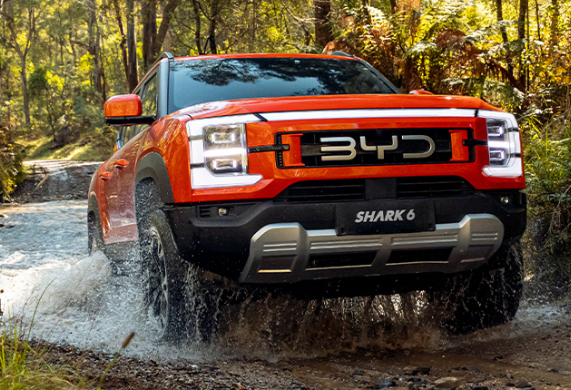
The BYD Shark 6 fuel consumption figure is one of the most interesting things about this plug-in hybrid ute. On paper, the Shark 6 can use dramatically less petrol than a conventional diesel ute, especially when we regularly recharge its large battery.
However, the headline fuel economy figure does not tell the entire story.
Because the BYD Shark 6 is a plug-in hybrid electric vehicle (PHEV), its petrol consumption changes significantly depending on battery charge, driving conditions, speed, payload, towing and how frequently we plug it in.
For the Australian-market BYD Shark 6 Dynamic and Premium, BYD currently lists 2.0L/100km fuel consumption, while the newer Shark 6 Performance is listed at 1.3L/100km WLTP. BYD also states an 800km combined range for the Dynamic and Premium versions.
But what happens when the battery runs low? And can we realistically achieve 2.0L/100km?
Let’s take a closer look.
Content in this publication
- BYD Shark 6 Fuel Consumption at a Glance
- Why Is the BYD Shark 6 Fuel Consumption So Low?
- Is 2.0L/100km Realistic in the BYD Shark 6?
- BYD Shark 6 Fuel Consumption With a Low Battery
- Real-World BYD Shark 6 Fuel Consumption
- BYD Shark 6 Highway Fuel Consumption
- BYD Shark 6 City Fuel Consumption
- How Much Fuel Does a BYD Shark 6 Use per 100km?
- BYD Shark 6 Fuel Tank Capacity
- BYD Shark 6 Electric Range
- How Battery Charging Affects Fuel Economy
- Does the BYD Shark 6 Recharge While Driving?
- BYD Shark 6 Fuel Consumption While Towing
- Does Payload Affect Shark 6 Fuel Economy?
- BYD Shark 6 Performance Fuel Consumption
- What Affects BYD Shark 6 Fuel Consumption?
- How to Get Better Fuel Economy From a BYD Shark 6
- Is the BYD Shark 6 Economical?
- Is the Official Fuel Consumption Misleading?
- BYD Shark 6 Fuel Consumption vs a Diesel Ute
- BYD Shark 6 Fuel Consumption FAQ
- Final Thoughts on BYD Shark 6 Fuel Consumption
BYD Shark 6 Fuel Consumption at a Glance
The most important thing to understand is that there are effectively two very different fuel-consumption scenarios with the Shark 6.
| Driving situation | Approximate fuel consumption |
|---|---|
| Official Shark 6 Dynamic/Premium figure | 2.0L/100km |
| Battery below 25% SOC | 7.9L/100km official figure |
| Real-world mixed driving example | Around 4.0L/100km |
| Real-world longer mixed/load test | Around 6.6L/100km |
| Highway driving with depleted battery | Around 9.5L/100km |
| Shark 6 Performance official figure | 1.3L/100km WLTP |
The official Australian specification sheet for the original Shark 6 lists 2.0L/100km when the battery state of charge is between 25 and 100 percent, but 7.9L/100km when SOC falls below 25 percent.
That difference explains why two Shark 6 owners can report completely different fuel economy figures while both are telling the truth.
Why Is the BYD Shark 6 Fuel Consumption So Low?
The Shark 6 does not operate like a traditional petrol ute.
It combines a petrol engine with a relatively large plug-in hybrid battery and electric motors. As a result, the vehicle can complete a significant percentage of everyday journeys using electricity rather than petrol.
The Australian Shark 6 Dynamic and Premium use a 1.5-litre turbocharged hybrid engine combined with all-wheel drive and electric motors. BYD lists maximum combined power of 321kW, while the official specification sheet lists a 29.58kWh Blade Battery.
So when we see an official fuel consumption figure of 2.0L/100km, we are not looking at a heavy ute somehow running exclusively on petrol while consuming two litres every 100km.
A substantial part of the test is being completed using energy stored in the battery.
Is 2.0L/100km Realistic in the BYD Shark 6?
Yes, but only under the right circumstances.
If we start with a charged battery, commute relatively short distances and recharge regularly, petrol consumption can be extremely low.
Imagine that most of our daily driving consists of a 30km or 50km commute. If much of that distance is completed electrically and we charge the Shark 6 again overnight, the petrol engine may only operate occasionally.
Under those circumstances, achieving very low petrol consumption is entirely plausible.
On the other hand, drive several hundred kilometres without charging and the result changes significantly.
The 2.0L/100km Figure Needs Context
This is why we should never compare the Shark 6's 2.0L/100km figure directly with the fuel economy of a conventional diesel ute without understanding how the measurement works.
A diesel Toyota Hilux, Ford Ranger or Isuzu D-Max gets all of its usable driving energy from diesel.
The Shark 6 receives energy from both:
- petrol in its fuel tank
- electricity stored in its high-voltage battery
- regenerative braking while driving
Therefore, petrol consumption alone only tells part of the efficiency story.
BYD Shark 6 Fuel Consumption With a Low Battery
This is the number long-distance drivers should probably pay the most attention to.
BYD's specification information lists 7.9L/100km combined consumption when battery SOC is below 25 percent for the 1.5-litre Shark 6.
That is considerably higher than the headline 2.0L/100km figure, but it is still competitive considering the vehicle's size, weight and performance.
Once battery charge becomes limited, the petrol engine has to contribute much more frequently.
The Shark effectively begins behaving more like a conventional hybrid, although its powertrain strategy is more complicated than that simple description suggests.
Why Consumption Rises When the Battery Is Depleted
Electricity is what allows the Shark 6 to post such impressive petrol-consumption figures.
When plenty of battery energy is available, the electric motors can handle a large percentage of propulsion.
As the usable charge falls, more energy ultimately needs to come from petrol.
That means someone charging every night could see dramatically better fuel consumption than someone driving 500km between charges.
Real-World BYD Shark 6 Fuel Consumption
Independent road tests give us a better idea of what owners might experience outside laboratory testing.
One Australian CarsGuide test recorded 4.0L/100km plus 16.8kWh/100km. The reviewer also considered around 700km of full-tank/full-charge combined range realistic in those conditions.
Another test covering 522km across city, suburban, regional and highway driving—including a period carrying close to maximum payload—finished with the trip computer showing 6.6L/100km.
Those numbers demonstrate exactly why there is no single real-world Shark 6 fuel-consumption figure.
Our result will depend heavily on how we actually use the vehicle.
BYD Shark 6 Highway Fuel Consumption
Highway driving can expose one of the limitations of plug-in hybrids.
Electric vehicles and PHEVs generally benefit greatly from regenerative braking and lower-speed urban driving. On a highway, speeds remain high for long periods and opportunities to recover energy through braking are limited.
Eventually, a long highway trip can also use most of the battery's available energy.
During one CarsGuide test, a 140km freeway section after the battery had been depleted returned approximately 9.5L/100km.
That is a much more useful reference than 2.0L/100km for someone who regularly drives long interstate routes without charging.
BYD Shark 6 City Fuel Consumption
City driving is where the Shark 6 makes considerably more sense from an efficiency perspective.
If we have somewhere to charge at home or work, many shorter journeys can be completed with little petrol use.
The official Shark 6 specification lists up to 100km of electric range between 25 and 100 percent state of charge for the 1.5-litre model.
Real-world electric range naturally varies, but CarsGuide reported travelling a little over 90km electrically in one test before the engine was required again.
For someone commuting 40km each day, that creates a very different ownership experience from someone travelling 200km daily.
How Much Fuel Does a BYD Shark 6 Use per 100km?
With a properly charged battery, the official answer for the Dynamic and Premium versions is 2.0 litres per 100km.
With the battery below 25 percent, the official specification lists 7.9 litres per 100km.
Real-world consumption can sit anywhere between—or even outside—those numbers.
For practical ownership, we would think about it this way:
Regular charging + short journeys = very little petrol.
Mixed driving + occasional charging = moderate petrol consumption.
Long-distance driving + depleted battery = consumption closer to a traditional petrol or diesel vehicle.
That is a far more useful way to understand Shark 6 efficiency than focusing entirely on its official headline figure.
BYD Shark 6 Fuel Tank Capacity
The BYD Shark 6 has a 60-litre petrol tank.
Combined with its battery, BYD lists total driving range of up to 800km for the Dynamic and Premium models.
Of course, actual range depends on battery charge, driving speed, terrain, weather, load, towing and driving style.
A full 60-litre tank alone does not necessarily mean an owner will achieve exactly 800km.
That range assumes the hybrid system and battery are contributing as well.
BYD Shark 6 Electric Range
One reason the Shark 6 can deliver such low petrol consumption is its unusually useful electric range for a ute.
The 1.5-litre Australian specification lists up to 100km of electric driving range under its stated test conditions.
That means many owners could potentially perform their normal weekday commute mostly using electricity and reserve petrol for longer weekend trips.
Why EV Range Matters More Than Many Buyers Realise
Suppose we own a Shark 6 and drive 50km per day.
If we recharge every night, a large percentage of our annual driving could theoretically take place without substantial petrol consumption.
Now suppose we drive 150km per day and rarely charge.
We will use the petrol engine far more frequently.
Same vehicle. Completely different fuel economy.
That is why PHEV ownership behaviour matters so much.
How Battery Charging Affects Fuel Economy
For anyone buying a Shark 6 primarily to reduce petrol costs, charging is essential.
Buying a plug-in hybrid and rarely plugging it in eliminates much of the advantage of having a large battery in the first place.
The more frequently we begin journeys with usable electrical energy available, the easier it becomes to reduce fuel consumption.
For the right owner, charging could turn the Shark 6 into an exceptionally economical daily vehicle considering its performance and dimensions.
For someone without convenient charging, the advantage becomes considerably smaller.
Does the BYD Shark 6 Recharge While Driving?
Yes, the hybrid system can recover energy while driving, including through regenerative braking.
However, regeneration should not be confused with plugging the vehicle into an external electricity source.
Regenerative braking recovers some energy that would otherwise be lost when slowing down. It cannot magically replace all the energy consumed while driving.
If we want to obtain the maximum fuel-saving benefit from a plug-in hybrid, external charging remains important.
BYD Shark 6 Fuel Consumption While Towing
Towing will increase energy consumption.
There is no universal towing fuel-consumption figure because the result depends on trailer weight, aerodynamic drag, speed, gradients, wind and battery state of charge.
The Dynamic and Premium Shark 6 models currently list 2,500kg braked towing capacity, while the newer Performance version is listed at up to 3,500kg braked.
When towing a heavy caravan or trailer over long distances, we should not expect the headline 2.0L/100km figure.
Once the initial battery energy has been used, petrol consumption will inevitably become more important.
Does Payload Affect Shark 6 Fuel Economy?
Yes.
Additional weight requires additional energy to accelerate and move the vehicle, particularly in stop-start conditions or hilly terrain.
A CarsGuide test involving 522km of mixed driving, including roughly one-fifth of the distance with a near-maximum payload, recorded 6.6L/100km according to the vehicle's computer.
That does not mean every loaded Shark will consume exactly 6.6L/100km.
It does illustrate that fuel economy remains highly dependent on operating conditions.
BYD Shark 6 Performance Fuel Consumption
The expanding Shark 6 range adds another consideration.
BYD Australia currently lists the Shark 6 Performance at 1.3L/100km WLTP, compared with 2.0L/100km for the Dynamic and Premium versions. The Performance uses a 2.0-litre turbo hybrid engine and is listed with 350kW maximum power.
Its official combined range is listed at 640km WLTP.
A recent CarsGuide test of the Performance recorded an indicated average of around 7.4L/100km during testing when battery charge was lower, again demonstrating how different real-world consumption can be from the official PHEV figure.
What Affects BYD Shark 6 Fuel Consumption?
Several factors can move our consumption dramatically above or below someone else's result.
The biggest variables are battery state of charge, charging frequency, journey length, highway speed, traffic, payload, towing, terrain, temperature, tyre pressures, climate-control use and acceleration.
Aggressive acceleration is particularly worth mentioning because the Shark 6 is powerful.
The Dynamic and Premium versions produce up to 321kW and are listed at 0–100km/h in 5.7 seconds.
Using that performance frequently will naturally require more energy.
How to Get Better Fuel Economy From a BYD Shark 6
The most effective strategy is simple: use the plug.
Owners who have access to inexpensive home charging have a major advantage.
We can also improve efficiency by keeping speeds reasonable, maintaining correct tyre pressures, avoiding unnecessary loads and using smooth acceleration.
For most Shark 6 owners, though, charging frequency will probably have a greater effect on petrol consumption than tiny changes in driving technique.
Is the BYD Shark 6 Economical?
It can be extremely economical for the right type of driver.
If our normal driving consists of short or medium-length journeys and we can charge regularly, petrol consumption could be remarkably low for a powerful dual-cab ute.
The equation becomes less impressive for owners who mainly undertake long highway journeys or rarely recharge.
That does not necessarily make the Shark 6 inefficient. It simply means we should evaluate a plug-in hybrid differently from a conventional diesel.
Is the Official Fuel Consumption Misleading?
Not exactly—but it can easily be misunderstood.
The official figure is produced under defined testing conditions and is useful for comparing vehicles tested using similar standards. BYD itself notes that official consumption results may differ from actual consumption because of driving style, journey type, environmental conditions and other factors.
The mistake is assuming that 2.0L/100km means the Shark 6 will continuously consume two litres of petrol every 100km regardless of battery condition.
It will not.
The electrical energy stored in the battery is crucial to achieving that number.
BYD Shark 6 Fuel Consumption vs a Diesel Ute
This comparison depends almost entirely on usage.
A conventional diesel ute generally produces relatively predictable fuel economy whether we drive 50km or 500km, although speed, load and towing still have major effects.
A PHEV like the Shark 6 behaves differently.
Over the first portion of a trip with a charged battery, petrol consumption may be extremely low.
Over a very long trip after the battery's usable charge has fallen, the difference between the Shark 6 and a conventional ute can become much smaller.
Therefore, asking which one uses less fuel without specifying how it will be driven does not tell us very much.
Who Benefits Most From the Shark 6 PHEV System?
The Shark 6's powertrain makes the most sense for drivers who can recharge frequently and complete a substantial percentage of their annual kilometres within or close to the available electric range.
That might include someone who uses a ute for work during the week, drives relatively short local routes and has home charging available overnight.
Long-distance drivers can still benefit from hybridisation, but their petrol consumption will generally be higher.
BYD Shark 6 Fuel Consumption FAQ
What is the official BYD Shark 6 fuel consumption?
BYD Australia currently lists fuel consumption of 2.0L/100km for the Shark 6 Dynamic and Premium, while the Shark 6 Performance is listed at 1.3L/100km WLTP.
How much fuel does the BYD Shark 6 use with a flat battery?
The Australian specification for the 1.5-litre Shark 6 lists 7.9L/100km when battery state of charge is below 25 percent. Real-world figures can be higher or lower depending on conditions.
What is the real-world fuel consumption of the BYD Shark 6?
Independent tests have produced very different results. CarsGuide has reported figures including approximately 4.0L/100km, 6.6L/100km, and around 9.5L/100km during freeway driving after substantial battery depletion, depending on the test conditions.
How far can a BYD Shark 6 travel on a full tank?
BYD lists a combined petrol-and-electric range of up to 800km for the Dynamic and Premium. Real-world range will depend on battery charge, speed, driving style, load, weather and other conditions.
Does the BYD Shark 6 save fuel?
It potentially saves a substantial amount of petrol when charged regularly and used for journeys that take advantage of its electric range. Drivers who rarely charge or spend most of their time covering long highway distances should expect considerably higher petrol consumption than the official 2.0L/100km figure.
Final Thoughts on BYD Shark 6 Fuel Consumption
The BYD Shark 6 fuel consumption can look exceptional on paper, but understanding the numbers is essential.
For the Dynamic and Premium models, BYD's official figure of 2.0L/100km demonstrates what a plug-in hybrid ute can achieve when the battery plays a significant role in the journey. With battery charge below 25 percent, however, the official figure rises to 7.9L/100km.
Real-world testing further shows how wide the range can be. Depending on battery charge and driving conditions, figures around 4–7L/100km are possible in mixed use, while extended highway driving with limited battery assistance can push consumption considerably higher.
So, is the Shark 6 fuel efficient?
For drivers who plug it in regularly, absolutely—its ability to complete a large portion of everyday driving electrically can dramatically reduce petrol use.
For drivers who rarely charge, the 2.0L/100km headline figure is unlikely to represent their everyday experience.
The best way to think about the Shark 6 is therefore not simply as a petrol ute with unusually low fuel consumption. It is a powerful plug-in hybrid that can shift a substantial part of our everyday energy use from the petrol pump to the charging point.
If you want to know other articles similar to BYD Shark 6 Fuel Consumption: Real-World Economy, Range and What to Expect you can visit the category Driving.
Can Nissan Rogue Pull a Boat? Complete Towing Guide
Can Nissan Rogue Be Flat Towed? Complete Towing Guide
Are Nissan Rogue Good on Gas? MPG, Fuel Economy, and Real-World Costs
Can Nissan Rogue Drive in Snow? Complete Winter Driving Guide

Kia Sorento Diesel Fuel Consumption: MPG, Efficiency and Real-World Range
Haval Jolion Hybrid Fuel Consumption: How Efficient Is It Really?
Leave a Reply
More content of your interest